AI Chip Regulation Is Not A Dystopian Surveillance State
Scott Alexander argues that Plan A's proposed AI chip regulations are not a dystopian surveillance state, but rather comparable to existing regulations on controlled substances, and that most feared dystopian outcomes already exist in current banking and AI chat monitoring.
This was one of the most common objections to Plan A. The plan proposes AI chip regulation to ensure that both China and America know where all the chips are, making their deal to regulate AI together “trustless” (ie neither side can defect even if they want to). Several people argued that this kind of regulation amounted to some kind of “Orwellian dystopia” or “global panopticon”.
I’m reminded of a story I heard - I can’t find it, maybe one of you can - from a DC insider who said it was enraging to work with Silicon Valley, because he would bring up what he thought was the obvious regulatory framework, the tech people would launch into jeremiads on how it could only be enforced by world dictatorship, and he would have to interrupt and say that no, this was how eggs or milk or something had been regulated for fifty years.
What regulations does Plan A propose on AI chips?
- Factories that produce them need to register with the government and submit to inspections.
- Customers who buy them (eg Google) need to register with the government and submit to inspections. If they resell them, they need further government permission to do so.
- Data centers that host them need to register with the government and submit to inspections. To pass these inspections, they will need to be very secure against cyber-attack.
- The chips in the data centers eventually have cryptographic software that lets either China or the US halt their work at any time1.
- Any data center that trains AIs need to be transparent (writing basic information about their operations, like the size of their training runs, to a public database) and verifiable (someone needs to be able to prove they’re running the code they claim to be running).
How bad are these regulations?
Regulations can be bad in at least two ways.
First, they can directly affect the thing they’re regulating. For example, if the government bans cocaine, people who enjoy cocaine can’t get it.
Second, their enforcement can indirectly justify a general expansion of government power and reduction of liberty, or provoke evasion attempts with dangerous side effects. For example, government bans on cocaine led to no-knock DEA raids, stop-and-frisk searches, and drug-sniffing dogs at airports, and to Mexican drug cartels and Colombian paramilitaries.
The direct effect of Plan A’s AI chip regulations is probably to raise the price of AI chips. How much? I don’t know, a few percent? Relatedly, the general march of technology makes chip price per FLOP falls 30% every year, and AI inference price per token fall by 98% every year (this is not an error, they actually get 40x cheaper every year). The neoliberal in me admits that it is in some sense a tragedy any time we raise the price of a good, but this seems like one of the more innocuous examples.
When people talk about Orwellian dystopias or global surveillance states, they presumably mean the indirect effects. But why should making chip factories and hyperscalers do more paperwork have such outsized costs, totally unlike those which we encounter in the regulation of other industries?
Plan A’s regulations on chips bear more than a passing resemblance to the way the United States currently regulates “controlled substances” - potentially addictive medications like Xanax or Adderall. Factories that produce them need to register with the government and submit to inspections. Customers who buy them (eg pharmacies) need similar levels of registration and inspection; to pass these inspections, they must prove themselves secure against various forms of attack. Whenever the pharmacies sell to a customer, they need to enter it into a database accessible by every doctor in the state.
How directly burdensome are controlled substance regulations? By traditional metrics, not very. They don’t drive up costs too much: Xanax, a Schedule IV controlled substance, costs $14 at market price for a 30 day supply. They don’t seem to slow innovation - a substantial portion of drugs approved by the FDA in the past ten years have been trivial pointless modifications to Schedule II stimulants. By the alternative metric of how much doctor and patient aggravation they produce, extremely burdensome - we have to fill out more forms, argue with more pharmacists, frequently miss prescriptions because something went wrong, and suffer occasional crippling shortages.
But has the existence of controlled substance regulations indirectly plunged the world into Orwellian dystopia? Has it turned life into a global panopticon? I wouldn’t say so. The government exerted some pre-existing state capacity to yoke Xanax factories to its will, and most people who weren’t Xanax factories weren’t affected in any way. Imposing regulations on AI chip factories is even easier than imposing regulations on Xanax factories, because there are fewer of them, and they’re owned by bigger companies.
Your prior should be that Plan-A-style chip regulations would increase the annoyingness of being in the AI chip industry from ~50th percentile among US industries to ~95th percentile2, raise prices in some way that immediately gets overwhelmed by the general trend, and otherwise not have much effect on the balance between freedom and oppression in the world.
The rest of this essay will move from this general prior to some possible exceptions.
Would I Need A License To Get A Cell Phone Or A Laptop?
Plan A primarily regulates AI chips. These are special high-powered chips very different from normal consumer hardware. A cutting-edge example, the H100, costs $40,000 per unit, so you can be pretty sure any computing device you have which costs less than that doesn’t contain this type of chip.
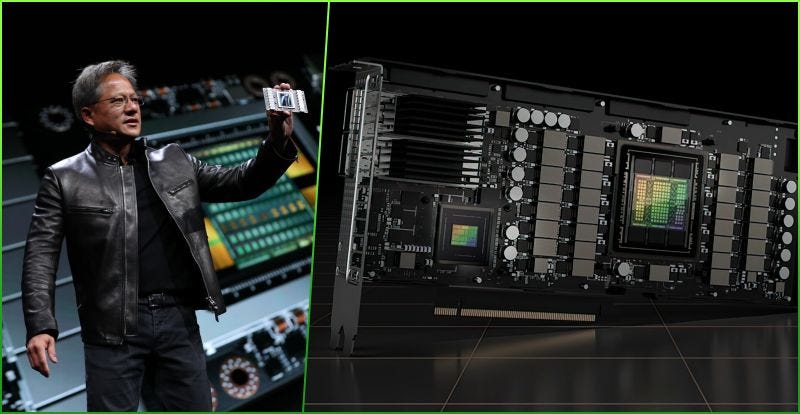
Could you combine hundreds of smaller chips to equal one H100? The economics here are punishing: latency and memory issues make each small chip far less useful than its raw compute numbers would suggest. Despite the world’s hunger for AI chips, NVIDIA’s monopolistic prices, China’s gripes about export restrictions, etc, the largest successful “decentralized” training run so far has only reached about 0.1% of frontier-model scale, and even that used fancy AI chips (they were just in different places).
Could some bad actor with extraordinary levels of motivation solve the technical hurdles and enlist enough cell phones / personal computers to overcome the diminishing returns through sheer scale? Plan A estimates that it would take about 5-10% of all the phones and computers in the world today, linked together like this, to train one frontier model. Although it might be barely possible to imagine the Chinese government enlisting 5 - 10% of all computers in the world in such a project, they couldn’t do it secretly, so we’re fine.
If the advent of AGI causes an explosion in economic growth, and consumer hardware production doubles or dectuples or something, might it reach the point where one actor really could obtain levels equal to 5 - 10% of all 2026 consumer hardware without ringing alarm bells? Yes; Plan A flags this as a risk. They suggest that if consumer hardware production seemed on track to grow to about ~twice current levels, then it might be necessary to either institute cap-and-trade, redesign consumer chips to prevent them from being used in AI training, or both (cap-and-trade on non-redesigned chips, plus unlimited redesigned chips).
(“twice current levels” might feel dangerously close in a world where compute grows exponentially, but consumer hardware compute isn’t growing exponentially in the same way as AI compute. At current growth rates - that is, without some kind of AGI economic growth explosion - it would reach twice current levels in the mid-2030s)
So the answer is: nobody would take your current laptop or cell phone away from you. If the world advanced such that it was producing far more laptops and cell phones, a regulatory regime might try taxing them to get production down to a safer level, but you still wouldn’t need a “license”, you would just pay the tax. More likely, a world on track to reach this point would modify its cell phone / laptop chips so they couldn’t train AI, and then there would be no taxes or limits at all.
Would Plan A Ban Open-Weight Models?
Yes, it bans the training of new open-weight models. This doesn’t involve any surveillance, consumer licensing, or any attempt to hunt down existing open-weight models. But after 2030, the US and China stop allowing big companies to produce new ones. This is a genuine cost to freedom, which Plan A attempts to justify.
First, maybe it’s not a cost? There might not be open-weights models in 2030 anyway. The most recent open-weights models today (2026) cost $100+ million to train. If 2030 AIs cost $10 billion, will companies still spend that amount of money and give away the resulting product for free?
Also, the US government recently temporarily banned Claude Fable out of concern that it could be used for hacking and terrorism, and allowed its re-release only after Anthropic promised to add extra safeguards against these use cases. Another potentially-dangerous Anthropic model, Mythos, remains unavailable to the public; this was a voluntary decision by Anthropic, but presumably if they hadn’t held back then the government would have taken interest. The regulatory regime for models like these remains in flux, but informally it seems to be that the companies “voluntarily” hold off release until they can prove to the government that there are good cyber safeguards.
But open-weights models can’t be safeguarded in this way. Nobody knows what will happen when open-weights models become as capable as Fable and Mythos (6-12 months from now, if trends hold). The popular AI Substack Interconnects provocatively declares that “open models have six months to live”. Most open-weights models are Chinese, so it’s unclear what policy action would look like. The US government might ban local companies from serving these (which would not be very effective), or the Chinese government might ban its own tech companies from producing them (which would be).
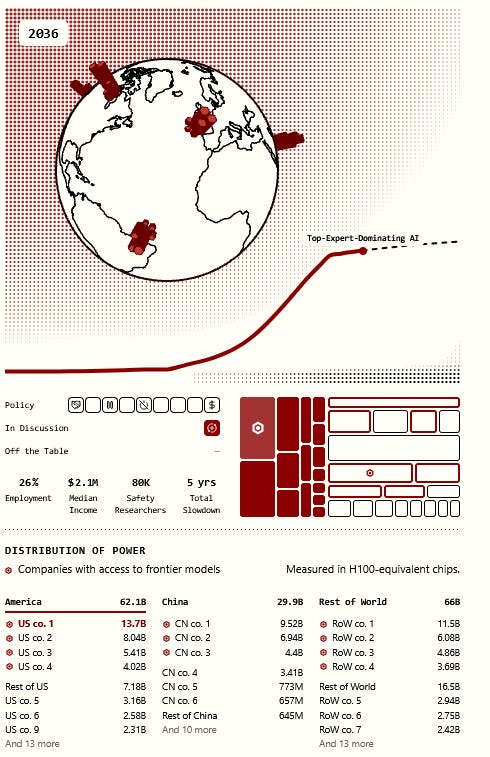
So the future of open-weights relies on a few Chinese tech giants continuing to spend billions of dollars to give AI away for free, against increasing skepticism from their own government. Plan A jettisons that and tries to achieve the same goal (no single point of failure for government censorship) a different way. They demand open-algorithms. A company that trains an AI doesn’t have to release its final weights, but it does have to release the research that went into producing it. This would allow any company in the world with the same amount of compute to produce a comparable AI. And since all companies are operating under the same consortium-imposed compute ceiling, and middle powers will have received a share of compute as a condition of joining the regime, that could potentially be dozens of different companies scattered across multiple different regulatory regimes. Their prediction for 2035 (conditional on Plan A) is about ten AI companies with at least 25% as much compute as the leading lab, in 3-6 different countries.
Would this work? I’m less sanguine than they are, for a few reasons. First, a less-idealistic government could simply pass the power-concentrating parts of Plan A (e.g. the open-weights ban) and not pass the power-diffusing parts of Plan A (e.g. an open-algorithms mandate). Second, although in theory banning access to other countries’ software requires Chinese Great Firewall levels of repression, in practice the US says “geo-block American citizens from using your software or we’ll kill you”, and every foreign company always complies. An optimist could mention that people could get around these geo-blocks with VPNs; a pessimist could counter that only the technically-savvy will get this far; a realist might note that only the tech-savvy could use open-weights AIs, so maybe this doesn’t lose us anything.
I still think this is a real cost of the plan, but it doesn’t have anything to do with surveillance (the reason you can’t have an open-weights model is because Chinese companies will stop training them, not because anyone will check your computer to look for them).
A Is For Autonomy
Plan A was designed as an attempt to avoid the disasters befalling the AI 2027 world. In one branch, the disaster was AI takeover, but in the other, it was concentration of power and global dictatorship.
How does Plan A avert global dictatorship? If AI takeover is averted, the default outcome of the current AI race is that some particular company wins. This could look like being first to a superintelligence powerful enough to “take over the world”, whatever that means. Or it could just look like the way Google “won” search or Microsoft “won” operating systems, except that they get the entire labor share of the world economy (which can then get leveraged to control an increasing amount of the capital share).
Probably at some point this winning company’s parent government has an opinion on this. In AI 2027, they resolve this through gradual semi-nationalization, where the lines between the company and the most ruthless/ambitious parts of the government blur, and both sets of oligarchs share in the gains. But maybe it will be less peaceful than this, and the government will seize control of the company, or the company will coup its own government, or something else will happen. None of this leaves very much room for ordinary people having much power or say in what comes next.
Plan A tries to avert this outcome by slowing things down and diffusing power. First, the legitimate governments of the US and China (in America’s case, including Congress, not just the executive) establish control over the speed of AI capabilities growth. Second, they replace the winner-takes-all race with a gradually rising capabilities ceiling, and diffuse technology widely enough that any country big enough to afford the compute can reach the ceiling. Instead of 1-2 countries with ~3 big labs each being in a “race”, there are 3-5 countries and 10-15 companies, all with approximately equally good AIs, and nobody can get a runaway advantage over anyone else.
Instead of companies developing superintelligence secretly and employing it before the public and the non-security branches of the government have a chance to respond, it gets developed in a fully transparent manner over a decade years. This gives ample time to debate (and agitate for) institutions like UBI. Institutions which have some power at stage n (for example, democracies and legislatures) can attempt to codify the rules that would let them keep power at stage n+1.
Would this work? Who knows? But the usual response from critics has been that if Plan A has any risks, no matter how minimal, this is unacceptable, because its benefits are “speculative” (saving the world from dangerous AI), and you may never trade plausible risks for merely speculative benefits. Yet tech companies achieving an outsized share of power is no longer “speculative”, in the sense of something that has never happened before and whose risk can be rounded off to zero. If you reject AIFP’s proposal for defusing this risk, you owe people an explanation of your magical zero-cost, zero-regulatory-burden alternative.
Unrelatedly, You Already Live In A Global Panopticon Orwellian Surveillance Dystopia
Here are some potential chip controls:
- Require AI chipmakers to secure bank-style KYC from their customers
- Along with that, require AI chipmakers to prove that their customers secure bank-style KYC from their customers.
- Require AI chipmakers to certify that their customers have certified that they won’t disclose the model weights of any AI trained on the chips being provided without informing the US government.
- Require AI chipmakers to certify their customers’ customers’ level of physical security, so nobody can steal the chips.
- Require AI chipmakers to submit all chips to a third-party lab which will confirm they don’t have more than the reported level of performance.
Take a second to guess how many of these policies Plan A supports - and whether, if it did support these policies, you would accuse it of being dystopian government overreach.
Answer: Plan A never had to consider any of these, because the Trump administration quietly enacted all of them this January, six months before Plan A was released. You probably never heard about them. I try to follow AI chip news a little, and I don’t remember hearing about them. As far as I know, none of the people warning that Plan A would destroy any hope of human freedom expressed any opinion on these.
Nor should they have! KYC policies for chipmakers are almost irrelevant when there are KYC policies on totally ordinary financial transactions! My bank knows who I purchased a $9.99 sandwich from; if it was from an Iranian guy, they’ll alert the government. The cryptocurrency movement tried to dismantle this particular surveillance state, and everyone laughed at them because they also sold monkey gifs. It’s bizarre to accept this as a matter of course, then draw your line for dictatorship at Plan A saying chips should be in secure data centers!
We can go further. What’s the worst possible AI-related affront to human freedom that you can imagine? Maybe all of your conversations with chatbots are monitored and get reported to the government if you say anything wrong?
Again, this is the status quo. In February, a mass shooter killed eight people in Canada. Afterwards, OpenAI sheepishly mentioned that:
The perpetrator had their ChatGPT account banned by OpenAI months before the attack due to troubling posts featuring scenarios of gun violence. According to reports, approximately a dozen OpenAI staff members debated whether to alert authorities about the shooter’s usage of the AI tool, with some identifying it as an indication of potential real-world violence. However, company leadership decided not to contact law enforcement, stating that the account activity did not meet their threshold for a credible or imminent plan for serious physical harm. Following the shooting, Canada’s AI Minister Evan Solomon summoned OpenAI executives to Ottawa to discuss safety protocols and thresholds for escalating harmful content to police.
If you ask GPT a question with enough scary keywords, “approximately a dozen” OpenAI staff members will debate whether to inform police! Ironically, the only way you’ll ever get rid of this is if someone adopts Plan A, which calls for “zero data retention” in consumer AIs.
I understand it’s rude to remind people that they live in a dystopia, but this is part of why I get so upset about people making hyperbolic claims about how bad Plan A is. None of these people actually try to measure how bad any of this stuff is. They just assume that things with few benefits that are passed without fanfare, like random Trump administration chip regulations, must be fine, and exciting ambitious projects by idealists who want to save the world must be bad. As a result, they’ll end up with insane restrictions on eggs and milk and financial transactions for no reason, but sink any attempt to avert catastrophe, no matter how light the touch.
So my claim is that the actual costs to freedom of Plan A’s chip regulations are:
- Move chip industry regulation stringency from ~50th to ~95th percentile among industries.
- Briefly tax consumer hardware to keep demand at ~2034 levels, until consumer hardware firms can design non-AI-capable chips.
- Ban the training of new open-weights models, after a point where they might have become economically prohibitive anyway.
These are substantial. But none of them involve a “surveillance state” or a “dystopia”, just standard government regulation levers like auditing factories and imposing taxes. And some of them can be delayed until after we see whether they’re necessary (if there’s no AGI-induced explosion of economic growth, maybe we can skip the second one).
Some people have argued that these are still too restrictive to implement until the risks of superintelligent AI are clearer. I think the strongest response there is that they won’t be implemented until then. Nobody expects Plan A to be passed immediately; even the Plan A scenario itself envisions it staying outside the Overton Window until 2028 - 2029, when the intelligence explosion already looms on the horizon too clearly for even the government to miss. Until then, the vision is to spread the word that this possible solution to a future crisis exists, and take the low-risk, reversible steps that put us in a position to make decisive moves later. Plan A is still speculation, and still-speculative strong action is a perfectly reasonable response to still-speculative threats.
But my perspective is that we’ll probably get all of the downsides of Plan A much sooner than that, for stupid reasons. The chip regulations mentioned above are a substantial fraction of the way to Plan A’s; they were part of a dumb idea to sell certain chips (but not others) to China to “cement American tech dominance”, which will obviously backfire. OpenAI monitors all of your chats in the hope of preventing a mass shooting that killed eight people, but it still failed to prevent the shooting. When we finally ban open-weights, the most dignified possibility is that it’ll because of Mythos-style security concerns; equally likely it will be something about kids generating deepfakes of their classmates on Z-Image. At that point, whatever, it’ll be all upside.
But if you disagree, please mention the particular downsides you’re worried about, not false claims like “it will be a surveillance state”.
This is the eventual goal, but the technology might not be ready in time; until then, they can have cruder kill switches or otherwise be easy to stop.
I estimated 40th to 75th, a chip expert I consulted estimated 20th to 95th, and Claude Fable estimated 60th to 97th.