Your Incentives Are Not The Same As Media Companies'
Scott Alexander critiques toxic Twitter behavior, explaining its personal and social costs, and warns against imitating confrontational media tactics.
Unfortunately I hate many of you.
Only the ones with Twitter accounts. If you don’t have one of those, you’re fine. But if you do have one, there’s a good chance you said something which horribly offended me. You said everyone who believed X was an idiot and a Nazi, and I believed X. You read the title but not the body of an article about some group I care about, and viciously insulted them based on your misunderstanding of their position. You spent five seconds thinking of a clever dunk on someone who happened to be a friend of mine trying really hard to make the world better, and ruined their day.
Maybe you think it’s all water under the bridge. It’s not. I mute people on a hair trigger, which means that I’ll never see anything else you write, ever again. If you make one ill-considered “haha, aren’t people who think [your strawman of my position] so stupid”, then you can be as eloquent and scholarly as you want in everything else you write, and I will never get a chance to consider it or change my mind or feature your ideas on ACX.
I don’t just mute you on Twitter. Until I forget who you are - which might take years - I get mildly upset every time I see your name. If someone links to an article you write, I’ll close it as soon as I recognize the byline. If you’re at some kind of real-life event I’m attending, I’ll avoid you. I’ve had negative associations with whole political movements just because one of their members insulted a person I respect, in some especially unfair way. I’ve sometimes found myself being irrationally uncharitable to everyone named Albert or Allen or Alvin just because a totally different guy named Alfred was a jerk on Twitter.
This isn’t out of some kind of principle. It’s how my emotions naturally work. I think it’s a natural human urge, and a lot of other people work the same way.
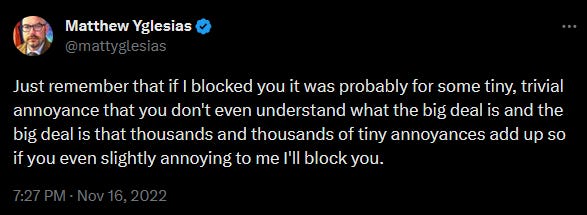
It can’t possibly be worth it for you. The fact that you skimmed the first third of a thinkpiece about a fiendishly complex issue and now want to insult one side of it (“They’re the literal epitome of Dunning-Kruger!”) cannot possibly have enough value in your mental economy to compensate for the fact that many of the people you most want to reach and befriend and keep on your side will hate you and never affiliate with you again.
I worry that normal humans are imitating journalists. If a journalist makes 99 people hate them, and 1 person like them enough to like or subscribe or click on their next article, that’s a win. Fox News alienates millions of people with its confrontational style, but Rupert Murdoch is the 71st richest man in the world; if he could alienate twice as many and be twice as rich, he would take that trade. Journalists have shaped Twitter culture; lots of people, god help them, imitate their mannerisms and interaction style. But your incentives are not the same as media companies’. If you alienate 99 people and get one person to say “Wow! You have exactly the same flavor of hatred for people who plant petunias that I do, but you express it so much more cruelly, I bet you’re literally making them cry, it really made my day!” you will not become the 71st richest man in the world. You will just lose 99% of the potential people who could listen to you or care about you or be your friends.
Also your soul, if you’re religious and believe in that sort of thing.