Creationism, Unchallenged
Scott Alexander examines the impact of media coverage on fringe beliefs like creationism, suggesting that reduced coverage doesn't necessarily lead to their spread.
How much should responsible news organizations report on stupid things?
If they don’t report at all, the stupid things go unchallenged. But if they report too much, then they signal-boost the stupid thing and give it free publicity (eg Donald Trump). Also, people who mistrust the media might reflexively support the stupid thing just because the media hates it (eg Donald Trump). Also, the more time you waste covering stupid things, the less time you have for real news (eg Donald Trump).
I recently read Causes And Consequences Of Mainstream Media Dissemination Of Fake News: Literature Review And Synthesis, which argues that the news might be covering too many stupid things right now. The authors note that “only 2.6% of visits to current affairs articles were to fake news websites” (though other sources suggest more) and that the mainstream press bears some responsibility for spreading inaccuracies beyond this small demographic. But they also understandably worry that maybe if the mainstream press wasn’t so aggressive in covering and debunking fake news, then fake news would go uncorrected.
When I think about this problem, I remember creationism.
In the early 2000s, creationism was Public Enemy Number…maybe not One, but somewhere in the top ten. If you’re old enough to remember the decade at all, you probably recall the key flashpoints. The Discovery Institute. Michael Behe. “Teach the controversy”. The Creation Museum. Of Pandas And People. That one anti-Richard-Dawkins rap song which somehow despite everything managed to be really good.
And you probably remember the efforts by “the reality based community” to spread awareness of the dangers of creationism – the xkcd comics, the petitions by 1400 scientists named Steve, the New York Times articles:
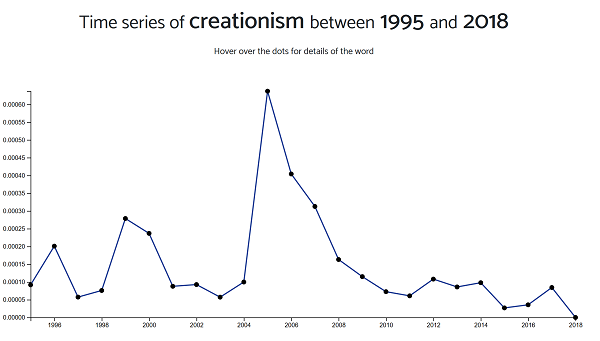
…yeah, the 2000s were a weird time. I’ve talked about this particular conflict already in my post New Atheism: The Godlessness That Failed. Today I want to focus on another aspect.
All those creationists are still there. A 2019 Gallup poll found that 40% of Americans believed “God created human beings pretty much in their present form at one time within the last 10,000 years or so”, little different from 44% who believed it when they first asked in 1983 or the 46% who believed it in 2006.
And the Discovery Institute! They’re still there! You can read their very modern-looking website at discovery.org. Their blog has three new posts on creationism just from the past two days (eg A Hot Seller From Discovery Institute Press: New Book Offers Intelligent Design In A Nutshell).
Same with the Creation Museum! Last year they completed a $5.5 million upgrade, including a planetarium, “4D theater”, and a snazzy “Biblical authority exhibit”. And they still have their full-scale replica of Noah’s Ark (looking more and more prescient these days).
Same with Michael Behe! He’s still publishing! Last year he released his newest book, Darwin Devolves, which “gives a sweeping tour of how modern theories of evolution fall short and how the devolving nature of Darwin’s mechanism limits them even further”. Also, in case you wanted to read Behe’s opinions about the coronavirus, that is a thing you can do.
As far as I can tell, the creationists are putting in just as much effort today as they did in 2006. But the mainstream went from fiercely challenging them, to totally ignoring them. And the change didn’t help them at all. They haven’t won any major victories, or convinced any more people. If anything, they’re doing worse – nobody hears about them. Although the decline in media coverage hasn’t prevented people from being creationist, it hasn’t helped creationism spread or build clout either.
I see people using rivers of ink to fight the modern equivalents of creationists. Pizzagaters, flat-earthers, moon-hoaxers, QAnon, deep-staters, people who say the coronavirus is a bioweapon, Alex Jones. Are they sure it’s not equally useless? Equally counterproductive?
Even beyond that, I see people willing to legitimize any tactic if it gives them a leg up on this group – censorship, social shaming, no-platforming, changing social media from a free public square to a carefully-monitored walled garden. Spreading the cowpox of doubt, teaching people to optimize for solving easy problems in ways that make it harder for them to think about the hard ones. The justification is always the same – if we don’t tighten control, then facts and science will lose out to bullshit and denialism, and fringe ideologies will burst into the mainstream and overwhelm it.
If that were the only way to save civilization from anti-science barbarism, maybe it would be a worthwhile trade. But the experience of unchallenged creationism suggests maybe we can relax.
