Links 3/17: Siteochrome P450
A wide-ranging links post covering recent research, political developments, and interesting findings across various fields, with particular focus on psychology research, political polling, and academic developments.
Greek scholar Philitas of Cos “studied false arguments and erroneous word-usage so intensely that he wasted away and starved to death”.
Outgroup Threat Responses, Ingroup Bias, And Nonapeptide Involvement Are Conserved Across Vertebrates. “In particular, the evolutionarily conserved, hormone-regulated nonapeptide systems (oxytocin, arginine-vasopressin, and homologous neuropeptides and their receptors) are involved in the mediation of the detection and avoidance of out-groups and response to in-groups and facilitation of in-group responses across multiple vertebrate species. Consequently, comparative investigations of both the behavioral expression of and the mechanism underlying out-group avoidance and in-group bias are necessary for a full understanding of the evolution of social behavior and responses to in- and out-groups.”
YouGov poll: Pro-Brexit voters are less likely to trust experts – not just political elites but even sports commentators, weather forecasters, and their own doctor. Some kind of fundamental psychological difference, or just a feeling that the experts aren’t part of their culture?
Related: Leave voters prefer their steaks well-done, compared to Remain voters preferring them rare. Possibly related to the media horror at the revelation that Trump likes his steaks well-done? I know nothing about steak, but I was always told as a child that I needed to order it medium rare because if I asked for it well-done everyone would laugh at me/hate me. In retrospect, this is really suspicious, and I should probably try well-done steak sometime to make sure it’s not one of those things where it tastes vastly better but everyone has to signal sophistication by pretending that it doesn’t.
Also in European polling news: even though older Americans support Trump and older Brits support Brexit, it’s the youngest French people who are some of the most likely to support nationalist candidate Marine Le Pen. Why the difference?
Jared Rubin on why the Middle East fell behind Europe during the Renaissance. One theory: their corporate partnership law wasn’t as good! Also, how come everyone writing about why Europe was so successful has the first name Jared and a surname based off a precious stone?
Ozy is running an intellectual Turing test on transgender and gender identity. Submissions are already closed, but if you go to the front page of their blog you’ll find the recent entries you can vote on.
DeepMind claims to have achieved transfer learning, the ability of an AI to transfer knowledge gained in one task to a superficially different one. In this case, an AI that learned to play one videogame was also able to apply that knowledge to play a slightly different videogame. A milestone on the road to AGI?
Bill Gates warns tens of millions could be killed by bio-terrorism.
Belarus passes a sort of reverse welfare law in which underemployed people have to pay the government extra, to make up for all the taxes they’re not paying because they’re underemployed. Needless to say, the law is not proving popular.
Wikipedia: Post-positive adjectives in modern English. Why do we use postpositive adjectives with indefinite pronouns? Eg “some nice place” vs. “someplace nice”?
U Penn professor studying poverty goes to work in a check cashing store to see why poor people use them, discovers that they provide better value than banks for poor people’s needs.
Big Pharma is very worried that a Trump appointee might deregulate the pharmaceutical market. A heuristic: the kind of deregulation worth pursuing is the kind that all the big companies in the industry hate.
ASI: Peer Effects Exist But They’re Not Very Big. A one standard deviation increase in your peers’ test scores causes a 0.03 increase in your own.
More on the psychopharmacological iron curtain: Cytisine (not to be confused with cysteine or cytosine, not that anybody here would do that) is an Eastern European anti-smoking medication which may be safer than existing American anti-smoking medication like Chantix. (h/t Aaron)
Mother Jones: We Should Practice Truth In Statistics, Even When It Hurts
A team from AEI has released a paper preregistering how they will analyze future data on the effect of minimum wage increases. This is really important; preregistered experiments remove the ability of researchers to fiddle with techniques until they get the results they want.
Which is more important for success in school, intelligence or other personality characteristics? The latest results: Intelligence is more important for standardized test scores, personality is more important for grades. This makes a lot of sense: whether you do well on your SATs is IQ, whether you turn in all of your homework on time is conscientiousness. Probably not too surprising, but useful in explaining differences in other research with different education-related endpoints. Related: the heritability of cognition vs. personality over the lifespan.
There’s a stereotype that intellectuals are more likely to be Democrat, but previous studies have failed to find a clear IQ/partisan association. A new study finds that IQ/partisan associations do exist but are a very recent phenomenon: they only hold for people born in the late 20th century.
Many people have been linking this study suggesting that psychotherapy changes personality for the worse – ie makes people more neurotic, more depressed, less conscientious, etc. I am very skeptical of this, since it’s a longitudinal study that contradicts the results of many previous randomized controlled trials. On a very quick first glance (maybe wrong?), it looks to me like they didn’t do much to control backwards causation – eg people who are more neurotic, more depressed, less conscientious, etc are more likely to get therapy. To which the correct response is “Duh”. Remember (I somehow find myself saying) not to believe a study just because it’s counterintuitive. If other people disagree with me on this one I’ll take a closer look.
Related-ish: Has Increased Provision Of Treatment Reduced The Prevalence Of Common Mental Disorders? Review Of The Evidence From Four Countries. In Anglosphere countries, number of people getting psychiatric care (broadly defined) has increased tremendously over the past thirty years. But the prevalence of psychiatric disorders has stayed approximately the same. Why? One obvious possibility is that it’s getting diagnosed more (or even that people with depression in remission because of good treatment are still saying they “have” depression) but the study tried to control for that by asking about prevalence of symptoms rather than diagnoses, and the symptoms really ought to respond to treatment. So what’s going on? The authors suggest that treatment is generally terrible; for example, less than 40% of mental health treatment in the US meets their criteria for being “minimally adequate”. “The current prevalence estimates of mental health treatment based on population surveys greatly exaggerate the prevalence of effective treatments received.”
Sad news: Dr. Mickey Nardo, who wrote one of the best psychiatry blogs on the Internet, passed away last month (obituary). His family asks that “in lieu of flowers, [we] would appreciate it if you would donate to” an organization promoting integrity in medical research in his name.
Belgians find that the sun illegally cast over four thousand votes in their local elections; other countries now concerned about possibility of solar-related voting fraud.
The prediction market for whether Donald Trump will be President at the end of 2017 thinks that there’s a 22% chance that he won’t be.
Related: Metaculus, a prediction website for science and technology.
Department of Justice revokes Obama-era rules phasing out use of private prisons at the federal level. For some reason this is more depressing to me than everything else, and really hammers in the fact that you can fight however hard you want for progress and then some moron can just come along and reverse it.
Wikipedia: Impact Of Privatization On British Rail. After privatization in the 1990s, ridership doubled, percent of travelers unsatisfied with their journey was cut in half, safety improved to be #1 in Europe per passenger-km, average satisfaction increased by 7 pp, and cost per passenger mile decreased by 20%. Nevertheless “70% of voters want a renationalisation of the railways, while only 23% support continued privatisation”.
Nobody has principles, part #56069384: Why does the White House support deferring to states’ rights on transgender bathrooms, but not on marijuana?
The Atlantic: 20 Ideas Of David Gelenter. I think a lot of this is wrong – and worse, it’s wrong things said well and convincingly – but I’m linking it anyway out of anger at the Washington Post trying to paint him as “anti-intellectual”.
List Of Kim Jong-Il’s Titles, eg “Dear Leader Who Is A Perfect Incarnation Of The Appearance That A Leader Should Have”.
The big politics news recently is Tom Perez beating Keith Ellison for DNC chair. Current Affairs argues that the Democrats “must be trying to fail”; their opponents seem to agree. The pro-Perez argument is that he’s pretty much the same as Ellison so there’s nothing to be upset about and the party should maintain unity. The counterargument, which I haven’t heard anyone rebut effectively, is then how come when Ellison was leading the race, the establishment was so eager to tap Perez to run against him?
In my article on cost disease, I mentioned that the price increases in the pet health industry were a useful comparison for the price increases in the human health industry. In the same way, can we use price increases in textbooks to better understand price increases in college?
Study points out that, contra the myth, most lottery winners use their winnings wisely and don’t go bankrupt. This is true, but the interesting story isn’t that lottery winners always go bankrupt, it’s that lottery winners are no less likely to go bankrupt than others. That is, if you were fiscally responsible anyway, you’ll be fiscally responsible with lottery winnings; if you were always fiscally irresponsible, winning the lottery won’t help.
With all this discussion on how much discrimination there is, it’s interesting that I’d never before seen a study that just surveys a lot of people on how much discrimination they face. Key result: 5% of black people (compared to 4% of white people) say they “often” face discrimination; 29.8% of black people (compared to 30.3% of white people) say they “never” face discrimination.
Witches declared February 24 a day to cast spells against Trump; evangelical Christians and 4chan chaos magicians vowed to mystically defend him. A useful natural experiment in which religion is true?
Robert Trivers has been saying for a long time that self-deception evolved as a way to help us effectively deceive others; now he’s got a paper presenting some empirical support.
Secondhand smoke might not be so bad. I don’t want to make a big deal of this yet because I haven’t checked if it’s true. If it is, it might represent another rare case of science failure and heads ought to roll.
Could we terraform Mars quickly and cheaply by planting a magnetic shield at its L1 point?
The Twitter feed of the journalist suspected in some of the recent Jewish community center threats; good for schadenfreude. Also: “vandalized” Jewish headstones in NYC probably fell over due to weather, natural causes. Plus: one actual neo-Nazi arrested, swastika tattoo and all.
By now you’ve probably heard about the attacks on Charles Murray at Middlebury. But it’s worth remembering that increasing college student closed-mindedness and violence aren’t just a problem for one side; pro-Palestine journalist Rania Khalek was kept from talking at UNC based on her opinions about the war in Syria. I continue to think that the only potentially effective counter to this kind of thing is Heterodox Academy and FIRE‘s attempts to rank colleges by tolerance level so that people interested in intellectual inquiry stop attending the most totalitarian, positive feedback loops create divergent selection, and administrations that want their schools not to become completely devoid of scholarship have US-News-style incentives to tone down their students’ worst tendencies.
There will be a temporary suspension of expedited processing of H1B visas starting in April. Unclear if this is some Trump-related plot or just normal bureaucratic variability, but if you need an H1B visa renewed you should probably look into it.
Alex Tabarrok notes that illegal apartment buildings keep getting demolished in Mumbai – then get rebuilt, because it’s cheaper to keep rebuilding the same building every time it gets demolished for being illegal than it is to deal with the bureaucracy involved in getting permission to construct things legally. I think I’m supposed to be horrified that any country, even a Third World one, could possibly be that inefficient. Instead I’m wondering if anyone’s ever tried this in San Francisco.
sinesalvatorem: The best way to keep terrorists out of terrorism is to convince them to settle down and raise a family. Plus: subsidized terrorist speed dating.
@outsideness described my silly story about Greek gods as “meme war”; when I asked him what he meant, he said that everything was meme war and didn’t explain further. Right on cue, I run into this article on people who think everything is meme war. A lot of other good stuff in there, including a critique of Chapmanesque post-rationality.
Theory: modern activism, and possibly the entire modern left, is shaped by what techniques are optimized to succeed on a college campus with a moderately friendly administration.
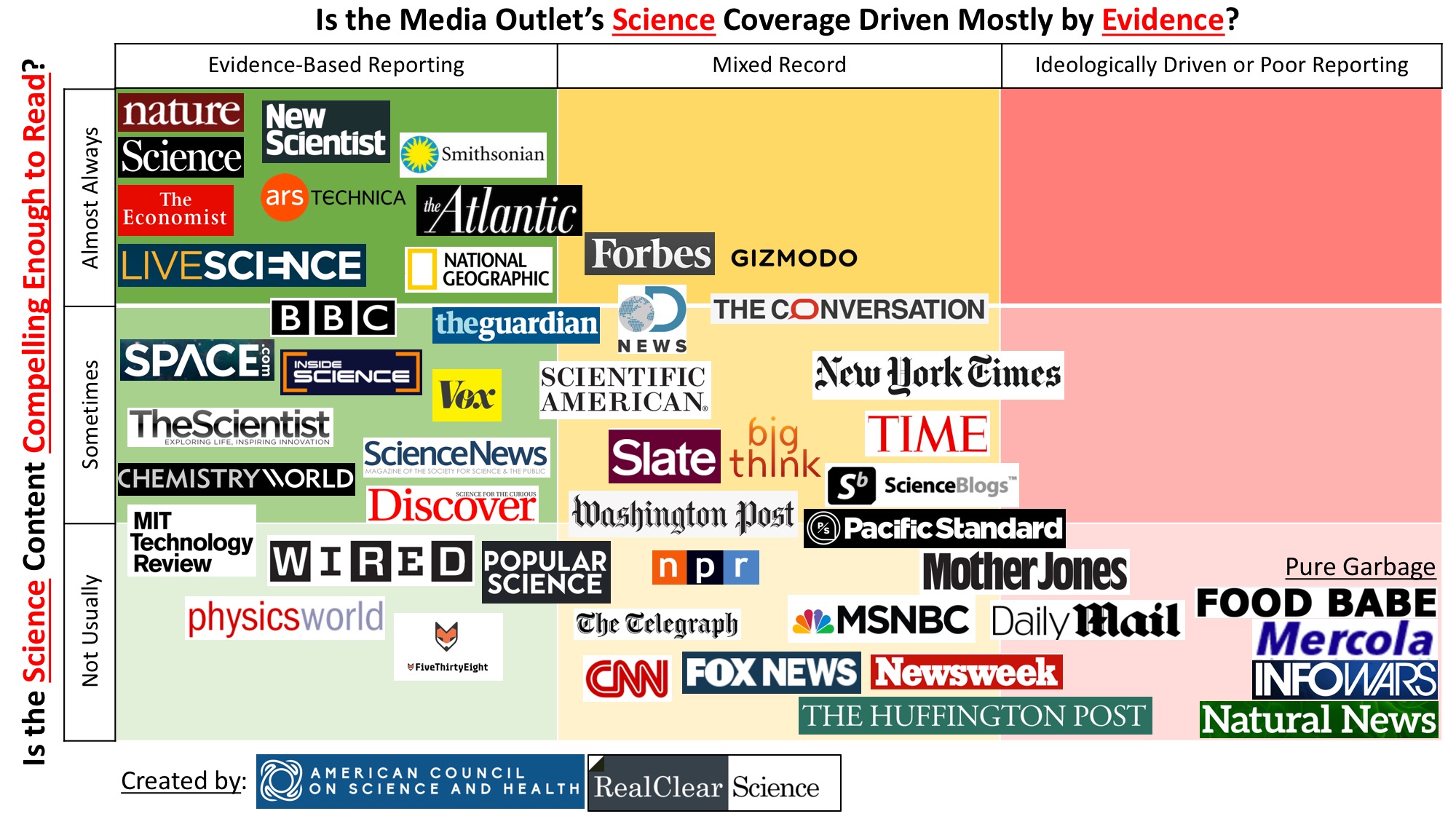
The American Council on Science and Health, which sounds important, has released this infographic on which sites’ science reporting to trust. I expected a simple division between eg “NYT good, InfoWars bad”, but they actually claim major differences in seemingly mainstream respectable news outlets. I don’t know if any of them are true. I also don’t really know what they mean by “compelling” and why I should trust the American Council on Science and Health to determine whether a story is “compelling” or not. [EDIT: Nature pulls a Trump and rejects the results even though they won]
Man tracks all of his son’s first words since birth. This is amazing, not just in seeing which words people learn when, but in seeing that it makes a beautiful natural exponential curve. I wish there were data for a longer period, though I can understand it would probably get out of hand after a while.
Study: militarizing police cuts crime, does not increase police-related civilian deaths. What other metrics, if any, might be used to study downsides of police militarization?
Brookings Institute on big government. Key takeaway: despite inflation-adjusted federal government spending quintupling in the last 50 years, there’s been minimal increase in government employees, mostly because government is now doing more of its work through private partnerships, nonprofits, and local administrations. It looks like the electorate wants both more stuff and smaller government, and politicans have “satisfied” both preferences by making government activities less visible and more proxy-administered. But proxy-administered government activities might be less efficient than just doing government activities openly with real federal employees, so arguably this hurts everybody.
Aella: Evidence-based camgirling.