Mysticism and Pattern-Matching
Scott Alexander hypothesizes that mystical experiences, hallucinations, and paranoia might be linked to an overactive pattern-matching faculty in the brain.
[Epistemic status: Total conjecture.]
One of the things that got me interested in psychiatry was the sheer weirdness of the human brain’s failure modes. We all hear that the brain is like a computer, but when a computer breaks, the screen goes black or it freezes or something. It doesn’t hear voices telling it that it’s Jesus, or start seeing tiny men running around on the floor. But for some reason, when the the human brain breaks, it may do exactly that. Why?
Psychiatry classes never just tell you the answer to this question, but reading between the lines I think it has something to do with top-down processing and pattern matching.


 Bottom-up processing is when you go from basic elements to more complex ideas – for example, when you see the three letters C, A, and T in a row, you might combine them to get the the word CAT. Top-down processing is when more complex ideas change the way you interpret basic elements. For example, in the first picture above, the middle letters in both words are the same. We read the first as H, because the image as a gestalt suggests the word “THE” and the word “THE” suggests an H in the middle. We read the second as A, because the image as a gestalt suggests the word “CAT” and the word “CAT” has an A in the middle. Our big-picture idea has changed the way we view the smaller elements composing it.
The same is true of the second image. We recognize the phrase “PARIS IN THE SPRINGTIME”, and so we assume that’s what the sign is trying to show us. In fact, the sign doubles the word “the”. But since this is bizarre and not something that makes sense in the gestalt, we assume this is a mistake and gloss right over it. We do this very, very easily – how many times have I duplicated the word “the” in this essay already?
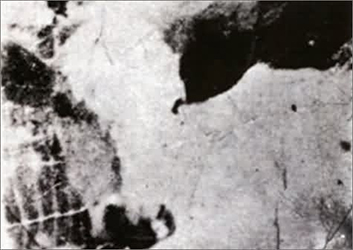
The third image is related to this tendency. To most people, it looks formless. Even once they hear that it’s an old black-and-white photograph of a cow’s head, it’s might still require a bit of staring before you catch on. But once you see the cow, the cow is obvious. It becomes impossible to see it as formless, impossible to see it as anything else. Having given yourself a top-down pattern to work from, the pattern automatically organizes the visual stimuli and makes sense of them.
This provides a possible explanation for hallucinations. Think of top-down processing as taking noise and organizing it to fit a pattern. Normally, you’ll only fit it to the patterns that are actually there. But if your pattern-matching system is broken, you’ll fit it to patterns that aren’t in the data at all.
The best example of this is Google Deep Dream:
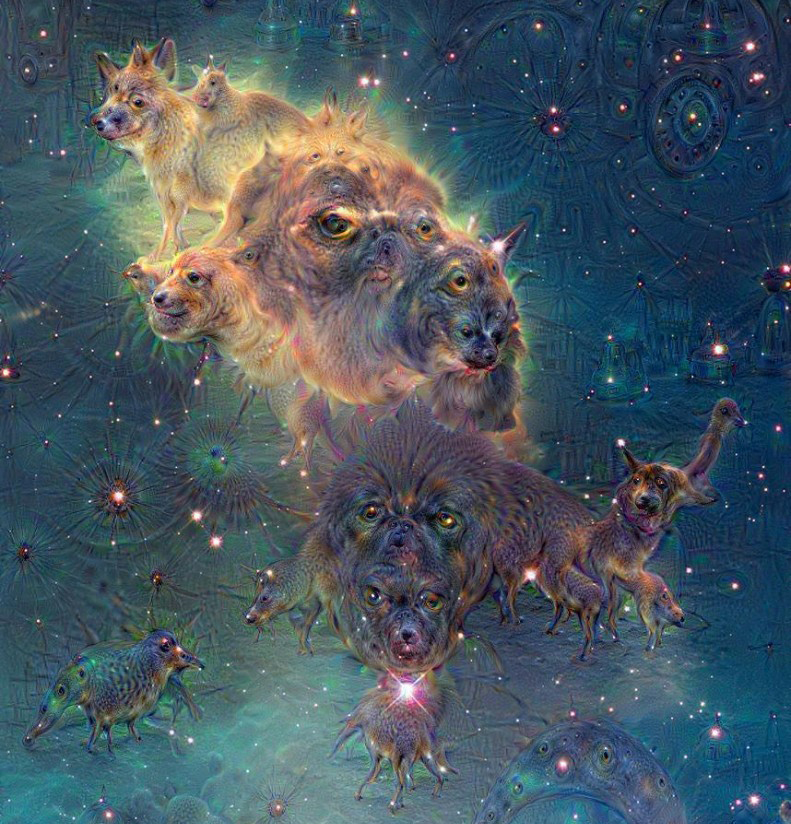 I don’t know much about neural networks, so I may not be getting this entirely right, but as far as I understand it, they trained a neural network on some stimulus like a dog. This was for research in machine vision; they wanted the net to be able to recognize dogs when it saw them; to pattern-match potentially noisy images of dogs into its Platonic ideal of a dog. But if you turn the pattern-matching up, it will just start seeing dogs everywhere there’s even the slightest amount of noise that resembles a dog at all. You only matched the sign above to “PARIS IN THE SPRINGTIME” because it was almost exactly like that phrase; if we stick your pattern-matching software into overdrive, maybe every sentence would start looking like more meaningful alternatives. Eevn sceeentns wtih aolsmt all the lerttes rergaearnd wulod naelry ianslntty sanp itno pacle. Turn it all the way up, and maybe you could make every sentence look like “PARIS IN THE SPRINGTIME”. Or something.
So hallucinations are when your top-down processing/pattern-matching ability becomes so dysfunctional that it can generate people and objects out of random visual noise. Why it chooses some people and objects over others I don’t know, but it’s hardly surprising – it does the same thing every night in your dreams.
Many of the same people who have hallucinations also have paranoia. Paranoia seems to me to be overfunctioning of social pattern-matching. When Deep Dream sees the tiniest hint of a line here, a slight dark spot there, it pattern-matches it into an entire dog. When a paranoiac hears a stray word here, or sees a sideways glance there, they turn it into this vast social edifice of connected plots. Every new thing that happens is fit effortlessly into the same pattern. When their psychiatrist says they’re crazy, that gets fit into the pattern too – maybe the psychiatrist is a tool of the conspiracy, trying to confuse them into compliance.
So where does the mysticism come in?
I notice that the same people who have hallucinations also have mystical experiences. By mystical experiences, I don’t just mean “they see angels” – in that case, the relationship to hallucination would be a tautology. I mean they feel a sense of sudden understanding of and connection with the universe. I know at least three groups that do this: druggies, meditators, and prophets. The druggies report feelings of total understanding on their drugs, and also report hallucinations. The meditators occasionally achieve enlightenment, but look at any text about meditation and you find mentions of visions and hallucinations experienced during the practice. The voices heard by the prophets are too obvious to mention.
One well-known way of bringing on such experiences is to abuse your pattern-matching faculty. The Chicken Qabalah of Rabbi Lamed Ben Clifford
Like a mountain goat leaping ecstatically from crag to crag, one thought springs into another, and another, ad infinitum. You can continue, almost forever, connecting things that you never thought were connected. Sooner or later something’s going to snap and you will overcome the fundamental defect in your powers of perception.
And:
Was that the message Ezekiel was trying to convey? Probably not. But who cares! Whatever it was the old boy was originally trying to say shrinks to insignificance. It is far more important to my spiritual enlightenment that my mind was forced to churn at breakneck speed to put all of this together, and then open itself up to the infinite possibilities of meaning. Look hard enough at anything and eventually you will see everything! it doesn’t even have to make very much sense what you connect to what. It’s all ultimately connected!
This philosophy, which I associate both with kabbalah and with the more modern Western hermetic tradition, says that learning a set of extremely complicated correspondences is an important step toward gaining enlightenment. See for example this site, which helpfully relates the sephirah Netzach to the planet Venus, the number 7, the emerald, the lynx, the rose, cannabis, arsenic, copper, fire, the solar plexus chakra, the archangel Haniel, the Egyptian goddess Hathor, the concepts of love and victory, et cetera, et cetera. You’re supposed to be able to use this to interpret things – for example, if you have a dream about a lynx, it could correspond to anything else in the system – but it looks like it would quickly get unwieldy. And other sources will give completely different systems of correspondences, and nobody gets too upset over it – in fact, some sources will happily encourage you to come up with your own correspondences instead, as long as you stick to them. It seems like the goal is less “remember that it’s extremely important that emeralds correspond to lynxes in reality” and more “have some system, any system, of interesting correspondences in mind that you can apply to everything you come across”.
Nor does it especially matter what you’re interpreting. The traditional things to interpret are mysterious things like dreams, or the Bible, but Crowley famously performs a mystical analysis of Mother Goose nursery rhymes (see Interlude here). The important factor seems to be less about there being sacred truth in the object being analyzed, and more about the process of performing the analysis.
(Zen koans are a little different, but also sort of involve torturing a pattern-finding ability for apparently no reason)
So to skip to the point: I think all of this is about strengthening the pattern-matching faculty. You’re exercising it uselessly but impressively, the same way as the body-builder who lifts the same weight a thousand times until their arms are the size of tree trunks. Once the pattern-matching faculty is way way way overactive, it (spuriously) hallucinates a top-down abstract pattern in the whole universe. This is the experience that mystics describe as “everything is connected” or “all is one”, or “everything makes sense” or “everything in the universe is good and there for a purpose”. The discovery of a beautiful all-encompassing pattern in the universe is understandably associated with “seeing God”.
Religious scholar William James once experimented with nitrous oxide and reached a state where he felt he had total comprehension of the universe. According to a story which I can’t verify, he became infuriated at losing the thread of understanding once the chemical wore off, so he decided to take notes during the experience: write down the secrets of the universe then, and reread them once he was sober. The experiment completed, he picked up the notepad in feverish excitement, only to find that he had written OVERALL THERE IS A SMELL OF FRIED ONIONS.
Imagine one of those Google robots pointing at an empty patch of sky and saying “No, look, seriously, there’s a dog right there. Right there! How are you not seeing this?” Things that make perfect sense in the context of a state of overactive pattern-matching look meaningless to a pattern-matching faculty operating normally. At best, you can sort of see the lines of what seemed so clear before (“Yeah, I can see that that stain on the wall is vaguely dog-shaped.”) This matches the stories I’ve heard of people who have some mystical experience but then can’t maintain or recapture it.
I think other methods of inducing weird states of consciousness, like drugs and meditation, probably do the same thing by some roundabout route. Meditation seems like reducing stimuli, which is known to lead to hallucinations in eg sensory deprivation tanks or solitary confinement cells in jail. I think the general principle is that a low level of external stimuli makes your brain adjust its threshold for stimulus detection up until anything including random noise satisfies the threshold. As for drugs, there’s lots of reasons to think that the neurotransmission changes they create will alter the brain’s pattern processing strategies.
Things this hypothesis doesn’t explain: why mystical experiences are linked with a feeling of no time, no space, and no self; why prayer or extreme devotion seems to induce them (eg bhakti yoga), and why they can be so beneficial – that is, why do people with mystical experiences become happier and better adjusted? Maybe the feeling of the world making sense is naturally a pleasant and helpful one. Certainly the opposite can be very stressful!