No Skyscraper Stagnation
Scott Alexander refutes claims of American decline based on skyscraper construction, presenting data showing continued growth and recent boom in supertall buildings.
Since we’re on the subject of whether technological progress has stagnated, I thought I’d address an issue that always seems to come up sooner or later.
Is there a decline in American skyscrapers possibly indicating a decline in American civilization?
I realize that some people may live in happy little bubbles where this question does not in fact always seem to come up sooner or later. But I tend to hear it a lot. It seems to be a favorite of former SSC commenter James Donald. From here:
The twin towers were big buildings, and buildings of that size cannot be built under progressive regimes. As the trabant was a fraud, created to disguise the fact that the Soviet Union could not build consumer cars, the One World Trade Center is a fraud, created to disguise the fact that the US can no longer build buildings as large as it used to be able to build.
He has more in the same vein here, here, and at his blog. But it’s not just Jim. From Countercurrents:
It’s not a coincidence that the tallest buildings in America were built during the 1970s. What we didn’t realize at the time was that we would never again have it so good. The 1970s represented a “tipping point,” to use the popular vernacular, for the American Dream.
Vox Day writes:
I suspect that human capability reached its peak or plateau around 1965-75 – at the time of the Apollo moon landings – and has been declining ever since. This may sound bizarre or just plain false, but the argument is simple. That landing of men on the moon and bringing them back alive was the supreme achievement of human capability, the most difficult problem ever solved by humans. 40 years ago we could do it – repeatedly – but since then we have *not* been to the moon, and I suggest the real reason we have not been to the moon since 1972 is that we cannot any longer do it. Humans have lost the capability.
He doesn’t bring up skyscrapers, but a commenter does.
Or, to totally remove any subtlety, here’s The Decline Of The West As Measured By The Rise Of New Skyscrapers.
The typical response to this sort of thing is to bring up the studies showing that increased skyscraper construction is in fact correlated with not with progress, but with economic decline. The Skyscraper Index is a whimsical attempt to use skyscraper construction to predict economic downturns. And that if the world’s largest skyscrapers are currently in Dubai and Saudi Arabia, maybe skyscrapers are less a sign of national glory and more a sign of having more oil than sense.
But it looks like Jim isn’t a fan of that argument. So let’s take a different tack:
America’s capacity to build skyscrapers isn’t decreased at all, in any way, whatsoever.
(says the guy with the secret guilty skyscraper obsession)
Here is a graph of the height in feet of the tallest skyscraper in America, by year.
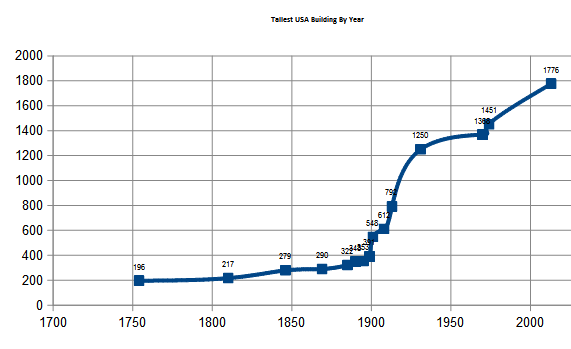 In the mid-1700s, the tallest building in the US was Christ Church in Philadelphia at 196 feet. There’s some underwhelming progress until about 1900, when a thirty-year spurt takes us from 391 feet to over a thousand. This spurt ends with the Empire State Building (1,250 feet) in 1931. There is then a forty year dry spell ending with the construction of the WTC and Sears Tower in rapid succession, then another forty year dry spell ending with the construction of One World Trade Center last year.
After the 1900 – 1930 spurt (which corresponded to the first widespread use of steel and elevators) growth is extremely linear.
Jim argues this is unfair because One World Trade Center, the recent data point beating the old Sears Tower and WTC, has an unusually large spire inflating its height. This is true.
If we ignore spires and concentrate on roof height, the old WTC was 1368 feet and the new WTC is also 1368 feet (coincidence?), showing little progress. Luckily for our argument, the Nordstrom Tower currently under construction in New York has a roof height of 1,479 feet, a good one hundred feet higher than the WTC and enough to restore linearity.
[Note: I feel bad arguing against Jim after banning him from commenting. I’ll unblock him from this post’s comment section for purposes of fairness.]
A different measurement might be concentrating on quantity rather than quality of skyscrapers. This graph shows the number of supertall (> 1000 ft high) skyscrapers in the US over time:
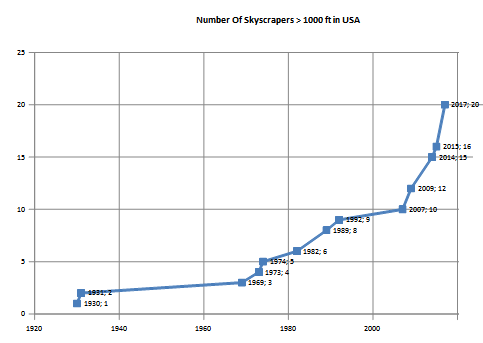 Two built in the 1930s (Empire State and Chrysler Buildings), none from 1931 to 1969 (our dry spell), a gradual trickle from 1969 to 2007 or so, and a sudden recent explosion. Thus the excitement about New York’s recent supertall boom. The current spurt includes the previously mentioned One World Trade Center, the Nordstrom Tower (which will be one foot lower than 1WTC at 1,775 feet), 432 Park Avenue (“only” 1,398 feet, but higher than 1WTC without its spire). There are more supertall buildings scheduled for construction in the Hudson Yards redevelopment project in New York than existed in the entire United States in 1973.
This isn’t even counting the really ambitious projects, like the plan to build a 2,000 foot tower on the site of the old Chicago post office. Which might sound overly ambitious, except that Chicago just finished a 1,389 foot Trump Tower.
It is true that China is now building more skyscrapers than the US. So there is an argument for relative decline. But the argument for absolute decline is much less strong. But of note, China also has four times the population density of the US, probably much more when you take into account the small portion of its territory where people actually live. That’s a pretty strong incentive to build higher.
Finally, one more graph – this one a little more complicated.
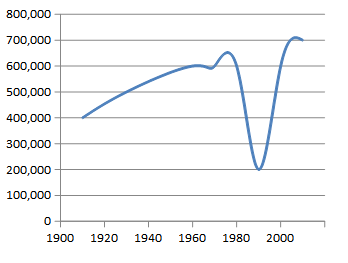 This is the cost per foot of building a skyscraper over time.
My methodology was to take the tallest skyscraper built during each decade, convert its cost into 2013 dollars, and divide it by the number of feet high in the skyscraper.
I did not follow this methodology exactly, because the tallest skyscraper of the 2010s is One World Trade Center, which cost about three times more per foot than any other skyscraper on the list. According to the Wall Street Journal:
One World Trade Center’s construction is vastly more expensive than a traditional office tower, in large part due to security costs associated with building the tallest building in North America on a site that has been the target of two separate terrorist attacks (the site was also bombed in 1993). Once known as the Freedom Tower, the 1,776-foot skyscraper sits atop a heavily reinforced, windowless podium. It also has a thick core of concrete and steel around its elevator shafts. By comparison, other-high profile buildings around the world have been far less expensive. The Port Authority long ago gave up hope that One World Trade would be a profitable investment in the short- or mid-term.
So 1WTC was a crazy outlier because they had to make it terrorist-proof. Rather than have it completely throw off the graph, I replaced it with the next tallest 2010s building I had cost information on, which I think was Four World Trade Center.
I was worried that this was unfairly penalizing newer skyscrapers because the 1000th foot probably costs more to build than the first and newer skyscrapers are taller. But I reran the analysis using the building from every decade closest to 1,000 feet (many were within 10 ft of the target) and got very very similar results (not shown).
The important lesson to take from this graph is that if you’re building a skyscraper, you should definitely hire whoever built Bank of America Plaza, the extreme outlier in 1990 that throws off the otherwise smooth curve with a sudden precipitious dip. They somehow built a very pretty building for one-third of the cost of everyone else in history, so kudos to them.
(but if it falls over the next time there’s a strong breeze, and the investigation finds it was actually made out of Styrofoam, don’t say I didn’t warn you)
The other important lesson is that skyscraper costs have changed little if at all since the age of the Empire State Building. This is important because one of the other decline arguments I get all the time is that building anything is so bureaucratized and expensive and bogged down by building codes and environmental compliance checks that nobody will do it. A friend recently told me – I can’t find the original quote so I can’t make sure I’ve got it right – that Estonia is considering building a tunnel all the way across the Baltic Sea for the same price it costs New York City to build four blocks worth of subway, presumably because NYC is so bureaucratized. I don’t know if that’s true with regard to subways, but if so skyscrapers seem to have escaped the worst of it.
One more point. The most notable thing I turned up researching this post was the extent of the 1930 to 1960s skyscraper dry spell. Ten buildings taller than 700 feet were built in 1933 or before – and zero from 1933 to 1960. Skyscraping didn’t really recover to its 1930 heights (no pun intended) until 1973 or so.
Anyone wanting to talk about a collapse of civilization from 1940 to 1970 would have had a lot of evidence from skyscraper decline. But that was exactly the period when most people today think technological progress was at its height!
I conclude that skyscrapers are not a very a good indicator of anything.