Proposed Biological Explanations For Historical Trends In Crime
Scott Alexander explores biological factors like lead exposure, omega-6 fatty acids, and lithium levels as potential explanations for historical crime rate trends, particularly the possible increase from 1850 to 1980.
My debate on crime rates with Michael Anissimov has been long and meandering, but I think we’re starting to come to something of a consensus. I think (I don’t know if Michael agrees) that the evidence showing long-term decline in crime from the Middle Ages to the Industrial Revolution is pretty good. There’s also irrefutable evidence showing decline in crime from about 1985 to the present. That leaves a gap from about 1850 to 1980.
I previously asserted crime was stable during that period, pointing out similar murder rates between 1850 New York and London and 1980 New York and London, which I trusted more than (say) burglary rates. But Michael replied with a 2002 study showing that improved medical technology has saved a lot of murder victims and bumped their attackers’ crimes down to attempted murder, meaning the apparent murder rate is artificially low. Correct that, and murder could have increased by 5-10x or more from 1850 to 1980, which would not be too different from the rates in lesser crimes like burglary.
I am still not entirely certain about this. We have good records on attempted murders for the past 30 years or so, and they have been going down along with the murder rate. And it is surprising that the improvement in medical technology so perfectly balances out the increase in violence. But it’s a strong study, and so I will provisionally accept that crime including murder could have risen by 5-10x or more from 1850 to 1980.
But we don’t have to accept that the reason is too much democracy or some sort of wacky political point like that.
I have previously come out as a biodeterminist. I suspect most social influences matter less than anyone thinks and most biological influences matter more than anyone thinks. When I say that, everyone always assumes I’m talking about genes, which is too bad because genes are almost the least interesting aspect of biodeterminism.
Anyone reading this blog probably already knows that lead is very strongly suspected of causing crime. A generation after gasoline was leaded, crime increased by a factor of four; a generation after lead was banned from gasoline, crime decreased by a factor of four. Levels of automobile lead emissions were found to explain 90% of the variability in violent crime in America. States that banned lead more quickly saw crime drop more quickly. Neighborhoods with higher lead levels consistently had higher crime rates. Blood lead levels show a marked inverse correlation with IQ, and a marked direct correlation with criminal history, even when plausible confounders are taken into account. And neuroscientists have known for decades that lead damages parts of the brain normally involved in good decision-making and in impulse control.
Lead levels started rising with the Industrial Revolution and, although in decline, are still far higher than in pre-industrial societies. They are highest in cities and especially in the inner city. They have shown correlation with crime, teenage pregnancy, and many mental disorders.
But like I said, everyone reading this blog probably already knows that. So let me talk about something I just learned last week.
Omega-6 fatty acids.
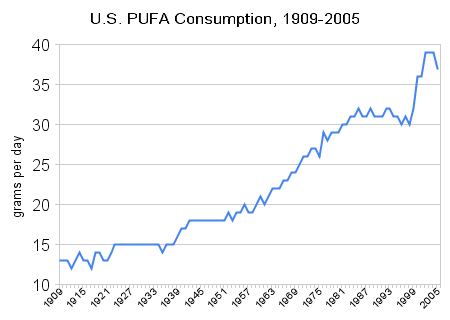
These are some of those “polyunsaturated fatty acid” things you always hear nutrition geeks talking about. They were pretty rare in human diets until the advent of industrial food processing. Here is a mysterious graph for which I have no source:
 Here’s another that comes from Stephan Guyenet:
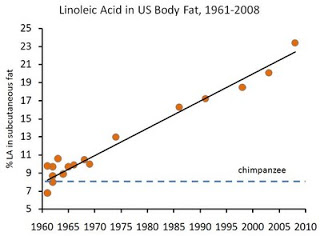 So suffice it to say that our consumption of these fatty acids has increased a lot. This is not surprising – they are most common in things like the vegetable oil that a bunch of preserved foods have.
The other main kind of polyunsaturated fatty acid, omega-3, is mostly found in seafood and is the main component of the infamous “fish oil”. It hasn’t increased very much at all and so most people have an abnormally high omega-6:omega-3 ratio compared to the past and to the environment of evolutionary adaptedness.
Omega-3 and omega-6 fatty acids are important for cell membrane fluidity, especially in the brain where they affect neurotransmitter receptors and other neural functions. If there are the wrong amounts of them, this would very plausibly derange various cognitive functions.
So let’s look at Joseph Hibbeln’s paper Seafood Consumption and Homicide Mortality.
The Guardian describes it like so: “Hibbeln and his colleagues have mapped the growth in consumption of omega-6 fatty acids from seed oils in 38 countries since the 1960s against the rise in murder rates over the same period. In all cases there is an unnerving match. As omega-6 goes up, so do homicides in a linear progression. Industrial societies where omega-3 consumption has remained high and omega-6 low because people eat fish, such as Japan, have low rates of murder and depression.”
From Stephen Guyenet’s excellent post Vegetable Oil and Homicide:
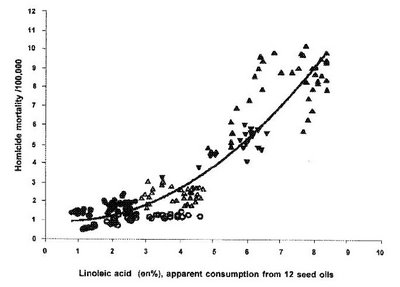 I know, I know, it’s a nice pretty line, but where are the randomized controlled trials?
To which one answers: “in dozens of different countries around the world”. One of the most famous is Gesch et al 2002, which gave dietary supplements including fish oil or placebo to 231 prisoners and found a 25% drop in prison violence (p = 0.03) using intention to treat and 35% (p = .001) using completers. A replication study on 231 Dutch prisoners found almost exactly the same results. Another study of 468 schoolchildren also showed exactly the same results. And…actually, I’m just going to quote from Anatomy of Violence: The Biological Roots of Crime, a book I just found on Google and have suddenly conceived a burning desire to own:
In Australia, six weeks of omega-3 supplementaion reduced externalizing behavior problems in juveniles with bipolar disorder. In Italy, normal adults taking omega-3 for five weeks showed a significant reduction in aggression compared to controls. In Japan, a randomized controlled trial found that ADHD children with oppositional definat disorder showed a 36% reduction in their oppositional behavior after fifteen weeks of omega-3. In Thailand, a randomized double-blind trial of the omega-3 fatty acid DHA resulted in a significant reduction in aggression in adult university workers. In the United States, women with borderline personality disorder randomized into supplementation of the fatty acid EPA for two months showed a significant reduction in aggression. Another American study, this time a four-month randomized double-blind placebo-controlled trial of fatty acid supplementation in fifty children, showed a significant 42.7% reduction in conduct-disorder problems.
We have been burned by omega-3 before. Every couple of weeks someone makes an exciting claim about it, and a few weeks later it is shown to be false or overblown. A big government review of the research on mental health basically dismisses everything done thus far as insufficient to draw meaningful conclusions. But I am hopeful.
I will add one more chemical, one of my favorites. Lithium. Many studies (1, 2, 3 find strong (that last one is p = .00003) links between lithium levels in the water supply and an endpoint crime or suicide. Lithium is a known neuroprotective agent, is probably at least calming, and may be otherwise good for the brain.
I am not certain of this, but I have heard from a few sources that modern water treatment/purification removes most minerals, which would suggest we are getting much less lithium than people in the old days who got their water from a well or whatever.
So we are likely getting more lead, more omega-6 (and relatively less omega-3), and less lithium than people in 1850. If there has been an increase in crime and other undesirable/impulsive behaviors, I think these biological insults are at least as worthy of examination as political changes that have occurred during that time.
