There Are Rules Here
Scott explores why conservative religious movements thrive while liberal ones decline, suggesting that strict rules and commitments strengthen communities, and considers this in the context of atheist religion-substitutes.
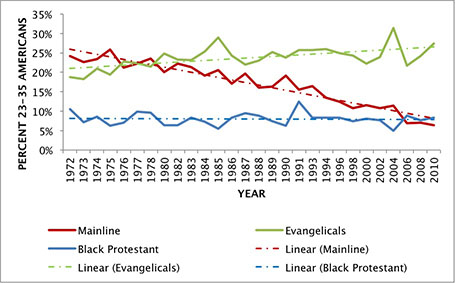
[source: sowhatfaith.com]
Patheos’ Science On Religion points out that liberal Protestantism is dying even as more conservative Protestant movements thrive. This seems counterintuitive in the context of society as a whole becoming less religious and conservative. So what’s going on?
In the early 1990s, a political economist named Laurence Iannaccone claimed that seemingly arbitrary demands and restrictions, like going without electricity (the Amish) or abstaining from caffeine (Mormons), can actually make a group stronger. He was trying to explain religious affiliation from a rational-choice perspective: in a marketplace of religious options, why would some people choose religions that make serious demands on their members, when more easygoing, low-investment churches were – literally – right around the corner? Weren’t the warmer and fuzzier churches destined to win out in fair, free-market competition?
According to Iannaccone, no. He claimed that churches that demanded real sacrifice of their members were automatically stronger, since they had built-in tools to eliminate people with weaker commitments. Think about it: if your church says that you have to tithe 10% of your income, arrive on time each Sunday without fail, and agree to believe seemingly crazy things, you’re only going to stick around if you’re really sure you want to. Those who aren’t totally committed will sneak out the back door before the collection plate even gets passed around.
And when a community only retains the most committed followers, it has a much stronger core than a community with laxer membership requirements. Members receive more valuable benefits, in the form of social support and community, than members of other communities, because the social fabric is composed of people who have demonstrated that they’re totally committed to being there. This muscular social fabric, in turn, attracts more members, who are drawn to the benefits of a strong community – leading to growth for groups with strict membership requirements.
The evolutionary anthropologist William Irons calls demanding rituals and onerous requirements “hard-to-fake symbols of commitment.” If you’re not really committed to the group, you won’t be very enthusiastic about fasting, abstaining from coffee, tithing ten percent, or following through on any of the other many costly requirements that conservative religious communities demand. The result? Only the most committed believers stick around, benefiting from one another’s in-group-oriented generosity, social support, and community.
Since then, Sosis has also demonstrated that religious Israeli kibbutz members are more generous in resource-sharing games than both secular, urban Israelis and secular kibbutzim. He argues that this is, in part, because demanding rituals – such as having to pray three times a day and study Torah many hours a week – serve as a signal of investment in the kibbutz community. The more rituals you participate in, the more invested you feel – and the more willing you are to sacrifice for your fellows.
But if your community doesn’t have any of these costly requirements, then you don’t feel that you have to be really committed in order to belong. The whole group ends up with a weakened, and less committed, membership. Liberal Protestant churches, which have famously lax requirements about praxis, belief, and personal investment, therefore often end up having a lot of half-committed believers in their pews. The parishioners sitting next to them can sense that the social fabric of their church isn’t particularly robust, which deters them from investing further in the collective. It’s a feedback loop. The whole community becomes weaker…and weaker…and weaker.
Even though I’ve quoted like half the blog post, it’s worth looking at just to see the empirical and statistical arguments for their hypothesis.
Not that any of this should come as a surprise. This is the same principle of maintaining separation between in-group and out-group members which has worked so well for so many eons. But making the in-group follow specific rules to prove their dedication does seem particularly effective.
I’ve been thinking about this in the context of atheist religion-substitutes. I went to the Secular Solstice last weekend, and it was held in the New York Society For Ethical Culture building. As usual I avoided social interaction by beelining to the nearest reading material, and in this case that was a plaque detailing the group’s history. The Society for Ethical Culture was founded in 1877 by an ex-rabbi (of course it was an ex-rabbi) and looks pretty much exactly like every atheist religious substitute today. That got me a little depressed. Atheism has been trying the same things for the past one hundred fifty years and, I would argue, largely failing for the past one hundred fifty years. Religion substitutes are hard.
The biggest atheist religion-substitute I know of is Sunday Assembly. I recently came across their “Ten Commandments”:
1. Is a 100 per cent celebration of life. We are born from nothing and go to nothing. Let’s enjoy it together.
2. Has no doctrine. We have no set texts so we can make use of wisdom from all sources.
3. Has no deity. We don’t do supernatural but we also won’t tell you you’re wrong if you do.
4. Is radically inclusive. Everyone is welcome, regardless of their beliefs – this is a place of love that is open and accepting.
5. Is free to attend, not-for-profit and volunteer-run. We ask for donations to cover our costs and support our community work.
6. Has a community mission. Through our Action Heroes (you!) we will be a force for good.
7. Is independent. We do not accept sponsorship or promote outside organisations.
8. Is here to stay. With your involvement, the Sunday Assembly will make the world a better place.
9. We won’t tell you how to live, but will try to help you do it as well as you can.
10. And remember point 1…The Sunday Assembly is a celebration of the one life we know we have.
But it’s tough for me to picture these on big stone tablets. And yeah, I know the reason we don’t have the original tablets is that when Sunday Assembly Moses came down from Mt. Sinai he saw the Sunday Assembly people only celebrating life 95 percent, and waxed wroth, and broke the tablets, and then ordered the Levites to slaughter all the men, women, and children who had participated in this abomination. And then…
…okay, that’s probably not the reason they’re not on tablets. But that’s just the thing. It’s impossible to imagine these commandments inspiring strong emotions in anybody. It’s impossible to imagine people sinning against them in a meaningful way. Most of them aren’t even commandments. They’re more like promises not to command. If you absolutely must compare this pablum to a list of ten points, the proper analogy is less to the Ten Commandments than to the Bill of Rights.
(“God shall make no law respecting an establishment of religion, or prohibiting the free exercise thereof…”)
Atheist religion-substitutes seem unconcerned about or actively hostile to placing rules upon their members. I mean, there are a lot of things that are like “You must be tolerant”. But in practice everybody thinks “intolerant” means “more intolerant than I am, since I am only intolerant of things that are actually bad,” so no one changes their behavior. People say that we have advanced by replacing useless rules like “don’t eat pork” with useful rules like “be tolerant”, but rules against eating pork resulted in decreased pork consumption whereas it’s not clear that rules like “be tolerant” result in anything.
The only secular-ish group I have ever seen which is truly virtuous in this respect is, once again, Giving What We Can. They demand that members give ten percent of their income to charity. To join you must request and sign a paper copy of a form pledging to do this. Every year, the organization asks you to confirm that you are still complying. I don’t know what happens if you aren’t, but I assume it’s too horrible to contemplate. Maybe Peter Singer breaks into your house and kills you for the greater good.
But the point is, here’s an organization that has a very specific rule and demands you follow it. And even though their pledge form looked kind of like a tax return, signing that form was more of a sanctifying and humbling experience than any of the religion-substitutes that try to intentionally generate sanctification. Not because I was at some chapel where someone gave a rousing sermon overusing the word “community”, but because I was binding myself, voluntarily submitting to a higher moral authority.
Someone on my blog a while back used the word “nomic” to refer to a subculture based on following a rule set, sort of like an opt-in religion without beliefs or supernatural elements. I looked to see if it was a real thing but couldn’t find any references other than the card game. But I find the idea interesting. If it contains mechanisms for treating subculture members differently than non-members, it seems like an optional add-on module to government, and a strong candidate for the sort of thing that could develop into a healthy Archipelago.
