To Understand Polarization, Understand Conservativism’s Failures
Scott Alexander examines how Republicans' failure to achieve smaller government despite holding power contributes to increased polarization and the election of more extreme candidates.
Earlier today I talked about one reason for increased polarization on the Democratic side. Now I want to match it with one reason the Republicans have even more of a problem.
Ask anyone what Republicans want, and they’ll say things like “smaller government”, “fewer regulations”, and “less welfare state”.
Meanwhile, here are some graphs showing how they’re doing (disclaimer: graphs like this are very dangerous, and I can only plead that I’ve seen numbers like these from enough sources that I think they have some contact with reality):
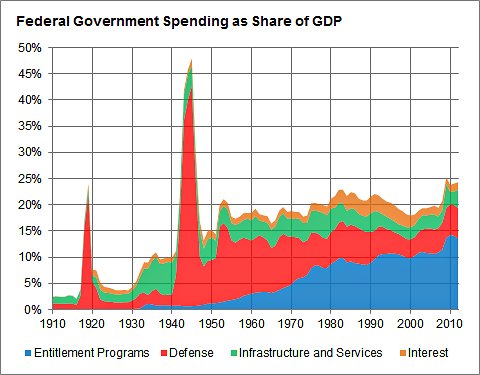
Source: https://fivethirtyeight.blogs.nytimes.com/2013/01/16/what-is-driving-growth-in-government-spending/ 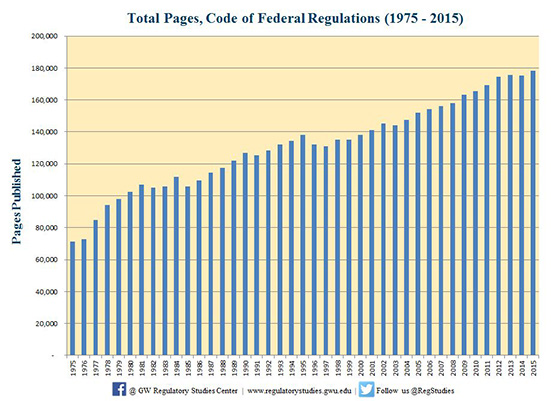
Source: https://regulatorystudies.columbian.gwu.edu/reg-stats
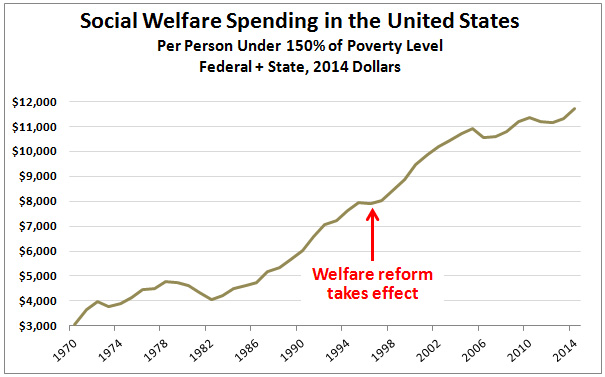
Apparently not so good.
This is true even though this is a historic apex of Republican power. They control the House, the Senate, the Presidency, 66% of state governorships, 68% of relevant state legislatures, and are kind of tied-ish for control of the Supreme Court. They’ve been two of the last four Presidents, and controlled Congress more often than not during that period.
This is really strange. Whatever they wanted, they should have been able to get. Who’s going to stop them? Democrats? Don’t make me laugh.
But in fact, we mostly kept getting bigger government, more regulations, and a bigger welfare state.
My guess is this is a larger-scale version of what I talked about in Considerations On Cost Disease. Various secular trends make everything more expensive and worse, which means government has to spend more money and regulation to get the same level of services, which means government gets bigger. There’s no easy way to stop this except to understand cost disease (which people don’t) or to drastically cut the level of services and admit it will keep getting worse (which politicians are scared of doing on their watch). This is not really the Republicans’ fault.
But Republican voters don’t know that.
All they see is candidates running for office on a platform of small government and less regulation. Then they win, they’ve got a huge majority and a great mandate, and at the end of their term government is as big as always and there are more regulations than ever.
And if maybe you’re not that sophisticated about these kinds of things, you think – these guys betrayed me. They’re Republicans in name only. They were corrupted by Washington. The liberal media finally got them. They’re weak and they caved as soon as the Democrats called them mean names. What we need are some real Republican candidates, ones who are actually willing to stand up to the establishment.
Then you elect the Real Republican Candidates, the Tea Party or whoever, and the same thing happens. Because we’re talking about secular trends and not about anything that Congress can easily affect.
So then the voters think they’re frauds too, and they get defeated in the primaries by other people who are even more Tea Party than they are, people who can say oh yeah, those Tea Party people were fake, but we have the necessary commitment to go to Washington and not cave in immediately.
This will never work. But the superficial logic of “Republicans are powerful enough to get whatever they want, we don’t have small government, therefore the current crop of so-called Republicans didn’t really want small government enough” is convincing. You end up with a signaling spiral where everyone’s in an arms race to show that they’re not actually the craven compromisers that people will inevitably assume them to be. That means hyperpartisanship and refusal to compromise on anything.
I’m talking about this as a Republican problem, but I think it’s a general issue whenever people have unrealistic expectations, ie always. The more our hopes diverge from the possible, the more we’ll reject all existing governments in favor of stronger and stronger forms of extremism.