Too Good To Be True
Scott Alexander critiques psychological studies claiming large effects from simple interventions, suggesting their impressive results may be due to flawed research rather than genuinely effective treatments.
Related To: You Might Get What You Pay For, Do Life Hacks Ever Reach Fixation?
Here are three interesting psychological studies:
1. Kirschenbaum, Malett, and Humphrey gave students a three month course in how to make monthly plans, then followed them up a year later to see how well their grades were doing. The students who made the plans got an average GPA of 3.3 compared to the students who didn’t getting 2.5. They concluded that plan-making skills are academically important, and that benefits persist at least one year after completion of the plan-making course.
2. Aronson asked Stanford students to write a letter to a middle school “pen pal” urging them to adopt a “growth mindset”. Since this was a psych study, it was all lies and there was no pen pal; the study examined whether writing a letter urging growth mindset made the students themselves have a growth mindset and whether this improved grades. Three months later, the students who wrote the letter had higher GPAs.
3. Oaten and Chang helped undergraduates set up an 8-week time management program involving schedules and diaries. The students who participated not only had better time-management, they also studied more, smoked less, drank less alcohol, exercised more, ate a better diet, spent less money, rated their emotions as better, missed fewer appointments, and were less likely to leave dishes in the sink (really!).
So, remember a couple of weeks ago when I wrote about some psychiatrists conducting a really big (n =~ 1000) study about an early intervention program for troubled youth? A program that cost $58,000 per person and lasted ten years?
And remember how, although it was deemed a success, it was deemed a success because it had modest effects on a couple of outcomes, without improving the really big ones like school retention, employment, or incarceration?
So on the one hand, having a short discussion about making monthly plans will boost your GPA almost a whole point a year later. On the other hand, ten years of private tutoring and pretty much every social service known to mankind will do next to nothing.
This suggests a dilemma: either psychological research sucks or everything else sucks.
I mean, you tell your social engineer “Here’s ten thousand dollars and a thousand hours of class time per pupil per year, go teach our kids stuff,” and they try their hardest.
And then some researcher comes along, performs a quick experimental manipulation (the pen pal one probably took 30 minutes and 30 cents) and dramatically improves outcomes over what the social engineer was able to do on her own.
Then one gets the impression that the social engineer was not using their $10,000 and 1K hours very wisely.
And if it were just the one example, then we could say Carol Dweck or Roy Baumeister or whoever is a genius, the rest of us couldn’t have been expected to come up with that, now that we know we’ll reform the system. But these results have been coming in several times a year for decades. If we’ve been adopting all of them, why aren’t people much better in every way? If we haven’t been adopting them, why not?
My money is on the other branch of the dilemma. The reason the $58,000 study got so much less impressive results is that it was run by medical professionals to medical standards, meaning it only showed the effects that were really there. The reason psychology gets such impressive results is…
Okay. I have only skimmed these three studies, so I don’t want to make it sound like I’m definitively crushing them. But here are some worrying things I notice.
The first study results are actually limited to a small subgroup with I think a single-digit number of students per cell.
The second study results work only on a complex statistical manipulation and disappear when you do basic correlation; further, although the manipulation is supposed to work by increasing trait growth mindset, the correlation between trait growth mindset and academic achievement when correlated directly is actually negative across all variables and in some cases significantly so (!)
The third study is really about stress-related behaviors during an examination period, meaning that all they showed was that people who as part of their time management course were forced to study in a carefully scheduled way for a term show less stress-related behavior during the term exam period, which makes more sense as they probably studied more earlier, had less studying left to do during the exam period, had more free time, and were less stressed. This context was dropped by the popular science press, turning the study into proof that good time management in general always produced all of these effects.
And although there are several other studies I have not been able to find equally worrying flaws with, if they report massive long-term gains from seemingly minor interventions, I expect they’re there and I just missed them.
Basically, you remember this chart?
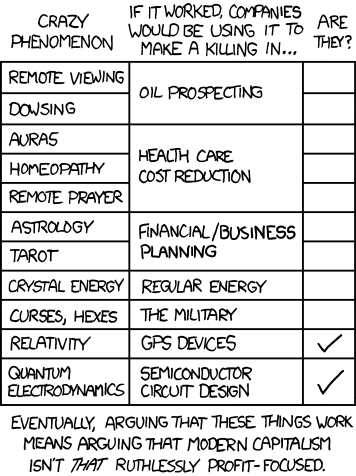
Source: xkcd
In “Crazy Phenomenon”, add “any large and persistent effect from social psychology”. In “If it worked…” add “education, rehab, and mental health”. In “Are They?”, add “not nearly as much as I would expect”.