Were There Dark Ages?
Scott Alexander argues that the Dark Ages in Western Europe (500-1000 AD) did occur, presenting evidence of economic, demographic, and intellectual decline during this period.
[Warning: non-historian arguing about history, which is always dangerous and sometimes awful. I will say in my defense that I’m drawing off the work of plenty of good historians like Bryan Ward-Perkins and Angus Maddison whom I interpret as agreeing with me. And that the people I am disagreeing with are not historians themselves, but other non-historians trying to interpret historians’ work in a popular way that I interpret as wrong. And that as far as I know no historian believes non-historians should never be allowed to talk about history if they try to be careful and cite their sources. Read at your own risk anyway.]
Cracked offers Five Ridiculous Myths You Probably Believe About The Dark Ages; number one is “The Dark Ages Were A Real Thing”:
The Dark Ages were never a thing. The entire concept is complete and utter horseshit cobbled together by a deluded writer. The term “Dark Ages” was first used in the 14th century by Petrarch, an Italian poet with a penchant for Roman nostalgia. Petrarch used it to describe, well, every single thing that had happened since the fall of Rome. He didn’t rain dark judgment over hundreds of years of human achievement because of historical evidence of any kind, by the way; his entire argument was based on the general feeling that life sucked absolute weasel scrotum ever since Rome went belly-up.
Likewise There Were No European Dark Ages, The Myth Of The Dark Ages, The Myth Of The “Dark Ages”, Medieval Europe: The Myth Of The Dark Ages, Busting The “Dark Ages” Myth, and of course smug Tumblr posts.
This isn’t coming out of nowhere. Many people’s idea of medieval times is exaggerated. Not every scientist was burned at the stake, not everyone thought the world was flat and surrounded by space dragons, and the High Middle Ages were notable for impressive levels of material progress which in some cases outpaced the Classical World and which set the stage for the upcoming Renaissance (the continuity thesis). Granted.
But I worry that as usual, this corrective to an overblown narrative of darkness has itself been overblown. People are now talking about how you’re a gullible rube if you still believe in a so-called “Dark Age”, and how all the real intellectuals know that this was a time of flourishing civilization every bit as good as the Romans or the Renaissance.
Bulls**t. The period from about 500 to about 1000 in Christian Western Europe was marked by profound economic and intellectual decline and stagnation relative to the periods that came before and after it. This is incompatible with the “no such thing as the Dark Ages” claim except by a bunch of tortured logic, isolated demands for rigor, and historical ignorance.
To go through the arguments one by one:
1. The “Dark Ages” were only dark in Europe. And not even all of Europe – not in the Eastern Roman Empire, not in al-Andalus…
I wonder if these people interrupt anyone who talks about the Warring States period with “actually, there were only warring states in China. Many other areas during this period had no warring states at all! Guess you fell victim to the Myth Of The Warring States Period.”
What about the Bronze Age? There wasn’t any bronze in Australia. The Hellenistic period? Huge swathes of the Earth’s land area remained un-Hellenized. The Time of Troubles? Actually, outside of Russia there were no more troubles than usual. The Era of Good Feelings? Maybe there were a bunch of bad feelings not in the US.
Every other historical age name is instantly understood by everyone to refer to both a time and a place. The only time anyone ever gives anybody else grief over this is when they talk about the Dark Ages. This is an isolated demand for rigor. And if this is really your true objection, let’s just agree to call it the Western European Dark Ages, as long as we can also agree it existed and was bad.
2. What about all the great stuff in the Dark Ages? Thomas Aquinas! Gothic cathedrals! Dante! Troubadours! The Song of Roland! Roger Bacon! Musical notation! Surely no period that produced all that can be called ‘dark’!
All of those are from after the period 500 – 1000 AD.
Suppose someone tells you that the middle of America contains the Great Plains, a very flat region. But you know that actually there are lots of tall mountains, like the Rockies. Have you debunked the so-called Great Plains narrative and proven that its believers are credulous morons? Or have you just missed that there’s a natural and well-delineated area suitable to be called “Great Plains” that doesn’t include your supposed counterexamples?
The period after 1000 AD did indeed have lots of great accomplishments. That’s because Europe at that time had 500 years to recover from the civilizational collapse that demolished its economic and intellectual capacity – a collapse whose immediate aftermath we call “the Dark Ages”. I agree there are some concepts of the Dark Ages that mistakenly include some of the time after the recovery, and that Petrarch’s original version commits this error. But I think that there’s also a five hundred year period – more than long enough to count as a real historical age – that absolutely fits the bill.
3. The term “Dark Ages” was invented by Petrarch – who wasn’t even a real historian – based only on his personal opinion.
The term “World War I” was invented by Ernst Haeckel, who was not a historian, based on his personal opinion that it seemed to be a war, and involve the whole world, and be the first one to do so.
The term “Cold War” was invented by George Orwell, who was not a historian, based only on his personal opinion that it seemed conflict-y but without much actual fighting.
Very few of the historical terms we use were invented by professional historians, and they are all necessarily based on that person’s opinion that it correctly describes the thing being described. I await people admitting that there was no Cold War, because who is George Orwell to think he can just name an era based on what he feels it was like?
This is another isolated demand for rigor. Historical periods get their names from random individuals reflecting on them; the names catch on if people agree that they fit.
4. The term “Dark Ages” was originally just supposed to mean that there aren’t many sources describing it, not that the era was bad
Nope, wrong. Some people have used it this way, but this is neither how the term’s original inventors intended it, nor how a majority of modern people (historian or otherwise) think of it.
As mentioned above, the idea of a Dark Age was first developed by the late medieval/early Renaissance thinker Petrarch. As per Wikipedia:
The idea of a Dark Age originated with the Tuscan scholar Petrarch in the 1330s. Writing of the past, he said: “Amidst the errors there shone forth men of genius; no less keen were their eyes, although they were surrounded by darkness and dense gloom”. Christian writers, including Petrarch himself, had long used traditional metaphors of ‘light versus darkness’ to describe ‘good versus evil’. Petrarch was the first to give the metaphor secular meaning by reversing its application. He now saw Classical Antiquity, so long considered a ‘dark’ age for its lack of Christianity, in the ‘light’ of its cultural achievements, while Petrarch’s own time, allegedly lacking such cultural achievements, was seen as the age of darkness. […]
Petrarch wrote that history had two periods: the classic period of Greeks and Romans, followed by a time of darkness in which he saw himself living. In around 1343, in the conclusion of his epic Africa, he wrote: “My fate is to live among varied and confusing storms. But for you perhaps, if as I hope and wish you will live long after me, there will follow a better age. This sleep of forgetfulness will not last for ever. When the darkness has been dispersed, our descendants can come again in the former pure radiance.”
Petrarch can’t just be referring to an absence of good historical sources – he’s talking about his own era!
Part of the evidence for the “absence of sources” claim is that the first use of the exact term “Dark Age” may come from by the 16th-century writer Caesar Baronius, who had a more specific time in mind, 888 – 1046. He wrote:
The new age (saeculum) which was beginning, for its harshness and barrenness of good could well be called iron, for its baseness and abounding evil leaden, and moreover for its lack of writers dark.
But Baronius was writing well after Petrarch, his “Dark Age” was very different from the one we know today (only used to refer to a 150-year period in the Church), and in the same sentence that he mentioned dark = few writers, he also calls it “harsh”, “barren of good”, “base”, and full of “abounding evil”. This is not exactly a resounding victory for people claiming that the Dark Age had nothing wrong with it except slightly fewer records.
5a. It’s historical malpractice to call something “The Dark Ages”. The job of historians is to record, not to judge.
So I assume you also raise a fuss whenever someone talks about Alexander the Great? The Golden Age of Athens? The Five Good Emperors? The Enlightenment? Ivan the Terrible? The Belle Époque? I S O L A T E D . D E M A N D . F O R . R I G O R.
I agree there’s some level on which all of these are a sort of boundary-crossing in the ethics of historiography. And I agree that maybe very responsible historians want to avoid this and come up with more neutral names for very official work – I’ve seen some people talk about “Alexander III of Macedon”. Well, okay. The “Periclean Age Of Athens”. Fine. The “Time There Were Five Whole Emperors In A Row, None Of Whom Were Sadistic, Perverted, Or Insane, Which As Responsible Historians We Cannot Officially Call “Good”, But Which By The Standards Of Ancient Rome Is Seriously Super Impressive”. Whatever.
But if you only challenge the term “Dark Ages”, I feel like you’re doing the opposite of this suspension-of-judgment. If you say “The Dark Ages weren’t really dark!” you’re putting yourself in a position to judge historical eras, saying that maybe some of them were dark and others weren’t, but this particular one wasn’t. In this case you’re not responsibly abdicating historical judgment. You’re making a historical judgment, and getting it wrong.
5b. The Dark Ages were only “dark” if you like big centralized states with powerful economies. There were lots of ways they might have been good. For example, ancient Rome had slavery, and most Dark Age societies didn’t. That seems pretty light-side to me!
And Alexander the Great was only “great” if you like killing a lot of people and conquering their lands.
Look, a lot of history sucked, and moral judgments are hard. Jared Diamond thinks hunter-gatherers were freer and happier than anyone since. Maybe the real Golden Age of Athens was in 40,000 BC, when Neanderthals on the rocky plain that would one day become Athens hunted mammoths in carefree abandon, loving life and being at one with nature and the changing seasons. Maybe the title “Alexander the Great” should really go to Alexander IV of Macedon, who was killed at age 14 and so never conquered, murdered, or oppressed anyone – truly an outstanding achievement matched by approximately zero other kings of the era.
In order to avoid this kind of speculation, I think of history as being along at least two axes: goodness and impressiveness. Alexander may or may not have been a good person, but he was certainly an impressive one. Periclean Athens might not have been the most virtuous city, but it was certainly one with lasting accomplishments. Since it is so hard to judge the goodness or badness of historical figures, most of our claims of greatness are claims about impressiveness. And compared to the periods before or after, Dark Ages Europe was unimpressive.
I’m probably an overly literal person, but whenever I think about dark ages, I think of the modern (and anachronistic for the period in question) association between light, population density, and economic activity:
 The Dark Ages in Europe were a time when things would have been more towards the North Korean end of that picture. In fact, you probably could have taken a similar picture at the time, with an east/west instead of north/south axis. From The Muslims of Andalusia:
[In medieval times], Europe was darkened at sunset, Al-Andalus shone with public lamps; Europe was dirty, Al-Andalus built a thousand baths; Europe lay in mud, Al-Andalus’ streets were paved.
I get that this is just a pun I’m taking too seriously. If you don’t like the term Dark Ages, I am happy to use the term “Unimpressive Ages”, “Disappointing Ages”, or “Pathetic Ages”. My point is that there is some axis, not the same as morality but involving economic and intellectual activity, in which the period 500 – 1000 AD was uniquely sucky.
6. Okay, forget disputes about the meanings of words or how to do history. On the object level, using normal meanings of the word “bad”, the Dark Ages were not that bad.
Wrong.
It’s hard to prove this is wrong, because there weren’t great statistics back then to compare Classical, Dark Age, and High Medieval societies on. As far as I know only two groups have dared try to estimate Western European GDP for these eras. Again from Wikipedia:
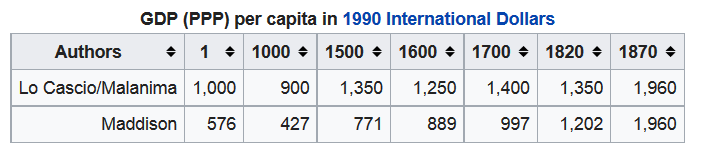 Both groups find that GDP declined from 1 AD (classical era) to 1000 AD (late Dark Age / medieval era). 1 was not the height of Rome, and 1000 was well into recovery from the Dark Ages, so we expect the difference between the Roman peak and the Dark Age nadir to be even more profound than this. But even these attenuated numbers tell the story of an entire millennium when human economic progress across an entire continent went backwards.
Although these numbers are inherently sketchy, the few real pieces of evidence we have seem to back them up. Arctic ice cores preserve a record of how much lead pollution was in the air, probably linked to human lead-mining activities. This allows us a pretty good look at how much lead-mining various European civilizations were doing:
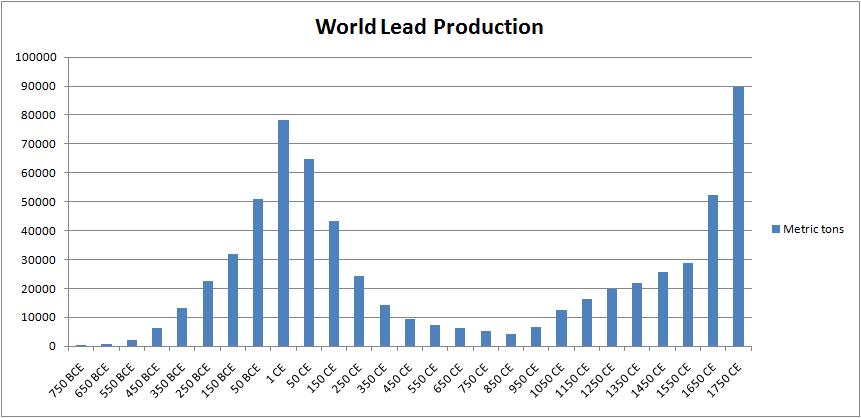 And granted, the Romans were a little more obsessed with lead than could possibly have been healthy. But these data are supported by reconstructions of silver mining, copper mining, and iron mining. All of these are easily quantifiable activities that reinforce Maddison, Lo Cascio, and Malanima’s picture of economic decline between the fall of Rome and 1000.
We see a similar decline in population. The Atlas of World Population History thinks that continental Europe had a population of 36 million people at its peak in 200 AD, falling to 26 million at a nadir in 600 AD, and gradually recovering back to 36 million or so around 1000 AD. Various other estimates for the population of the Roman Empire and medieval Europe broadly support this picture (though remember that the Roman Empire didn’t occupy the same space as medieval Europe and so comparisons have to be more complicated than just comparing two sets of numbers). If this is true, the Classical to Dark Age transition caused a population decrease of about 10 million, or 30% of the population (though some of this happened in Late Antiquity). These are the sorts of numbers usually only associated with the worst plagues and genocides.
Classical Rome had a population of between 500,000 and a million. Even classical Athens had a population of over 100,000. By mid Dark Ages, there was no city in Christian Western Europe larger than about 50,000 people. The infrastructure for maintaining large urban populations had fallen apart.
And true, a lot of this is sparse and reconstructed. My usual go-to for economic history questions, Tumblr user xhxhxhx, was able to get me a bunch of excellent graphs comparing classical Rome to the High Middle Ages, classical Rome to the Golden Age of Islam, High Middle Ages to the Golden Age of Islam, etc. When I complained that none of them compared anything to the Dark Ages which was the whole point of my question, he answered that the data were worse quality, because “civilization collapsed, so fewer people were tracking wages and prices”.
So yes, I agree that there’s only a limited amount of data proving that the Dark Ages sucked. That’s because civilization collapsed, so people weren’t keeping great records. I don’t think this is a strong argument against the Dark Ages being bad.
7. But aside from the economy, there was still lots of great culture and intellectual advancements
If I ask Google for a list of the hundred greatest philosophers of all time, it brings up http://www.listal.com/list/100-greatest-philosophers. It doesn’t seem especially professional or official, but it’s a decent-looking list and because it’s the top Google result I can prove I wasn’t biased by selecting it.
Here’s a graph of number of European philosophers on the list per 500 year period:
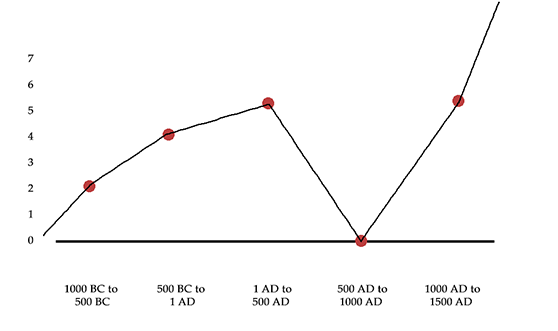 The giant pit from 500 to 1000 where there was not a single European philosopher worthy of inclusion on the list corresponds to the traditional concept of a Dark Age without very impressive intellectual output.
Harold Bloom has a list of great books in ‘the Western Canon’. Once again separating them into 500 year intervals and graphing:
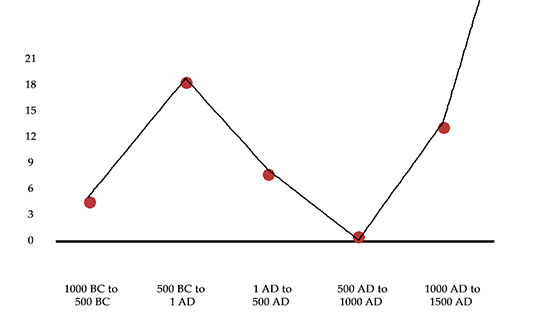 Again, we see a giant pit from 500 to 1000 AD (though this time it is not completely empty – Beowulf is the sole qualifying work).
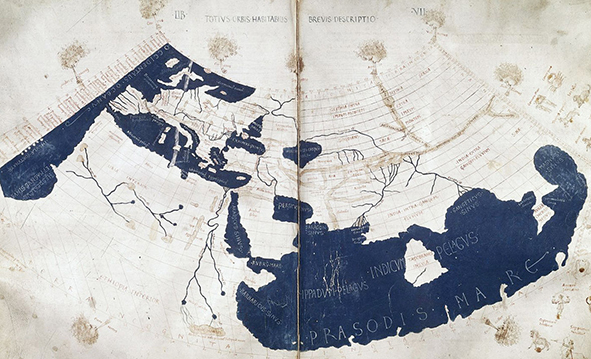
Here’s a map (admittedly a later reproduction, since the originals are lost) by the greatest classical geographer Ptolemy:
 And here’s an 8th-century map by Beatus of Liebana:
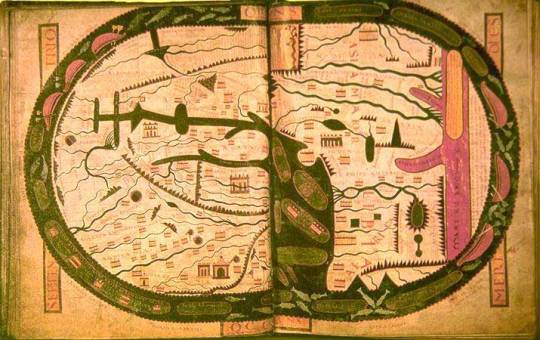 I’m not cheating here by taking the worst-quality Dark Age map (that would be one of these). If you can find a better Christian Western European map from 500 – 1000, tell me and I’ll replace this one with it. But as far as I can tell, this really was state-of-the-art.
The decreased quality of intellectual output seems to have been matched by a decline in quantity. I can’t find any great sources quantifying the number of books written in the classical world, but there are a few semi-reliable numbers about library size. The Ulpian Library of Emperor Trajan seemed to have tens of thousands of scrolls, and it was only one of as many as 28 libraries in Rome. Estimates of the number of volumes in the Library of Alexandria range from 40,000 to 400,000. Archaeologists studying the Villa of the Papyri in Herculaneum, a private residence in a medium sized town, have found a private library of almost 2,000 scrolls.
Medieval libraries seem to be much smaller. From Oxford Bibliographies:
It follows from this that the wealth and fame of any institution that required books would inevitably affect the size of its library, and, given the fact that books were always expensive, medieval libraries were, from a modern point of view, not large. The largest Anglo-Saxon libraries may have contained about two hundred books. In 1331 the collection at Christ Church, Canterbury, numbered 1,850, which may well have been the biggest collection in England and Wales. In 1289 the library of the university of Paris contained 1,017 volumes which, by 1338, had increased to 1,722—an increase of about 70 percent.
This might not be entirely fair – Roman scrolls were smaller than medieval books, so a work that took up one medieval book might have occupied several Roman scrolls, inflating the size of Roman libraries. But there still seems to be a pretty big gap between the tens to hundreds of thousands of volumes in classical libraries and the few hundred to few thousand in libraries all the way up until the High Middle Ages.
[EDIT: This might not be true – see here]
In a lot of cases, the people of the Dark Ages (and the High Middle Ages afterwards) themselves acknowledged this. The Roman author Vitruvius was the gold standard for architecture up to the Renaissance, and Brunelleschi became famous for creating a dome that surpassed the Roman domes made 1300 years earlier. Roman doctors like Galen and Celsus were semi-worshipped by medieval doctors; when the 16th century (!) doctor Theophrastus von Hohenheim became known as “Paracelsus” (meaning “equal to or better than Celsus”), it was taken as an outrageous boast of ability despite his having the benefit of 1500 extra years of medical science.
8. The Dark Ages weren’t all bad. There were still a few important accomplishments. Therefore, they cannot truly be called “dark”.
The night includes several bright things, such as the moon, the stars, and streetlights. But it’s still fair to call the night “dark”. You don’t have to prove that 100% of something fits a description at 100% of times to use the description.
One of the links from the top of the post says:
If the “dark ages” were so unproductive and backwards, how does one explain the proliferation of inventions and developments during this time period. A simple listing of inventions, discoveries and developments demonstrates the the Middle Ages were anything but dark.
…then goes on to give various inventions, the only ones of which from 500 AD – 1000 AD are “collar and harness for horses and oxen”, “iron horseshoes”, and “the swivel axle”.
Look. I am sure that horseshoes were a revolutionary advance in equine footwear. But the ancient Greeks gave us geometry, history, cartography, the screw, the water wheel, gears, cranes, lighthouses, and fricking analog computers. If you want to stake your claim to be more than a miserable failure as a historical age, you are going to have to do better than horseshoes.
(also, maybe the Romans invented iron horseshoes first anyway?)
9. I still think the term “Dark Ages” could possibly lead to misconceptions.
Yeah.
I like this debate because it’s so pointless, but also reveals some of the basic structure of these kinds of arguments. Like most language questions, we act like we’re debating facts, when in fact we’re debating fuzzy category boundaries that are underdetermined by facts. See previous work on is Pluto a planet?, is obesity a disease?, are transgender people their chosen gender?, etc.
There’s no strict criteria for what makes something a Dark Age or whether the term should be used at all. We’re left to wonder whether using it conveys more useful information than it does misinformation.
There are many interpretations of “The Dark Ages happened” that might be wrong, like:
1. There was darkness everywhere, not just in Europe
2. There was darkness in Europe all the way until the Renaissance, and the High Middle Ages sucked
3. Every single person in this era was an illiterate superstitious peasant covered in filth, and not one good thing ever happened
4. Greco-Roman civilization was better in every way than the period that followed it, including morally
On the other hand, there are many interpretations of “the Dark Ages didn’t happen” that might also be wrong, like:
1. The fall of Rome was not associated with a decline in wealth and population.
2. The fall of Rome was not associated with a loss of capacity for things like urban living or large-scale infrastructure
3. The intellectual output of the period was exactly as high in quality and quantity as the intellectual outputs of other periods
4. Civilization always proceeds in a nice Whig History straight upward line with no risk of catastrophic collapses
Surely people can get caught in different bravery debates here. If they live in a bubble where everyone falls prey to the first set of misconceptions, it can be tempting to try to rectify that by saying the Dark Ages never happened. If they (like me) live in a bubble where everyone seems to fall prey to the second, it’s tempting to…well, write a post like this one.
And then there are political implications that will work for the benefit of one group or another. If there was a Dark Age:
1. …maybe it casts Catholicism or Christianity in a bad light, since this was also the age when they rose to be a major power
2. …maybe it points to a broader conflict between science and religion, since this was a very religious age in ways
3. …maybe it suggests that civilization is more fragile than we think, and since it collapsed once it can collapse again
4. …maybe it makes Greece and Rome look extra good, since they were again of the curve in terms of civilizational greatness
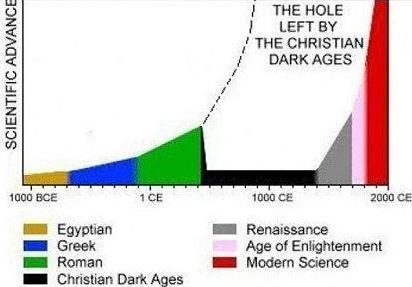
Pictured: one way to politicize this discussion; not recommended
And finally, there are signaling aspects. Since everybody hears a vague Monty-Python-And-The-Holy-Grail-esque conception of the Dark Ages (“He must be a king…he doesn’t have shit all over him”), but only people who take a history class in college hear about the Continuity Thesis, loudly proclaiming that there was never a Dark Age is one way to signal education and intellectualism (I dare you to tell me that isn’t what’s going on in this Tumblr post). On the other hand, if you’re one of those people who rails against “postmodernism” and “cultural relativity” and wants a reputation for “calling a spade a spade”, it might be gratifying to get to say that actually, that one historical era that seems kind of sucky (but fancy college professors keep insisting otherwise) does, in fact, suck.
I think I know why this question bothers me so much, and it’s because I hate when faux-intellectuals give stupid black-and-white narratives that are the tiniest sliver more sophisticated than the stupid black-and-white narratives that the general population believes, then demand to be celebrated for their genius and have everyone who disagrees with them shunned as gullible science-denying fools.
(I know a lot of people accuse me and this blog of doing exactly this, and I’m sorry. All I can say is that I’m at the odd-numbered levels of some signaling game you’re at the even-numbered levels of, and it sucks for all of us.)
For other people, maybe it’s something different. Maybe a Chinese historian doesn’t like the term “Dark Ages” because she sees too many people think Europe-specific terms apply to the whole world, and for her the tiny number of people who do this are so annoying that it overwhelms any possible advantage the idea might have. Maybe a Muslim likes it because it helps contrast the poverty of Christendom with the glory of al-Andalus, and shake the myth that Europe has always been on top. I don’t know.
10. So you’re saying both positions are true and everyone is equally right?
No. Although I sympathize with the feelings behind both positions, I say the Dark Ages happened. I think the best evidence we have suggests the fall of Rome (and the period just before) was associated with several centuries of economic and demographic decline, only reaching back to their classical level around 1000 AD. I think it was also associated with a broader intellectual and infrastructure decline, which in some specific ways and some specific fields didn’t reach back up to its Roman level until the Renaissance. I think that common sense – the sense you get when you treat the question of the Dark Age the same as any other question, and try to avoid isolated demands for rigor – says that qualifies for the phrase “Dark Age”.
[see also: Highlights From The Comments On Dark Ages]
