Chip Off The Old Block
Scott reflects on having young children and how they've inherited specific traits, preferences, and quirks from both him and his wife in surprisingly precise ways.
I.
Having kids has given me new appreciation for old poetry. The first time I read Song of Hiawatha, I skimmed over the part in Book 3 where Hiawatha first meets his father Mudjekeewis:
Filled with joy was Mudjekeewis
When he looked on Hiawatha,
Saw his youth rise up before him
In the face of Hiawatha,
Saw the beauty of Wenonah
From the grave rise up before him."Welcome!" said he, "Hiawatha,
To the kingdom of the West-Wind!
Long have I been waiting for you!
Youth is lovely, age is lonely,
Youth is fiery, age is frosty;
You bring back the days departed,
You bring back my youth of passion."
But this passage communicates a secret of parenthood, something I’ve never seen discussed anywhere else. By the time you’re a parent, you’re on your way to being old, ugly, tired, and cynical. I certainly was. This felt like a brute fact about the world: we all know time only moves one direction. Then I had kids, and got confronted with people who were basically me, but young and beautiful and happy. That part of them which wasn’t me was the other person I love best in the world, also transmuted into a young and beautiful and happy form. This was a completely unexpected delight which nothing besides this one fragment of poetry had ever tried to prepare me for.
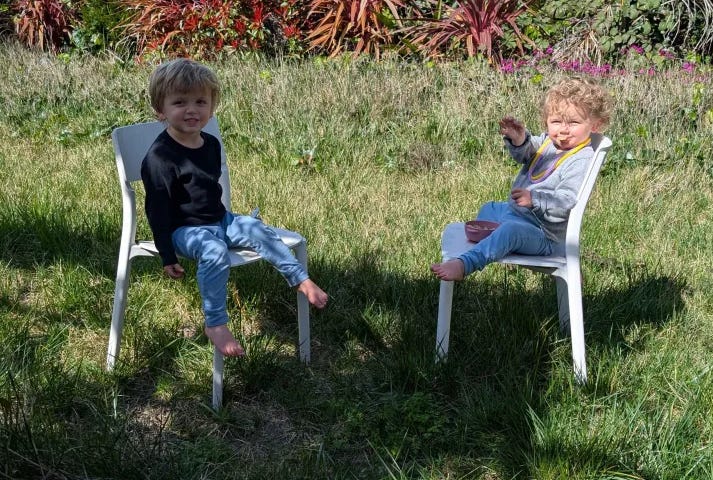
I might never have noticed this if I’d only had girls. I love my daughter, but I’ve never been a little girl; it doesn’t bring anything back for me. It’s like Mudjekeewis says - you’ve got to have a son to see your youth rise up before you.
Sometimes this is fire and passion and beauty and so on. But also, I was a bit of a weird child. I understand lots of children love trains. But probably not many get an article in the local newspaper about how train-obsessed they are. My mother still has it, framed in the guest bedroom, to embarrass me whenever I visit. Beside it are little pictures of me in my train engineer’s cap and train t-shirt and train pants holding my train book in one hand and railroad caboose lantern in the other. Every so often I will find I still remember some weird fact about the maximum speeds of various 1980s train designs, memorized before I could consistently use the potty.
Surely there can’t be a gene for train obsession. And I certainly didn’t pass it down on purpose. But my son is obsessed with trains. He describes the bars of his crib as a choo choo because, if you turn your head sideways, they look like a railroad track. He describes the wall around the neighbor’s yard as a choo choo because, if you’re standing on top of it, the pattern of bricks looks like a railroad track. He describes the armrest of his rocking chair as a choo choo, because . . . I still don’t understand this one. He insists on reading Blue Train, Green Train again and again. His favorite toy is a wooden railroad set. His favorite place to go is the train station.
(I asked some of my friends with male children how into trains they seemed, and they all answered “not particularly”. Then I mentioned this to an uncle, who informed me that my cousin is a top model train reseller on eBay. Maybe it is genetic.)
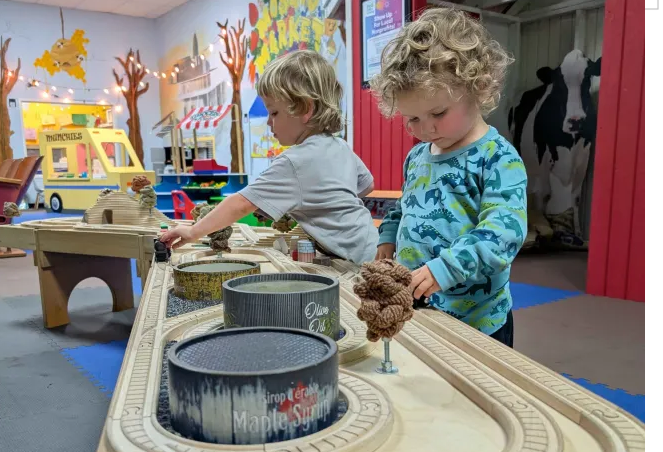
When I was young, my OCD was much more disabling. The worst was my closet door. I had to close it seven times every night before I was satisfied. It’s been decades since I was that bad; my children can’t know anything about it. But lately, my son has taken to obsessively closing the door to the cabinet in his room at night. One evening, after he must have shut it ten or twenty times, I almost yelled at him: “COME ON! YOU KNOW YOU ONLY HAVE TO DO IT SEVEN TIMES!” But maybe he doesn’t know; maybe the genetic transmission isn’t that high-fidelity.
The good news is that all of this gives me a new ally in all my little quarrels with my wife. I’m hypersensitive to being startled when I’m drifting off to sleep; I used to grumble whenever my wife made a tiny amount of noise, and she would grumble about my grumbling, and finally we learned to compromise at some level that worked for both of us. But now it’s great! Whenever my wife makes a tiny amount of noise around bedtime, my son will wake up and scream, and he literally doesn’t know the meaning of the word “compromise”. As a result, everything is much quieter. Except for the screaming.
Or: I get irrationally annoyed if someone leaves a room without closing the door, but it’s fine, it would be weird to bother people about it, it would seem too confrontational to conspicuously get up and close the door, so I just take a deep breath and forget about it. Except that now I don’t have to, because my son immediately gets up from whatever he’s playing with and closes the door for me.
The bad news is that my daughter has inherited all of my wife’s traits, so now it’s 2-2. My room and my son’s room are spotless - my son refuses to sleep if there’s even one toy on the floor. My wife’s and daughter’s room look like a trailer park after a tornado. To my son and my dismay, they both hum wherever they go.
(also, my wife is always grumpy in the morning until she drinks her tea. My daughter is grumpy in the morning until she pretends to pour liquid from her little toy teapot into her little toy teacup and then pretends to drink it. Maybe it’s not fully genetic.)
Other times, our traits combine in unpredictable ways. I don’t like bugs - they’re gross and creepy and sometimes they bite or sting you. But my wife has an entomology degree and a lifelong passion for the subject. This doesn’t exactly look like loving bugs - it’s more that she has a map in her head of all their little alliances, and takes sides in their tiny pointless feuds: “No, you can’t kill that beetle, it eats a bug which kills butterflies, which means it’s one of the good ones!” Still, compared to any normal person, “she loves bugs” is a fair low-level description. On our honeymoon in South America, a tour guide pointed out some especially horrible millipede, and my wife reached down to pick it up, and the tour guide freaked out and eventually apologized for not mentioning that you shouldn’t do that, with his excuse being that nobody before her had ever tried.
My son combines these traits like this: he will scour our house for bugs. He is very good at it. When he finds one, he will kneel down, put his face right up to it, stare intently, then say, in a monotone, “My no like it. Daddy bring outside.” I will explain to him that it’s just a gnat or an ant or something and I don’t care, but he’ll continue to obsess and say “My no like it.” Finally, I’ll put it on a piece of paper or in the bug tube or something and bring it outside. He will follow and, once I set it outside, he’ll kneel next to it, continuing to stare at it, watching to see where it goes. If I ask him what he’s thinking, he’ll just repeat “My no like it.”
II.
Along with inheriting our preferences, our children have inherited our skills.
I’ve seen other two-year-olds draw. Draw isn’t even the right word - they scribble random loops all over the paper. My son does this too. My daughter doesn’t. She draws perfect little circles. Sometimes she’ll say she’s drawing a person, and it will actually look like a little person, with eyes and a nose.
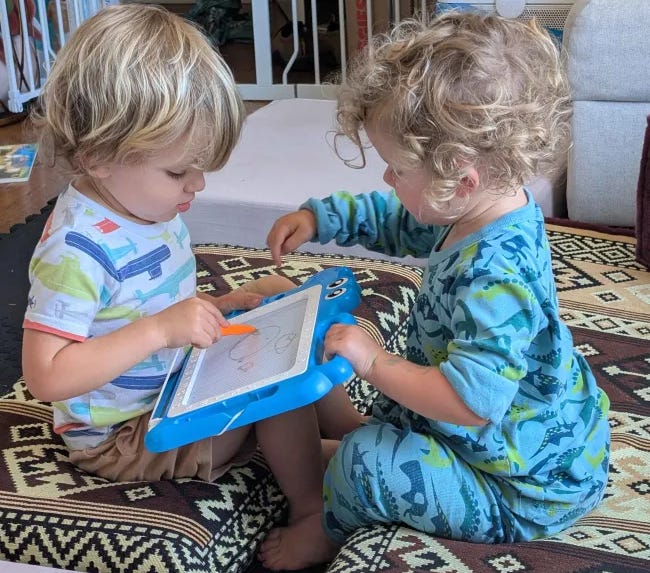
I asked my wife how we got a child who is good at art. She sheepishly admitted that her mother had been a child prodigy at drawing. Art schools had competed to have her. She’d given up on it because it felt too easy (???) and become a math professor instead. I had never heard this story before - I just knew her mother taught math - but here was our daughter, drawing surprisingly person-like people.
As for my son, we’ll have to see. He already narrates all of his thoughts. Since he’s only two, his thoughts are pretty rigid and stereotyped. Every evening as he goes to bed, he will say “My go to sleep this way!” because as a child he used to sleep facing the door, and now he sleeps facing away from the door, and even though it’s been months since the change, he still finds it worthy of remark. Every morning, when he wakes up, he says “Oh, it day!” because it is daytime. Then he says “My upstairs time!” because he is excited about going upstairs. Then he reaches the top of the stairs, looks out the kitchen window, and says “Oh, it day here too!” because it’s also day upstairs. I’m not claiming any of this is smart or interesting. I’m claiming he constantly says whatever he’s thinking about to anyone around him, no matter how irrelevant and repetitive, and that this is of course the first sign of a future great blogger.
(my daughter is much more reserved, which is one reason she gets short shrift in all these parenting posts; if you’re reading this years from now, sorry Lyra)
My son has another characteristic of great writers, which is that he loves judging things. His two favorite judgments are “it very funny!” and “that no actually nice”, which he deploys in mostly inexplicable ways:
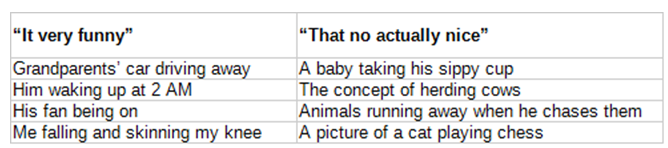
And yes, he does say “that no actually nice”. I’ve always been sensitive to overusing the word “actually” in my writing. But I must overuse it in my speech too, because he picked it up before being able to consistently use the word “is”. As a result, he sounds like one of those Far Side cavemen, combining big words with comically inappropriate grammar.

This is another skill of both our children, maybe all children: they’re very linguistically productive. Something about having lots to say, plus minimal command of the language, lets them coin extremely meme-able phrases. My wife and I have started communicating in child-phrase-memes. If she teases me, she’ll say “It very funny!” and I’ll answer “It no actually nice!” Then she might respond with “It yes actually nice”, which is how our kids argue.
Many years from now, my children will hopefully have grown into great writers and intellectuals - and at the same time, my wife and I will have degenerated into speaking entirely like toddlers.
III.
I’ve written about transgender issues, racial IQ differences, and the Gaza war. Compared to these, writing about my kids should be a walk in the park. If only. The online parenting community is large, opinionated, and vicious.
(I use the term “parenting community” loosely; many of these people have no children of their own, just strong opinions on how other people should raise theirs).
In particular, if I ever admit that I’m disciplining my children less than maximally hard, or letting them get away with anything, or taking their preferences into account at all, a horde of I-don’t-have-children-myself-buts will show up to tell me that I’m a terrible dad and my kids will grow up spoiled/weak/soft and probably end up on welfare or in prison or writing for the New York Times. Earlier this year I mentioned that my son uses various stalling tactics to delay his bedtime, and I briefly became the Twitter Main Character and 2020s Face Of Bad Parenting for not cracking down on him harder.
So I owe you an update: my son doesn’t stall his bedtime anymore. This didn’t require any change on my part. He just sort of grew out of it, as I hoped and predicted.
How can this be, when (in the words of some commenters) I was ‘paying the Danegeld’ by agreeing to his various inane requests? Sticking to medieval analogies, the Danegeld was an anomalous institution, a product of non-iterated games by new civilizations encountering each other for the first time. It contrasted with the foundational background of the medieval world - feudalism, a bundle of specific culturally-evolved rights and duties, stable across years and centuries. James Scott memorably describes its rich complexity, starting with the seemingly simple rule that serfs were supposed to give their lords a certain number of baskets of grain per harvest:
Virtually everywhere in early modern Europe were endless micropolitics about how baskets might be adjusted through wear, bulging, tricks of weaving, moisture, the thickness of the rim, and so on. In some areas the local standards for the bushel and other units of measurement were kept in metallic form and placed in the care of a trusted official or else literally carved into the stone of a church or the town hall. Nor did it end there. How the grain was to be poured (from shoulder height, which packed it somewhat, or from waist height?), how damp it could be, whether the container could be shaken down, and finally, if and how it was to be leveled off when full were subjects of long and bitter controversy.
Living with small children occasionally resembles a sudden Viking invasion, but it more often feels like this kind of byzantine code of feudal rights and duties.
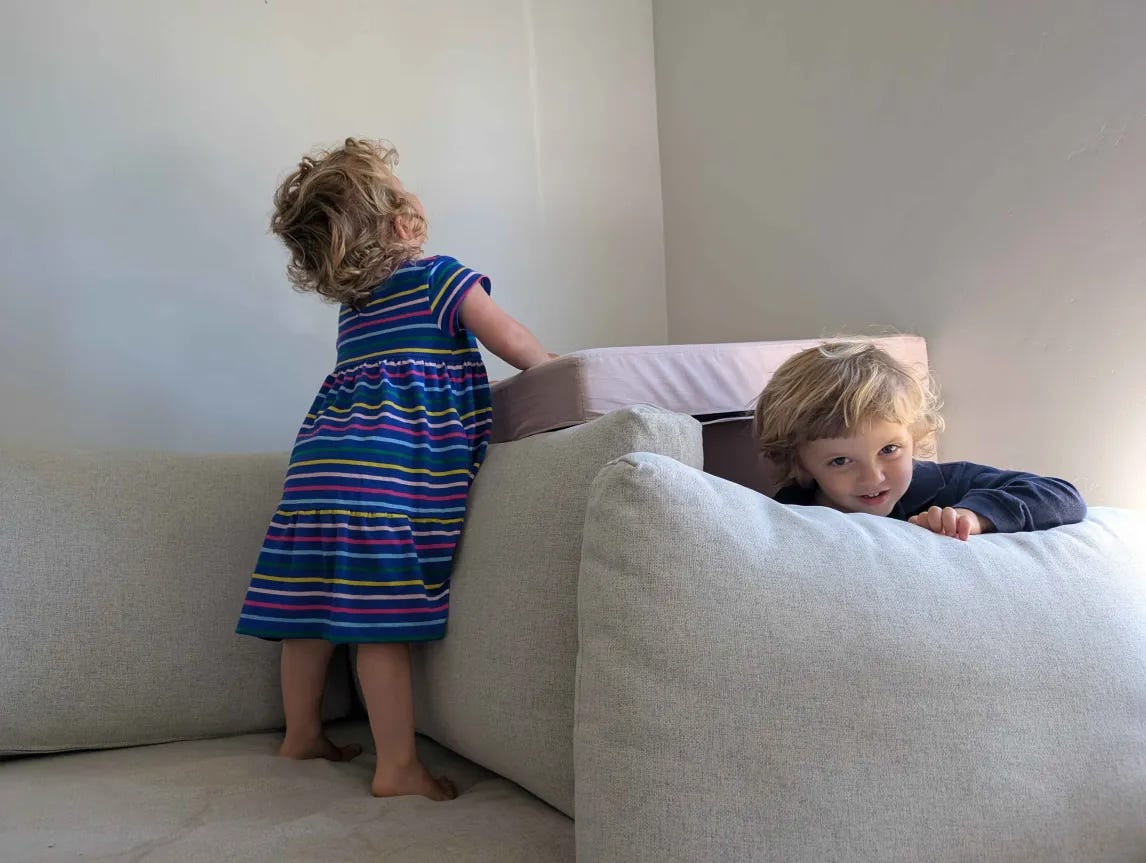
For example, my son’s bedtime stalling has turned into the following equilibrium: when I say “Bedtime!” he pleads “two more minutes!” Then I have to give him the two more minutes. If I don’t give him the two more minutes, he has the right to scream and kick as I drag him to his room. But if I do give him the two more minutes, then when I say “Two minutes over!” he must go to bed quickly and enthusiastically. This is a great trade on my part, especially since I can just announce “Bedtime!” two minutes before I actually want him to go to bed.
(also, he has no concept of time, and if I say “two minutes over” after thirty seconds then he’s none the wiser. I try to not to exploit this loophole for personal advantage, but it’s a good lever to have in a crisis.)
The next step in his bedtime routine is tooth-brushing. Here the feudal code says that he has to brush his teeth for the amount of time it takes me to say “chugga-chugga-chugga-chugga-CHOO-CHOO!” several times. If I try to go longer than that, he can scream and kick in protest. But if he tries to stop before I’m done, I can grab him and forcibly finish the job. Again, a great trade, especially because he can’t count and just assumes I’m saying it some reasonable number of times, plus I can add as many “chugga”s as I want to the beginning. This feels sort of like cheating, but on-the-fly adjustment of rules is part of the feudal tradition:
The local lord might, for example, lend grain to peasants in smaller baskets and insist on repayment in larger baskets. He might surreptitiously or even boldly enlarge the size of the grain sacks accepted for milling (a monopoly of the domain lord) and reduce the size of the sacks used for measuring out flour; he might also collect feudal dues in larger baskets and pay wages in kind in smaller baskets. While the formal custom governing feudal dues and wages would thus remain intact (requiring, for example, the same number of sacks of wheat from the harvest of a given holding), the actual transaction might increasingly favor the lord.
Next he wants to listen to music. I must give him at least one song of his choice. He has to give up after two songs. One vs. two songs is negotiable based on how late it is and how well things have been going up to that point, but usually we’re both able to agree which is more appropriate or concede in exchange for favors later.
Finally, he goes to bed. Exactly how long he must stay there is subject to more delicate rules. He used to get up much earlier than I was willing to tolerate; after negotiation, we decided that he must stay in his room until at least 6 AM.

The agreement was sealed by the purchase of an automated green light which turned on at 6 and announced that he could start banging on the door. Unfortunately, the terms proved unclear; given that he was allowed to come up “when the green light was on”, he proceeded to learn how to override the auto-timer and turn it on himself at any hour of the night, at which point he felt licensed to bang on the door. This necessitated a delicate renegotiation, but we finally settled on a new rule: no leaving his crib before the light turns on, including to fiddle with the light.

Is this still bad overly-permissive parenting, just a higher-level of Danegeld-paying? Should I be yelling at him: “YOU HAVE NO RIGHTS! BRUSH YOUR TEETH AS LONG AS I DEMAND, AND YOU’LL GET A WHUPPING IF YOU STOP BEFORE I’M READY!”? My argument against is that for a trivial cost of 3-5 extra minutes of my time per night, my children enthusiastically comply with their whole bedtime routine, sans protest or difficulty. Also, Tocqueville argues that the replacement of the ancient system of fair feudal privileges and duties with one of authoritarian enforced obedience led to the French Revolution, and I’m not sure what the parenting equivalent would be but it sounds bad.
The biggest disadvantage is that, although I do think my children genuinely try to keep these rules, they’re too young to have what I consider natural intuitions about category boundaries. My son is allowed two songs per night - but sometimes, halfway through his second song, he decides he doesn’t like it and wants to switch to a new one. And having switched, he doesn’t think it should count as two songs until the new song is finished, because he hasn’t gotten to hear and enjoy two songs he actually liked. Meanwhile, to my mind this is an illegal attempt to hear two and one-half songs. Most of our remaining fights happen around edge cases like these, although they’re thankfully getting rarer.
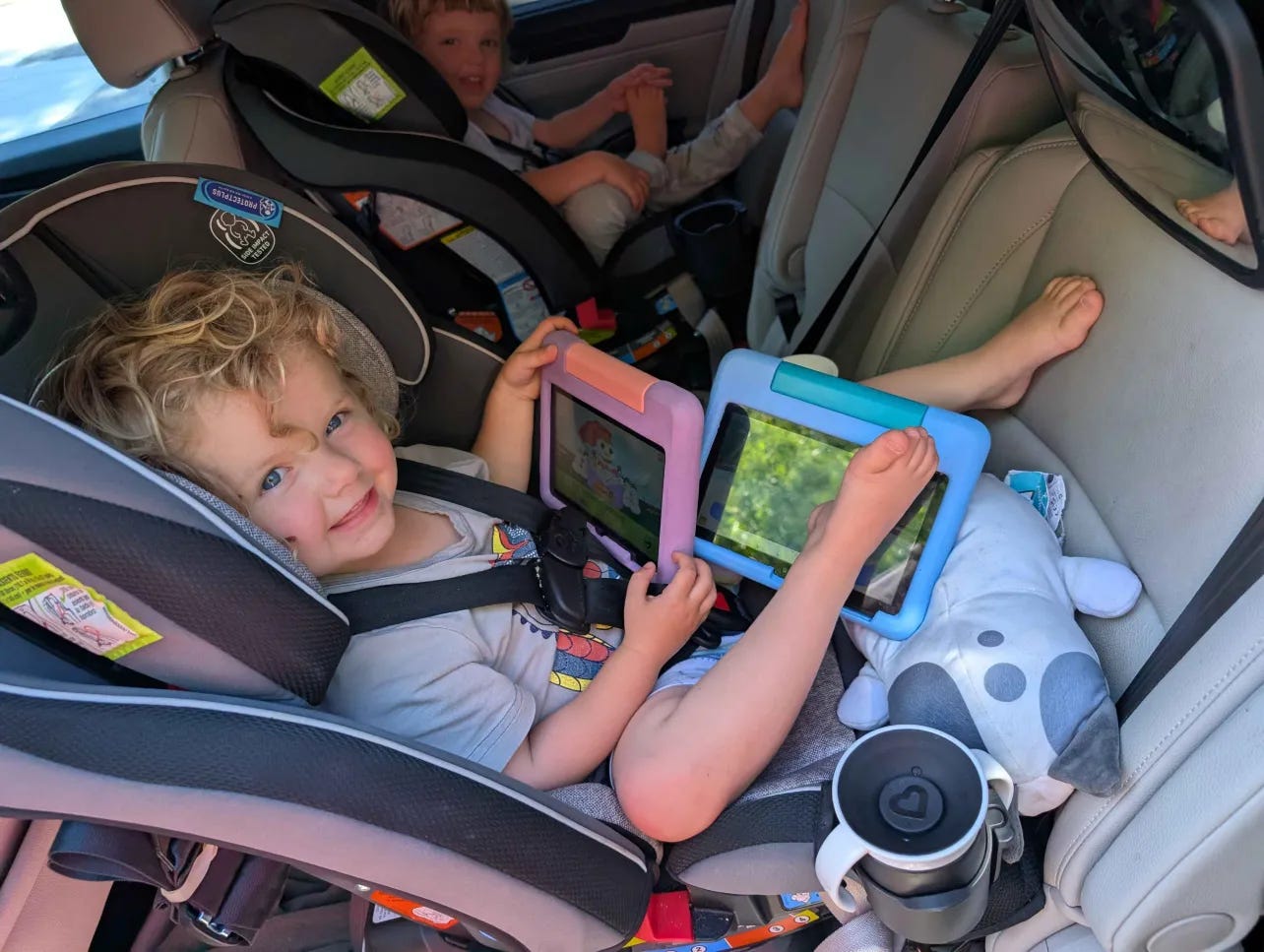
The second biggest disadvantage is that it’s hard to do nice things for my children; any temporary indulgence gets interpreted as a renegotiation of the feudal code and becomes tomorrow’s expectation. My wife lets the kids play with tablets on long car rides. Now whenever I want to drive the kids somewhere, even to the cafe five minutes away, they demand their tablets. At first, when I said no, they interpreted this as a defection and claimed the right to scream all through the trip. After enough training, they learned the new rule - Mommy allows tablets in the car on long rides, Daddy bans them on short ones - but it was a stressful first couple of car trips. The twins have usufruct rights to one cup of Gatorade every morning. Sometimes they ask for Gatorade in the evening; and after a long tough day it would be so easy to just give it to them. But I know that if I did it once, every future time I refused would get treated as a violation and penalized with screaming.
The smallest disadvantage - more cute than actually bad - is that my children have learned to interpret their relationship to the universe as partaking of sort of cosmic feudal code. I understand this happened in real ancient/medieval times - God as “Lord of the Universe” and so on - but it’s stranger to see it happen to your own kids. Sometimes my son asks to see his Nana - who lives five hundred miles away, and visits only once a month - and I’ll tell him that she’s five hundred miles away and this is impossible. “See Nana two minutes?” he will ask, because the feudal code always gives him the right to ask for two more minutes of something.
Or maybe this isn’t about feudalism at all - interpreting your society’s legal code as giving you the right to bargain with the universe is very Jewish. Maybe it’s just another way the bloodline expresses itself.