Preliminary Milei Report Card
Scott analyzes Javier Milei's presidency in Argentina, noting mixed results in economic indicators and policies, with some successes in budget cuts and inflation reduction, but increased poverty rates.
How is Javier Milei, the new-ish libertarian president of Argentina doing?
According to right-wing sources, he’s doing amazing, inflation is vanquished, and Argentina is on the road to First World status.
According to left-wing sources, he’s devastating the country, inflation has ballooned, and Argentina is mired in unprecedented dire poverty.
I was confused enough to investigate further. Going through various topics in more depth:
1: Government Surplus
When Milei was elected, Argentina went from constant deficits to almost unprecedented government surplus, and has continued to run a surplus for the past six months.
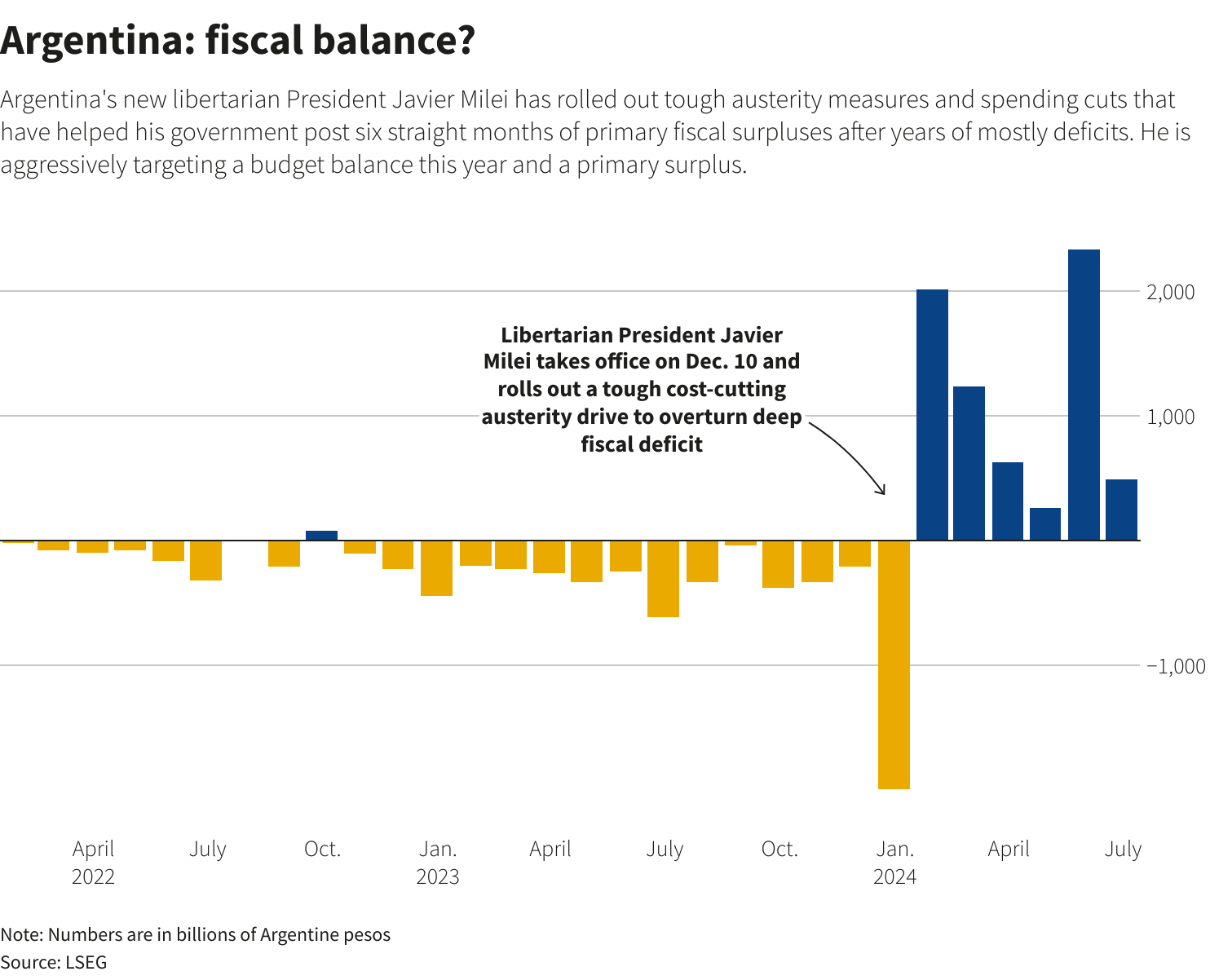
This wasn’t fancy macroeconomic magic. Milei just cut government spending:
- He eliminated 9 of 18 government ministries, including the Ministry of Culture and the Ministry of Women, Gender, and Diversity.
- He laid off 24,000 government workers (and hopes to increase that to 70,000).
- He cut fuel subsidies (paywalled link)
- He may have cut (or at least not increased, which given inflation levels is an effective cut) funding for universities, which now complain they have no electricity and are giving classes in the dark.
- He has changed the way inflation affects pensions in what was realistically a large budget cut.
- Et cetera.
This source says he cut the size of government by about 30% overall. Unsurprisingly, this eliminated the Argentine deficit.
2: Inflation
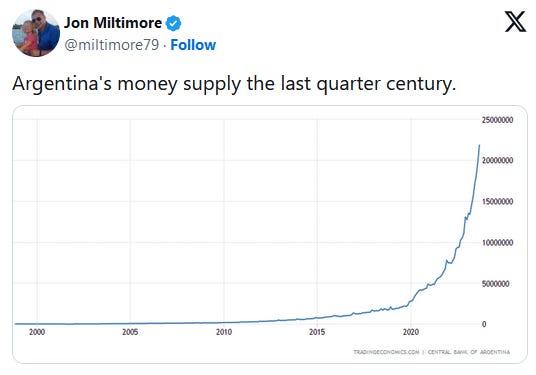
This has been Argentina’s biggest problem for many years. There’s no mystery why: in order to cover its deficit, the government printed money. This was reaching crisis levels just before Milei’s election (source).
Classical economics says that if you cut government deficits and stop printing money, inflation should decrease. It did:
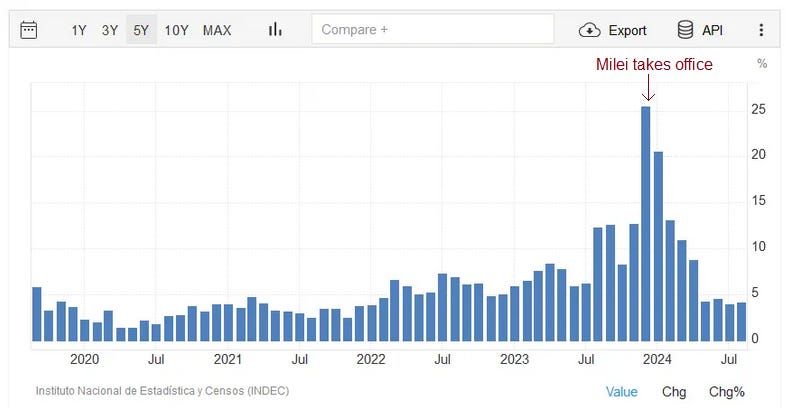
Monthly inflation went from 25% to about 4%. This is obviously great, but there are two small notes of concern.
First, the 25% number was just one really bad month. Inflation had been at a baseline of about 4% for most of the last five years. The immediately-pre-Milei government really cranked up the money printer in its last few months, increasing the numbers to 10% for a few months, and finally 25% for one really bad final month. Milei was able to get it down to its usual baseline of 4%, but I think he was hoping to get it lower. So far it’s been stubborn and stayed at the 4% level through the spring and summer.
Second, even 4% monthly inflation is awful. 4% monthly = 60% yearly. Remember, the United States briefly had 9% yearly inflation after COVID and people were livid. Argentina’s “good” “improved” inflation is still 7x that.
Why do some left-wing sources say that inflation has gotten worse than ever under Milei and become the worst in the world?
In normal countries, where monthly inflation is too small to notice, you measure yearly inflation. If you look at yearly inflation under Milei - as in, literally, the last twelve months of inflation - it looks like this:
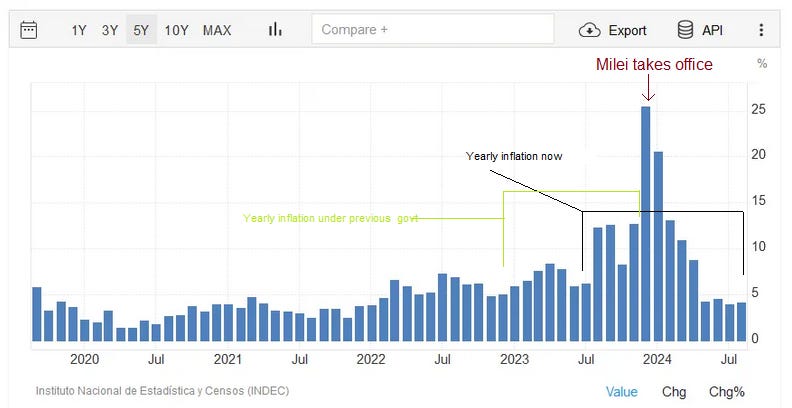
The movement of the twelve-month window of “yearly inflation” now encompasses the worst part of Milei’s predecessors’ inflation, and so looks awful. Meanwhile, during Milei’s predecessors’ administration, the twelve-month window included earlier periods with less inflation, and looked better. So a devious liar could say that “inflation” (meaning yearly inflation, which is admittedly the standard measurement) is “unprecedentedly bad” during Milei’s administration.
You can debate how many sources are actually trying to con you this way vs. just including the yearly inflation number for “context” or something (1, 2, 3, 4, etc).
3: Poverty
No way around this one, Argentine poverty got worse.
The poverty rate soared from 42% before Milei to 53% now. It’s hard to tell how much of this is the bad policies of the last government coming to roost vs. Milei’s own fault. But Milei firing all those government workers, slashing subsidies, ending welfare programs, devaluing the peso, etc, have certainly contributed.
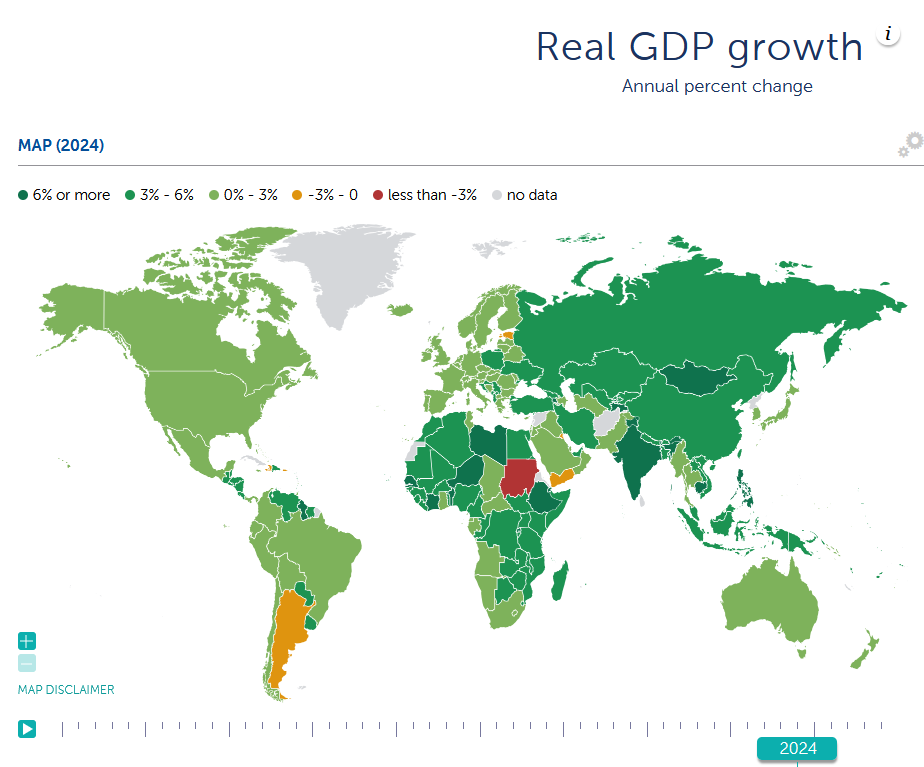
According to classical economics, this kind of “shock therapy” is supposed to be temporarily bad, but long-run good. So although it probably doesn’t feel this way to Argentines, things are potentially still going according to plan. But economics doesn’t have a clear prediction for how bad things will get, or how long it will take before they are good again, and I haven’t seen any analysis of whether the current recession is consistent with predictions or whether people should start worrying.
There are some very slight, early signs that things might be starting to get better. For example, according to the link above:
The Catholic University of Argentina’s (UCA) observatory had estimated the poverty rate soared to 55.5% in the first quarter of the year before easing to 49.4% in the second quarter, giving a 52% average for the first six months of this year.
And from here:
"We are still in recession, but there are some signs that it may be coming to an end," said analyst Marcelo Rojas, referring to signals the country's economic slump may have bottomed out.
And from here (July is mentioned because it’s the latest month from which we have good data):
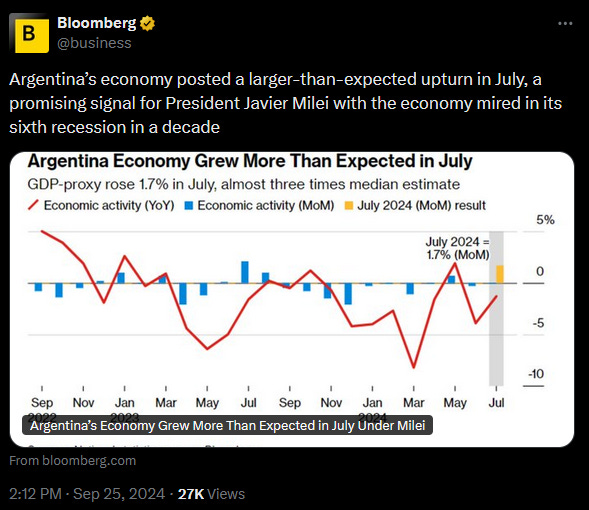
This source says the opposite and I don’t know why:
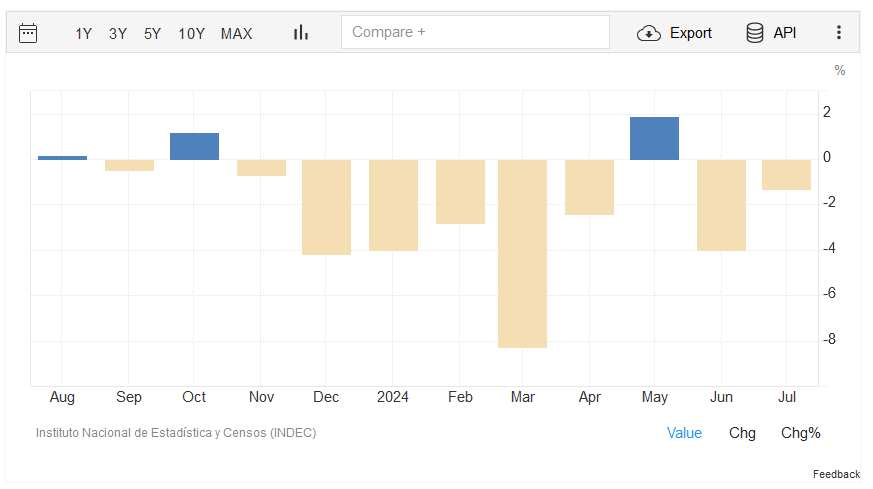
So there are slight signs of hope but Argentina’s economy has definitely gotten worse.
[EDIT: commenter Duarte recommends reading Juan Ramon Rallo on signs of recent improvement (Twitter).]
4: Rent Control
This is another part of the pro-Milei narrative. He abolished Argentina’s rent control, and:
…since Milei's repeal of rent control laws took effect on December 29, the supply of rental housing in Buenos Aires has jumped by 195.23%, according to the Statistical Observatory of the Real Estate Market of the Real Estate College.
(the 195.23% number seems implausibly high to me, but I can’t find any contradictory claims, so I’m nervously letting it stand)
There are strong economic arguments to believe that abolishing rent control should lower prices in the long run. In the short run it seems like it could go either way. In this case, although there are some stories of people whose apartments got more expensive, the official statistics say prices have dropped by 27%.
This seems like a clear Milei victory and I can’t find anyone credibly claiming it isn’t. The only note of caution that I take seriously comes from this Twitter user:
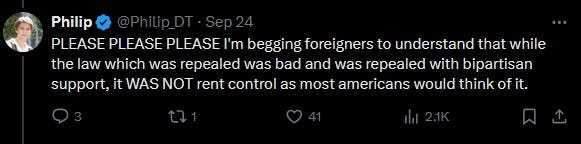
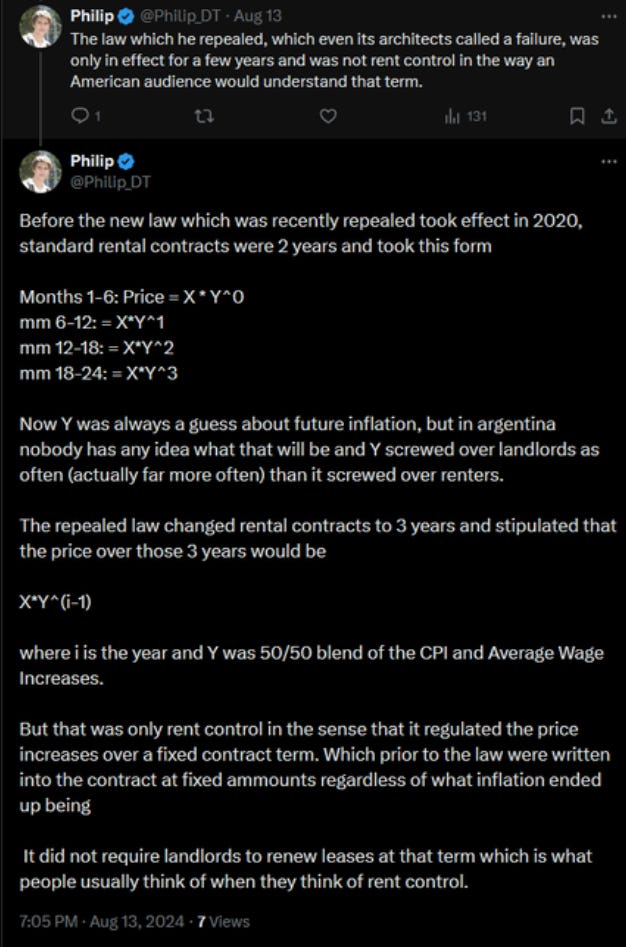
I appreciate this clarification, but I don’t want to overupdate. Milei repealed a lot of housing/renting legislation, including laws regulating the size of deposits, laws about what kind of currency you could use for housing contracts, etc. I think an overall picture of “Milei made the housing market much freer, and it improved” is correct. Still, Philip has a good point that this wasn’t the central American example of rent control, which is something like “as long as it’s the same tenant, landlords can never raise prices more than a certain amount per year”.
5: Approval Rating
All these economic statistics are getting hard to follow. What about something more fundamental: are people happy with Milei?
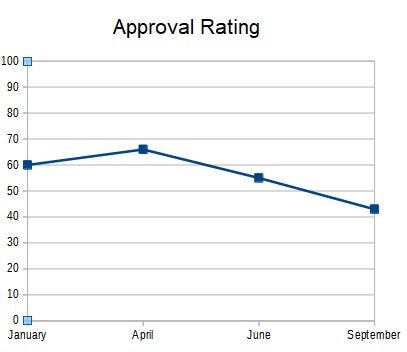
Milei’s approval rating started out high: 60-66%. As the recession dragged on, it got lower - now it’s at 43%. But even after nine months of recession, he remains more popular than Joe Biden, Keir Starmer, Emmanuel Macron, and other major western leaders.
But it’s worth putting that in context:
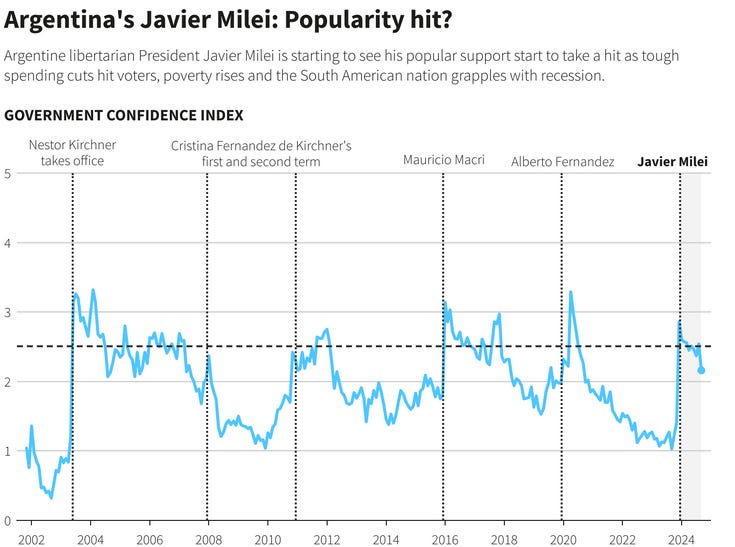
Argentina has a history of being enamored with new leaders who promise to change everything, then souring on them when everything fails to change. So far Milei is merely on trend.
Maybe more important than Milei’s own approval rating is how he stands relative to other politicians and party leaders who he’ll have to defeat for re-election. Here the news is good (proximal source, ultimate source):
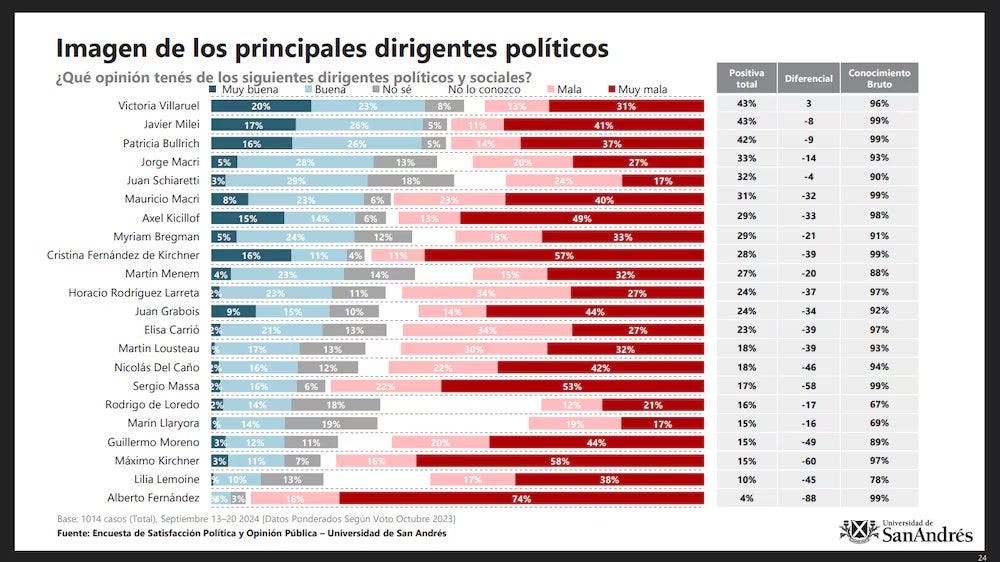
The only Argentine politician more popular than Milei is Victoria Villaruel - Milei’s own vice-president. Villaruel has an interesting background: she’s a conservative Catholic activist and amateur historian who writes books arguing that past Argentine right-wing governments have committed fewer atrocities (and past Argentine left-wing governments more atrocities) than generally believed, which has earned her accusations of “denialism”. I don’t understand how this led to her being vice president, or why she’s so popular.
For more on how Argentines think, see this Reddit discussion. I see Argentines (at least the sort of Argentines who speak English and go on Reddit) having mixed opinions on Milei - but everyone is united in hating the opposition.
6: Overall
When Javier Milei took office, he promised to do shock therapy that would short-term plunge Argentina into a recession, but long-term end its economic woes.
He has fulfilled his campaign promise to plunge Argentina into a recession. Whether this will long-term end its economic woes remains to be seen.
I think he gets credit for some purely political victories (completing the budget cuts he said he would complete), for decreasing inflation, and for improving the housing market. But in the end, history will judge him for whether his shock therapy eventually bears fruit. I don’t think that judgment can be made yet, and I don’t see many economists eager to go out on a limb and say that there are strong signs that his particular brand of shock therapy will definitely work/fail.
There are disappointingly few Milei prediction markets, probably because it’s hard to operationalize “he makes the economy good”. This multi-pronged mega-market has few traders, and weakly predicts a mix of good and bad things, maybe leaning a little good. But here is a more specific one:
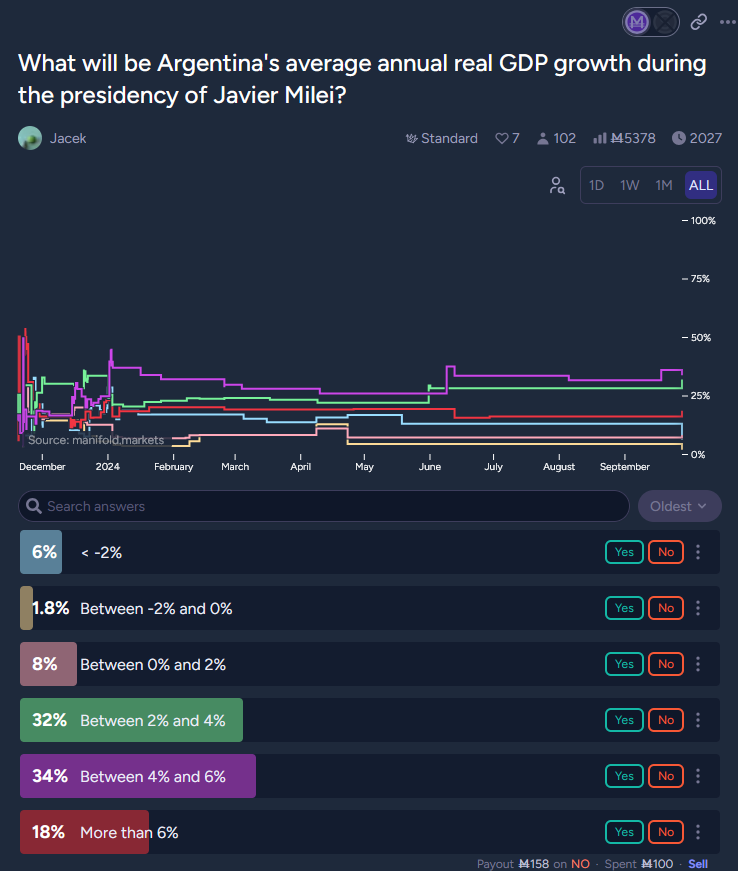
…which compared to Argentina’s historical GDP growth rate seems - no, sorry, Argentina’s historical GDP growth rate is too weird to draw any conclusions.
And maybe the most important test: