Re: Re: Re: Pritchard On Liberal Happiness
Scott defends his argument that economic growth significantly increases happiness against Pritchard's critique, arguing she underestimates income effects and overestimates redistribution's potential while misunderstanding liberalism's respect for individual agency.
In early July, Cassie Pritchard argued on Twitter that liberalism had failed; it bet the farm on economic progress making people happier, but although it delivered impressive economic progress, happiness had failed to follow.
In late July, I countered that Pritchard had made a mistake by comparing happiness to income, when the literature instead supports a correlation of happiness with log(income). Add the log term, and most happiness-income relationships reappear, and liberalism goes back to looking pretty good.
Last week, Pritchard responded on her Substack. I don’t have the interest to give this the full treatment it requires, but she deserves some response, so I’ll make a few points.
Pritchard argues that the effect of income on happiness, though real, is small:
In short, a correlation does exist, and it’s plausibly causal. But it’s pretty small.
How small? Well, Alexander cites another article from Killingsworth that gives us the correlation across the entire dataset of individual observations, not just across these smoothed-out groups: “the correlation between average happiness and log(income) is 0.09 in the experience sampling data...the effect of an approximately fourfold difference in income is about equal to the effect of being a caregiver...and less than a third as large as the effect of a headache.” (Emphasis added).
So, according to Alexander’s strongest sources, quadrupling one’s income from $50,000 to $200,000 explains less impact on your happiness any given day than a bad hangover. This is not a suitable foundation on which to build an entire political program--or even most of one.
Why didn’t he deal with the smallness of the income effect in his post? I don’t know, but he may have misinterpreted my original tweet as saying income doesn’t matter at all, in which case this data functions as an effective rebuttal. If that’s what happened, I don’t begrudge Alexander for it; Twitter context-collapse comes for us all.
Pritchard states that the effect of her income change is the same as requiring a person to be a full-time caregiver for a disabled elderly relative, then dismisses that as too trivial to matter. This is bizarre; I’ve seen strong healthy men get PTSD from having to be full-time caregivers. It’s one of the most profound life changes imaginable, and Pritchard just mocks it as pathetically small, then starts speculating about my motives for not admitting how utterly insignificant it is!
Is it weird that Pritchard’s source lists becoming a full-time caretaker as only one-third as bad as having a headache? No. Because it asks about point-in-time happiness, all things that happen at a specific point in time will seem large compared to protracted state changes in lifestyle. Put another way, since rich people are rich every day, the proper comparison is having a headache every day. I thankfully don’t get many headaches, but my wife has migraines. I can tell when she’s having them because she locks herself in her room with all the lights off and moans for several hours. Being in this state day in and day out sounds too horrible to contemplate - so 3x as bad as the already-terrible badness of having to be a caretaker for a disabled elderly relative seems about right. If quadrupling my income is really one-third as good as going from a permanent headache to normal and healthy, I should be trying harder to quadruple my income!
(I don’t drink much, so I can’t speak from experience, but I bet having hangovers every day, or even one-third of a hangover, would also be pretty bad.)
Since we apparently disagree on the badness of forced caregiving, headaches, and hangovers, it might be helpful to look at Pritchard’s ultimate source (Kahneman & Deaton, 2010) for some other anchors. Here are some other differences about as big as a 4x income difference:
- The difference between married people and divorced people.
- 3x the difference between normal-weight people and obese people
- The point-in-time difference between it being a weekend vs. a weekday.
This is merely a 4x income difference; Pritchard and I are alternately discussing the antiquity-modernity difference or the First-Third World difference, both of which are 100x income differences. Since 100x is greater than four cubed, we ought to be able to stack all of these, and say it’s like the difference between being an obese person stuck at the office on Monday morning after a nasty divorce, vs. spending a Saturday afternoon with your true love while you’re both thin and beautiful.
(or if you prefer national-level comparisons to personal ones, remember that a quadrupling of national income represents about 3x the happiness difference between pre-pandemic America vs. worst-part-of-COVID-lockdown America.)
Much of the rest of Pritchard’s post then goes on to savage me for paying any attention to such a trivial difference which she has so thoroughly proven to be irrelevant; I can only say that none of the anchors above seem irrelevant to me and so I deny that income is irrelevant either. I’ll skip over those parts and focus on some of her other claims.
She next points out that happiness scaling with log(income) might be an argument for redistribution:
Remember, happiness scaling with log(income) rather than with income means that each marginal dollar of income procures less happiness than the last. This means that giving an amount of money to poor people (like through redistribution) improves happiness a lot more than if the same amount went to richer people.
Killingsworth says this himself: “decision-makers that seek to improve collective happiness might find that preferentially increasing incomes of those who earn the least generates a large ROI for collective happiness.”
This study finds an extremely robust income-happiness correlation, and yet redistribution emerges as an essential policy concern, distinct from growth. Clearly, if our ends are maximizing happiness, Alexander’s monomaniacal focus on output is misguided. People can—and should—prefer certain redistributive tradeoffs even if they have negative effects on growth. Alexander anticipates this response to some extent, but handwaves it away in his discussion of an international dataset.
I know extreme adjectives are in fashion these days, but I think it’s unfair to call me monomaniacal: I say several times in my post that other things besides income also matter, and we should pursue those too. I am responding to her claim that income doesn’t matter; this shouldn’t require reciting a list of every other thing that does. I endorse redistribution and have written about this elsewhere, at length.
But redistribution can only go so far; there’s no scheme for redistributing the income in Burundi which will make the average Burundian as rich as even a poor American. And Belgium, the highest-redistribution developed country1, has a happiness rating on the graph we’re both using of only 0.1 points higher than the US, despite a similar-ish GDP per capita ($60,000 vs. $75,000 according to the constant international dollars used to make the chart, although more like $60,000 vs. $90,000 in real life). So at current margins, going from US levels of redistribution to match the most redistributive First World country might gain 0.1 - 0.2 points of happiness, assuming that US redistribution programs were implemented as well as Belgium’s are2.
(remember, the difference that Pritchard was mocking as trivial above - quadrupling income - corresponded to 1.2 points).
Why does redistribution matter so little? I think Pritchard’s comment about log(income) above, while correct in direction, doesn’t grapple with size. Suppose that we redistribute all billionaire wealth in the US to poor people. Under the simplest version of this - invest it all in a sovereign wealth fund making 3%/year and give the interest to the bottom 20% - the average poor person’s household income goes from about $20K to ~$25K-$30K, the bottom quintile’s happiness goes up by log(30,000/20,000)*observed_slope = 0.28, and total national happiness goes up by ~0.05 points on our 1-10 scale3.
(again, Pritchard previously dismissed a 1.2 point difference as insignificant).
I don’t see “grow the economy” and “do redistribution” as opposing priorities. For a given willingness to redistribute, the dollar amount of redistribution you can do is entirely a function of the total size of the economy. You can’t change willingness-to-redistribute by an order of magnitude, both for practical/political reasons and because it’s already within less than an OOM of the mathematically possible ceiling (eg you can’t triple tax rates on people who are already taxed at 40%). But you can grow the economy an order of magnitude - and countries have and will, again and again.
(I do think that you can, and should, increase the efficiency of redistribution, and might be able to get bigger gains out of this, but this doesn’t trade off against economic growth, and liberalism of course also endorses efficiency.)
Pritchard says we should pursue “certain” redistributive policies “even if they have negative effect on growth”. There may be a few magic bullets like this which are worth the cost, but I think doing this en masse is a manifesto for eating your seed corn. In order to squeeze out an extra 0.05 - 0.2 points now, we would permanently disable the motor that has lifted society by 3 whole points over the past few centuries - indeed, the same motor that will power her redistributive programs a century hence. This is a good way to get a trivial electoral gain today, while being cursed by your great-great-grandchildren.
She thinks my claim that policy differences matter less than culture differences ignores some counterexamples:
Right off the bat, he compared Finland and Israel against the USA—this elides how big the differences can be between the countries that get policies/culture right, and those that “screw them up.” For example, Botswana is slightly richer than Belize, but Belize is 3.27 points higher in life satisfaction. That 3.27 point difference is functionally the same as Alexander’s estimate that, “since the medieval era...happiness should have increased about three points on a 1-10 scale” thanks to economic growth. So even if you buy that growth has bought humans three extra happiness points since 1000 CE, you could apparently get that same boost just by being more like Belize instead of Botswana—today, without waiting a thousand years.
Since we’re talking about the effect of policy (and income) in the US, I think it’s more helpful to base our comparisons off the US than off Botswana. The 1-10 point scale is distorted - real happiness is likely logarithmic - which means that the 7-8 range of the 10 point scale should be interpreted as in some sense bigger than the 3-4 range. I’m trying to respect the weirdness of the scale by judging the possibility of interventions in the US by other countries close in income to the US - comparing Belize to Botswana makes it harder to adjust for the graph’s deceptive scale.
(as demonstration, consider that if we naively imagined that improving US policies could bump us up by 3.27 points - the same as improving Botswanan policies to be more like Belize - then the US would rank at 10.1 on a 1-10 scale4, which is impossible. If either Pritchard or I were virtuous, we would be subjecting all of this to some sort of horrible logarithmic transformation before talking about it; absent that virtue, the best we can do is try to extrapolate from countries like the ones we’re considering, rather than ones in a wildly different part of the income distribution)
(this probably slightly affects my claim that income increases happiness at some specific amount too, but here we can at least look at the local slope, and most of the damage is near the very top of the graph which affects the +3.27 point claim and not smaller claims about plausible income increases)
But also, a glance at the full-color graph gives some hints to why Belize is so happy, and it’s not policy:
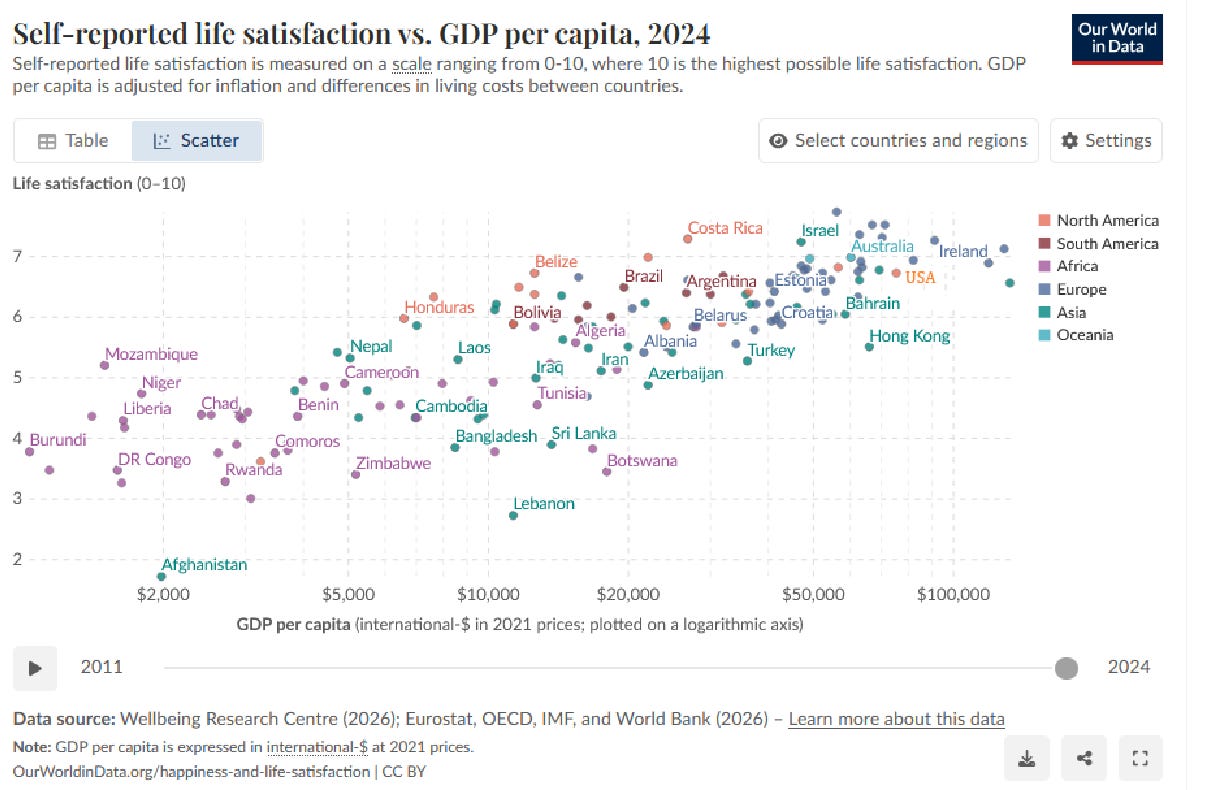
All Latin American countries rank unusually highly, from El Salvador (controlled by a right-wing dictator) to Nicaragua (controlled by a left-wing dictator) to Belize (controlled by a centrist democracy plus some legacy British colonial institutions). Rather than speculate that Belize has solved policy, we should assume that Latin Americans are dispositionally sunny, which also matches my observations of most Latin Americans I know. This can’t be imported to the US by policy fiat.
(except by importing the Latin Americans themselves; the reader may decide whether liberals deserve credit for this happiness-increasing policy).
Finally, even if despite these cautions we were to accept Pritchard’s comparison at face value and attribute the 3.27 point Botswana - Belize difference entirely to policy victories that could be replicated in America, the proper expectation would be half that - 1.63 points. Pritchard got her high number by comparing an outlier low country to an outlier high country, but America is neither anomalously low nor high. So it couldn’t benefit from ditching Botswana’s anomalously bad policies5, and could only reap the gains from adopting Belize’s anomalously good ones - thus, half her previous estimate.
I continue to think that looking at the range of countries similar in culture and income to America makes a better comparison, unless Pritchard genuinely believes there’s something special about Belize’s policies - in which case she should explain what that is.
Contra my claim that economic growth is stable and policies variable, economic growth is not stable.
But Alexander also overstates the extent to which growth is stable, and other policy unstable. For one thing, deep and enduring declines in output are possible even outside of state-collapse scenarios. Greece lost about a quarter of GDP per capita in just five years after the 2008 financial crisis. This wasn’t the result of a civil war, or a revolution, or state collapse. Greece was a relatively high-income liberal democracy that simply cratered due to bad policy and external economic shocks. Growth dividends can be reversed through bad governance, contra Alexander’s “growth is stable” formulation.
I agree that Pritchard could find one example of this, but the question hinges on whether this is an unusual deviation that she had to work overtime to find, or a relatively common occurrence in the natural order of things. We can check this graph:
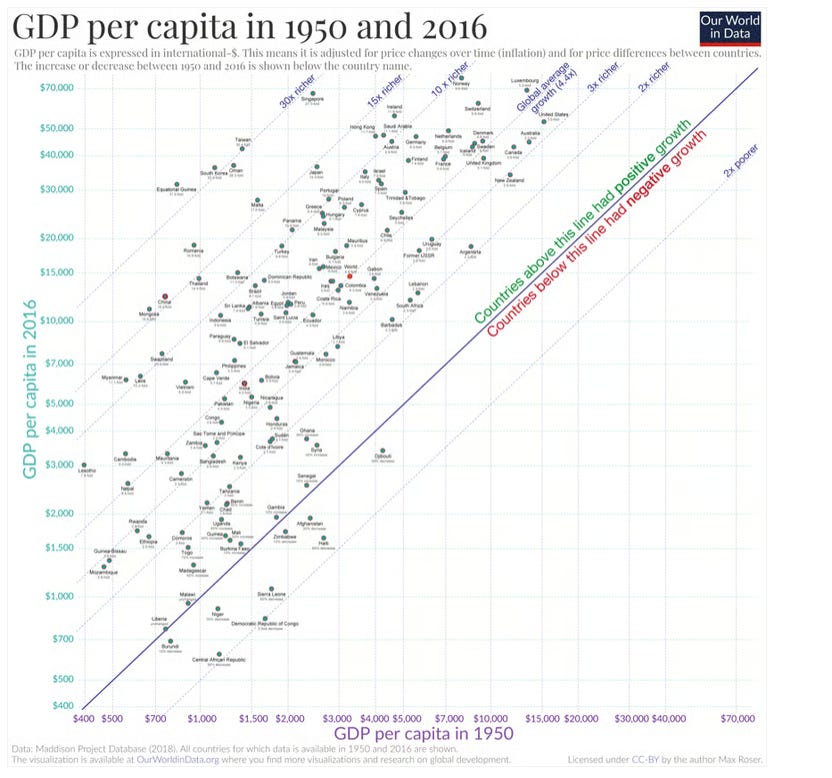
Only a tiny handful of countries, mostly war-torn near-anarchies, saw negative growth over this period.
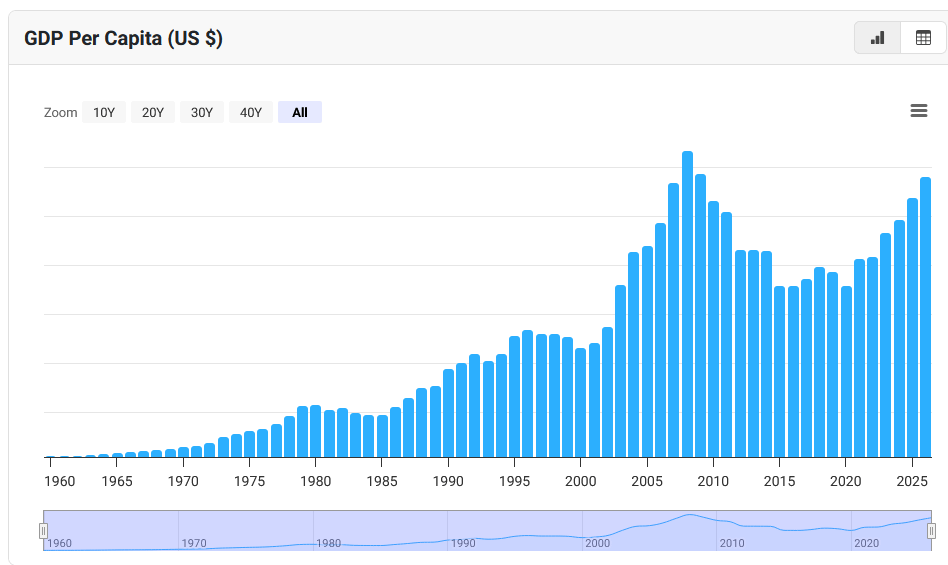
Also, I’m happy to report that Greece is now almost back to its 2008 GDP per capita. Losing eighteen years is obviously still bad, but on a purely evidential level, I think this suggests the crash put them below their capacity in a way that allowed them to regress back to the mean later.
Conversely, policy can be durable. Social Security and Medicare have survived decades of hostile-party governments. When you establish a popular redistribution regime in a democratic state, it can be pretty fucking tenacious. The Nordics have also largely retained their ample welfare states; there has been some degradation at the margins, but the core policies remain intact, and people in these countries are the happiest in the world.
Again, I think this attempts to replace nearby relevant examples with far-off irrelevant ones. The Nordic countries may have a deep historical disposition to ample welfare states; meanwhile, in the US, the most impressive welfare state expansion of my lifetime, Obamacare, was hobbled within ten years, and Trump has reversed most Biden-era policies out of some combination of general principle and spite. If a Democrat wins in 2028, they will no doubt reverse most of Trump’s own changes. The environment that produces these reversals (control of the federal government yo-yoing between Democrats and Republicans who hate each other and can’t compromise) doesn’t seem on the verge of improving.

Even the NHS, an example of a successful and durable application of the welfare state, is being undone in practice not by direct cancellation but by a failure to fund and manage it competently.
I stick to my claim that, although there aren’t literally zero exceptions, overall it seems like growth is usually steady and policies are usually reversible.
Since I can only compare modern poor countries to modern rich countries, this might be an envy effect (of knowing other countries are richer than yours) rather than a direct effect of wealth.
We can’t go back in time to survey medieval English peasants to compare them against modern Americans, so Alexander looks for a group today, in a different place than the USA. He finds modern-day Burundians as a plausible substitute. This kind of move is questionable. It should at least be named and appropriately caveated if you attempt it, but Alexander doesn’t do that.
Anyone can intuit what might be wrong with this swap: Burundians are aware their country is poor relative to the rest of the world. England in 1000 CE was not much poorer than anywhere else—and even if it had been, its peasants would have had little way of knowing.
Before we discuss data, I think it’s useful to consult common sense.
I’ve spent time in some Third World countries. I don’t recommend it as a lifestyle. My experience has made me deeply grateful for little things like roofs that are made of shingles and don’t leak during rainstorms. I am thrilled to be able to eat foods which are not rice or beans. I give thanks for 24-7 electricity, flush toilets, and litter-free streets. Every morning I smile to wake up in a city with lawns and parks that isn’t Cairo:

It’s great to have a car. It’s lovely to be able to use A/C on hot days (sorry, Europeans). It’s divine when my children don’t die of preventable diseases. My local waterways and parks are not covered by thick layers of trash6.

George Orwell spoke of ideas that were too stupid for anyone except intellectuals to believe. I count among their number that actually, nobody enjoys any of the preceding things one bit, the people who have them are no better-off than the people who don’t, and the only thing that affects your happiness at all is hearing a rumor that someone 10,000 miles away might have a different relative status to yourself.
Keep in mind we’re not positing the nice-things-don’t-make-you-any-happier theory to explain otherwise recalcitrant data. We’re positing it, in defiance of contrary data supporting the common-sense view, in the hopes that it can overcome not just our common-sense prior against it, but also all empirical investigation.
I have no idea why so many people are so excited about doing this. The only thing I can think of is that people hear about the hedonic treadmill and blow it up to monstrous proportions, thinking that it can entirely destroy all happiness that comes from any cause other than envy and relative standing (why does it spare envy and relative standing? I don’t know).
But the hedonic treadmill isn’t that strong. It can take the edge off happiness but not defeat it entirely. A better version of this post would go into more detail on this (I try to very tentatively start that process here) but for now I think it suffices to assert that it is not omnipotent. The urban legend that, given time, lottery winners and paraplegics end up no happier/sadder than before is a misinterpretation of a 1978 study; more recent studies show that in fact, they are happier/sadder. Good things are good. You can stop arguing that good things aren’t good, as this has been decisively shown not to be the case.
Anyway, we can look at graphs that compare national income to happiness, and other graphs that compare national equality to happiness, and see which matters more (source):
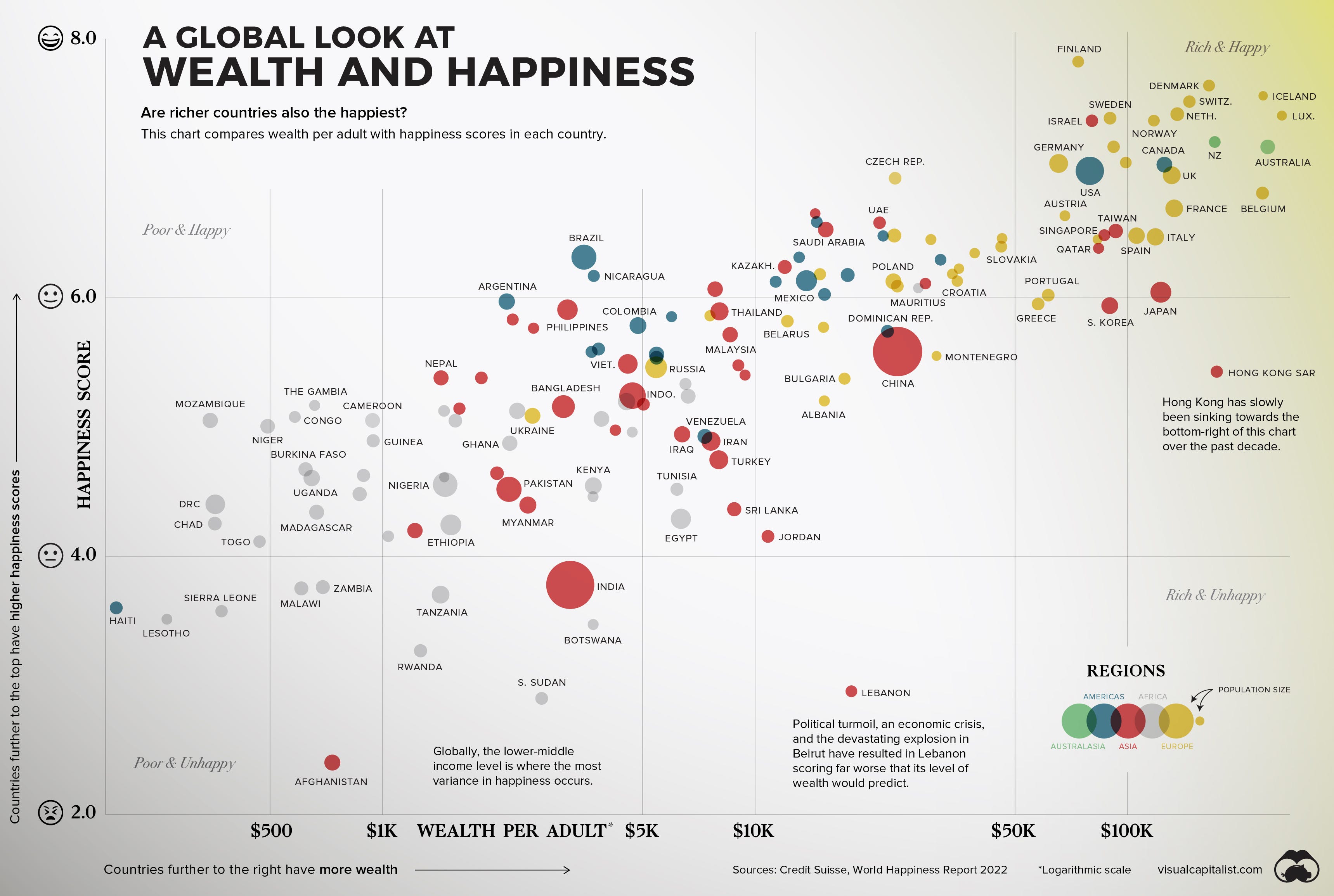
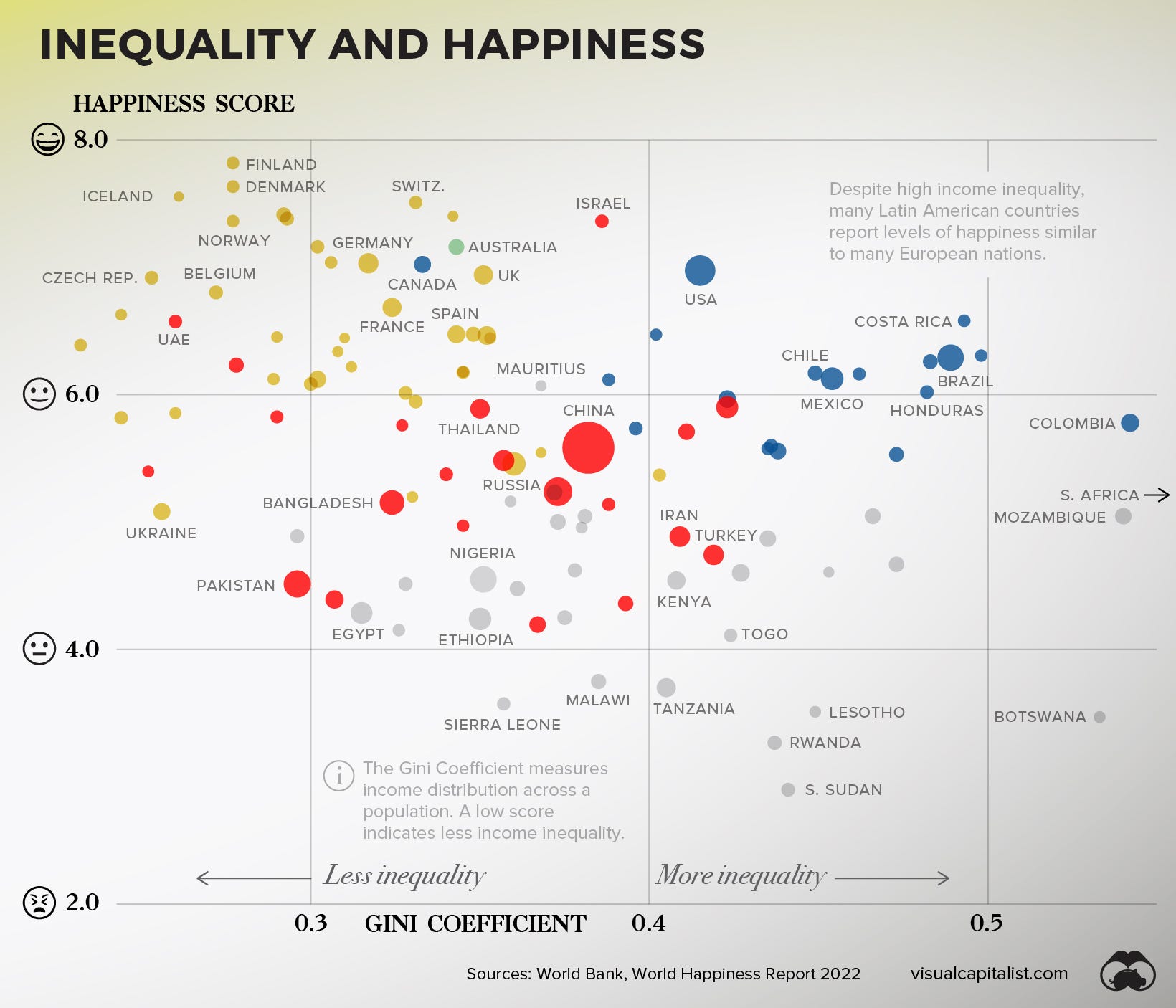
One is a straight line, the other a blob. True, national inequality is not exactly the same as international inequality, but wouldn’t it be weird if your standing relative to your neighbor didn’t matter, but your standing relative to people 10,000 miles away who you know only by rumor mattered so monstrously that it could plunge your entire country into a permanent depression (which, coincidentally, exactly matched its access to the elements of the good life)?
National happiness correlates more with log(income) than individual happiness, suggesting something about uplifting whole societies rather than individuals.
The fact that national happiness correlates far more strongly with log(income) than with individual happiness (remember, that was a correlation of just 0.09, or ~1% of the variance in individual happiness) supports this story about institutions as a common cause of both income and happiness.
If I understand correctly, this isn’t true. Unless I’m missing it, Pritchard hasn’t demonstrated it. She just came up with some comparators for individual-level happiness, dismissed them on the grounds that they were “only” the same magnitude as having to be a caretaker for an elderly relative, and didn’t compare them to the slope of international-level happiness anywhere I can see.
I think this article tries to do that, and it finds that the individual-level and country-level effects are about the same, but I’m not sure, and people should feel free to correct me if I’m wrong.
The income - happiness correlation could be spurious, due to both being caused by something else like good institutions.
Richer societies tend to have stronger democracies, less corruption, more security, rule-of-law, and so on; these are the kinds of institutional differences that make countries rich, according to the institutional model of economic growth (exemplified by economists like Daron Acemoglu). They also, quite probably, make people happier.
Endogeneity will always be a risk for these sorts of comparisons. And I agree that these other things also make people happier (although learning that the secret to happiness is strong democracy, security, low corruption, and rule-of-law is hardly a point against liberalism!)
But the strongest argument that this isn’t the whole picture comes from oil sheikhdoms like Saudi Arabia. We know why these countries are rich. It’s not because they have strong democracies or great rule of law (they don’t). It’s because of the oil! These countries are about as happy as their per capita income would predict. Saudi Arabia’s happiness level is either very slightly below, or equal to, that of the US.
In the other direction, the typical example of a poor country that nevertheless has good democratic institutions is Botswana; as Pritchard notes, their happiness is anomalously low for their income bracket7. I think this is just a coincidence - I certainly don’t think good institutions make things worse, and I do think they probably make things a little better - but I do think it argues against it being the whole effect.
The income-happiness correlation could be due to optimism, or lack of anxiety, or something. We should prefer stability over infinite undirected growth.
Finally, we have the problem of forward expectations. Even if growth plays some causal role in happiness, is that because of the absolute increase in income? Or is it because a consistently growing economy is one in which people have optimistic expectations about their future prospects?
This may sound like hair-splitting, but it matters. If the benefit to happiness comes from absolutely-higher income, then plausibly it might scale infinitely. But if it’s because growth makes people more optimistic about their prospects (like relieving them from worry about losing their jobs), then this may be a fixed benefit that growth secures as long as it’s happening, but which does not compound.
There’s evidence to suggest that exactly these kinds of forward expectations do influence people’s well-being. A 2011 study examining how perceived job insecurity, employability, and actual unemployment affected happiness found that “the potential penalty [to happiness] of unemployment is very large, as other studies have found; however, when circumstances allow a person to have complete confidence in gaining a job the adverse effects of unemployment are more than three quarters mitigated” (emphasis mine).
That’s a huge effect, and it suggests that progressive policies like a national jobs guarantee might yield happiness improvements far in excess of simply raising the incomes of people who would otherwise be unemployed.
On Pritchard’s model, why are people unhappy about not having a job? Although there are fuzzy benefits to work like the feeling of being a self-supporting provider, plausibly the primary effect of unemployment is that one has less money. If money doesn’t matter, lacking a job shouldn’t matter much either!
People are unhappy about lacking jobs because they correctly think this implies they will have less money, and they correctly think that having less money will make them unhappy. Then, when someone guarantees them a job, they correctly think this implies they will have more money, and correctly expect to be happier. Of course future expectations of good things can contribute to happiness!
(I don’t understand where she gets that a job guarantee would yield happiness improvements “far in excess” of raising incomes; I think guaranteeing to those people that they would have as much money as they needed would relieve the stress of unemployment too; in any case, I don’t see what evidence Pritchard provides against this).
Another possibility is that she thinks I’m claiming that only the exact amount of money someone has right now matters, whereas she wisely understands that happiness is mostly a function of stress, agency, expectations, et cetera. But I agree that some of the strongest determinants of happiness are stress, agency, expectations, et cetera, I just think these are downstream of money.
The reason that many Burundians are stressed about whether they will starve or not, and almost no Americans are stressed about this, is because America is richer than Burundi. The reason billionaires are never stressed about whether they can pay rent on time is because they’re billionaires. The reason many other Americans are stressed about whether they can pay rent on time is because our government has pursued anti-competitive, anti-capitalist NIMBY policies that prevent people’s increased wealth from translating into increased access to housing. As we become richer and more liberal, our anxieties become fewer, and our expectations rosier.
To take an extreme example, if I made $1 million/year, then I could put some aside, and not be worried about losing my job, since my savings would provide me many years of runway. Or I could buy some kind of private job-loss insurance. Or if everyone in the country made $1 million per year, then the government would have little problem paying extremely generous unemployment benefits or even a universal basic income that freed me of the need to have a job at all.
Understood rightly, Pritchard’s point reinforces my argument rather than detracting from it, although for her mention of a jobs guarantee in particular, see here.
What about hunter-gatherers?
Additionally, there are other stand-ins we might use to approximate the happiness of our medieval forebears, besides Burundi. Alexander relegates this to the footnotes of his essay, where he admits that present-day “hunter-gatherers are somewhere between 6 and 8 [on the happiness scale] despite their apparent poverty.” Who is the better proxy for our distant ancestors? Burundians, living in a dysfunctional modern society, or those hunter-gatherers, living in groups thought to closely mimic the social and economic environment that prevailed for the vast majority of the human past?
We have to take this much more seriously than Alexander does. If foraging peoples today are about as happy as wealthy Americans are, and if they represent something like a baseline contentment that predominated for most of human existence, then suddenly that lovely chart of countries’ happiness/GDP looks rather bad—half the world is miserable, and only the richest countries have clawed their way back to what was once a universal human patrimony of modest contentment.
Come on, obviously the happiness collapse was hunter-gatherers → subsistence agriculturalists, not subsistence agriculturalists → modern industrial societies. Read Jared Diamond! Or James Scott!
I didn’t go into much detail about this because erasing our civilizational memory of agriculture and returning to a hunter-gatherer lifestyle on the African savannah isn’t within the Overton Window. Pritchard is doing a bait-and-switch where she goes from the fact that perhaps the ancestors of the Hadza people on the Kenyan savannah 10,000 years ago were happier than my model would predict, to an accusation that I’m hiding data inconvenient to my theory, to a conclusion that you should prefer Zohran Mamdani to Pete Buttigieg.
I claim I’m not hiding or neglecting anything, just continuing my policy of trying to compare like with like within the same economic stratum, culture, and geologic epoch, rather than reach for whatever irrelevant comparison might buttress my theory.
The Easterlin paradox proves that wealth doesn’t matter for happiness.
In fact, there is a long-lived and abundant literature devoted to exactly the problem of whether we can infer that more income causes more happiness over time, or if they’re merely correlated at a given moment in time. I’m not sure why Alexander didn’t engage with any of this literature, but in that failure I see more evidence of liberal exhaustion. It’s an unwillingness to look hard and look thoroughly, instead falling back to defend the easy, familiar answer: just keep juicing the Output Machine.
One study from 2016 puts it this way: “one would therefore have expected economic growth to bring considerable increases in life satisfaction. But in many countries, it has not – the so-called ‘Easterlin paradox’.”
I’ve discussed Easterlin here and here - I previously agreed with Pritchard’s perspective, but was convinced away from it partly by Scott Sumner’s arguments here and partly by papers like this one and this one finding that the paradox goes away with better measurement techniques. I admit that some of this relies upon the common-sense argument I made above, rather than my deep commitment to some economic measurement techniques over others. I didn’t discuss this in depth because I’d already discussed it elsewhere, and because readers love when an essay becomes a 10,000 word digression into measurement technique quality.
If the measurement technique people are wrong and Easterlin is true, my best guess is that it’s true because other effects of growth swamp the effects of income; for example, people like living near family and having money, and as societies move from subsistence agriculture to modernity, they get more money but have fewer opportunities to live near family. I agree we should be working to ameliorate the negative effects of economic growth as best we can.
I was wrong that no illiberal country has higher happiness than the US.
Alexander also says in an aside: “[Finland and Israel] are still within the liberal mainstream, and no country outside the liberal mainstream has ever managed to equal current US happiness levels [of 6.72].” Saying Israel is within the “liberal mainstream” is certainly contestable, but he’s also just wrong. The United Arab Emirates scored slightly higher than the USA in 2024, and I don’t think anyone would reasonably consider them a liberal country. Kuwait hit 6.95 in 2023, Belize a functionally-identical-to-the-US-today 6.71 in 2022, Oman 6.85 in 2019, etc. And he underrates the “near-misses” of countries like Saudi Arabia and Singapore (or Nicaragua, Kosovo, and El Salvador, for that matter). A small miss in a noisy dataset might be considered “equal” if we had error bars to look at.
My statement was correct for my 2024 dataset8. Pritchard seems to be looking at some other dataset that mixes numbers from between 2019 and 2024, where some illiberal countries do exceed the US. I don’t think the exact dataset matters too much; I agree with her that this might be within a margin of error.
Suppose that we go with her dataset, and admit that the UAE, Kuwait, and Oman all beat the United States. What does that tell us about liberalism?
All three of these countries are Arab oil dictatorships. Arab dictatorships don’t seem like a uniquely eudaimonia-promoting form of government, so probably this is just more evidence supporting J. Paul Getty’s three step formula for success.
I am somehow against democracy.
These points are simple disagreements over our respective interpretations of the relevant data. But what really alarms me is that Alexander didn’t touch my accusation that liberal frustration has curdled into disdain for democracy. One of liberalism’s greatest contemporary theorists, speaking to an audience that includes much of the Big Tech and AI elite, did not think popular sovereignty worth even a passing mention. The radical project of self-government is liberalism’s greatest legacy—not technocratic fetishism of supply curves.
Instead, he spent 2000 words confessing his exhaustion with everything that isn’t growth. He waved off the effects of “probably culture or something,” dismissed material redistribution as something “opposite-party administration[s] can take...away,” and urged liberals to deepen their worship of the Output Machine: “So long as technological civilization continues to function, we can keep rising and rising, until in 300 years we approach the 10/10 barrier and have to get a new chart.” You won’t get tired of winning, but your great-great-great-grandchildren will.
I didn’t particularly understand this criticism before, and I still don’t understand it. It struck me as an insult flung along the way, and I thought I was trying to keep things productive by limiting myself to dry economics rather than responding in kind.
Voters don’t like socialism. If you asked voters whether they wanted a form of liberalism that improved the economy while also doing some redistribution on the side, or a form of socialism which specifically dismissed economic improvement as a priority, they would probably choose the liberalism. In what sense am I, who am backing the thing voters want, being more contemptuous of democracy than Pritchard, who is backing a thing voters don’t want?
I think Pritchard should volunteer as a campaign director or speechwriter for Bernie Sanders, or Alexandria Ocasio-Cortez, or Zohran Mamdani. I would like for her to suggest them the following speech:
My fellow Americans. My opponents say that my democratic socialist policies will harm the economy. Is this true?
I don’t know and I don’t care. A good economy doesn’t make people happy, and I have no interest in preserving it. Maybe my policies will make the economy worse. Maybe it will make the economy so much worse that you will lose electricity and running water and have to live in mud huts. That’s fine. The people of Burundi live in mud huts, and although they claim they are much less happy than you are, we can’t prove that this is fully causal. It might just be correlation that they live in mud huts and have no electricity, and that at the same time they report being desperately sad. Until economists decisively rule this out, I will put no effort into checking whether my policies will collapse techno-industrial civilization or not.
I think it’s entirely plausible that my policies will prevent you from getting a second car, or will force you to downsize to a smaller house. In fact, I can’t rule out that they’ll prevent you from ever being able to eat anything but rice and beans ever again. You may believe this would make you sad. But if you ignore various contrary results, I can sort of tell a story where actually you care only about keeping up with the Joneses. And since you and the Joneses alike will be living in slums and eating beans, you will be no less happy than you are now. Or maybe you’ll only be the same amount less happy as if you had to be full-time caregiver for a disabled elderly relative, but everybody knows that’s a trivial amount that rounds off to zero.
In conclusion, vote Sanders/Ocasio-Cortez/Mamdani!
I think the average American voter would not like this speech.
If Pritchard believes something that would sound bad in a campaign speech, does that mean she hates democracy and is contemptuous of ordinary people? Obviously not. Democracy doesn’t mean treating voters as infallible oracles of what’s true. It means using them as the ultimate foundation of a system of government. They often have false beliefs and make bad decisions, but we put our fate in their hands because we trust them to at least have a certain level of good intentions, or if not good intentions at least a certain level of self-interest, and this has historically been the best check on tyranny and misrule.
Pritchard clearly hasn’t given the median American voter - who picked Trump! - very much input into her beliefs, identity, or actions, as well she should not. The best that she (and I) can say about the electorate is that they’ve so far preserved a system where both of us can make our own choices, live our lives in the ways we most enjoy, and work to help others in the ways that we consider most effective. A mature commitment to democracy, one that survives contact with the actual decisions made by voters, should celebrate this preservation of liberty, rather than demanding of the voting public more than it can provide.
I only care about growth.
[Scott] accepted my charge that liberalism is primarily concerned with turning up the dial on the Output Machine. (This surprised me: I worried that I had unfairly stereotyped liberals as mere growth-maximizers; maybe I’d overlooked a still-vibrant reverence for self-government and popular agency.) But we part ways on whether the Output Machine can really deliver happiness.
Even if growth does produce happiness, the magnitude of the effect is narrower than Alexander lets on. And there’s good reason to doubt the effect is a causal one in the first place. His response to my post was exactly as narrow as I’d feared liberalism had become: growth really is what matters, and everyone just needs to keep the faith.
I didn’t particularly accept that charge so much as try to argue that, even granting the assumption (that liberalism was about growth), the conclusion (that this had failed to make people happy) was false. It’s easy and fun to argue dry economics; it’s thornier to argue about the purpose of a just society.
Having said that, let me try to retroactively justify why the Output Machine matters to liberals; this will be a partial recap of my post Should Strong Gods Bet On GDP?
In the past 250 years of liberal democracy in America, the voting public has made the economy one of its top priorities. If it’s all a scam, all a monstrous illusion - because economic growth can’t really make people happy - then it seems democracy has made a terrible mistake and people are incapable of self-rule. Maybe they should be ruled by elite technocrat psychologists capable of seeing through the illusion and choosing things that are actually good for people. But if in fact people pursue economic growth because they like it, that undermines this argument for dictatorship and suggests that, even if we disagree with the median voter’s position on whether or not the orange man is bad, they aren’t so fundamentally wrong about their own desires as to be unworthy of self-rule.
But also, wealth is crystallized optionality. We tend to elide this - to say the difference between me and Elon Musk is that I fly coach and he takes a private jet - but this isn’t quite right; the difference between me and Musk is that I fly coach and he gets to choose between coach and a private jet. Obviously he chooses the private jet, so on the margins this is a distinction without a difference, but at the tails it can take you to some interesting places. Maybe the good life is moving to Nepal and studying for ten years to be a yoga teacher. What stops you? I know someone who wants to do this, and it’s all money - how would they support themselves for ten years? Isn’t Nepal so poor it would be miserable to live there? Would there even be yoga teacher jobs available for them when they come back, or would they live a precarious existence, lurching from gig to gig or mooching off friends and family? Meanwhile, if Elon Musk wanted to move to Nepal and study for ten years to become a yoga teacher, he could do it tomorrow without a care in the world.
For me, the good life is living with my friends in a front-row seat to the hinge of history and raising happy children; so far it’s going pretty well, but we frequently worry about things like whether our friends can afford to buy the house next to us, or how much it will cost to send our kids to private school rather than the universally-loathed Oakland school system. I can only fulfill my dream as well as I have because I’ve got money; if I had more money, I could fulfill it better, with fewer stresses.
Maybe some communist thinks the good life is living on a commune and growing their own wheat with nary a billionaire in sight; not only is that entirely legal in America (Twin Oaks made it work!) but it’s even more legal than it would be to try the same experiment in Cuba, Venezuela, the USSR, or any other supposedly communist country. When I ask communists why they don’t do it, they often say something like that they can’t afford the land, or they wouldn’t be able to produce everything on site and aren’t sure how they would pay for the imports, or something like that. Exactly right: wealth is crystallized optionality. The more you have, the better you can chart your own path to the good life. If wealth doesn’t matter, that’s another way of saying that giving people more opportunity to live their lives the way they want doesn’t matter.
Pritchard again:
If people vote for a high-speed rail line and it takes 20 years to get built (because of the intolerable proliferation of veto points in our society) then how democratic are we, really? Are we getting the value of agency that democracy brings, and which is itself associated with happiness? […]
But I believe that growth, carefully and intentionally directed, can have a bigger impact on human happiness than just letting it rip. That desire for intentional, democratic direction of the economy is precisely why I became a socialist in the first place. Capitalism, I realized, just isn’t that good at maximizing happiness.
Yes, capitalism is fantastic at optimizing productivity and growth. It is world-historically good at producing what people will buy. But the problem is that “what people will buy” isn’t quite the same thing as “what people want,” and “what people want” isn’t the same thing as “what makes people happy.” It turns out that happiness is an extremely hard problem, and there is no One Weird Teleological Trick for solving it.
This is, I think, the closest that her piece gets to a response to the above.
I agree that there’s no One Weird Trick for happiness and getting what we actually want. For example, delegating this to “careful and intentional direction” of the government has, thus far, resulted in the government spending its resources on terrorizing immigrants and bombing Iran. Maybe next year it will stop doing any of that stuff and instead make decisions vastly wiser and more wondrous than we could possibly make ourselves, decisions so brilliant that we curse our hubris in ever daring to think we could spend our own money in accordance with our own desires. But I’m not betting on it.
Pritchard ignores the possibility that individual humans can experience agency by directing their own lives (and their own wealth) “carefully and intentionally”. She presents a choice between the idiotic random spending of individuals, who “just let it rip” and are too stupid to realize that “what [they] buy isn’t the same thing as what [they] want”, and a government that can somehow zero in perfectly on the general will. Every time the government confiscates our money to spend it on Alligator Alcatraz, it’s a happiness-maximizing agency-promoting decision made by the best parts within us; any time we deploy our own resources to our own ends, it’s a bitter joke that we will immediately regret.
This doesn’t match my personal experience: my last big outlay was paying for an ADU in our backyard so we have more space so we can try to have more kids. I’m querying my True Self as hard as I can right now, yet I can’t torture it into admitting that my desire to have a large family is mere foolish undirected spending that I will later curse myself for, and what I really desire deep down is for Trump to “carefully and intentionally direct” my money to more reptile-themed detention camps.
Still, the media loves this stuff. I must have read a dozen articles by now about how Too Much Choice Can Hurt You; in their view, the average late capitalist subject stands befuddled by the fifty different kinds of grape soda available in the local supermarket, eventually wanders out without any of them, and is so stressed by the experience that he forgets to integrate into a loving community of supportive friends and family members. Only after being relieved of all this excessive choice by a wise government can he be truly happy9.
And there’s some truth to this. Many people, given optionality, will waste it on buying sixty pairs of shoes. The right to the pursuit of happiness can have no firm foundation in personal desert, just as the right to freedom of opinion must survive the fact that everyone’s opinion except mine is dumb. But not everyone wastes their freedom of choice. And even the people who do waste their freedom of choice can sometimes freely choose to repent and do better. Every day, people who are prone to making bad choices come to me, a psychiatrist, and say “I keep making bad choices and I don’t know why” and I try to help them, and sometimes together we make a little progress. Maybe if we grow the techno-economic base, invent new willpower-enhancing drugs, give people unlimited intelligence at their fingertips, and teach them the virtues of rationality, we can keep chipping away at the delta between people’s True Will and their bad decisions.
And there’s obviously a role for government as a coordinator of those desires we can’t achieve on our own. I don’t want to be invaded by the Chinese, but there are game theoretic obstacles to organizing a military through completely voluntary donations, so I’m happy to pay taxes to the government to protect me. Even things like foreign aid can be like this in unexpected ways. There is a great role for redistribution in increasing people’s ability to control their lives. And there are some goods that can only be achieved from a position within a society; I tend to favor the ancient solutions of neighborhood, church, and other voluntary associations for these, but government may help here too.
The question isn’t whether there’s any role for government. To me, the big question, the one that Pritchard and I disagree on even when we agree on these basics, is whether, once we’ve used government to coordinate the things we have to do together, we should keep expanding the role of government bigger and bigger to satisfy some sense that something is missing from our status as free individuals with the right to voluntary association.
Ms. Pritchard refuses to let me get away with arguing dry economics, and demands I meet her on the open plain of squishy values. Fine. I accuse her of living in despair. I think she sees the individual human being - the only sort of human being there is - and feels like there’s something paltry and pathetic about it. Its desires are meaningless, its actions the pointless flailing of an epileptic, if you let it have choices then it would sit confused and miserable. Its will is flimsy and frangible unless justified by inclusion in a greater whole10. And even though she knows deep down that this greater whole will take her blood and treasure and squander it on Gila Monster Guantanamo or Anaconda Azkaban, same as it’s ever been, she’s got to try, because otherwise what’s the point?
But this isn’t so. It was for all mankind that Crowley developed his great maxim, “Every man and woman is a star”, but it was for her in particular that Robert Anton Wilson flipped it to its modern formulation: “Every man and woman is a tsar”. You can be the autocrat you want to see in your own life. Or, in the even more modern formulation, you can just do things. You can build your own utopian city! You can write an epic poem about the Iraq War! You can move to Ukraine and volunteer to fight! You can develop a new philosophy of charity that saves 200,000 lives! You can invent a bacterium that prevents tooth decay! You can genotype weird Scottish people in a long-shot bet to end all suffering forever! And yes, along with all these things you should do redistribution and use government as a coordination mechanism for the things you can’t do yourself or with your family/neighborhood/church/co-conspirators. But the proverb says “You’re not ready for a relationship until you can be complete without one”, and this goes for your relationship with Leviathan as much as any girl.
So is liberalism “exhausted”? Only in the sense that a Taoist sage is exhausted. He has no great appetite for sudden dramatic adventures that will change everything. Instead he sits on his mountaintop, acting without acting, helping the world solve its own problems. Or if that’s too cringe, only in the way a good therapist is exhausted. She doesn’t run her patients’ business for them, or matchmake them, or tell them what gender identity to have. She may be smarter than her patients, maybe she could run their business better than they do, but she holds off. Her job is to give them the resources to improve their lives by their own standards (and then, once she’s earned their trust by solving the problems they came in with, maybe put her finger on the scale very slightly with leading questions, to help people dig up their own True Will if it’s fallen into obscurity). Neither the sage nor the therapist is lazy or out of ideas; both are choosing to mitigate the risks of their high position by empowering their charges rather than puppeteering them. Still, if you look at the patients of a good therapist, or the lands ruled by a great Taoist sage, you will find them flourishing out of all proportion to the seeming inaction of their directors.
In conclusion, common sense, individual-level data, and national-level data all agree that income matters quite a lot for happiness. Redistribution also matters, but the effect isn’t overwhelming, you can’t redistribute money you don’t have, and focusing so myopically on redistribution that you ignore growth is a form of eating your seed corn. Anxiety, expectations, employment, and all those other things also matter, but solving them through general wealth and good governance is more certain than trying to micromanage each one individually. Liberalism is not too “exhausted” to meddle in individuals’ lives, it makes a principled decision not to do so out of a respect for human agency and an uncertainty that governments can consistently beat individual choice. This decision has paid off over the course of hundreds of years, making countries that have chosen liberalism and growth vastly richer than those that rejected it, and this has paid off in greater happiness for their inhabitants. Even if not quite as much greater as the effects of removing a permanent hangover.
…although I should add that my co-conspirators in the field of inventing new gray-market Frankensupplements and marketing them through weird FDA loopholes have developed a genetically-modified bacterium which they claim prevents hangovers by producing acetaldehyde-digesting enzymes in the small intestine. Pick liberalism, and you can be rich and hangover-free; pick socialism, and you’ll be neither.
I asked Claude if there was any accepted way to measure the amount of redistribution in a country, and it said the change in before-tax vs. after-tax Gini coefficient and directed me to this list, topped by Belgium.
This only applies within the normal range. We could think of Saudi Arabia’s oil wealth as “redistribution”, in which case it comes out looking very good. But that’s only true because Saudi Arabia has redistributable oil wealth which vastly exceeds its entire productive sector. Again, I think we should be looking at things close to us which differ on the margins, rather than extreme cases that don’t analogize to our own situation.
Assuming there are no negative consequences to confiscating all the rich people’s wealth. [TODO: Check if this has ever gone wrong before]
According to the data currently on Our World In Data, which I think is slightly different from either the previous data in most post or the data Pritchard is using; see footnote below.
Why is Botswana so unhappy? I think there are two reasons. First, it’s an epicenter of the African AIDS epidemic. Second, most of its wealth comes from diamonds, and most of it stays in the hands of diamond mine owners (while still raising measured GDP per capita). Pritchard can claim this as a victory - you need redistribution! - but I hope nobody interpreted me as claiming that one ultra-rich diamond mine owner in the middle of extreme poverty is the sort of “high national GDP per capita” that makes people happy (we could eliminate this entire problem by taking median income, which wouldn’t change the happiness/income relationship much). Interestingly, Botswana’s government is rich (taxes on all the diamonds) and tries to redistribute the wealth to ordinary citizens. But even though this works in the Gulf States (where redistributing oil revenues makes people very happy) it doesn’t work here. Why not? I think two things. First, more dakka - the Gulf States’ oil dividend is ~10x bigger per capita than Botswana’s diamond windfall. Second, the Gulf States share the wealth through some combination of guaranteed well-paying jobs and UBI checks, whereas Botswana merely tries to provide very good social services.
Does Botswana provide evidence either direction for envy/inequality based theories? Hard to say. Botswana (most people poor, but diamond mine owners rich) has about the same happiness as its neighbor Zimbabwe (everyone poor), but I don’t want to update on this too hard because Botswana also has better social services than Zimbabwe, so you could imagine a situation where the better social services make people happier, the inequality makes people less happy, and it averages out to the same.
Only a thin layer; I do live in the SF Bay Area, after all.
See Footnote 5 for more on why Botswana might be unhappy.
I think! I remember checking this and it being true, but although the screenshot of my previous post shows that it’s using 2024 data, I can no longer find the 2024 data on OurWorldInData, which must have switched to 2025 data in the interim. I’m sorry I can’t double-check this and give you a definitive confirmation that I didn’t get something wrong. According to the 2025 numbers, some illiberal countries tie America’s happiness, but none beat it.
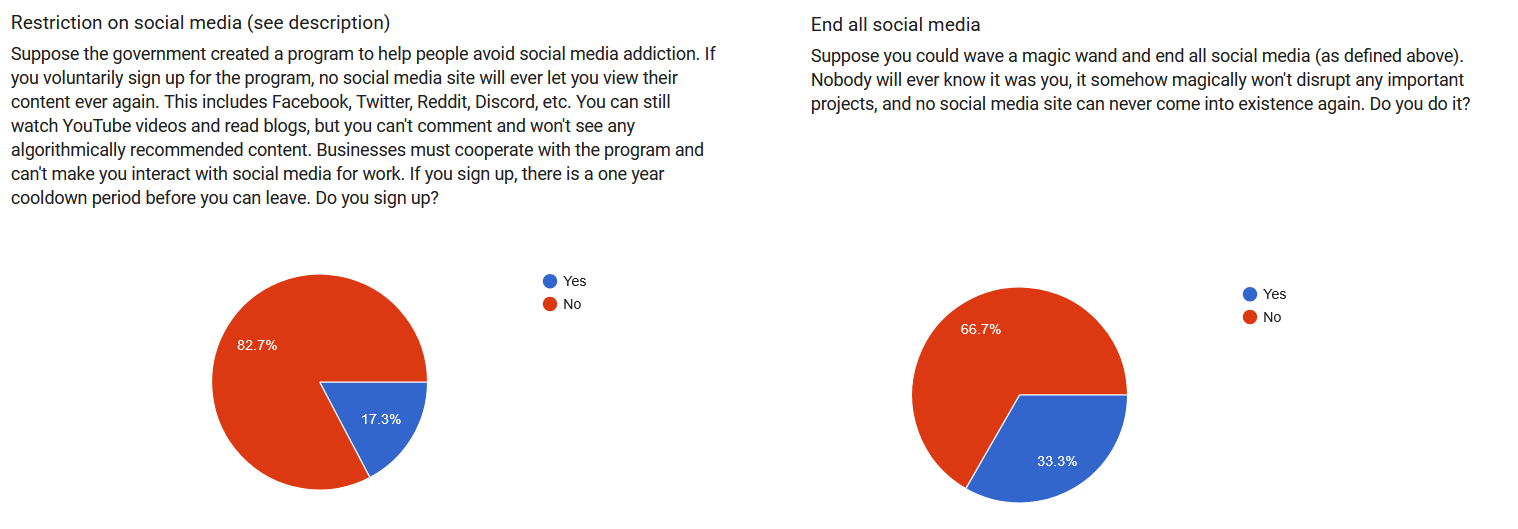
Pritchard nods to this by pointing out that “economic growth” gave us social media, but “do any of us really think social media has been a net benefit to human happiness?” I actually asked this question on an ACX survey, and was surprised how emphatically people rejected the “helpless automaton forced against my will to use social media” story:
[TODO: Think up cool reed-based metaphor for this.]