90% of all claims about the problems with medical studies are wrong
Scott Alexander examines the claim that '90% of medical research is false', arguing it's an exaggeration while acknowledging real issues in the field.
I have frequently heard people cite John Ioannidis’ apparent claim that “90% of medical research is false”.
I think John Ioannidis is a brilliant person and I love his work and I think this statement points at a correct and important insight. But as phrased, I think this particular formulation when not paired with any caveats creates just a little more panic than is warranted.
Before I go further, Ioannidis’ evidence:
He starts with simple statistics. Most studies are judged to have “discovered” a result if they reach p < 0.05, that is, if there is 5% probability or less the findings are due to mere chance (this is the best case scenario, where the study is totally free from bias or methodological flaws).
Suppose you throw a dart at the Big Chart O’ Human Metabolic Pathways and supplement your experimental group with the chemical you hit. Then ten years later you come back and see how many of them died of heart attacks.
Most chemicals on the Big Chart probably don’t prevent heart attacks. Let’s say only one in a thousand do. Maybe your study will successfully find that 1/1000. But the 999 inactive chemicals will also throw up about 50 (999 * 5%) false positives significant at the 5% level. Therefore, even if you conduct your study perfectly, and it shows a significant decrease in heart attacks, there’s about a 98% chance it’s false.
One would hope medical scientists plan their studies with a little more care than throwing a dart at a metabolic chart. Yet many don’t; a lot of genetic research is conducted by checking every single gene against the characteristic of interest and seeing if any stick. And even when scientists have well-thought out theories, the inherent difficulty of medicine means they probably have less than a 50-50 chance of being right the first time, which means a 5% significance level has a less than 5% predictive value.
And this isn’t even counting publication bias or poor methodology or conflicts of interest or anything like that.
Disturbingly, this problem seems to be borne out in empirical tests. Amgen Pharmaceuticals says it repeated experiments in 53 important papers and was only able to confirm 6. And Ioannidis himself did a re-analysis which is quoted as finding that “41% of the most influential studies in medicine have been convincingly shown to be wrong or significantly exaggerated.”
So I don’t at all disagree with the general consensus that this is a huge problem. But I do disagree with the following statements:
1. 90% of all medical research is wrong
2. A given study you read, or your doctor reads, is 90% likely to be wrong.
3. 90% of the things doctors believe, presumably based on these medical findings, is wrong.
4. This proves the medical establishment is clueless and hopelessly irrational and that two smart people working in a basement for five minutes can discover a new medical science far better than what all doctors could have produced in seventy years.
Is 90% of all medical research wrong?
As far as I can tell, there is no source at all for the 90% figure. I can’t find it in any of Ioannidis’ studies and indeed they contradict it. His table of predictive values of different studies doesn’t have any entries that correspond to 90% (“underpowered exploratory epidemiological study” is relatively close with 88%, but this is just for that one type of study, which is known to be especially bad). The Atlantic sums it up as:
His model predicted, in different fields of medical research, rates of wrongness roughly corresponding to the observed rates at which findings were later convincingly refuted: 80 percent of non-randomized studies (by far the most common type) turn out to be wrong, as do 25 percent of supposedly gold-standard randomized trials, and as much as 10 percent of the platinum-standard large randomized trials.
Notice which number is conspicuously missing from that excerpt.
Now another study of his did show that in 90% of studies with very large effect sizes, later research eventually found the effect size to be smaller, but this was out of a pool of studies specifically selected for being surprising and likely to be false. I don’t think it’s the source of the number and if it were that would be terrible.
As far as I can tell, this started from a quote in an Atlantic article on Ioannidis which included the line “he charges that as much as 90 percent of the published medical information that doctors rely on is flawed”. This then got turned into the title of a Time article “A Researcher’s Claim: 90% of Medical Research Is Wrong”, which itself got perverted to 90% of Medical Research Is Completely False.
So an unsourced quote that up to 90% of studies are flawed has somehow turned into a rallying cry that it has been proven that at least 90% of studies are false. To take this seriously we would have to believe that the numbers for all research are the same as the numbers for the poorly conducted epidemiological studies or the studies specifically selected for surprising results. I guess having a nice round number is good insofar as it makes the public pay attention to this field, but as far as actual numbers go, it’s kind of made up.
Is any given study you read, or your doctor reads, 90% likely to be wrong?
But let’s take the above number at face value and say that 90% of medical studies are wrong. Fine. Does that mean the last medical study you read about in Scientific American, or that your doctor used to recommend you a new drug, is wrong?
No. Let’s look at the Medical Evidence Pyramid.
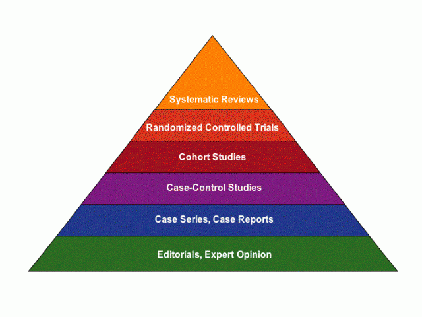 The medical evidence pyramid is much like all pyramids, in that the bottom levels are infested with snakes and booby traps and vengeful medical evidence mummies. It’s only after you reach the top few levels that you get the gold and jewels and precious, precious mummy powder.
This plays out in the same table of Ioannidis’ speculations we saw before. While an in vitro study of the type used to identify possible drug targets might have a positive predictive value of 0.1%, a good meta-analysis or great RCT has a positive predictive value of 85%; that is, it’s 85% likely to be true.
There are only two reasons someone might hear about the studies on the snake-infested bottom levels of the pyramid. Number one, that person is a specialist in the field who is valiantly trying to read through the entire niche medical journal the paper was published in. Or number two, the study found something incredible like DONUTS CURE CANCER IN A SAMPLE OF THREE LAB RATS!!! and the media decided to pick up on it. Hopefully everyone already ignores studies of the DONUTS CURE CANCER IN A SAMPLE OF THREE LAB RATES!!! type studies; if not, there’s really not much I can say to you.
But most of the medical results that you hear about are the ones that get published in important journals and are trumpeted far and wide as important medical results. These are closer to the top of the pyramid than to the bottom. They’re usually big expensive studies on thousands of people. Since the universities, hospitals, and corporations sponsoring them aren’t idiots, they usually hire a decent statistician or two to make sure that they don’t spend $300,000 testing something only to have a letter to the editor of the NEJM point out that they forgot to blind their subjects so it’s totally worthless. And finally, in many cases you would only run a study that big and expensive if you had something plausible to test – you’re not going to spend $300,000 just to throw a dart at the Big Chart O’ Human Metabolic Pathways and see what happens.
So these studies that people actually hear about are bigger, they have more incentives to get their methodology right, and they’re testing propositions with high plausibility. How do they do?
I said above that one of Ioannidis’ studies was frequently quoted as saying that “41% of the most influential studies in medicine have been convincingly shown to be wrong or significantly exaggerated.”
This is from a great study I totally endorse, but the 41% number was maximized for scariness. If I wanted to bias my reporting the other direction, I could equally well report the same results as “Only about 5% of influential medical experiments with adequate sample size have later been contradicted.”
How? Ioannidis got his result by taking all medical studies with over 1000 citations in the ’90s, of which there were 49. Of these, 4 were negative results (ie “X doesn’t work”) so he threw them out. This is the first part I think is kind of unfair. Yes, negative results aren’t as sexy as positive results, but they’re still influential medical research, and if Ioannidis is quoted as saying that X% of medical findings are later contradicted when he means that X% of positive medical findings are, that’s not quite fair.
Annnnyway, of the 45 famous studies with positive findings, 11 didn’t really get tested and so we don’t know if they’re right or wrong. Eliminating these is also a potential bias, because we expect that studies which seem sketchy are more likely to be replicated so people can find out if they’re actually right. Ioannidis quite rightly set himself a higher bar by not eliminating them, but the quote about 41% of studies being wrong does seem to have gone back eliminated them – at least that’s the only way I can make the study numbers add up to 41% (the numbers given in the study actually say 32% of these studies failed to replicate).
So our 41% number is based off of 34 studies, best described as “34 famous medical studies that found positive findings ie the least believable kind of finding, plus were suspicious enough that someone wanted to replicate them”.
Of these 34 studies, 7 were outright contradicted. Bad? Definitely. But for example, one of them was a study with a sample size of nine patients. Another study may well have been correct, but the results were interpreted wrongly (it said that estrogen decreased lipoprotein levels which everyone assumed meant decreased heart disease, but in fact later studies found increased heart disease without necessarily disproving the lipoprotein levels). Five of the six others were epidemiological trials, firmly on the middle of the pyramid. Only two of these contradicted studies were a true experiment with a sample size of >10.
(even here, I am sort of skeptical. Three of these disproven studies, two epidemiologicals and an experimental, purported to show Vitamin E decreased heart disease. Then a single better trial showed that Vitamin E did not decrease heart disease. While recognizing the last trial was better, it does seem like something more complicated is going on here than “all three of the earlier trials were just wrong”, and I’ve recently been convinced antioxidant research is a huge minefield where tiny differences in protocol can cause big differences in results. But fine, let’s grant this one and say there were two outright-contradicted experiments.)
So aside from the seven that were outright wrong, another seven were listed as “overstating their results”.
There are a couple of problems that bothered me here. One of them was that Ioannidis decided to count studies as contradicting each other if relative risk in one study was half or less than in the other study, “regardless of whether confidence intervals might overlap or not”. So even if a study effectively said “Here is a wide range of possible results, we think it’s about here in the middle but our research is consistent with it being anywhere in this range”, if another study got somewhere else in that range, the first study was marked as “exaggerated”.
The second problem is, once again, poor studies versus poor interpretations. Ioannidis cites as an example of an exaggerated study one lasting a year and showing that the drug zidovudine helped slow the progression of HIV to AIDS. It concluded that giving HIV patients long-term zidovudine was probably a good idea. A later study lasted longer, and said that yes, zidovudine worked for a year, but then it stopped working. Because the earlier study had suggested longer-term zidovudine, it was marked as “exaggerated results”, even though the results of both studies were totally consistent with one another (both found that zidovudine worked for the first year). This is probably of little consolation to AIDS patients who were treated with a useless drug, but it seems pretty important if we’re investigating study methodology.
So the way I got my 5% figure was to take the two experimental studies with decent sample sizes which were actually contradicted and compare them to the 38 large experimental studies total that started the experiment.
So this suggests that if you see a large experimental study being trumpeted in the medical literature, the chance that it will be found to be totally false (as opposed to true but exaggerated) within ten years or so is only about 5% – which if you understand p-values is about what you should have believed already.
(I think. This requires quite a few assumptions, not the least of which is that my calculations above are correct!)
Also worth noting: Ioannidis’ experiment did not investigate the absolute highest level of the medical pyramid, systematic reviews and meta-analyses. I expect the best of these to be better than any individual study.
3. Are 90% of the things doctors believe, presumably based on medical findings, wrong?
After going through the steps above, it should be pretty obvious that the answer is no, because doctors are mostly reading famous influential studies like the ones mentioned above, which are at worst 40% and at best 5% wrong.
But there’s another factor to be taken into account, which is that why would you only read one study on something when lots of important findings have been investigated multiple times?
Suppose that you’re throwing darts at the Big Chart O’ Human Metabolic Pathways, with your 1/1000 base rate of true hypotheses. You run a very good methodologically sound study and find p = .05. But now there’s still only a 1/50 chance your hypothesis is correct.
But another team in China runs the same study, and they also find p = .05. We expect the Chinese to get false to true results at a rate of one to two (because the 1 in the 1/50 stays 1, but the 50 is divided by 20 to produce approximately 2. Wow, I’m even worse at explaining math than I am at doing it.)
Now a team in, oh, let’s say Turkey runs the same study, and they also find p = .05. We expect the Turks to get false to true results at a rate of one to ten, for, uh, the same math reasons as the Chinese. When the, um, Icelanders repeat the study, our odds go to one to two hundred.
So we started with 1000:1 odds, the first study brought us up to 50:1 odds, the second study to 2:1 odds, the third study to 1:10 odds, and the fourth study to 1:200 odds, ie we are now 99.5% sure we’re right.
Real medicine is both better and worse than this. It’s better in that we often have dozens of studies rather than just four. It’s worse in that the studies are not all so methodologically sound that we can multiply our odds by 20 each time (to put it lightly).
But some of them are, and once we get enough of them, the base rate problems which plague individual medical findings go away very quickly. Even if only one of the studies is methodologically sound, if the reason they’re studying their topic is because a bunch of other less believable studies all got positive results, that’s a much better base rate than “because I hit it with my dart”.
When doctors say that, for example, iron supplements help anaemia, it’s not because they hit iron on their Big Chart O’ Human Metabolic Pathways, then ran a single study, got p = .05, and rushed off to publish a medical textbook. It’s because they knew hemoglobin had iron in it, there are at least 21 randomized controlled studies, probably some had p-values closer to .001 than to .05 even though I don’t have any of them in front of me to check, and eventually some really really smart statisticians at the Cochrane Collaboration gave it their seal of approval. Most doctors’ beliefs aren’t on quite this high a level, but most doctors’ beliefs aren’t on the “Someone threw a dart, then did one study” level either.
4. Does this prove the medical establishment is clueless and hopelessly irrational and that two smart people working in a basement for five minutes can discover a new medical science far better than what all doctors could have produced in seventy years?
A lot of people seem to go from Ioannidis’ experiment to something like “So I guess everyone in medicine is just clueless about how science and statistics work. I’ll go read a couple of medical studies and then be able to outperform everyone in this totally flawed field.”
(important note: I’m not accusing MetaMed of this! They seem pretty sane. I am accusing some people I come across in the community who are much more enthusiastic than the relatively sober MetaMed people of doing something like this.)
But the problem isn’t that no one in medicine is familiar with Ioannidis’ research. It’s that they’re not really sure what to do about it and figuring out a plan and implementing it will take time and effort.
Ioannidis’ work isn’t exactly secret. I’ve hung out with groups of residents (ie trainee doctors) who have discussed Ioannidis’ findings over the dinner table. According to The Atlantic
To say that Ioannidis’s work has been embraced would be an understatement. His PLoS Medicine paper is the most downloaded in the journal’s history, and it’s not even Ioannidis’s most-cited work—that would be a paper he published in Nature Genetics on the problems with gene-link studies. Other researchers are eager to work with him: he has published papers with 1,328 different co-authors at 538 institutions in 43 countries, he says. Last year he received, by his estimate, invitations to speak at 1,000 conferences and institutions around the world, and he was accepting an average of about five invitations a month until a case last year of excessive-travel-induced vertigo led him to cut back.
So if so many people are aware of this, why isn’t the problem getting fixed more quickly?
An optimist could say the problem isn’t getting fixed because there is no problem. A vast volume of embarassingly wrong medical literature gets published, inflates the publishers’ resumes, and everyone else ignores it and concentrates on the not-really-so-bad large randomized trials. To the post-cynic it is all a smooth, well-functioning machine.
A pessimist might say that the problem isn’t getting fixed because it’s impossible. The average medical hypothesis is always going to have a low base rate of being true – in fact, if we force scientists to only study high base-rate hypotheses, by definition everything we discover will be boring. There will never be enough resources to apply huge rigorous trials to every one of the millions of things worth studying. So we’re always going to have weak studies about low-base rate hypotheses, which is what Ioannidis is attacking as the recipe for failure.
A realist might point out there are some things we can do, but it involves coordinating a huge and complicated system with many moving parts. Journals can force trials to register before they conduct their experiments to avoid publication bias. The scientific community can give more status to people who perform important replications and especially important negative replications. Study authors and the media can come up with better ways to report their results to doctors and the public without blowing them out of proportion. Statisticians can…actually, anything I say statisticians can do is just going to be a mysterious answer, along the lines of “do better statistics stuff”, so I’m not going to embarass myself by completing this sentence except to postulate that I’ll bet there’s some recommendation that could complete it usefully.
But all these things involve vague entities who aren’t really actors (“the scientific community”, “the media”) acting in ways that are kind of against their immediate incentives. This is hard to make people do and usually involves a lot of grassroots coordination effort. Which is going on. But it takes time.
But no matter what happens, I think a useful epistemic habit is to be very skeptical of individual studies, and skeptical but not too skeptical of large randomized trials, good meta-analyses, and general medical consensus when supported by an evidence base.