Against Dog Whistle-ism
Scott Alexander criticizes media tendencies to label politicians as racist or sexist based on ambiguous statements, arguing we should focus more on their stated positions and actions.
I.
Back during the primary, Ted Cruz said he was against “New York values”.
A chump might figure that, being a Texan whose base is in the South and Midwest, he was making the usual condemnation of coastal elites and arugula-eating liberals that every other Republican has made before him, maybe with a special nod to the fact that his two most relevant opponents, Donald Trump and Hillary Clinton, were both from New York.
But sophisticated people immediately detected this as an “anti-Semitic dog whistle”, eg Cruz’s secret way of saying he hated Jews. Because, you see, there are many Jews in New York. By the clever strategem of using words that had nothing to do with Jews or hatred, he was able to effectively communicate his Jew-hatred to other anti-Semites without anyone else picking up on it.
Except of course the entire media, which seized upon it as a single mass. New York values is coded anti-Semitism. New York values is a classic anti-Semitic slur. New York values is an anti-Semitic comment. New York values is an anti-Semitic code word. New York values gets called out as anti-Semitism. My favorite is this article whose headline claims that Ted Cruz “confirmed” that he meant his New York values comment to refer to Jews; the “confirmation” turned out to be that he referred to Donald Trump as having “chutzpah”. It takes a lot of word-I-am-apparently-not-allowed-to-say to frame that as a “confirmation”.
Meanwhile, back in Realityville (population: 6), Ted Cruz was attending synagogue services at his campaign tour, talking about his deep love and respect for Judaism, and getting described as “a hero” in many parts of the Orthodox Jewish community” for his stance that “if you will not stand with Israel and the Jews, then I will not stand with you.”
But he once said “New York values”, so clearly all of this was just really really deep cover for his anti-Semitism.
II.
Unlike Ted Cruz, former London mayor Ken Livingstone said something definitely Jew-related and definitely worrying.
A month or two ago a British MP named Naz Shah got in trouble for sharing a Facebook post saying Israel should be relocated to the United States. Fellow British politician Ken Livingstone defended her, and one thing led to another, and somewhere in the process he might have kind of said that Hitler supported Zionism.
This isn’t totally out of left field. During the Nazi period in Germany, some Nazis who wanted to get rid of the Jews and some Jews who wanted to get away from the Nazis created the Haavara Agreement, which facilitated German Jewish emigration to Palestine. Hitler was ambivalent on the idea but seems to have at least supported some parts of it at some points. But it seems fair to say that calling Hitler a supporter of Zionism was at the very least a creative interpretation of the historical record.
The media went further, again as a giant mass. Ken Livingstone is anti-Semitic. Ken Livingstone is anti-Semitic. Ken Livingstone is anti-Semitic. Ken Livingstone is anti-Semitic. Ken Livingstone is anti-Semitic. I understand he is now having to defend himself in front of a parliamentary hearing on anti-Semitism.
So. First things first. Ken Livingstone is tasteless, thoughtless, embarrassing, has his foot in his mouth, is inept, clownish and offensive, and clearly made a blunder of cosmic proportions.
But is he anti-Semitic?
When I think “anti-Semitic”, I think of people who don’t like, maybe even hate, Jews. I think of the medieval burghers who accused Jews of baking matzah with the blood of Christian children. I think of the Russians who would hold pogroms and kill Jews and burn their property. I think of the Nazis. I think of people who killed various distant family members of mine without a second thought.
Obviously Livingstone isn’t that anti-Semitic. But my question is, is he anti-Semitic at all? Is there any sense in which his comments reveal that, in his heart of hearts, he really doesn’t like Jews? That he thinks of them as less – even slightly less – than Gentiles? That if he were to end up as Prime Minister of Britain, this would be bad in a non-symbolic, non-stupid-statement-related way for Britain’s Jewish community? Does he just say dumb things, or do the dumb things reflect some underlying attitude of his that colors his relationship with Jews in general?
(speaking of “his relationship with Jews”, he brings up in his own defense that two of his ex-girlfriends are Jewish)
I haven’t seen anyone present any evidence that Livingstone has any different attitudes or policies towards Jews than anyone else in his general vicinity. I don’t think even his worst enemies suggest that during a hypothetical Livingstone administration he would try (or even want) to kick the Jews out of Britain, or make them wear gold stars, or hire fewer Jews for top posts (maybe he’d hire more, if he makes his hiring decisions the same way he makes his dating decisions). It sounds like he might be less sympathetic to Israel than some other British people, but I think he describes his preferred oppositional policies toward Israel pretty explicitly. I don’t think knowing that he made a very ill-advised comment about the Haavara agreement should make us believe he is lying about his Israel policies and would actually implement ones that are even more oppositional than he’s letting on.
Where am I going with this? It’s stupid to care that Ken Livingstone describes 1930s Germany in a weird way qua describing 1930s Germany in a weird way; he’s a politician and not a history textbook writer. It seems important only insofar as his weird description reveals something about him, insofar as it’s a sort of Freudian slip revealing deep-seated attitudes that he had otherwise managed to keep hidden. The British press framed Livingstone’s comments as an explosive revelation, an “aha! now we see what Labour is really like!” They’re really like…people who describe the 1930s in a really awkward and ill-advised way? That’s not a story. It’s a story only if the weird awkward description reveals more important attitudes of Livingstone’s and Labour’s that might actually affect the country in an important way.
But not only is nobody making this argument, but nobody even seems to think it’s an argument that has to be made. It’s just “this is an offensive thing involving Jews, that means it’s anti-Semitic, that means the guy who said it is anti-Semitic”. Maybe he is. I’m just not sure this incident proves much one way or the other.
III.
Nobody reads things online anymore unless they involve senseless violence, Harambe the gorilla, or Donald Trump. I can’t think of a relevant angle for the first two, so Trump it is.
Donald Trump is openly sexist. We know this because every article about him prominently declares that he is “openly sexist” or “openly misogynist” in precisely those words. Trump is openly misogynist. Trump is openly misogynist. Trump is openly misogynist. Trump shows blatant misogyny. Trump is openly sexist. Trump is openly sexist and gross.
But if you try to look for him being openly anything, the first quote anyone mentions is the one where he says Megyn Kelly has blood coming out of her “wherever”. As somebody who personally ends any list of more than three items with “… and whatever”, I may be more inclined than most to believe his claim that no anatomical reference was intended. But even if he was in fact talking about her anatomy – well, we’re back to Livingstone again. The comment is crude, stupid, puerile, offensive, gross, inappropriate, and whatever. But sexist?
When I think of “sexist” or “misogynist”, I think of somebody who thinks women are inferior to men, or hates women, or who thinks women shouldn’t be allowed to have good jobs or full human rights, or who wants to disadvantage women relative to men in some way.
This does not seem to apply very well to Trump. It’s been remarked several times that his policies are more “pro-women” in the political sense than almost any other Republican candidate in recent history – he defends Planned Parenthood, defends government support for child care, he’s flip-flopped to claiming he’s pro-life but is much less convincing about it than the average Republican. And back before his campaign, he seems to have been genuinely proud of his record as a pro-women employer. From his Art of the Deal, written in the late 1980s (ie long before he was campaigning):
The person I hired to be my personal representative overseeing the construction, Barbara Res, was the first woman ever put in charge of a skyscraper in New York…I’d watched her in construction meetings, and what I liked was that she took no guff from anyone. She was half the size of most of these bruising guys, but she wasn’t afraid to tell them off when she had to, and she knew how to get things done.
It’s funny. My own mother was a housewife all her life. And yet it’s turned out that I’ve hired a lot of women for top jobs, and they’ve been among my best people. Often, in fact, they are far more effective than the men around them. Louise Sunshine, who was an executive vice president in my company for ten years, was as relentless a fighter as you’ll ever meet. Blanche Sprague, the executive vice president who handles all sales and oversses the interior design of my buildings, is one of the best salespeople and managers I’ve ever met. Norma Foerderer, my executive assistant, is sweet and charming and very classy, but she’s steel underneath, and people who think she can be pushed around find out very quickly that they’re mistaken.
There have since been a bunch of news reports on how Trump was (according to the Washington Post) “ahead of his time in providing career advancement for women” and how “while some say he could be boorish, his companies nurtured and promoted women in an otherwise male-dominated industry”. According to internal (ie hard-to-confirm) numbers, his organization is among the few that have more female than male executives.
Meanwhile, when I check out sites like Women Hold Up Signs With Donald Trump’s Most Sexist Quotes, the women are holding up signs with quotes like “A person who is flat-chested is very hard to be a 10” (yes, he actually said that). This is undeniably boorish. But are we losing something when we act as if “boorish” and “sexist” are the same thing? Saying “Donald Trump is openly boorish” doesn’t have the same kind of ring to it.
This bothers me in the same way the accusations that Ken Livingstone is anti-Semitic bother me. If Trump thinks women aren’t attractive without big breasts, then His Kink Is Not My Kink But His Kink Is Okay. If Trump is dumb enough to say out loud that he thinks women aren’t attractive without big breasts, that says certain things about his public relations ability and his dignity-or-lack-thereof, but it sounds like it requires a lot more steps to suggest he is a bad person, or would have an anti-woman administration, or anything that we should actually care about.
(if you’re going to bring up “objectification”, then at least you have some sort of theory for how this tenuously connects, but it doesn’t really apply to the Megyn Kelly thing, and anyway, this)
And what bothers me most about this is that word “openly”. Donald Trump says a thousand times how much he wants to fight for women and thinks he will be a pro-women president, then makes some comments that some people interpret as revealing a deeper anti-women attitude, and all of a sudden he’s openly sexist? Maybe that word doesn’t mean what you think it means.
IV.
I don’t want to claim dog whistles don’t exist. The classic example is G. W. Bush giving a speech that includes a Bible verse. His secular listeners think “what a wise saying”, and his Christian listeners think “ah, I recognize that as a Bible verse, he must be very Christian”.
The thing is, we know G. W. Bush was pretty Christian. His desire to appeal to Christian conservatives isn’t really a secret. He might be able to modulate his message a little bit to his audience, but it wouldn’t be revealing a totally new side to his personality. Nor could somebody who understood his “dog whistles” predict his policy more accurately than somebody who just went off his stated platform.
I guess some of the examples above might have gotten kind of far from what people would usually call a “dog whistle”, but I feel like there’s an important dog-whistle-related common thread in all of these cases.
In particular, I worry there’s a certain narrative, which is catnip for the media: Many public figures are secretly virulently racist and sexist. If their secret is not discovered, they will gain power and use their racism and sexism to harm women and minorities. Many of their otherwise boring statements are actually part of a code revealing this secret, and so very interesting. Also, gaffes are royal roads to the unconscious which must be analyzed obsessively. By being very diligent and sophisticated, journalists can heroically ferret out which politicians have this secret racism, and reveal it to a grateful world.
There’s an old joke about a man who walks into a bar. The bar patrons are holding a weird ritual. One of them will say a number, like “twenty-seven”, and the others of them will break into laughter. He asks the bartender what’s going on. The bartender explains that they all come here so often that they’ve memorized all of each other’s jokes, and instead of telling them explicitly, they just give each a number, say the number, and laugh appropriately. The man is intrigued, so he shouts “Two thousand!”. The other patrons laugh uproariously. “Why did they laugh more at mine than any of the others?” he asks the bartender. The bartender answers “They’d never heard that one before!”
In the same way, although dog whistles do exist, the dog whistle narrative has gone so far that it’s become detached from any meaningful referent. It went from people saying racist things, to people saying things that implied they were racist, to people saying the kind of things that sound like things that could imply they are racist even though nobody believes that they are actually implying that. Saying things that sound like dog whistles has itself become the crime worthy of condemnation, with little interest in whether they imply anything about the speaker or not.
Against this narrative, I propose a different one – politicians’ beliefs and plans are best predicted by what they say their beliefs and plans are, or possibly what beliefs and plans they’ve supported in the past, or by anything other than treating their words as a secret code and trying to use them to infer that their real beliefs and plans are diametrically opposite the beliefs and plans they keep insisting that they hold and have practiced for their entire lives.
Let me give a snarky and totally unfair example. This is from the New York Times in 1922 (source):
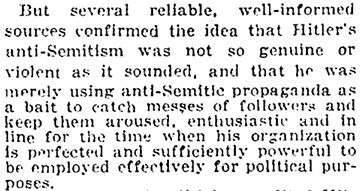 I won’t say we should always believe that politicians are honest about their beliefs and preferred policies. But I am skeptical when the media claims to have special insight into what they really think.
