AI Persuasion Experiment Results
Scott Alexander's experiment tested how different essays affect people's concerns about AI risk, finding a modest but persistent increase in concern after reading.
I.
Last month I asked three thousand people to read some articles on AI risk and tell me how convinced they were. Last week, I asked them to come back and tell me some more stuff, to see if they stayed convinced.
I started off interested in the particular articles – which one was best at convincing newcomers to this topic. But I ended up hoping this could teach me about persuasion in general. Can online essays change people’s minds about complicated, controversial topics? Who is easiest to convince? Can we figure out what features of an essay do or don’t change people’s minds?
Depending on the last digit of people’s birth dates, I asked them to read one of five different essays:
— I asked people whose birth dates ended with 0 or 1 to read Wait But Why’s The AI Revolution: The Road To Superintelligence.
— I asked people whose birth dates ended with 2 or 3 to read a draft version of my own Superintelligence FAQ.
— I asked people whose birth dates ended with 4 or 5 to read Lyle Cantor’s Russell, Bostrom, And The Risk Of AI.
— I asked people whose birth dates ended with 6 or 7 to read Michael Cohen’s Extinction Risk From Artifical Intelligence.
— And I asked people whose birth dates ended with 8 or 9 to read Sean Carroll’s Maybe We Do Not Live In A Simulation. This had nothing to do with AI risk and was included as a placebo – that is, to get a group who had just had to read an online essay but presumably hadn’t had their minds changed about AI.
I hosted all of these pieces on Slate Star Codex and stripped them of any identifiers so that hopefully people would judge them based on content and not based on how much they liked the author or what color the page background was or whatever. It mostly worked: only 67% of readers had no idea who had written the essay, with another 23% having only vague guesses. Only about 10% of readers were pretty sure they knew.
People did read the essays: 70% of people said they finished all of theirs, and another 22% read at least half.
So the experiment was in a pretty good position to detect real effects on persuasion if they existed. What did it find?
II.
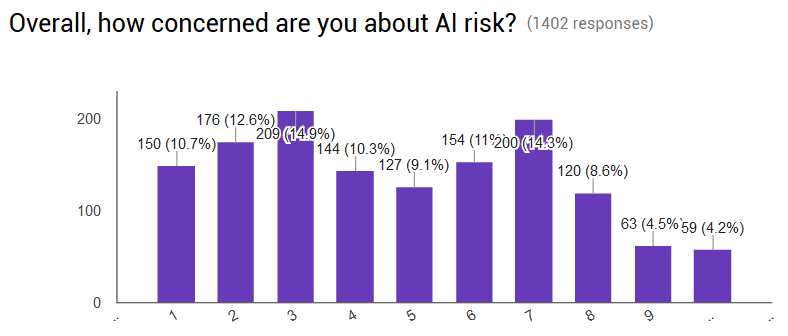
My outcome was people’s ratings on a score of 1 – 10 for various questions relating to AI. My primary outcome, selected beforehand, was their answer to the question “Overall, how concerned are you about AI risk?” About half of the respondents took a pre-test, and I got the following results:
 After reading the essays, this changed to:
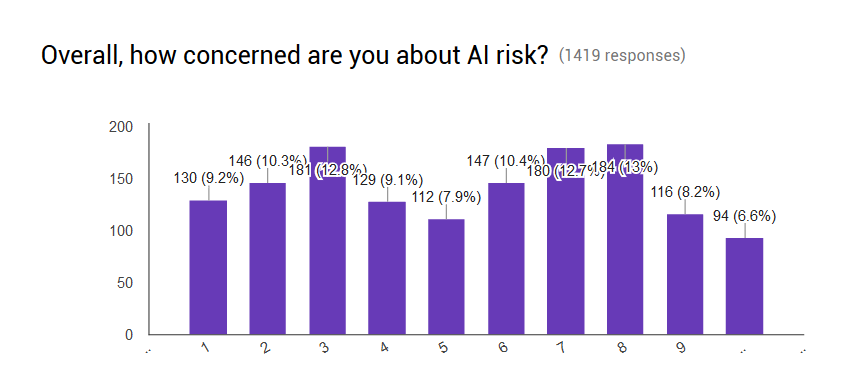 Overall, people increased their concern an average of 0.5 points.
(Note that I only had half the sample take a pretest, because I was worried that people would anchor to their pretest answers and give demand effects. This turned out not to be a big deal; the people who had taken a pretest changed in the same ways as the people who hadn’t. I’ve combined all data.)
But what about the different essays? All five groups had means between 5 and 6, but the exact numbers differed markedly.
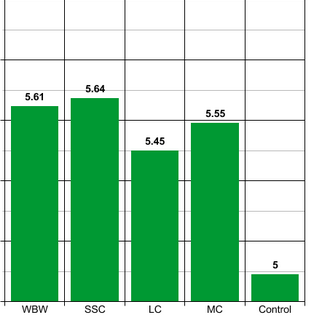
Note truncated y-axis
On further testing, the differences between the four active essays weren’t significant, but the difference between all of the essays and the control was significant.
III.
Aside from the primary outcome, I also had various secondary outcomes: answers to specific questions about AI risk. First, a list of average pretest and posttest answers (pretest, posttest):
How likely are we to invent human-level AI before 2100?: 5.7, 5.9
How likely is human-level AI to become superintelligent within 30 years?: 7.3, 7.3
How likely is human-level AI to become superintelligent within 1 year?: 4.8, 5.2
How likely that a superintelligent AI would turn hostile to humanity?: 6.4, 6.8
How likely that a hostile superintelligence would defeat humans?: 6.8, 7.1
All the nonzero differences here were significant.
If we look at this as a conjunction of claims, all of which have to be true before AI risk becomes worth worrying about, then it looks like the weak links in the chain are near-term human-level AI and fast takeoff. Neither of these are absolutely necessary for the argument, so this is kind of encouraging. There is less opposition than I would expect to claims that AI will eventually become superintelligent, or to claims that a war with a superintelligent AI would go very badly for humans.
Given the level of noise, there wasn’t a lot of evidence that any of the (active) essays were more persuasive than others on any of the steps, including the two dubious steps. This is actually a little surprising, since some essays focused on some things more than others. Possibly there was a “rising tide lifts all boats” effect where people who were more convinced of AI risk in general raised their probability at every step. But there was too much noise to say so for sure.
IV.
Was there any difference among people who were already very familiar with AI risk, versus people who were new to the topic?
It was hard to tell. Only about two percent of readers here had never heard about the AI risk debate, and 60% said they had at least a pretty good level of familiarity with it.
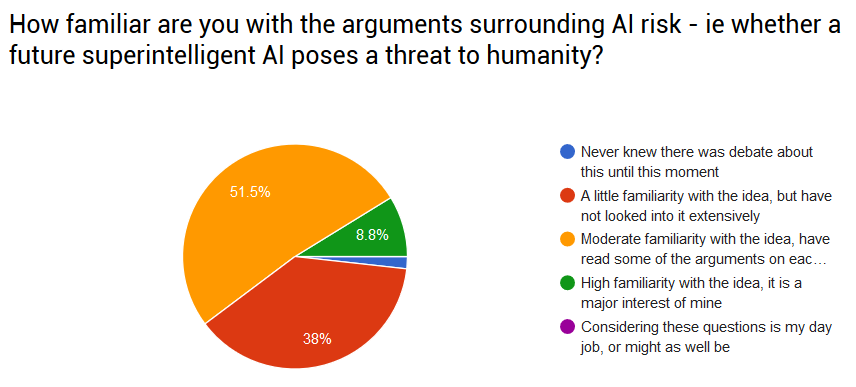 The best I could do was to look at the 38% of participants (still about 1000 people!) who had only “a little familiarity” with the idea. Surprisingly, these people’s minds didn’t change any more than their better-informed peers. The average “little familiarity” person became 0.8 points more concerned, which given the smaller sample size wasn’t that different from the average person’s 0.5.
In general, people who knew very little about AI thought it was less important (r = 0.47), which makes sense since probably one reason people study it a lot is because they think it matters.
V.
How stable were these effects after one month?
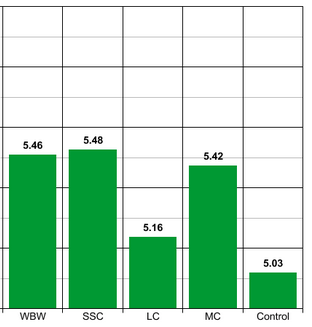
Still truncated y-axis
Pretty stable.
Other than an anomalous drop in the third group (I’m sticking with “noise”), the effect remained about two-thirds as strong as it had been the moment after the participants read the essays. All essay groups remained significantly better than the control group.
I looked at the subgroup of people who’d had little knowledge of AI risk before starting the experiments. There was a lot more noise here so it was harder to be sure, but it seemed generally consistent with the same sort of effect.
So in conclusion, making people read a long essay on AI risk changed their overall opinions about half a point on a ten-point scale. There weren’t major differences between essays. This was true whether or not they were already pretty familiar with it. And about two-thirds of the effect persisted after a month.
At least in this area, there might be a modest but useful effect from trying to persuade people.
In terms of which essay to use to persuade people? I don’t have any hard-and-firm results, but there were two trends I noticed. First, my essay was somewhat underrepresented among the people who’d had the biggest jumps (3 points or more) in their level of concern. Second, the third essay was anomalously bad at maintaining its gains over the month. That leaves just the first and fourth. Some people in the comments said they were actively repulsed by the fourth, and WaitButWhy seems pretty good, so at the risk overinterpreting noise, you might as well just send people theirs.
You can find the chaotic and confusingly-labeled data below. It might help to read the survey itself to figure out what’s going on.
Main experiment: .xlsx, .csv
One month follow-up: .xls, .csv