Anxiety Sampler Kits
Scott Alexander introduces an 'Anxiety Sampler Kit' for testing various anxiety supplements, aiming to personalize treatment and gather data through self-experimentation.
The best thing about personalized medicine is that it’s obviously right. The worst thing is we mostly have no idea how to do it. We know that different people respond to different treatments. But outside a few special cases like cancer, we don’t know how to predict which treatment will work for which person. Some psychiatric researchers claim they can do this at a high level; I think they’re wrong. For most treatments and most conditions, there’s no way to figure out whether a given sometimes-effective treatment will work on a given individual besides trying it and seeing.
This suggests that some chronic conditions might do best with a model centered around a controlled process of guess-and-check. When it’s safe and possible, we should be maximizing throughput – finding out how to test as many medications as we can in the short time before we exhaust our patients’ patience, and how to best assess the effects of each. The process of treating each individual should mirror the process of medicine in general, balancing the need to run controlled trials and gather more evidence with the need to move quickly.
I don’t know how seriously to take this idea, but I would like to try it.
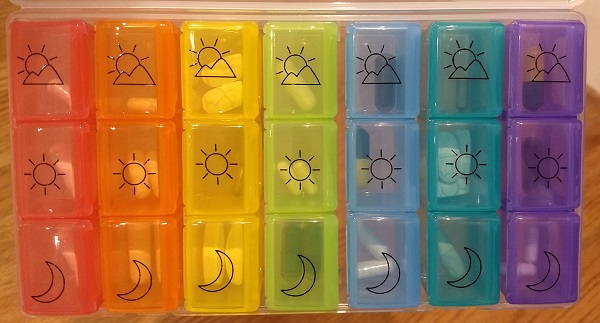 Some friends and I made thirty of these Anxiety Sampler Kits, containing six common supplements with some level of scientific and anecdotal evidence for treating anxiety (thanks to Patreon donors for helping fund this). The 21 boxes include three nonconsecutive boxes of each supplement, plus three boxes of placebos. They’re randomly arranged and designed so that you can’t tell which ones are which – I even put some of the supplements into different colored capsules, so you can’t even be sure that two capsules that look different aren’t the same thing.
Each box contains enough supplement for one dose, and all supplements are supposed to work within an hour or so. Whenever you feel anxious, you try the first non-empty box remaining. Afterwards, you rate how you felt on the attached log (not pictured). When you’ve finished all twenty-one boxes, you fill out a form (link is on the attached paperwork) and figure out whether there was any supplement you consistently rated higher than the others, or whether any of them were better than placebo. If your three highest ratings all went to boxes which turned out to contain the same supplement, and it did much better than placebo, then you have a strong argument that this is the best anti-anxiety supplement for you.
(this setup isn’t quite as irresponsible as it sounds. The six supplements I’m using are all considered very safe. I’m not concealing which six supplements are in it – it’s magnesium, 5-HTP, GABA, Zembrin, lemon balm, and l-theanine – so you can check if you have allergies to any of them. And there’s a spoilers page available if you have a bad reaction and need to tell your doctor what caused it)
Also on the form is a link to send me your data, which I’m asking you to do as a condition for using the kits. I’ll add everything up and this will double as an n = 30 placebo-controlled trial of six different supplements. I don’t think n = 30 is enough to impress anybody, but it might be enough to get some informal hunches about what works and be able to give people better advice. And if the experiment goes well, I can always make more kits.
If you live in the Bay Area, have enough anxiety that you expect to use a sample at least two days a week, and are okay with self-experimentation, these kits might be for you. Starting tonight I’m leaving a box full of them at the Rationality & Effective Altruism Community Hub, on the ground floor of 3045 Shattuck, Berkeley. REACH is usually open (or contains people who will open it if you knock) at all reasonable hours, and the caretaker there is aware that people might be coming in to get these kits. If you notice the box is out of kits, please comment here telling me so and I’ll add an update so people don’t waste their time. [EDIT: All out of kits, sorry! Once I have gotten results I might make a new batch.]
Remember that by taking a kit, you’re saying you expect to have anxiety that you’d be willing to experiment on at least twice a week (it’s okay if it doesn’t work out this way exactly) and you’re committing to – if you’re able to finish the test – sending me a form with your results. People who are pregnant or nursing, who have relevant preexisting medical conditions, or who are already taking potentially-interacting medications should talk to their doctor before trying these kits. I will not give you medical advice about whether these kits are safe for your specific situation, so please don’t ask. If you would be comfortable taking a random supplement you got off the shelf at Whole Foods, you should feel comfortable with everything in here.
I might take this idea further, but I’m going to wait until the first set of results come in. If you are interested in taking this idea further, send me an email and let me know your thoughts.