Apart From Better Sanitation And Medicine And Education And Irrigation And Public Health And Roads And Public Order, What Has Modernity Done For Us?
Scott Alexander uses historical data to refute the Reactionary claim that modern society increases war, showing instead that violence has decreased significantly in progressive eras.
. . .
Brought peace.
As you may have noticed, instead of another GIGANTIC WALL OF TEXT I am trying to write my rebuttal to Reactionary philosophy in the form of several smaller posts that I can then link together in a sequence index. This particular post addresses Reactionary claims that modern society causes international instability, leading to increased war (or increased “total war”) and the resulting mayhem.
This claim I received mostly from blog posts I can’t find right now and from discussions with Michael Anissimov. It goes that when states are fully sovereign, self-interested, and run by noble classes – as they were long ago – their wars are rare, as short as possible, and mostly fought in a civilized way.
But when states are subject to a larger international order (like the UN or “international law”), interested in ideological concerns, and governed by a host of factions competing for democratic power – as they are today – wars are more common, bungled into increased length and fatality, and turn into “total war” where anything goes and civilians are considered valid targets.
Michael specifically mentioned the Congress of Vienna as an example of the old order, pointing out that a bunch of aristocrats met up, divided Europe among them, and there was peace for decades afterwards. He compared this to the inelegance of modern “police actions” and “foreign interventions”, pointing out how World Wars I and II, at the beginning of the modern era, were unmatched in their deadliness and brutality.
Luckily, these questions about war and the stability of different models of international relations can be investigated empirically. Are wars worse today, or were we worse during the old aristocratic era? By what standards?
Let’s ask the media! War Is Going Out Of Style, says the New York Times. War And Violence On The Decline In Modern Times, trumpets NPR. Josh Goldstein says we are “winning the war on war”, Steven Pinker proclaims the victory of the better angels of our nature, and John Mueller even more triumphantly posits that War Has Almost Ceased To Exist
The statistics bear them out. The BBC notes:
The Human Security Report found a decline in every form of political violence except terrorism since 1992. “A lot of the data we have in this report is extraordinary,” its director, former UN official Andrew Mack, said.
It found the number of armed conflicts had fallen by more than 40% in the past 13 years, while the number of very deadly wars had fallen by 80%.
The study says many common beliefs about contemporary conflict are “myths” – such as that 90% of those killed in current wars are civilians, or that women are disproportionately victimised. The report credits intervention by the United Nations, plus the end of colonialism and the Cold War, as the main reasons for the decline in conflict.
The trend is older than just this decade. According to Goldstein:
In fact, the last decade has seen fewer war deaths than any decade in the past 100 years, based on data compiled by researchers Bethany Lacina and Nils Petter Gleditsch of the Peace Research Institute Oslo. Worldwide, deaths caused directly by war-related violence in the new century have averaged about 55,000 per year, just over half of what they were in the 1990s (100,000 a year), a third of what they were during the Cold War (180,000 a year from 1950 to 1989), and a hundredth of what they were in World War II. If you factor in the growing global population, which has nearly quadrupled in the last century, the decrease is even sharper. Far from being an age of killer anarchy, the 20 years since the Cold War ended have been an era of rapid progress toward peace.
And Steven Pinker shows the following graph:
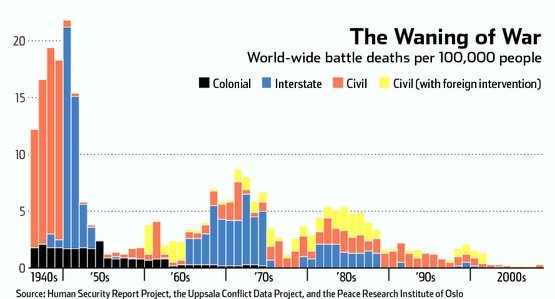 So there’s more than enough data to show the world has been getting more peaceful over the past seventy years. The most plausible Reactionary response would be that this is too small a time horizon: that the horrors of progressivism should be viewed over a timescale of centuries.
First of all, this shouldn’t be true. A staple of Reactionary thought is that the world has become notably more progressive since World War II, and a hyper-willingness to attribute anything that’s declined since that period to the progressive world-view. What’s good for the goose is good for the gander. Second, it is very suspicious to say that the part of the data you don’t have good statistics for, and only that part of the data, proves your point.
But in order to address this objection more fully, I tried to get fuzzy ballpark area data on the deadliness of wars in past centuries. My methodology was to comb Wikipedia’s list of wars by death toll, take all the ones with casualties of one million or greater, and organize them by era. The eras I used were 21st Century So Far, 1950-2000, 1900-1950, 1850-1900, 1800 -1850, 1700-1800, 1600-1700, 1500-1600, 1000-1500, 1-1000, and 500 BC – 1. Where casualties were given as a range, I took the center of that range, except in the Taiping Rebellion where I believe the top of Wikipedia’s range is crazy high and so I took nearer the bottom; where conflicts spanned more than one era, I placed them in the one containing the majority of the conflict.
I added up total war casualties for each era, then scaled them by population using 2005 as the standard – that is, deaths were multiplied so that the new number was the same percent of the 2005 population as the original was of its own era’s population. Then I divided by the length of the era to give average deaths per century during that era.
The 1900 – 1950 era indeed came on top, with 626 million projected deaths per century per 2005 population. Second place was 1600 – 1700, with 442 million. Other violent periods of note were 1850 – 1900 (326M), 1000 – 1500 (230M), and 1800-1850 (106M). There was no obvious trend related to time.
However one trend worthy of note is that the 21st Century So Far and the period 1950-2000 were by far the two most peaceful eras of any in the study (both at about 28M).
So the most progressive periods in history are also the most peaceful. And the Reactionaries’ pet period, the 1600s when the Stuarts ruled England and the Hapsburgs were still mighty, was the deadliest age of history outside a World War. I tested what would happen if I limited the domain to Europe, and the results are much the same (with the exception of 1850 – 1900 becoming much more peaceful).
This study is actually biased against me and in favor of the Reactionaries in two ways. First, I eliminated all wars with death counts less than a million, because otherwise it would have taken forever. But that disproportionately eliminates pre-modern wars, since they were fought among lower-population nations – a conflict today need only kill 1/7000th of the population to make my list, but one in 0 BC would have had to kill a full 1/100 or be dropped entirely.
Second, technology! Two days worth of airplanes dropping bombs on Dresden in the 1940s killed more people than several long and bloody medieval crusades. More modern death counts should probably be discounted to take into account the fact that we are just way better at killing each other when we want to, even though we want to much less often. Yes, the era of World Wars saw slightly greater deaths per population than the era of absolute monarchy in Europe. But the Allies were killing people with nuclear bombs, and the Hapsburgs were killing people with bayonets. The 17th century in particular, and the past in general, just really really sucked.
Some Reactionaries, intuiting this pattern, have tried to dismiss it by saying that, while progressive eras have few wars, their wars are much worse – the sort of “total war” that characterized World Wars I and II, and so rose to new levels of killing and barbarity.
But this article lists the worst conflicts of all time by percent of population killed. And you have to go to number six on the list just to get to World War II! World War I isn’t even on the list! The Mongols did not kill 11% of the population of Earth in twenty-one years by not being aware you could harm civilians; the various mercenaries of the Thirty Years’ War were no more innocent.
One last fact noticed in the process of going through Wikipedia’s wars list: in any particular era, it is always the least progressive countries that are having the wars. Even the miniscule death count in the late 20th and early 21st centuries is limited almost entirely to authoritarian African countries and Islamic theocracies. In neither World War was the major conflict two democracies (by any reasonable definition) fighting one another, and at least in the latter totalitarian side deserves a disproportionate amount of blame. The bloodiest conflicts of the past few thousand years, even adjusting for population, have been in China, which is basically Reactionary Utopia with an authoritarian Emperor, a Mandate of Heaven, and strict racial homogeneity. There is a lot of debate over whether two democracies have ever gone to war (answer: it depends how true of a Scotsman you are) but this very fact should cue you in that war and democracy are not positively correlated (and most likely not even neutrally correlated).
So to sum up: as the world has become more progressive over the past seventy years, conflicts and deaths from conflict have dropped precipitously. Virtually every past era was much more violent than our own, and the biases of this study probably mean they were more violent even than our numbers indicated. Every single one of the five deadliest conflicts in human history occurred before the Enlightenment, and in any given era the more progressive countries both start and participate in fewer wars than the less progressive countries.
Very likely this is due partly or mostly to economic factors – the point that no two countries with McDonalds’ ever go to war is a good one. But this does not negate the fact that our current political and social system is the one that economic factors decided to set up in order to achieve their economic goals.
