Contra NYT On Economists On Education
Scott Alexander criticizes a New York Times article for misrepresenting economists' views on education vouchers, showing the data actually indicates more support than opposition among economists.
[epistemic status: still having a hard time believing I am right about this, but have double-checked. Tell me if I’m missing something. Correction: I previously left the word “Generally” out of the title by accident. I have slightly softened a claim about ‘journalistic malpractice’ based on many people apparently finding the phrasing less misleading than I do.]
From today’s New York Times: Free Market For Education: Economists Generally Don’t Buy It:
The odds are good that privatizing education will be part of the agenda for President-elect Donald J. Trump’s administration. […] You might think that most economists agree with this overall approach, because economists generally like free markets. For example, over 90 percent of the members of the University of Chicago’s panel of leading economists thought that ride-hailing services like Uber and Lyft made consumers better off by providing competition for the highly regulated taxi industry.
But economists are far less optimistic about what an unfettered market can achieve in education. Only a third of economists on the Chicago panel agreed that students would be better off if they all had access to vouchers to use at any private (or public) school of their choice.
While economists are trained about the value of free markets, they are also trained to spot when markets can’t work alone and government intervention is required.
This is followed by a long discussion of market failures and externalities, with the implication that this is the sort of knowledge that economists are using to come to their anti-voucher views.
But look at the NYT’s source for its claim about economists:
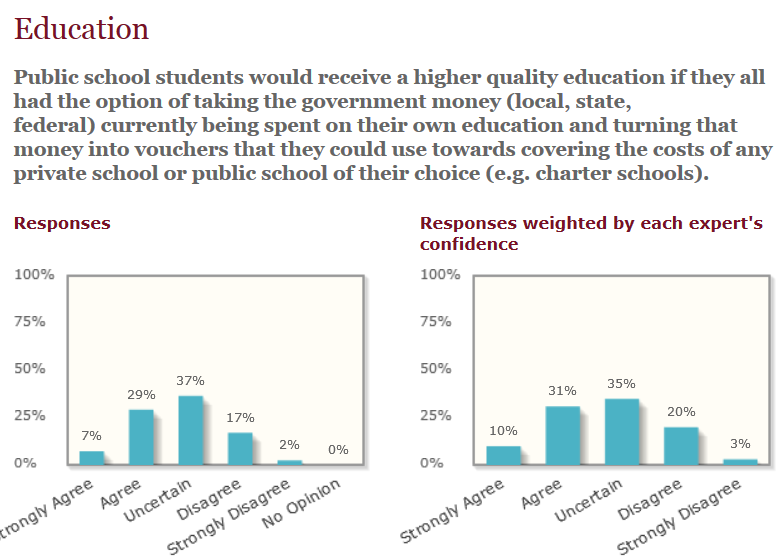 36% of economists agree that vouchers would improve education, compared to 19% who disagree. The rest are unsure or didn’t answer the question. The picture looks about the same when weighted by the economists’ confidence.
A more accurate way to summarize this graph is “About twice as many economists believe a voucher system would improve education as believe that it wouldn’t.”
By leaving it at “only a third of economists support vouchers”, the article implies that there is an economic consensus against the policy. Heck, it more than implies it – its title is “Free Market For Education: Economists Generally Don’t Buy It”. But its own source suggests that, of economists who have an opinion, a large majority are pro-voucher.
(note also that the options are only “agree that vouchers will improve education” and “disagree that vouchers will improve education”, so that it’s unclear from the data if any dissenting economists agree with the Times’ position that vouchers will make things worse. They might just think that things would stay the same.)
I think this is really poor journalistic practice and implies the opinion of the nation’s economists to be the opposite of what it really is. I hope the Times prints a correction.