Contra Robinson On Schooling
Scott Alexander critiques arguments against school vouchers, discussing potential efficiency gains and drawbacks of privatization in education, while proposing experimental approaches to school reform.
I.
Nathan Robinson argues against school vouchers: Why Is The Decimation Of Public Schools A Bad Thing?
(note that despite the inflammatory title, he’s arguing that the decimation of public schools is, indeed, a bad thing)
He starts with a meta-level point: most criticisms of Trump’s Education Secretary nominee Betsy DeVos merely point out that she will promote schools vouchers instead of public schools, expecting their audience to be suitably turned off. But this won’t change the minds of DeVos supporters, whose whole point is that they want more school vouchers. In order to convince people, you’ve got to convince people. If this doesn’t seem like a suitably profound insight to you, the click the link, read the piece, and notice how there’s something weird about it. Is it written in a funny font? Is the computer screen flickering or something? Finally, you realize with dawning horror that this is the first time you’ve read a logical argument, written in good faith and intended to convince someone, in the past you-can’t-remember-how-many months.
But anyway, let me explain why I think it’s wrong.
Robinson says:
Introducing profit into the school system is very dangerous, for a simple reason: it creates a terrible set of incentives. If we hand a voucher to a for-profit private school, or give a large grant to a for-profit charter school, there is a strong incentive for the school to give as little in return as possible. After all, since a for-profit corporation exists to maximize value to shareholders (not value to students), for-profit schools should try to spend as little money educating students as possible, in order to reap the largest financial gains. If you don’t have to spring for new lab equipment or new textbooks, you have no incentive to do so merely because it would benefit the students.
He does note the obvious counterargument, but he’s not convinced:
Privatization advocates have a compelling response to this argument. They reply that it misses the full picture. Yes, corporations have an incentive to maximize shareholder value. But they can’t do that without satisfying their customers. The interests of shareholders and consumers are brought into alignment through the existence of choice. In the case of schools, because parents have a voucher, if the school is not prioritizing its students, parents can simply go elsewhere. Nobody is making them send their students to this particular school. The theory of school choice is about choice, and choice creates competition, which creates quality. A school that simply funneled money to its executives and shareholders would not long maintain its enrollment.
But the theory of choice here is a romantic fiction. In reality, parents will not have many options among which to choose (there are only so many schools within a feasible distance of one’s home, after all) and moving schools can be an extraordinarily disruptive and complicated process that hurts the child. We can also see how, even in theory, it is easy for a privatized school system to simply enrich the wealthy, while making schooling for poor children worse. In a public school system, all money is spent on the schools. In a for-profit school system, at least some portion of that money is directed instead toward the pockets of shareholders (if it wasn’t, the for-profit schools couldn’t continue to exist). And if we have a school district comprised in total of three for-profit elementary schools, and all of them simply pocket most of the voucher money while failing to educate the children, then no matter what “choices” among schools parents make, they won’t be able to improve the quality of the schools. One might expect new operators to enter the market, but if the only way to make any real money on the children is to neglect them, then new operators won’t be any better than the old ones.
This is a good point, made somewhat weaker by failure to consider why it doesn’t apply to everything else.
Robinson compares school vouchers to foodstamps, which are basically “food vouchers” to be redeemed at grocery stores. I often see poor people using food stamps at my own grocery store, so I know the quality of service these poor people get for their money. And it is really good. Practically all grocery stores are really good. There’s a story about Boris Yeltsin coming to America for the first time, walking into a random grocery store, seeing that random middle-class Americans had a better selection of goods than the highest-status Soviet officials, and freaking out that this was some kind of weird Potemkin economy that the Americans had set up to demoralize him. Grocery stores don’t just have fifty different kinds of cereal and a hundred different kinds of soda, they’re also really cheap. You can buy a day’s worth of food for an hour’s minimum-wage work, maybe two hours if you want a little quality and variety.
So why don’t grocery store shareholders leech off so much money that everything is overpriced and has terrible service? Why aren’t stores dingy and full of rats? Why don’t we have a world where, as Robinson argues, the theory of choice is a romantic fiction because all of the grocery-related options available to poor people are terrible, and no new operators can do a better job because the only way to make money in the grocery business is to shaft customers and have a terrible store selling rice mixed with sawdust?
Something like 48% of Americans are satisfied with the education system in the US. My guess is 100% of Americans are satisfied with the grocery system in the US. Why should this be?
My guess: the loss from profits matters less than the gain in efficiency.
Profit margins are a specific number. You can just look them up. Usually they’re not very big. Once you look up that number, you know how much profit the company is making. After that, you’ve circumscribed “the dangers of profit” to a relatively small amount.
An example: Health care in this country is overpriced and everyone knows it. Some people think this is because greedy insurance companies are charging too much in order to make a profit.
But health insurance companies have a profit margin of about 3% (see caveats here, but I do think the 3% number is the one relevant to this discussion). This is a big deal in terms of absolute number of dollars. But it’s not a big deal if you’re wondering how much they affect health care costs. If you’re paying $5,000 a year for health insurance, then take away all profit motive from the insurance companies and you would pay $4850 a year for health insurance. This is less than year-to-year variation, let alone any of the components that actually matter.
Insurance companies aren’t callously throwing sick people out on the street for profitability reasons, they’re callously throwing sick people out on the street because they can only pay as much money as their customers give them and that isn’t enough to fund as much health care as people need. Or, well, maybe out of the people they callously throw out on the street, 3% are for profit and the other 97% are of necessity.
The same is true of other famously predatory businesses like payday lenders. Wikipedia notes:
In a profitability analysis by Fordham Journal of Corporate & Financial Law, it was determined that the average profit margin from seven publicly traded payday lending companies (including pawn shops) in the U.S. was 7.63%, and for pure payday lenders it was 3.57%. These averages are less than those of other traditional lending institutions such as credit unions and banks. Comparatively the profit margin of Starbucks for the measured time period was just over 9%, and comparison lenders had an average profit margin of 13.04%. These comparison lenders were mainstream companies: Capital One, GE Capital, HSBC, Money Tree, and American Express Credit.
Payday lenders aren’t charging outrageous interest rates so they can get fat off the profits. They’re charging outrageous interest rates because loaning money to poor people who often fail to pay back their loans is a hard business to break even on.
Now apply this logic to private schools. You think they’re going to ruin everything by funneling more and more money into their own profitability? I propose that about 11% of their funding would go to profit, the same as current private schools. Actually less than that, since most current private schools serve rich people who don’t care about outrageous markups as long as they can buy prestige.
But isn’t 11% still more than nothing? If private schools cost the same amount of money as public schools, but 11% of that went to shareholder profits, wouldn’t our children receive an 11% worse education?
Or to put it another way – what are we buying with that 11% of the education budget?
The hope would be that we’re buying efficiency.
Robinson writes:
Let’s consider what the conservative argument on schooling actually is. It goes like this: government-run institutions tend to function poorly. They are not efficient, like businesses are, because they do not have incentives to perform well. Businesses, because they must compete for customers in a market environment, must offer the best products if they want to stay profitable. Governments, on the other hand, can offer crappy products, and because they are state-imposed monopolies, there is no way for consumers to go elsewhere. School choice will improve schools, because instead of forcing students to attend whatever school the government happens to offer, choice allows parents to decide which school they prefer. Schools will have to strive to be better and better, because parents can pull their students out and go elsewhere if they don’t like them. Introducing a profit motive into schooling offers a powerful incentive for schools to offer a great product. If there is money to be made on being a good school, you can bet businesses will want to provide great schools. Thus private, for-profit schools with vouchers are a highly efficient way of delivering the best-quality education.
He counters that “introducing profit into the school system is very dangerous”, but never really says that the argument above is wrong. So we’re looking at a tradeoff here. There’s the dangers of profit and the promises of better efficiency. If profits aren’t going to take too much money out of the system, might the gain from efficiency be worth the small cost?
Here is a graph by the Cato Institute – note that this is already adjusted for inflation:
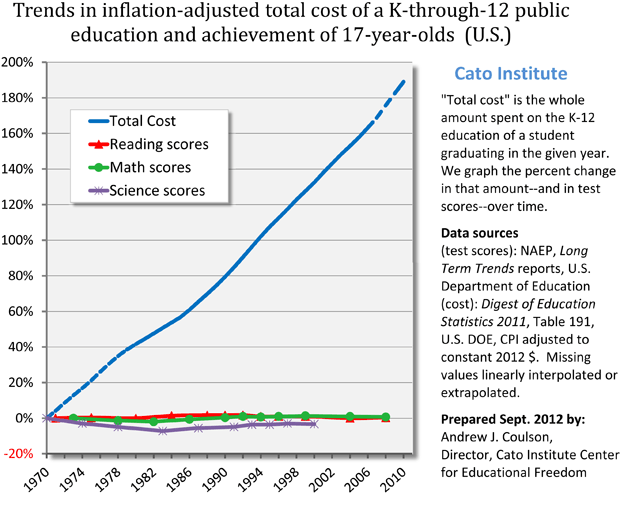 In case you don’t trust them, here’s Politifact rating a similar claim mostly true, although they get slightly different numbers using a different methodology.
What are we to make of this? It’s not that teachers are getting paid any more – their salaries have remained stagnant over the time involved and they may even have lost ground compared to other professions. It’s not that school buildings cost more – I don’t have good data on schools in particular, but I looked into skyscrapers and found there wasn’t any general rise in construction prices. So how is an activity which basically involves getting a bunch of kids into a building and throwing a teacher at them rising so dramatically in the absence of changes in building or teacher prices? I’ve only heard three theories:
The first theory is that student test scores are improving, but we’re stuck in a Simpson’s Paradox. That is, students of some racial groups get higher scores than others, every racial group’s score is improving, but a higher percent of students are in low-performing racial groups now which is bringing the average down. But it looks like race-specific scores are also stagnant (1, 2), with the possible exception of a jump for blacks between 1980 and 1990. Given that no other ethnic group had this jump and school spending has increased at a constant rate the whole time, I think this is more likely socioeconomic factors than education spending.
The second theory is that all this extra money has been used to help previously underserved special needs kids. But these kids apparently cost about twice as much as average to educate. Up to 13% of students are special needs, although I don’t know if that’s the same definition of “special needs” as the people calculating the cost used. But if we take that as our estimate, then providing extra services to special needs kids can explain a rise of 13% in education costs, but not the 150% we actually see.
The third theory is Wilde’s Law: “The bureaucracy is expanding to meet the needs of the expanding bureaucracy.”
One argument in favor: the same thing that’s happening to primary education is happening to college education. College costs about 4x as much (inflation-adjusted) as it did in 1980.
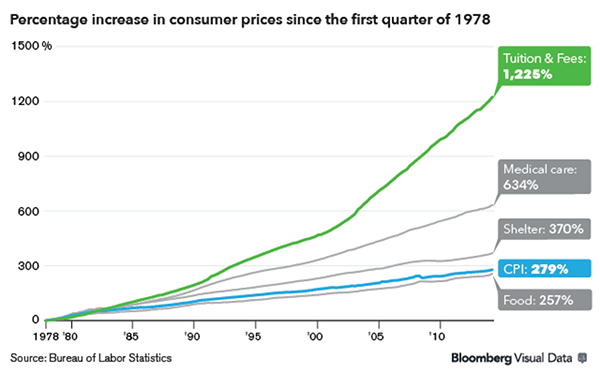 This is not because of decreased government subsidization. It’s not going to shareholders – most colleges are nonprofits and even public institutions have seen outsized increases. And although I don’t have any equivalent to the flat-lining test scores from primary school, today’s college students don’t seem to be four times better-educated than those of yore. So where did all that money go?
I don’t think anybody knows. There are whole studies that have been done on this. Every so often people argue about it on the editorial pages. Some people say “administration”, other people say it’s not exactly administration but it’s something else. I don’t know. But it doesn’t seem to be Simpson’s Paradox or special needs kids.
A lot of smart people think that easy availability of student loans fueled college cost increases – see eg here. The theory was that colleges could charge more money, so they did. I definitely don’t understand how this works economically, but it seems like somehow easy availability of money combined with lack of real competitive pressure caused colleges to increase administration and pass the cost on to students. Maybe something similar happened in primary schools?
If this third hypothesis of increased primary school costs is true, then going back to the level of bureaucracy we had in 1970 would cut costs by 75% while maintaining similar test scores. Or it would allow us to keep costs constant and pay for things that actually work.
The point is, private schools lose 11% of their funding to shareholder profit, and public schools apparently lose 75% of their funding to, uh, nobody really knows.
Do private schools also lose 75% of their funding to nobody-knows, since I don’t see many of them around as cheap as schools were in 1980? I’m not sure. Arnold Kling does some calculations here and suggests that private schools should have really big profit margins. But they apparently don’t. Overall I admit I am confused on this issue. But I am a little more hopeful that private schools might be able to work this issue out than that public schools can. [EDIT: see note at bottom of post]
It may seems kind of bloodless to focus on cost. But the amount of money added to the public school budget without any change in outcomes is more than enough to house every homeless person in the country in style and comfort. Money matters. And when we talk about private schools being obsessed with profit, that’s an argument about money. It’s acknowledging that every dollar diverted to shareholders is a dollar that isn’t going to improving education, housing the homeless, or something else useful.
Robinson writes:
It’s because the things needed by poor people, if done well, will never be money-makers. Introducing an incentive to make money will necessarily mean exploiting and neglecting the poor, whose “choices” are highly constrained by their circumstances. I fear privatization not because of some mystical devotion to the inefficiencies of government but because I fear the erosion of the idea of education as something that isn’t win-win, that we give to children because they deserve it rather than because we can profit from it. I worry that the sort of people who run things “like a business” do not really care about children very much, and are motivated by the wrong incentives. I am concerned about what would happen if they ever faced a choice between doing the right thing and doing the lucrative thing.
With all due respect, I think there is something mystical in this thought process, some demon best exorcised with a bell, candle, and Public Choice Theory textbook. There’s no object called The System, which is focused on profit in businesses and focused on education in public services. There’s just a bunch of people motivated by a combination of ethics, incentives, and trying not to get fired. Business isn’t antithetical to caring – the average family doctor is motivated by desire to help patients, even though she’s also a small business. And lack of a profit motive doesn’t guarantee good behavior – it looks like the administrators of nonprofit colleges decided to spend their windfall on prestige and empire-building rather than on keeping costs low.
I have very low confidence in this. I know many people who are involved in education, and they are all very good people who are very passionate and definitely would never skim 75% off the top and use it to buy gold-plated yachts for themselves. In my home state of California, there was a big funding shortfall ten years ago, and schools tried to cut everything they could, but finally they said there was nothing left to cut and they had no more ideas, and I believe that they tried as hard as they could. If bureaucracy is inflating the price of schooling, it’s not doing so in an obvious way where you can point a finger at the exact bureau involved.
But it might be a general ethos of inefficiency that makes a lot of little things add up – I know it is in health care. And I at least think it would be worth trying the experiment.
(I realize the experiment is already being tried, with wildly varying results based on the specifics. I want to look into this research in more depth soon to see if there are any consistent trends.)
II.
A digression to support my point that sometimes increased efficiency can compensate for money diverted into profits – what about hospitals?
Hospitals are about evenly split between for-profit and not-for-profit institutions. Measuring “hospital quality” is even harder than measuring school quality, but researchers have tried to do this on various metrics. The results are hard to sum up, and I was only able to find a few studies and not anyone’s magisterial summation of the field, but it looks like there are minimal differences between for-profit and non-profit private hospitals, with government hospitals doing worst of all:
— A team from Harvard finds that for-profits and non-profits have about equal quality, and government-owned hospitals are worse than either. A follow-up study by the same team finds non-profit hospitals becoming for-profit is not associated with a drop in care.
— Truven Health Analytics finds some advantages for church-owned nonprofit hospitals, with secular nonprofit hospitals and for-profit hospitals in the middle, and government-owned hospitals worst of all. Note that this is my interpretation of a lot of different data and you might want to look at the particular metrics they use to draw your own conclusions.
— A textbook on the hospital industry finds that “on average, the performance of non-profit hositals in treating elderly patients with heart disease appears to be slightly better than that of for-profit hospitals, even after accounting for systematic differences…however, this small average difference masks an enormous amount of variation in hospital quality within the for-profit and not-for-profit hospital groups.”
— A study in a cardiology journal found “no evidence that for-profit hospitals selectively treat less sick patients, provide less evidence-based care, limit in-hospital stays, or have patients with worse acute outcomes than nonprofit centers”.
— As per the Handbook Of Health Economics:
The most rigorous and extensive study of large-scale empirical study of quality published to date that permits comparisons of quality by hospital ownership is by Keeler and co-authors (1992). They used two process measures of quality based on reviews of 14,000 medical record for five diseases in five states. One of this “explicit process” gauged the extent to which the charts showed that specific diagnostic and therapeutic procedures were performed competently. Rather than focus on particular elements of care as explicit process did, a second process measure, “implicit process,” measured the care process overall. For example, one of their implicit process questions to physician reviewers was: “Based on what you now know about this case, would you send your mother to this hospital?” In addition, they gauged quality on an outcome measure — the difference between actual mortality and the rate that would be expected based on the patient’s characteristics.
They found no difference in quality between private not-for-profit and for-profit hospitals on two indicators, excess mortality and explicit process; public hospitals fared worse on both criteria. However, on a third measure, implicit process, there was a statistically significant difference between quality of care of private not-for-profit hospitals and the other two ownership types, indicating higher quality levels for the for profits. The authors appear to have been more persuaded by the results on the first two indicators, stating that “nonprofit and for-profit hospitals provide similar quality overall”
In their national study of 981 hospitals in 1983-84, Shortell and Hughes (1988) found no difference in quality measured in terms of mortality by ownership. However, using fewer covariates, Hartz et al. (1989) did find that mortality was higher in for-profit than in private not-for-profit hospitals.
Sloan and co-authors (1998a,1998b, 1998c) examined outcomes of care of elderly persons hospitalized for one of four conditions: hip fracture; stroke; coronary heart disease; and congestive heart failure. They analyzed the first admission for these conditions since patients with a first unanticipated major health shock are less likely to shop among hospitals. Their outcome measures were survival, functional status, cognitive status, and living arrangements (probability of living in a nursing home). Although, on some measures, patients admitted to major teaching hospitals did better, a result consistent with Keeler et al. (1992), there were no statistically significant differences in outcomes between non-teaching private not-for-profit and for-profit hospitals. On some measures, elderly patients admitted to non-teaching government hospitals had worse outcomes, holding a large number of other factors constant.
So it looks like the differences between for-profit and not-for-profit hospitals are pretty slight, and that government hospitals are likely worse than either. This should be equally confusing to people who believe that the profit motive is invariably destructive and to people who believe it invariably results in better service.
This would be a good time to note that, contrary to the impression one might get from the Current Affairs article, only 13% of charter schools are for-profit. So a system with vouchers and charter school would probably be most like private non-profit hospitals, which these studies also show as doing well, and as decisively better than government-run hospitals. Also, everything I’ve talked about up to this point is mostly irrelevant. Maybe I should have started by mentioning this.
III.
From the same article:
There are other serious problems with the “gutting” of public schools. As we have argued before in Current Affairs, converting public schools to a voucher system makes education operate similarly to food stamps. After all, SNAP benefits operate roughly the same way: instead of giving people food, we give them the equivalent of money, which they then use to go and buy food. A voucher program does the same for schooling: instead of giving them schools, we give them a voucher, which they can use to go and find a private school. But look what happens with food stamps: the moment you start handing out a “voucher,” conservatives start seeing it as some kind of unearned “handout.” Pressure then develops to cut the handout. Is there any reason to think that “education stamps” would be subjected to less cost-cutting political pressure than food stamps? A serious problem with voucher programs is that they erode the idea of education as a fundamental right, instead making it seem like a privilege that one does not necessarily deserve. But education should be a right, because children cannot help the circumstances of their birth, and should therefore not be punished for their parents’ poverty.
I think this is drawing the wrong lesson from education’s popularity relative to food stamps. Robinson thinks conservatives like one-size-fits-all handouts, but not voucher handouts. I think conservatives like universal handouts, but not handouts to the poor.
Imagine a world where food stamps are replaced by the Federal Food Agency. Every week, a truck comes to poor people’s houses and gives them a one-size-fits-all food package that the government believes satisfies their nutritional needs. Do you think conservatives would be any happier with this than they are with food stamps? For that matter, did conservatives support public housing projects any more or less than they support housing vouchers now?
On the other hand, Medicare remains popular even though it’s essentially a voucher. Patients with Medicare choose their doctor, choose their hospital, and then Medicare pays for it. But because everyone expects to benefit someday, it has pretty broad bipartisan support; even its critics mostly want to change rather than eliminate it.
I don’t think changing public education from a service to a voucher would change whether people support it or not.
IV.
So I disagree with Robinson’s specific arguments. But there are some things that worry me about school vouchers.
First, the hospital case study is kind of ambiguous. Although for-profit hospitals aren’t noticeably worse than not-for-profit, they’re also not noticeably better. And the existence of for-profit hospitals hasn’t started some kind of virtuous cycle where all hospitals compete to save money and provide better care that ends up with hospitals being lean and inexpensive and just as accessible as grocery stores. Having a field be open to competition isn’t necessarily incompatible with it being overpriced and inefficient. And commenters point out that existing private schools are not generally 75% cheaper than public schools, suggesting that cost-cutting is hard.
Second, Robinson notes later that:
Privatization schemes are also heavily dependent on the existence of highly astute parents, who have the time and inclination to carefully study schools. The most vulnerable children are unlikely to have such parents. And we can imagine a system in which private schools offer parents $100 out of the voucher money if they agree to enroll their children. Desperate and uncaring parents might snap up the cash, with the neediest children ending up in the most vicious, uncaring, profit-grubbing schools.
I doubt there would be such blatant kickbacks – they’d be illegal and I don’t think they’ve happened on other voucher programs like food stamps – but his point that many parents are ignorant or malicious is well-taken. You don’t need literal bribery to get schools which are very good at having flashy ad campaigns but not very good at education. Parents might not check the test scores of a smooth-sounding school any more than they check the health care grades of their local hospital. The worst-case scenario is schools associated with cults or fringe political ideologies that prey on the children of people who believe them, either out of genuine fanaticism or a cynical calculation that fanatics are easy to milk.
Third, the whole point of Trumpism is that once we have fewer immigrants we can create a culturally cohesive community where everybody shares some core values. But the school system – as fractured and diverse as it is – is really one of the only institutions responsible for instilling some basic civic values in everyone and making sure they’re all on the same page. I do not put it past people to start sending their kids to schools that teach liberal values or conservative values in particular, and then one of the few (albeit mostly ineffective) brakes on further polarization is removed. On the other hand, Catholic school is already sort of like this and they don’t seem to be some weird foreign cancer on the body politic, so maybe it’s not such a big deal?
Fourth, vouchers could worsen class segregation. Maybe not too much, because everyone already goes to public schools in their own class-segregated neighborhood anyway. But at least there’s a little socioeconomic diversity now. And with vouchers, there’s a risk of deliberate sorting/signaling, where if everyone gets a voucher for $10,000, decent schools will charge $15,000 just to sell the “privilege” of going to a school without poor students. That is, in the same way people will pay extra for a house in a gated community because they worry poor people make bad neighbors, they might pay extra for a spot in a more-expensive school because they worry poor people will make bad classmates. A little bit of this segregation goes a long way, because if enough people do this then the exactly-$10,000 schools will only have poor people, in much the same way that a little bit of racial segregation goes a long way.
(I don’t know much about proposed voucher systems, but I wonder if it would be possible to have a system where you’re not allowed to combine the voucher with your own money. That is, if you get a $10,000 voucher, you can go to a school charging $10,000. But if you want to go to a school charging $11,000, you have to throw away the voucher and pay the whole price out of pocket.)
To all these downsides we would have to add one very big upside – it destroys the incentive to overspend on/segregate housing in order to get into a “good school district”. Elizabeth Warren has argued this is primarily behind the secular rise in real estate prices that has undermined the economic position of the middle class for the past fifty years. This factor could easily be more important than everything else combined and might make school vouchers a plus even if they seriously worsened the quality of education.
Overall my thoughts on school vouchers are the same as my thoughts on pretty much everything in this category: let’s experiment. Figure out a window of acceptable possibilities that are reversible and don’t have too much risk, and let different states and areas try different ones. As we start to understand things better, extend the window of possibilities in the relevant direction. Check results. Rinse. Repeat. Then figure something out.
V.
Finally, one more point from the article that deserves its own discussion:
If we have a school district comprised in total of three for-profit elementary schools, and all of them simply pocket most of the voucher money while failing to educate the children, then no matter what “choices” among schools parents make, they won’t be able to improve the quality of the schools. One might expect new operators to enter the market, but if the only way to make any real money on the children is to neglect them, then new operators won’t be any better than the old ones.
It’s important because lack of good competition is indeed the bane of all of these sorts of industries. Economic theory predicts that in a perfectly competitive environment businesses will be pretty good; it is much less sure of itself in these sorts of three-school districts without enough competition to have much effect.
In the real world, someone will have to empirically determine how much this matters. In my own fantasy world, I have a solution that the new Education Secretary probably won’t be on board with: Let’s let random people open tiny schools.
Something like 3% of parents home-school their children. This cuts across class and racial lines better than you’d think. All the research shows that home-schooled students do much better than traditionally schooled students on standardized tests, college admission exams, college GPAs, and general life satisfaction as adults. This is probably unfair, because home-schooled students are the descendents of the sort of thoughtful conscientious parents who want to home-school their children, so they probably have a big genetic advantage. But there is at least absolutely no evidence that home-schooling makes anyone do any worse.
The average cost per pupil per year in the US is something like $10,000. So suppose we give everyone $10,000 school vouchers. A parent who wants to make the median US yearly income of $30,000 would have to teach three students. Add in some overhead and curriculum costs, and maybe it’s more like five students.
So imagine. A woman has a kid and decides she doesn’t want to go back to work and leave the kid in daycare for eighteen years. She takes some test, clears some regulatory hurdle, promises that she’ll clear a certain bar on her kids’ standardized test scores, and registers as an approved school. Then she gets a couple of friends and neighbors who trust her to send their kids to her too. Maybe her husband works outside the home, so she doesn’t even need five. She’s happy with two or three (I think it would be important that you can’t make any money by educating your own kid; otherwise the incentive is to keep them out of school and pretend to be educating them yourself). Then she tutors them in a class a fifth the size of comparable public school classes.
If you’re an actual, qualified teacher, maybe you can get ten or twenty kids who are interested. That’s $100,000 to $200,000, minus your overhead, much more than qualified teachers make today with a much lower class size. Remember, for the majority of American history, kids were taught by a member of the community in a one room schoolhouse, and that was the system that produced Benjamin Franklin, Thomas Edison, et cetera.
(and remember that all the research shows that formal teacher training and level of teacher credentialing has zero effect on how well teachers teach kids)
This would provide provide a means of self-directed, boss-free income for millions of people, including undercredentialled poor people, disabled people who can’t leave the home, people in rural areas, and especially young mothers. It would rebuild community ties. And it would ensure no one ever has to worry about districts with only three schools, or even districts with only thirty schools.
I don’t know. Probably there’s some sort of horrible flaw that I’m missing. But I still think the moral of the story is to experiment more. And school vouchers might be a good start.
EDIT: From the comments: “At my independent non-profit high school we have reduced the cost per student-year down to $3,000. Despite this budget we are able to offer the students many opportunities that public schools don’t. Art classes like glassblowing and copper and silversmithing, advanced science curricula like organic and biochemistry, health class vastly more informative that the state requirements, zero bullying enforced by a self-organized student culture, I could go on all day. For comparison the average cost for nearby school districts is $17,000 per high schooler-year and offer a fraction of the services we provide.”