[PARTIALLY RETRACTED] Cortical Neuron Number Matches Intuitive Perceptions Of Moral Value Across Animals
Scott Alexander finds a correlation between animals' cortical neuron count and people's intuitive perception of their moral value, based on a small survey.
[EDIT: No longer confident in this post, see here.]
Yesterday’s post reviewed research showing that animals’ intelligence seemed correlated with their number of cortical neurons. If this is true, we could use it to create an absolute scale that puts animals and humans on the same ladder.
Here are the numbers from this list. I can’t find chickens, so I’ve used red junglefowl, the wild ancestor of chickens. I can’t find cows, so I’ve eyeballed a number from other cow-sized ruminants (see here for some debate on this).
| Animal | # cneurons | % of human cneurons | # equivalent to human |
| Lobster | 100,000 | 0.0006 | 160,000 |
| Chicken | 50 million | 0.3 | 320 |
| Cow | 300 million | 1.9 | 53 |
| Pig | 425 million | 2.7 | 38 |
| Elephant | 5.6 billion | 35 | 2.9 |
| Chimpanzee | 6.2 billion | 39 | 2.6 |
| Human | 16 billion | 100 | 1 |
Some animal rights activists discuss the relative value of different species of animal. You have to eat a lot of steak to kill one cow, but you only have to eat a few chicken wings to kill one chicken. This suggests nonvegetarians trying to minimize the moral impact of their diet should eat beef, not chicken. But any calculation like this depends on assumptions about whether one cow and one chicken have similar moral values. Most people would say that they don’t – the cow seems intuitively more “human” and capable of suffering – but most people would also say the cow isn’t infinitely more valuable. Different animals rights people have come up with different ideas for exactly how we should calculate this.
I wondered how people’s intuitive ideas about the moral value of animals would correspond to their cortical neuron count. I asked Tumblr users who believed that animals had moral value to fill out a survey (questions, results) estimating the relative value of each animal, in terms of how many animals = 1 human. Fifty people answered, including 21 vegetarians and 29 nonvegetarians. Their numbers ranged from 1 to putting their hand on the 9 key and leaving it there a while, but when I took the median, here’s what I got:
| Animal | # = human (cneurons) | # = human (survey) |
| Lobster | 160,000 | 4000 |
| Chicken | 320 | 500 |
| Cow | 53 | 50 |
| Pig | 38 | 35 |
| Elephant | 2.9 | 7 |
| Chimpanzee | 2.6 | 5 |
| Human | 1 | 1 |
The middle column in this table is the same as the third column on the one above – it’s how many of each animal it takes before the group has the same cortical neuron count as a human. The last column is the survey results on how many of each animal it takes to have the same moral worth as a human.
The two are pretty similar. For example, 53 cows have the same neuron count as one human, and respondents said that 50 cows would have the same moral value as one human. Respondents placed a little less value on elephants and chimps than their neurons warranted, and a lot more on lobsters. Carl S suggests by email that lobsters might have been a bad choice: they have fewer neurons than an ant (really!) but because they’re so big everyone assumes they must be pretty advanced. Despite this, overall people’s answers were pretty close. Here’s a log-log graph:
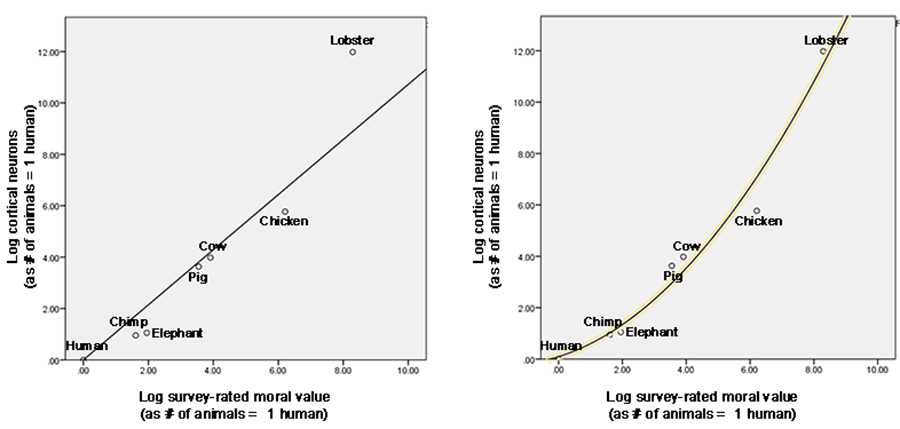 This is a better match for the moral value data than other ways of calculating animal intelligence. For example, a cow has an encephalization quotient of 0.5, compared to a human’s 7.5. That would suggest a human is worth 15 cows, which doesn’t match the survey-takers’ impressions.
I would like to see this repeated with a larger survey of a more representative population. But for now I think this adds at least a little credibility to intuitive ways of thinking about these problems.
