Give Yourself Gout For Fame And Profit
Scott Alexander examines the historical link between gout and achievement, ultimately finding the evidence unconvincing despite some intriguing connections.
I.
Actually, no. You should not do this. Most of you were probably already not doing this, and I support your decision. But if you want a 2000 word essay on some reasons to consider this, and then some other reasons why those reasons are wrong, keep reading.
Gout is a disease caused by high levels of uric acid in the blood. Everyone has some uric acid in their blood, but when you get too much, it can form little crystals that get deposited around your body and cause various problems, most commonly joint pain. Some uric acid comes from chemicals found in certain foods (especially meat), so the first step for a gout patient is to change their diet. If that doesn’t work, they can take various chemicals that affect uric acid metabolism or prevent inflammation.
Gout is traditionally associated with kings, probably because they used to be the only people who ate enough meat to be affected. Veal, venison, duck, and beer are among the highest-risk foods; that list sounds a lot like a medieval king’s dinner menu. But as kings faded from view, gout started affecting a new class of movers and shakers. King George III had gout, but so did many of his American enemies, including Franklin, Jefferson, and Hancock (beginning a long line of gout-stricken US politicians, most recently Bernie Sanders). Lists of other famous historical gout sufferers are contradictory and sometimes based on flimsy evidence, but frequently mentioned names include Alexander the Great, Charlemagne, Leonardo da Vinci, Martin Luther, John Milton, Isaac Newton, Ludwig von Beethoven, Karl Marx, Charles Dickens, and Mark Twain.
Question: isn’t this just a list of every famous person ever? It sure seems that way, and even today gout seems to disproportionately strike the rich and powerful. In 1963, Dunn, Brooks, and Mausner published Social Class Gradient Of Serum Uric Acid Levels In Males, showing that in many different domains, the highest-ranking and most successful men had the highest uric acid (and so, presumably, the most gout). Executives have higher uric acid than blue-collar workers. College graduates have higher levels than dropouts. Good students have higher levels than bad students. Top professors have higher levels than mediocre professors. DB&M admitted rich people probably still eat more meat than poor people, but didn’t think this explained the magnitude or universality of the effect. They proposed a different theory: maybe uric acid makes you more successful.
Before we mock them, let’s take more of a look at why they might think that, and at the people who have tried to flesh out their theory over the years.
Most animals don’t have uric acid in their blood. They use an enzyme called uricase to metabolize it into a harmless chemical called allantoin. About ten million years ago, the common ancestor of apes and humans got a mutation that broke uricase, causing uric acid levels to rise. The mutation spread very quickly, suggesting that evolution really wanted primates to have lots of uric acid for some reason. Since discovering this, scientists have been trying to figure out exactly what that reason was, with most people thinking it’s probably an antioxidant or neuroprotectant or something else helpful if you’re trying to evolve giant brains. Other researchers note that in lower animals, uric acid is a “come out of hibernation” sign which seems to induce energetic foraging and goal-directed behavior more generally.
Some of these people note the similarity between uric acid and caffeine:
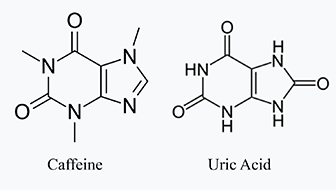 If uric acid had caffeine-like effects, then high levels of uric acid in the blood would be like being on a constant caffeine drip. The exact numbers don’t really work out, but you can fix this by assuming uric acid is an order of magnitude or so weaker than straight caffeine. Add this fudge factor, and Benjamin Franklin was on exactly one espresso all the time.
But you can’t actually be hyperproductive by being on one espresso all the time, can you? Don’t you eventually gain tolerance to caffeine and lose any benefits?
Although uric acid is structurally similar to caffeine, it’s even more similar to a chemical called theacrine. In fact, theacrine is just 1,3,7,9-tetramethyl-uric acid:
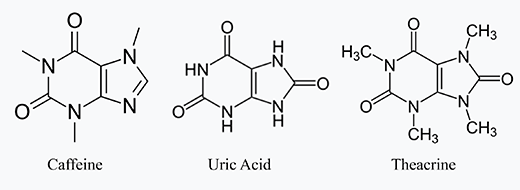 Theacrine (not the same as theanine, be careful with this one!) is a caffeine-like substance found in an unusual Chinese variety of tea plant. It’s recently gained fame in the nootropic community for not producing tolerance the same way regular caffeine does – see eg Theacrine: Caffeine-Like Alkaloid Without Tolerance Build-Up. This makes the theory work even better: Franklin (and other gout sufferers) were constantly on one espresso worth of magic no-tolerance caffeine. Seems plausible!
II.
This theory is hilarious, but is it true?
I was able to find eleven studies comparing achievement and uric acid levels. I’ve put them into a table below.
| Study | sample size | finding | significant at | awfulness |
| Kasi | 155 tenth-graders | r = 0.28 w/ test scores | 0.001 | significant |
| Bloch | 84 med students | r = 0.23 w/ test scores | 0.05 | immense |
| Steaton & Herron | 817 army recruits | r = 0.07 w/ test scores | 0.02 | significant |
| Mueller & French | 114 professors | r = 0.5 with achievement-oriented behavior | 0.01 | astronomical |
| Montoye & Mikkelsen | 467 high-schoolers | negative result | N/A | unclear |
| Cervini & Zampa | 270 children | positive result | unknown | what even is this? |
| Inouye & Park | ??? | r = 0.33 with IQ | 0.025 | what even is this? |
| Anumonye | 100 businessmen, 40 controls | r = 0.21 with drive | 0.05 | immense |
| Ooki | 88 twins | r = 0.17 with 'rhathymia' | 0.05 | how is this even real? |
| Dunn I | 58 executives | positive | ??? | immense |
| Dunn II | 10 medical students | negative | N/A | astronomical |
Nine out of eleven are positive. But I find it hard to be confident in any of them. Modern studies can be pretty bad, but studies from the 1960s ask you to take even more things on trust, while inspiring a lot less of it. Many of these studies were unable to find the outcomes that the others found, but discovered new outcomes of their own. Many failed to report basic pieces of information. The largest experiments usually found the least impressive results. Overall this looks a lot like you would expect from something forty years before anyone realized there was a replication crisis.
I also notice that the most positive studies compare business executives to people in other walks of life, and the least positive studies compare good students with bad students. Business executives get a lot of chances to differ from the general population – maybe they still eat more meat and richer food? Maybe they’re stressed and stress affects uric acid levels?
What about the list of very famous people with gout? I agree it’s a lot of people, but what’s the base rate? Kings were born to their position, so we have no reason to think they were especially high achievers (someone in their family might have been, but that gene could have gotten pretty diluted). Since so many kings got gout, this suggests rich old people in the past had gout pretty often regardless of achievement. Also, this was before people invented good medical diagnosis, so probably arthritis, injuries, and any other form of joint pain got rounded off to gout too. What percent of rich old people in the past had some kind of joint pain? I’m prepared to guess “a lot”.
The biochemists report equally confusing results around the uric acid / caffeine connection. Caffeine mostly works by antagonizing adenosine, a chemical involved in sleepiness. According to Hunter et al, Effects of uric acid and caffeine on A1 adenosine receptor binding in developing rat brain, uric acid does not affect adenosine, and so probably does not have a caffeine-like mechanism of action. On the other hand, caffeine probably has a small additional effect on catecholamine (eg dopamine, norepinephrine) release, and a different paper finds that uric acid does share this mechanism. So it doesn’t have caffeine’s main effect, but it does seem to have some kind of mild stimulant properties.
Given this level of uncertainty around every step in the hypothesis, I would describe any link between uric acid and achievement as kind of a stretch at this point. I feel bad about this, because it’s an elegant theory with mostly positive studies in support, but I’m just not feeling like it’s met its burden of proof.
III.
But some recent research is trying to bring this field back from the dead. At least this is what I get from Ortiz et al, Purinergic System Dysfunction In Mood Disorders, which synthesizes some more modern evidence that “uric acid and purines (such as adenosine) regulate mood, sleep, activity, appetite, cognition, memory, convulsive threshold, social interaction, drive, and impulsivity”. It argues that we know there are neurorecptors for adenosine (another similar-looking molecule) and ATP (adenosine triphosphate, the body’s main form of chemical energy). These seem to be involved in depression and mania, in the predicted direction (manic people have too much ATP, depressed people have too little, and treatments for both conditions seem to normalize ATP levels). These results seem to be daring someone to make up a theory where mania is just too much chemical energy floating around, but if Ortiz et al are doing that, it’s sandwiched in between so many dense paragraphs on receptor binding that I can’t make it out.
More interesting for us, uric acid is related to all these chemicals and also seems to be involved in mania. See eg de Berardis et al, Evaluation of plasma antioxidant levels during different phases of illness in adult patients with bipolar disorder, which finds that uric acid is elevated in manic patients, and the more manic, the higher the uric acid levels. And Machado-Vieria claims to have gotten pretty good results treating bipolar mania with allopurinol, a gout medication that decreases uric acid – and the more the allopurinol decreased uric acid, the better the results. There’s also a little evidence that depressed people have lower uric acid than normal. None of this is a large effect – there are still a lot of depressed people with higher-than-normal uric acid and a lot of manic people with lower – but it’s around the same size as all the other infuriatingly suggestive effects we find in psychiatry that never lead to overarching theories or go anywhere useful.
Future studies should try to replicate the link between uric acid and mania, and come up with a better understanding of why it might be true – maybe since uric acid is a decay product of ATP, the body interprets it as a sign that energy is plentiful? They should try to explain away anomalies – if gout is maniogenic, how come so many people with gout are depressed? Is it just because having a painful illness is inherently depressing? And then it should investigate how mania bleeds into normal personality. Is someone with slightly higher uric acid a tiny bit hypomanic all the time?
If they can fill in all those steps, I’ll be willing to take a fresh look at the old papers linking gout and achievement. Until then, you should probably hold off on eating megadoses of venison to become the next Ben Franklin.
