How Likely Are Multifactorial Trends?
Scott Alexander questions the plausibility of multifactorial explanations for trends, using the US crime rate decline as an example, and seeks literature on comparing single-factor vs multi-factor explanations.
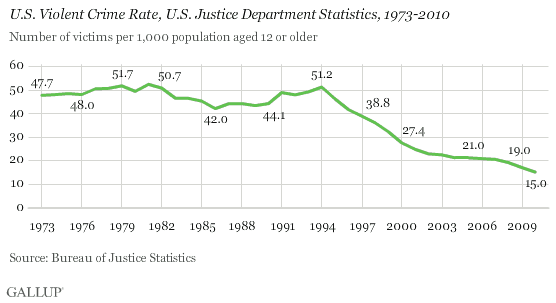
Vox recently wrote about 16 Theories For Why Crime Plummeted In The US.
Their story is based on a report by the Brennan Center For Justice, which I haven’t read, so I’m hesitant to critique it too much. The little I got off of Vox I don’t like. For example, if I understand correctly they’re arguing that the lead-crime connection is overblown because although lead was banned in the 1970s (thus affecting people who reached peak crime-committing age in the 1990s), the decline in crime continued even into the 2000s. But lead stays in the environment a long time, there’s still a lot of work to be done eliminating various sources of lead, and so blood lead levels continue to decline. That makes their argument ring a little hollow.
But I want to talk about a more meta-level point.
The analysis ends up concluding that there is no “smoking gun” and crime probably declined because of a bunch of reasons coming together. For example, they say that “up to 12 percent of the drop in property crime during the 1990s was due to the rise in incarceration, but it was probably more like 6 percent”, and “up to ten percent of the drop in crime in the 1990s was caused by hiring more police.” The general picture I get is that there were about ten different factors, each explaining ten percent of the decline.
 Imagine two different perspectives on this.
First, a learned professor says “Oh yes, the public always wants to hear about how one big exciting thing caused the decline in crime, but that kind of thinking is unsophisticated. Something as complicated as crime is governed by many factors, and you certainly wouldn’t expect one big knockout change to lower it to this degree. Like everything else, it’s probably a combination of different things that came together, each accounting for a small percent of the variance.”
Second, someone counterargues: “If ten different factors caused the decline in crime, that would require that ten different things suddenly changed direction, all at the same time in 1994. That’s a pretty big coincidence. In fact, let’s reductio ad absurdum this. Imagine it was ten million different factors, each accounting for one ten-millionth of the decline. But that seems stupid. For example, since there are only about ten million criminals in the US, we could structure this as one factor per criminal. Imagine that, in 1994, each of America’s ten million criminals independently and coincidentally had a major life change that made crime seem less attractive. That’s ridiculous. But in that case, any other explanation based on ten million factors should seem ridiculous. And if we give a heavy credibility penalty to a story with ten million factors, we should give some credibility penalty to a story with ten factors.”
The second person seems to me to have a strong argument, which makes me think Vox and the Brennan Center’s model where ten different trends each explain about ten percent of the decline is unlikely.
I feel like somebody has already thought about this and there’s an entire literature I’m missing, but Google is failing me (badly – this
[EDIT: Yes, there’s the trivial case where all ten factors are correlated, for example they all have to do with an improving economy. I’m talking about the non-boring version of the question.]
[EDIT2: I might have subconsciously absorbed this thought process from Stefan Schubert]
