Literally Inconceivable: Contraceptives And Abortion Rates
Scott Alexander analyzes the complex relationship between contraception and abortion rates, concluding that in societies where contraceptives are already legal, increasing access likely decreases abortion rates.
I have amazing parents who would never do something sneaky like install a keylogger on my computer to keep tabs on me as I move thousands of miles away from home. But if I’m wrong and they did do that, they’re probably sweating pretty hard right now. My search history for the last two days looks a lot like “efficacy of contraceptives”, “contraceptive failures”, “pregnancy risk if contraceptive failure”, “unintended pregnancy”, “unintended pregnancy abortion”, and “COME ON GOOGLE WHY WON’T YOU GIVE ME GOOD INFORMATION ON UNINTENDED PREGNANCIES AAARGH”
(this last one brings up a berkeley.edu address, which does not surprise me one bit)
My parents can relax – the searches are because of the comments on a recent post of mine. In response to a claim that pro-lifers should be in favor of contraception since it decreases abortions, I argued that moral philosophy doesn’t always work that way, but let the main point – that contraception decreases abortion – stand. Some people, especially Joe and Gilbert, challenged my assumption, leading to an unpleasant wade through the swamp of contraception-related data.
The Anti-Contraceptive Position
Let’s start with the nay-sayers. In what he claims is a long essay (ye call that long? I’ll be showin’ ye long!) Bad Catholic evaluates correlation between abortion and contraception rates in different countries. He finds – mostly using data from the pro-choice Guttmacher Institute, a huge clearinghouse of abortion data we will be returning to again and again – that:
Contraception has been shown to decrease abortion rates primarily in [ex-Soviet bloc] countries with already high abortion rates. These represent a minority of countries. Contraception has been shown to increase abortion rates primarily in [non ex-Soviet bloc] countries with already low abortion rates. These represent a majority of countries. Contraception has been shown to slightly reduce abortion rates after its initial increase of abortion rates, but has never been shown to reduce abortion rates back to pre-contraception levels. This is my claim. I have no doubt that there’s a lot more to say, given the incredible amount of studies I haven’t seen. But as far as I can tell, this is a claim far closer to the truth than the oft-repeated, always unexamined “Contraception reduces abortion rates”.
This at first sounds bizarre – how could contraception, a technology that decreases unintended pregnancy – increase abortion, a result of unintended pregnancy? Enter the Peltzman effect, aka risk compensation.
I have a deep love for the Peltzman effect. Part of this is that it’s one of the few terms we social scientists have that sounds as nifty as the one physicists and mathematicians bandy around all the time. Another part is that a girl messaged me on OKCupid once explaining the Peltzman effect to me and asking me on a date (I never claimed my life was normal). But the rest of it is that it’s jsut this really elegant and unexpected finding where across a broad set of domains people respond to hard-won advances that make them safer with “Cool! Now I can behave irresponsibly!” It’s been found with anti-lock brakes (drivers drive closer to the car in front of them), with seat belts (people just drive faster), and with childrens’ safety gear (children just behave more recklessly).
The Peltzman effect doesn’t always hold true; sometimes we expect it and can’t find it. And it rarely makes things worse – it usually is cited as keeping things at the same level they were before, and one well-studied exception, the Munich taxi study, only finds a tiny increase in accidents.
But inside view here – how many people here, if they don’t want kids, would be willing to have totally unprotected sex? And how many people would be willing to have sex using condoms? But condoms have a typical failure rate of 15% – meaning that if a couple has sex for a year using only condoms for protection, there’s a 15% chance the woman will get pregnant. With combined oral contraceptive pill, it’s 8%. So if these contraceptive methods make people about ten times more willing to have sex when they don’t want pregnancy – not at all hard to imagine! – they could raise the unintended pregnancy rate and therefore the abortion rate.
This is the context of Joe’s study showing that in Spain from 1997 – 2007, a large rise in contraceptive usage occurred simultaneous with a large rise in abortion.
A few other arguments seem transparently stupid to me – for example, some people like to point out that US states with high contraception rates also have high abortion rates, but that’s mostly a feature of those states being very liberal and so allowing abortion clinics to operate there. So lets move on to…
The Pro-Contraceptive Position
Just in case you thought you were going to escape without any graphs:
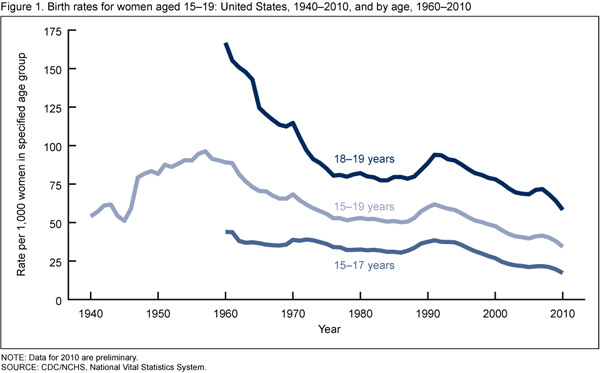 Here’s teenage birth rates over the last 75 years. Like nearly all social problems, they have been steadily and somewhat mysteriously declining, but we notice an especially sharp decline around 1960, the year the Pill was introduced. Abortion wasn’t legalized until the 70s and was pretty uncommon before then, so we can leave it out of this analysis and say that it sure looks like the invention of a new form of contraception decreased pregnancies.
Also near an all-time low are abortion rates (I assume they mean “all-time low since abortion was legalized”?). This seems to be due to both fewer unintended pregnancies and less willingness to end unintended pregnancies with abortion. Santelli et al 2002 find the decline to correspond nicely to increasing use of contraceptives. Some pro-lifers claim (data unavailable), that after 2002 abortions continued to drop even though contraception use stayed steady. Unfortunately, all I can find is the CDC saying contraceptive use continued to rise – in the absence of their contrary data, I’m giving this point to the “increased contraception helped reduce abortion” people.
(one way that we could reconcile these two results, if we were feeling very generous, is to say that overall contraception use has remained the same, but users have switched to more effective modern forms of contraception like the implant or IUD, with a failure rate less than 1/100th that of condoms)
But this is actually consistent with Bad Catholic’s claim above – contraception increases the abortion rate when first introduced, then eventually stabilizes and decreases it, but never back to the level before contraception. So let’s evaluate that one. Bad Catholic writes:
An honest look at the data shows that in virtually every country that increased the use of contraception, there was a simultaneous increase in that country’s abortion rate. In England (Rise in contraceptive use: simultaneous rise in abortions), France (Rise in contraceptive use: simultaneous rise in abortions), Australia, (Rise in contraceptive use: simultaneous rise in abortions), Portugal (Whose abortion rate only began to rise after 1999, after oral contraceptive methods were made widely available), Canada (Whose abortion rate only began to rise after the legalization of oral contraceptives in 1969), and, as the Guttmacher Institute shows, Singapore, Cuba, Denmark, the Netherlands, and South Korea, to name a few.
Let’s investigate the countries in order. The claim seems to be only that abortions and contraceptive use rose “simultaneously”, but following his links this turns out to mean “throughout the 20th century”. There is no attempt to prove that the particular shape of the contraception curve matched that of the abortion curve or anything like that, just that there was more contraception in 2000 than in 1950, and, whaddya know, more abortions as well. The same methodology could very easily correlate abortion with global temperature. His statistics on England, France, and Australia all seem to be of this type.
He makes a stronger claim about Canada: that “the abortion rate only began to rise after the legalization of oral contraceptives in 1969”. You know what else was legalized in Canada in 1969? Abortion. I’m going with “probably not a good test case”.
As for Portugal, the claim that oral contraceptive methods were legalized in 1999 seems wrong; his own link says they have been available since 1985 and that only the emergency contraceptive pill was made available in 1999. Further, his claim that “abortion rates only began to rise after 1999” also seems wrong – his link shows what looks like a pretty linear rise in abortion rates from 1996 to 2006; I don’t think anyone eyeballing those numbers would be tempted to consider 1999 anything remotely like an inflection point. My own guess for an inflection point would be 2007, and sure enough when I Google it that was the year they fully legalized abortion.
The Guttmacher Institute doesn’t link to its sources as diligently as Bad Catholic, so I’m just going to accept their claim that six countries – Singapore, Cuba, Denmark, Netherlands, US, and South Korea – saw simultaneous increases in contraception and abortion – after all, it goes against the direction of their bias so they have no incentive to lie. They give their results the following explanation:
The reason for the confusion stems from the observation that, within particular populations, contraceptive prevalence and the incidence of induced abortion can and, indeed, often do rise in parallel, contrary to what one would expect. The explanation for these counterintuitive trends is clear.2 In societies that have not yet entered the fertility transition, both actual fertility and desired family sizes are high (or, to put it another way, childbearing is not yet considered to be “within the calculus of conscious choice”3). In such societies, couples are at little (or no) risk of unwanted pregnancies. The advent of modern contraception is associated with a destabilization of high (or “fatalistic”) fertility preferences. Thus, as contraceptive prevalence rises and fertility starts to fall, an increasing proportion of couples want no more children (or want an appreciable delay before the next child), and exposure to the risk of unintended pregnancy also increases as a result. In the early and middle phases of fertility transition, adoption and sustained use of effective methods of contraception by couples who wish to postpone or limit childbearing is still far from universal. Hence, the growing need for contraception may outstrip use itself;4 thus, the incidence of unintended and unwanted pregnancies rises, fueling increases in unwanted live births and induced abortion. In this scenario, contraceptive use and induced abortion may rise simultaneously.
As fertility decreases toward replacement level (two births per woman), or even lower, the length of potential exposure to unwanted pregnancies increases further. For instance, in a society in which the average woman is sexually active from ages 20 to 45 and wants two children, approximately 20 of those 25 years will be spent trying to avoid pregnancy. Once use of highly effective contraceptive methods rises to 80%, the potential demand for abortion, and its incidence, will fall. Demand for abortion falls to zero only in the “perfect contraceptive” population, in which women are protected by absolutely effective contraceptive use at all times, except for the relatively short periods when they want to conceive, are pregnant or are protected by lactational amenorrhea.5 Because such a state of perfect protection is never actually achieved, a residual demand for abortion always exists, although its magnitude varies considerably among low-fertility societies, according to levels of contraceptive use and choice of methods.
This seems incredibly reasonable, and we will come back to it later. Let’s abandon all of these time series type studies and see if we can find a halfway-decent controlled experiment.
Well, uh…we can find a controlled experiment. These people in St. Louis gave people free contraceptives and later found that they had a teenage pregnancy rate much lower than the rest of the population. Gilbert gives this study exactly the correct criticism – participants from a very specific population (poor people in St. Louis interested in signing up for a contraceptive study) are being compared to the general population (everyone in the United States). This is inexcusable, especially considering that Real Science has an extremely standard way of avoiding this problem (sign people up for your study, only give the intervention to a randomly selected half, and the other half is an instant control group). Other fatal issues – the study used IUDs, the most effective form of contraception, but most of the worry that contraception might increase abortion comes from less effective means like condoms and the Pill. Finally, if you’re really interested in the way that widespread availability of contraceptives makes a culture more libertine, just giving them to a couple of people within that culture isn’t going to capture that effect. I am maybe a little bit hugely disappointed that most of the media and bloggers reporting on this didn’t mention these sorts of issues.
But it does show one interesting thing, which is that when people get free contraception, they start using more effective contraception methods. Would this also cause risk compensation? I don’t know, but I feel like there has to be some amount of sex beyond which it’s just no longer fun, and some contraceptive methods are so effective that it would be really hard to have so much sex that they’re worse than nothing.
Let’s close this section with a few minor points.
Contraceptive advocates point to the Netherlands, with one of the lowest abortion rates in the world. Given the stereotypes of the Dutch, they probably didn’t get that way through careful abstinence, and indeed their government is unusually generous in providing free contraceptives.
It turns out people can just survey women having abortions and ask them if they used contraceptives or not! 54% of abortion patients were using contraception at the time, which pro-life websites get very excited about: “IT’S MORE THAN HALF!” But putting these numbers in context may diminish their enthusiasm: the four-fifths of American women who use contraception account for 54% of abortions; the fifth of women who don’t use it account for the other 46%. The Guttmacher Institute gets more or less the same numbers, but frames them in a very convincingly pro-contraceptive way:
The two-thirds of U.S. women at risk of unintended pregnancy who use contraception consistently and correctly throughout the course of any given year account for only 5% of all unintended pregnancies. The 19% of women at risk who use contraception but do so inconsistently account for 44% of all unintended pregnancies, while the 16% of women at risk who do not use contraception at all for a month or more during the year account for 52% of all unintended pregnancies.
So it seems clear that the more (and better) you use contraception, the less likely you are to have an abortion.
Summary
I think we can use these results to build a consistent picture.
Contraceptive and abortion rates often rise simultaneously. This rise is not necessarily causal, and is more likely to be due to both being parts of the same philosophy – people want to have lots of sex but not have kids. As this philosophy becomes more widespread, as it has nearly everywhere in the 20th century with the Sexual Revolution and Demographic Transition, both contraception and abortion will rise. As it gains ground, both contraception and abortion will become more legal and available, making them rise even further. It is unclear to what degree the availability of contraception itself causes the rise of this philosophy. I’m intrigued by this claim that penicillin rather than the pill started the Sexual Revolution, but if someone wants to claim that it was all due to contraceptives, I don’t have enough expertise in the area to prove her wrong.
On the other hand, once a society has undergone this transition and settled on “lots of sex, few kids” as being its dominant values, then the local application of more contraception seems to decrease abortion rates. We know this because of the surveys of abortion patients saying they are disproportionately likely not to be contraceptive users. We know this because of the decline in teenage pregnancies with the advent of the Pill. And we also notice the game-changing nature of new, more effective contraceptives with near-zero failure rates replacing older, more fallible ones, and the not-provably-causal but certainly suggestive secular decline in abortion rates that corresponds with that replacement.
Overall my guess would be that a society that legalizes contraceptives would see an increase in abortion rates (which might or might not be causal depending on that society’s situation), but that in a society like our own, where contraceptives are already legal and the demographic transition is pretty much complete, increasing access to contraceptives is probably going to decrease abortion. And increasing access to extremely effective contraceptives like the implant or RISUG, especially when they replace less effective contraceptives like the condom, are very very probably going to decrease abortion.
