Polemical Imbalance
Scott Alexander defends his stance on the 'chemical imbalance' theory of depression, arguing that Mad In America's critique actually supports his view of a more nuanced understanding in psychiatry.
Today is an exciting day for me. I got argued against on Mad In America. This one is going straight to my resume.
Mad In America apparently doesn’t like being called an anti-psychiatry blog, so let’s call it a blog…that discusses psychiatry…and doesn’t usually like what it sees. They were heavily involved in popularizing the idea that psychiatry erred grieviously in overselling “chemical imbalance”, and they didn’t much like my post on the same topic:
Alexander argues that the notion that psychiatrists once promoted the idea of low serotonin as a cause of depression and Selective Serotonin Reuptake Inhibitors (SSRIs) as proper treatment for that deficiency is all simply a false “narrative” invented by “antipsychiatry” activists. These activists then “frame it as ‘proof’ that psychiatrists are drug company shills who were deceiving the public.” Alexander points to quotes of American Psychiatric Association officials in a post by MIA Blogger Philip Hickey, and notes that none of the quotes specifically describe a low-serotonin explanation for depression. The Hickey post cited is not actually about that topic, but about the promotion of the phrase “chemical imbalance”; nevertheless, Alexander broadly refers to Hickey and all of Mad in America as “antipsychiatry”, and he then writes, “If the antipsychiatry community had quotes of APA officials saying it’s all serotonin deficiency, don’t you think they would have used them?” Alexander argues, “The idea that depression is a drop-dead simple serotonin deficiency was never taken seriously by mainstream psychiatry.” There seems to be a lot of evidence to the contrary still today readily available even on the web, though.
This is exactly the sort of fight I probably shouldn’t get involved in continuing. But I’m going to do so anyway, because I think Mad In America’s counterargument is actually going to end up supporting my point and maybe shed more light on the situation.
Up there, when they say “Alexander points to quotes of American Psychiatric Association officials in a post by MIA Blogger Philip Hickey, and notes that none of the quotes specifically describe a low-serotonin explanation for depression [but] the Hickey post cited is not actually about that topic, but about the promotion of the phrase ‘chemical imbalance'” – that’s where I get pretty confident they’ve missed my point.
Remember, the thesis of my last post was that the “chemical imbalance” argument hides a sort of bait-and-switch going on between the following two statements:
(A): Depression is complicated, but it seems to involve disruptions to the levels of brain chemicals in some important way
(B): We understand depression perfectly now, it’s just a deficiency of serotonin.
If you equivocate between them, you can prove that psychiatrists were saying (A), and you can prove that (B) is false and stupid, and then it’s sort of like psychiatrists were saying something false and stupid.
Given that this is my thesis, it’s exactly right for me to debate a post on “chemical imbalance” by showing that none of the quotes involved reduce the problem to just a basic serotonin deficiency!
And when Rob Wipond from MIA says he’s found “a lot of evidence to the contrary still readily available even on the web”, well, spoiler, he’s found more people saying A.
II.
Let’s go through his examples:
For example, a 2004 Washington University in St. Louis press release, about a study published in Biological Psychiatry, states that the “brain’s serotonin receptors” are “at abnormally low levels in depressed people” and that antidepressants “work by increasing serotonin levels in the brain.”
I assume he’s talking about this press release about a study that shows abnormally low levels of serotonin receptors in depressed people. First of all, the study actually did show this. I don’t think it’s irresponsible to mention that a study shows low levels of serotonin receptors in depressed people when a study actually shows this. Second of all, the press release makes it extremely clear that they don’t know exactly what’s going on: “Little is understood about how depression makes people feel sad, but neuroscientists do know that the brain chemical serotonin is involved.” They mention that SSRIs appear to work for depression, but admit that “The bad news is that beyond that first step of increasing serotonin, we understand very little about how these drugs relieve symptoms of depression”. Finally, this study actually found something much more complicated than the prevailing narrative – a serotonin deficiency model of depression would have predicted high levels of serotonin receptors in related brain structures (more chemicals = fewer receptors) but in fact it found the opposite. This fits with the emerging theory that depression may be related to increased serotonin levels in certain parts of the brain, which SSRIs provoke a compensatory response against.
This press release is actually as good as the harshest critic could have wished for. It admits we don’t really know how depression works, it admits we don’t really know how SSRIs treat it, and then it presents the result of a study that shows that serotonin is implicated but not in the way the “serotonin deficiency” theory would expect.
The only way Mad In America turned this into a poster child for psychiatry deceiving people about serotonin was to quote from it extremely out of context.
Let’s go to their next example:
And there is prominent psychiatrist Richard Friedman writing in the New York Times in 2007 that psychiatrists were soon going to be able to conduct “a simple blood test” to determine “what biological type of depression” a person had and then treat them with the right drug. “For example,” writes Friedman, “some depressed patients who have abnormally low levels of serotonin respond to S.S.R.I.’s, which relieve depression, in part, by flooding the brain with serotonin.”
Okay, but Friedman starts with a story about how SSRIs often don’t work for patients, then says that this is because some people have depression that doesn’t seem to be serotonergic: “Some depressed patients who have abnormally low levels of serotonin respond to SSRIs, which relieve depression, in part, by flooding the brain with serotonin. Other depressed patients may have an abnormality in other neurotransmitters that regulate mood, like norepinephrine or dopamine, and may not respond to SSRIs”. He says (correctly!) that “in everyday clinical practice, we have little ability to predict what specific treatment will work for you”.
These are not the words of a drug company shill who says that depression is 100% serotonin in order to put everyone on SSRIs! These are the words of someone who agrees with me that depression is somehow related to neurotransmitters, but it’s still very uncertain which ones and how. His only sin seems to be an overly optimistic view of the speed at which we would come out with genetic tests.
Next example:
There’s also a lot of evidence that the low-serotonin theory of depression is still today being taken seriously by mainstream psychiatry and is still being promoted to the public. A current University of Bristol public education website on depression explains that, “Low serotonin levels are believed to be the cause of many cases of mild to severe depression.”
That appears to be this University of Bristol public education website. The site says it’s by “Claire Rosling”, so I searched her name and I get this roster of people’s sophomore chemistry projects. Ms. Rosling’s is…the website Mad In America cited. Apparently this was part of some college chemistry assignment where people write about molecules to compete for a £50 prize. Ms. Rosling’s was serotonin.
So Mad In America argues that the entire psychiatric establishment is pushing the “depression = serotonin” argument, but the best example they can come up with is some poor woman’s undergraduate chemistry homework?
(in case you’re wondering, she didn’t win. Some girl named Anna won for her webpage on Recycling Plastic.)
Next example!
A current Harvard Medical School special health report, “Understanding Depression”, explains that, “Research supports the idea that some depressed people have reduced serotonin transmission. Low levels of a serotonin byproduct have been linked to a higher risk for suicide.”
Once again, holy !@#$, they’re reporting the results of actual studies. It’s dishonest to do studies on serotonin and find that it is linked to depression? Anyway, when I look up the actual report it starts with the following paragraph: “It’s often said that depression results from a chemical imbalance, but that figure of speech doesn’t capture how complex the disease is. Research suggests that depression doesn’t spring from simply having too much or too little of certain brain chemicals. Rather, depression has many possible causes, including faulty mood regulation by the brain, genetic vulnerability, stressful life events, medications, and medical problems. It’s believed that several of these forces interact to bring on depression.”
Once again, this is the best you can do to find psychiatrists pushing an oversimplified version of the chemical imbalance theory??!
Next example:
WebMD’s “Depression Center” states that, “There are many researchers who believe that an imbalance in serotonin levels may influence mood in a way that leads to depression. Possible problems include low brain cell production of serotonin, a lack of receptor sites able to receive the serotonin that is made… According to Princeton neuroscientist Barry Jacobs… common antidepressant medications known as SSRIs, which are designed to boost serotonin levels, help kick off the production of new brain cells, which in turn allows the depression to lift.”
First of all, this page does not use the classic “serotonin deficiency” theory of depression. This is the hippocampal neurogenesis theory, which in my last post I specifically contrasted with the classic serotonin deficiency theory. Yes, it involves serotonin in some way, but since one of the most important facts about depression is that SSRIs treat it, every theory is going to involve serotonin in some way.
Further, right after this paragraph, WebMD continues: “Although it is widely believed that a serotonin deficiency plays a role in depression, there is no way to measure its levels in the living brain. Therefore, there have not been any studies proving that brain levels of this or any neurotransmitter are in short supply when depression or any mental illness develops. Blood levels of serotonin are measurable — and have been shown to be lower in people who suffer from depression – but researchers don’t know if blood levels reflect the brain’s level of serotonin. Also, researchers don’t know whether the dip in serotonin causes the depression, or the depression causes serotonin levels to drop.”
Once again, I see nothing here to indicate that they are covering up flaws in this theory, pushing it to unsuspecting consumers, or claiming that exploratory research is settled science. They’re presenting the best theories we’ve got, then noting how tentative they are and what the flaws are.
(on the other hand, the article does say that there are “40 million” brain cells, when in fact there are about 90 billion. I’m not saying you should trust WebMD, just that they don’t bungle depression in that particular way)
Next example:
And if the theory was never taken seriously and isn’t being taken seriously, no one has apparently told the National Academy of Sciences or two news media outlets with expert psychiatric editorial boards yet. Psychiatry Advisor’s February 12, 2015 headline for a report about a Duke University study is, “Serotonin Deficiency May Up Depression Risk.” Psychiatry Advisor explains that, “(m)ice with normal serotonin levels, the control group, did not demonstrate depression symptoms a week after the social stress, while the serotonin-deficient rodents did(.)” The study, appearing in the Proceedings of the National Academy of Sciences, states that, serotonin deficiency has been “implicated in the etiology of depression” though a cause-effect relationship has not yet been “formally established.” The researchers write that their results, “provide additional insight into the serotonin deficiency hypothesis of depression.” Medical News Today headline their report on it even more strongly: “Mouse study finds that serotonin deficiency does increase depression risk.” (Medical News Today notes in passing that an earlier, somewhat similar study by a different team came to the exact opposite findings.)
At this point Mad in America’s examples are self-refuting. I am getting the impression they will never be happy unless no news media ever covers the dozens of studies that come out each year linking depression to serotonin. I know this sounds mean, but what other conclusion am I supposed to come to? Here we have a study that provides some evidence for serotonin’s involvement, says very specifically that “a cause-effect relationship has not been formally established”, mentions that other studies have shown the opposite – and yet Mad In America still wants me to accept this as an example of irresponsibly pushing the serotonin theory!
Look. Hundreds of studies have shown some sort of relationship between serotonin and depression. At this point that’s not controversial. What’s controversial is the importance of the relationship, whether it’s causal, whether other things matter more, et cetera. Every single one of Mad In America’s examples has been pretty exemplary in saying that all of these things are still uncertain and need to be investigated further. What more could they do to be more responsible? A total blackout on all news coverage of the new evidence for serotonin’s involvement that keeps coming in?
Ironically, if people had done that, we would have far less evidence that depression was not just a simple serotonin deficiency. The most important nail in that theory’s coffin was that tianeptine, a medication that lowers serotonin levels, effectively treats depression. But that’s a study about serotonin of exactly the same sort as the University of Washington study Mad In America complains about! One of the most convincing alternatives to a purely serotonergic picture is the BDNF-neurogenesis theory. But that’s exactly the theory being pushed in the WebMD article Mad In America complains about!
III.
I raised some of these issues in a comment on the Mad in America blog, and author Rob Wipond kindly responded to me:
 Let me address some of these objections piece by piece:
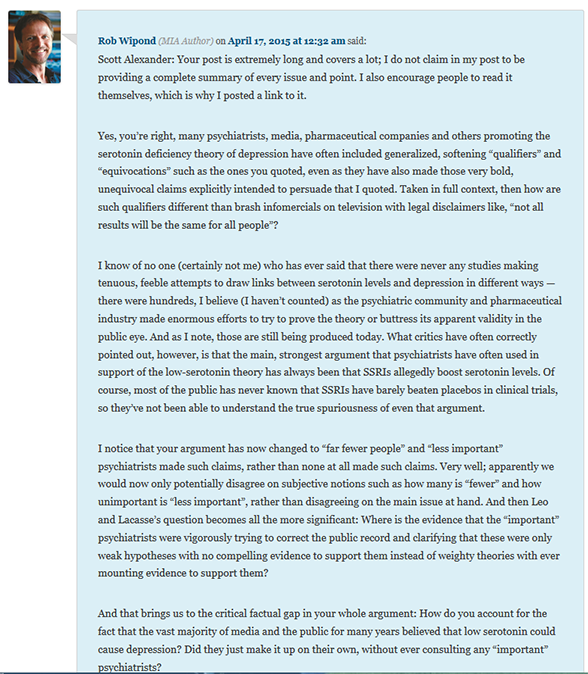
Yes, you’re right, many psychiatrists, media, pharmaceutical companies and others promoting the serotonin deficiency theory of depression have often included generalized, softening “qualifiers” and “equivocations” such as the ones you quoted, even as they have also made those very bold, unequivocal claims explicitly intended to persuade that I quoted. Taken in full context, then how are such qualifiers different than brash infomercials on television with legal disclaimers like, “not all results will be the same for all people”?
The very bold, unequivocal claims explicitly intended to persuade that you quoted WERE A SOPHOMORE CHEMISTRY PROJECT, PLUS A BUNCH OF PEOPLE SPECIFICALLY SAYING THAT THESE SHOULD NOT BE TAKEN AS VERY BOLD UNEQUIVOCAL CLAIMS, BUT THEN YOU QUOTED OUT OF CONTEXT TO TAKE THAT PART OUT. AND THE SOPHOMORE CHEMISTRY PROJECT DIDN’T EVEN WIN THE £50 PRIZE.
Okay. Sorry. I shouldn’t have yelled like that. More seriously: there are a lot of things we don’t totally understand, but which scientific research suggests some weak preliminary theories about. For example, we don’t understand fibromyalgia, but if I were writing a textbook on fibromyalgia, or if a patient asked me what it was, then after some appropriate caveats and equivocations, I would say it has something to do with some sort of inflammation in the fascia which causes central sensitization to pain stimuli. Could I end up being totally wrong? Yeah. But at this point I think there’s enough evidence in this direction that, insofar as it’s important to satisfy patients’ curiosity about what’s going on with them, that it’s proper to mention the current best guess. Likewise, if I am a researcher or a scientific publication, I don’t think I have some duty to carefully hide my results. A big part of scientific progress is people saying “I just got some small amount of evidence which makes me think it’s this” and then other people trying to confirm or refute that with more evidence, until eventually it comes together into a strong theory.
I think researchers and psychiatrists were pretty responsible in coming up with the serotonin deficiency theory. It was inspired by the effectiveness of serotonergic drugs. Then a bunch of studies – Wipond agrees there were hundreds – provided results that seemed to confirm it. Given all of this information, I don’t think it was negligent to say that there was quite a bit of evidence pointing to serotonin, as long as you followed this with caveats that the evidence was still preliminary and lots of other things seemed to be involved too. As I’ve been arguing all along, that’s exactly what most people did.
I know of no one (certainly not me) who has ever said that there were never any studies making tenuous, feeble attempts to draw links between serotonin levels and depression in different ways — there were hundreds, I believe (I haven’t counted) as the psychiatric community and pharmaceutical industry made enormous efforts to try to prove the theory or buttress its apparent validity in the public eye. And as I note, those are still being produced today. What critics have often correctly pointed out, however, is that the main, strongest argument that psychiatrists have often used in support of the low-serotonin theory has always been that SSRIs allegedly boost serotonin levels. Of course, most of the public has never known that SSRIs have barely beaten placebos in clinical trials, so they’ve not been able to understand the true spuriousness of even that argument.
I don’t really understand this objection. There was a strong piece of evidence in favor of serotonin in the form of SSRI-effectiveness, scientists pursued that lead by doing hundreds of studies implicating serotonin using different methodologies, most were in favor and so scientists thought the theory had some merit…what exactly is wrong here? This sounds like every scientific theory – Wegener noted that continents looked like they fit together in a way that implied continental drift, geologists did hundreds of other studies that all pointed to continental drift, therefore they started believing in continental drift.
While Wipond may not know of the people saying there was no evidence for serotonin besides SSRI effectiveness, these people certainly exist and provide one of his side’s major arguments. Indeed, many of the articles I linked to on my original post made exactly that argument. The BBC said that: “although ideas like the serotonin theory of depression have been widely publicised, scientific research has not detected any reliable abnormalities of the serotonin system in people who are depressed.” New York Review Of Books says: “Instead of developing a drug to treat an abnormality, an abnormality was postulated to fit a drug…But the main problem with the theory is that after decades of trying to prove it, researchers have still come up empty-handed”.
To learn more about the claim that SSRIs barely beat placebo, see my article on this.
I notice that your argument has now changed to “far fewer people” and “less important” psychiatrists made such claims, rather than none at all made such claims. Very well; apparently we would now only potentially disagree on subjective notions such as how many is “fewer” and how unimportant is “less important”, rather than disagreeing on the main issue at hand. And then Leo and Lacasse’s question becomes all the more significant: Where is the evidence that the “important” psychiatrists were vigorously trying to correct the public record and clarifying that these were only weak hypotheses with no compelling evidence to support them instead of weighty theories with ever mounting evidence to support them?
In retrospect, “no one has ever said” is a stupid thing for me to have said. I do not deny that a sophomore at University of Bristol once said low serotonin caused depression. And you can find individual psychiatrists who believe a lot of stupid stuff. Some psychiatrists believe in homeopathy. Some psychiatrists believe in reincarnation (the guy in that article conducted my job interview at the University of Virginia. I tried to be very polite.) Some psychiatrists believe that after losing hundreds of thousands of dollars to online Nigerian scammers, it makes perfect sense to give hundreds of thousands more dollars to other Nigerian scammers, because “these were different Nigerians”. But I will venture to say none of these are consensus positions in the psychiatric community.
And this is why I wanted to continue this discussion here on this blog. If I had selected a set of statements from eminent psychiatrists that had lots of caveats and were extremely responsible, I could be justifiably accused of cherry-picking. Instead, Mad In America selected some statements, probably intending to cherry-pick the other way, but when looked at more closely, they’re all pretty responsible and say exactly what I would have said at the time – SSRIs seem to work, there’s some evidence pointing to serotonin being involved, but the whole thing is terribly complicated. To me, this establishes the consensus position in a way much more clearly than I could have done on my own.
And yes, this consensus position got simplified and distorted. I have no doubt that drug companies drew from it to do exactly the sort of infomercials that Mr. Wipond describes. I have no doubt that individual psychiatrists, when faced with low-functioning patients who are bad at understanding complicated systems but who really wanted to know what was going on, said “serotonin” and left it at that. And I have no doubt that to a public who still largely think evolution means “once upon a time a chimp gave birth to a human baby”, complicated caveats about how serotonin levels are linked to depression but might not cause depression largely went over their heads except for the single word “serotonin”.
(“That’s the happiness molecule! Right?”)
But in general I think my point stands. “Chemical imbalance” as generally used points to a sophisticated model of interacting metabolic pathways which goes far beyond serotonin, and which as far as I know is still very much on the table. While serotonin was justifiably pointed to as a promising candidate early on, it was generally done with appropriate caveats that turned out to be warranted, and the research community has now retreated from some of that earlier language while still considering serotonin a promising lead. And SSRIs continue to be moderately effective antidepressants in the people for whom they are indicated.
(ie somewhere less than half of the people for whom they are prescribed).