Trouble Walking Down The Hallway
Scott Alexander analyzes two conflicting studies on gender bias in STEM hiring, exploring reasons for their contradictory results and the challenges in reaching a definitive conclusion.
Williams and Ceci just released National Hiring Experiments Reveal 2:1 Faculty Preference For Women On STEM Tenure Track, showing a strong bias in favor of women in STEM hiring. I’ve previously argued something like this was probably the case, so I should be feeling pretty vindicated.
But a while ago I wrote Beware The Man Of One Study, in which I wrote that there is such a variety of studies finding such a variety of contradictory things that anybody can isolate one of them, hold it up as the answer, and then claim that their side is right and the other side are ‘science denialists’. The only way to be sure you’re getting anything close to the truth is to examine the literature of an entire field as a gestalt.
And here’s something no one ever said: “Man, I’m so glad I examined the literature of that entire field as a gestalt, things make much more sense now.”
Two years ago Moss-Racusin et al released Science Faculty’s Subtle Gender Biases Favor Male Students, showing a strong bias in favor of men in STEM hiring. The methodology was almost identical to this current study, but it returned the opposite result.
Now everyone gets to cite whichever study accords with their pre-existing beliefs. So Scientific American writes Study Shows Gender Bias In Science Is Real, and any doubt has been deemed unacceptable by blog posts like Breaking: Some Dudes On The Internet Refuse To Believe Sexism Is A Thing. But the new study, for its part, is already producing headlines like The Myth About Women In Science and blog posts saying that it is “enough for everyone who is reasonable to agree that the feminists are spectacular liars and/or unhinged cranks”.
So probably we’re going to have to do that @#$%ing gestalt thing.
Why did these two similar studies get such different results? Williams and Ceci do something wonderful that I’ve never seen anyone else do before – they include in their study a supplement admitting that past research has contradicted theirs and speculating about why that might be:
1. W&C investigate hiring tenure-track faculty; MR&a investigate hiring a “lab manager”. This is a big difference, but as far as I can tell, W&C don’t give a good explanation for why there should be a pro-male bias for lab managers but a pro-female bias for faculty. The best explanation I can think of is that there have been a lot of recent anti-discrimination campaigns focusing on the shortage of female faculty, so that particular decision might activate a cultural script where people think “Oh, this is one of those things that those feminists are always going on about, I should make sure to be nice to women here,” in a way that just hiring a lab manager doesn’t.
Likewise, hiring a professor is an important and symbolic step that…probably doesn’t matter super-much to other professors. Hiring a lab manager is a step without any symbolism at all, but professors often work with them on a daily basis and depend on their competency. That might make the first decision Far Mode and the second Near Mode. Think of the Obama Effect – mildly prejudiced people who might be wary at the thought of having a black roommate were very happy to elect a black President and bask in a symbolic dispay of tolerance that made no difference whatsoever to their everyday lives.
Or it could be something simpler. Maybe lab work, which is very dirty and hands-on, feels more “male” to people, and professorial work, which is about interacting with people and being well-educated, feels more “female”. In any case, W&C say their study is more relevant, because almost nobody in academic science gets their start as a lab manager (they polled 83 scientists and found only one who had).
2. Both W&C and MR&a ensured that the male and female resumes in their study were equally good. But W&C made them all excellent, and MR&a made them all so-so. Once again, it’s not really clear why this should change the direction of bias. But here’s a hare-brained theory: suppose you hire using the following algorithm: it’s very important that you hire someone at least marginally competent. And it’s somewhat important that you hire a woman so you look virtuous. But you secretly believe that men are more competent than women. So given two so-so resumes, you’ll hire the man to make sure you get someone competent enough to work with. But given two excellent resumes, you know neither candidate will accidentally program the cyclotron to explode, so you pick the woman and feel good about yourself.
And here are some other possibilities that they didn’t include in their supplement, but which might also have made a difference.
3. W&C asked “which candidate would you hire?”. MR&a said “rate each candidate on the following metrics” (including hireability). Does this make a difference? I could sort of see someone who believed in affirmative action saying something like “the man is more hireable, but I would prefer to hire the woman”. Other contexts prove that even small differences in the phrasing of a question can lead to major incongruities. For example, as of 2010, only 34% of people polled strongly supported letting homosexuals serve in the military, but half again as many – a full 51% – expressed that level of support for letting “gays and lesbians” serve in the military. Ever since reading that I’ve worried about how many important decisions are being made by the 17% of people who support gays and lesbians but not homosexuals.
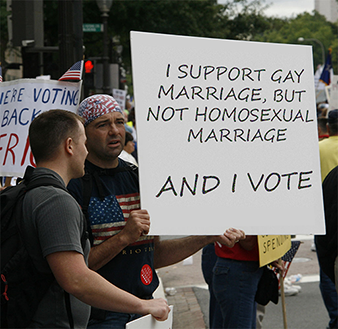
For all we know maybe this is the guy in charge of hiring for STEM faculty positions
4. Williams and Ceci asked participants to choose between “Dr. X” (who was described using the pronouns “he” and “him”) and “Dr. Y” (who was described using the pronouns “she” and “her”). Moss-Racusin et al asked participants to choose between “John” and “Jennifer”. They said they checked to make sure that the names were rated equal for “likeability” (whatever that means), but what if there are other important characteristics that likeability doesn’t capture? We know that names have big effects on our preconceptions of people. For example, people with short first names earn more money – an average of $3600 less per letter. If we trust this study (which may not be wise), John already has a $14,400 advantage on Jennifer, which goes a lot of the way to explaining why the participants offered John higher pay without bringing gender into it at all!
Likewise, independently of a person’s gender they are more likely to succeed in a traditionally male field if they have a male-sounding name. That means that one of the…call it a “prime” that activates sexism…might have been missed by comparing Dr. X to Dr. Y, but captured by pitting the masculine-sounding John against the feminine-sounding Jennifer. We can’t claim that W&C’s subjects were rendered gender-blind by the lack of gender-coded names – they noticed the female candidates enough to pick them twice as often as the men – but it might be that not getting the name activated the idea of gender from a different direction than hearing the candidates’ names would have.
5. Commenter Lee points out that MR&a tried to make their hokey hypothetical hiring seem a little more real than W&C did. MR&a suggest that these are real candidates being hired…somewhere…and the respondents have to help decide whom to hire (although they still use the word “imagine”). W&C clearly say that this is a hypothetical situation and ask the respondents to imagine that it is true. Some people in the comments are arguing that this makes W&C a better signaling opportunity whereas MR&a stays in near mode. But why would people not signal on a hiring question being put to them by people they don’t know about a carefully-obscured situation in some far-off university? Are sexists, out of the goodness of their hearts, urging MR&a to hire the man out of some compassionate desire to ensure they get a qualified candidate, but when W&C send them a hypothetical situation, they switch back into signaling mode?
6. Commenter Will points out that MR&a send actual resumes to their reviewers, but W&C send only a narrative that sums up some aspects of the candidates’ achievements and personalities (this is also the concern of Feminist Philosophers). This is somewhat necessitated by the complexities of tenure-track hiring – it’s hard to make up an entire fake academic when you can find every published paper in Google Scholar – but it does take them a step away from realism. They claim that they validated this methodology against real resumes, but it was a comparatively small validation – only 35 people. On the other hand, even this small validation was highly significant for pro-female bias. Maybe for some reason getting summaries instead of resumes heavily biases people in favor of women?
Or maybe none of those things mattered at all. Maybe all of this is missing the forest for the trees.
I love stories about how scientists set out to prove some position they consider obvious, but unexpectedly end up changing their minds when the results come in. But this isn’t one of those stories. Williams and Ceci have been vocal proponents of the position that science isn’t sexist for years now – for example, their article in the New York Times last year, Academic Science Isn’t Sexist. In 2010 they wrote Understanding Current Causes Of Women’s Underrepresentation In Science, which states:
The ongoing focus on sex discrimination in reviewing, interviewing, and hiring represents costly, misplaced effort: Society is engaged in the present in solving problems of the past, rather than in addressing meaningful limitations deterring women’s participation in science, technology, engineering, and mathematics careers today. Addressing today’s causes of underrepresentation requires focusing on education and policy changes that will make institutions responsive to differing biological realities of the sexes.
So they can hardly claim to be going into this with perfect neutrality.
But the lead author of the study that did find strong evidence of sexism, Corinne Moss-Racusin (whose name is an anagram of “accuser on minor sins”) also has a long history of pushing the position she coincidentally later found to be the correct one. A look at her resume shows that she has a bunch of papers with titles like “Defending the gender hierarchy motivates prejudice against female leaders”, “‘But that doesn’t apply to me:’ teaching college students to think about gender”, and “Engaging white men in workplace diversity: can training be effective?”. Her symposia have titles like “Taking a stand: the predictors and importance of confronting discrimination”. This does not sound like the resume of a woman whose studies ever find that oh, cool, it looks like sexism isn’t a big problem here after all.
So what conclusion should we draw from the people who obviously wanted to find a lack of sexism finding a lack of sexism, but the people who obviously wanted to find lots of sexism finding lots of sexism?
This is a hard question. It doesn’t necessarily imply the sinister type of bias – it may be that Drs. Williams and Ceci are passionate believers in a scientific meritocracy simply because that’s what all their studies always show, and Dr. Moss-Racusin is a passionate believer in discrimination because that’s what her studies find. On the other hand, it’s still suspicious that two teams spend lots of time doing lots of experiments, and one always gets one result, and the other always gets the other. What are they doing differently?
Problem is, I don’t know. Neither study here has any egregious howlers. In my own field of psychiatry, when a drug company rigs a study to put their drug on top, usually before long someone figures out how they did it. In these two studies I’m not seeing anything.
And this casts doubt upon those four possible sources of differences listed above. None of them look like the telltale sign of an experimenter effect. If MR&a were trying to fix their study to show lots of sexism, it would have taken exceptional brilliance to do it by using the names “John” versus “Jennifer”. If W&C were trying to fix their study to disguise sexism, it would have taken equal genius to realize they could do it by asking people “who would you hire?” rather than “who is most hireable?”.
(the only exception here is the lab manager. It’s just within the realm of probability that MR&a might have somehow realized they’d get a stronger signal asking about lab managers instead of faculty. The choice to ask about lab managers instead of faculty is surprising and does demand an explanation. And it’s probably the best candidate for the big difference between their results. But for them to realize that they needed to pull this deception suggests an impressive ability to avoid drinking their own Kool-Aid.)
Other than that, the differences I’ve been considering in these studies are the sort that would be very hard to purposefully bias. But the fact that both groups got the result they wanted suggests that the studies were purposefully biased somehow. This reinforces my belief that experimenter effects are best modeled as some sort of mystical curse incomprehensible to human understanding.
(now would be an excellent time to re-read the the horror stories in Part IV of “The Control Group Is Out Of Control”)
Speaking of horror stories. Sexism in STEM is, to put it mildly, a hot topic right now. Huge fortunes in grant money are being doled out to investigate it (Dr. Moss-Racusin alone received nearly a million dollars in grants to study STEM gender bias) and thousands of pages are written about it every year. And yet somehow the entire assembled armies of Science, when directed toward the problem, can’t figure out whether college professors are more or less likely to hire women than men.
This is not like studying the atmosphere of Neptune, where we need to send hundred-million dollar spacecraft on a perilous mission before we can even begin to look into the problem. This is not like studying dangerous medications, where ethical problems prevent us from doing the experiments we really need. This is not like studying genetics, where you have to gather large samples of identical twins separated at birth, or like climatology, where you hang out at the North Pole and might get eaten by bears. This is a survey of college professors. You know who it is studying this? College professors. The people they want to study are in the same building as them. The climatologists are getting eaten by bears, and the social psychologists can’t even settle a question that requires them to walk down the hallway.
It’s not even like we’re trying to detect a subtle effect here. Both sides agree that the signal is very large. They just disagree what direction it’s very large in!
A recent theme of this blog has been that Pyramid Of Scientific Evidence be damned, our randomized controlled trials suck so hard that a lot of the time we’ll get more trustworthy information from just looking at the ecological picture. Williams and Ceci have done this (see Part V, Section b of their supplement, “Do These Results Differ From Actual Hiring Data”) and report that studies of real-world hiring data confirm women have an advantage over men in STEM faculty hiring (although far fewer of them apply). It also matches the anecdotal evidence I hear from people in the field. I’m not necessarily saying I’m ambivalent between the two studies’ conclusions. Just that it bothers me that we have to go to tiebreakers after doing two good randomized controlled trials.
At this point, I think the most responsible thing would be to have a joint study by both teams, where they all agree on a fair protocol beforehand and see what happens. Outside of parapsychology I’ve never heard of people taking such a drastic step – who would get to be first author?! – but at this point it’s hard to deny that it’s necessary.
In conclusion, I believe the Moss-Racusin et al study more, but I think the Williams and Ceci study is more believable. And the best way to fight sexism in science is to remind people that it would be hard for women to make things any more screwed up than they already are.
