Post-Partisanship Is Hyper-Partisanship
Scott Alexander discusses how political groups can shift from outgroups to 'fargroups', leading to less hostility and more exoticization, and predicts this pattern may increase political in-fighting while reducing inter-party conflict.
I.
A few years ago, I wrote:
I want to avoid a very easy trap, which is saying that ingroups vs. outgroups are about how different you are, or how hostile you are. I don’t think that’s quite right.
Compare the Nazis to the German Jews and to the Japanese. The Nazis were very similar to the German Jews: they looked the same, spoke the same language, came from a similar culture. The Nazis were totally different from the Japanese: different race, different language, vast cultural gap. But the Nazis and Japanese mostly got along pretty well. Heck, the Nazis were actually moderately positively disposed to the Chinese, even when they were technically at war. Meanwhile, the conflict between the Nazis and the German Jews – some of whom didn’t even realize they were anything other than German until they checked their grandparents’ birth certificate – is the stuff of history and nightmares. Any theory of outgroupishness that naively assumes the Nazis’ natural outgroup is Japanese or Chinese people will be totally inadequate.
So what makes an outgroup? Proximity plus small differences. If you want to know who someone in former Yugoslavia hates, don’t look at the Indonesians or the Zulus or the Tibetans or anyone else distant and exotic. Find the Yugoslavian ethnicity that lives closely intermingled with them and is most conspicuously similar to them, and chances are you’ll find the one who they have eight hundred years of seething hatred toward.
I didn’t coin a silly term for the relationship of the Yugoslavs and the Tibetans, but let’s use “fargroup” in order to remind us of the Near/Far distinction. We think of groups close to us in Near Mode, judging them on their merits as useful allies or dangerous enemies. We think of more distant groups in Far Mode – usually, we exoticize them. Sometimes it’s positive exoticization of the Noble Savage variety (understood so broadly that our treatment of Tibetans counts as an example of the trope). Other times it’s negative exoticization, treating them as cartoonish stereotypes of evil who are more funny or fascinating than repulsive. Take Genghis Khan – objectively he was one of the most evil people of all time, killing millions of victims, but since we think of him in Far Mode he becomes fascinating or even perversely admirable – “wow, that was one impressively bloodthirsty warlord”.
(this jars when other cultures do it to people we consider Near-Mode evil – for example India’s Hitler-themed clothing store, romance movies, and their use of Mein Kampf as a business advice book. It’s a bit strange, but not objectively stranger than us having a comedy movie about Kim Jong-un)
Fargroups aren’t always people who are literally distant from us. It seems more like it’s people who don’t threaten us, or aren’t in competition with us, or don’t get involved in the conflicts we care about, or something like that. There’s a Scientologist Church just a couple of miles from my house, and I recognize that Scientologists do some pretty horrible things, but none of them affect me, or people close to me, or values that I have a personal connection with, so I’m still more likely to find them cartoonishly funny, Kim Jong-un style, than I am to feel angry or afraid of them.
We exoticize fargroups, but we can also use them as props in our own local conflicts. For example, a lot of the time I hear about ISIS, it’s in contexts like the Democrats being weak on ISIS or Trump playing into ISIS’ hands, or how our immigration policy makes us easy prey for ISIS, or fundamentalist Christians are no different from ISIS, or something like that. We use sympathetic fargroups the same way. The Tibetans aren’t just wise and noble, they’re a foil to our overly materialist society, or an example of how religion can be based on reason instead of faith, or whatever. This is all as the theory would predict. The GOP view the Democrats as more of an outgroup and ISIS as more of a fargroup. It’s harder for them to have genuine outrage at ISIS for beheading a bunch of people, than for them to have outrage at the Democrats for not mentioning the beheading. Even in cases where they seem angry at ISIS in a non-Democrat related way, I would argue that a lot of it can be traced back to appreciating the way ISIS proves various domestic points, like “Muslims are scary” or “the barbarism vs. civilization axis is important”.
II.
Last month I asked on Tumblr:
I remember that when I was young and the Internet was young, people online were debating religion vs. atheism ALL THE TIME. It felt inescapable. Whatever else you were trying to discuss, eventually it would turn into a religion vs. atheism debate. Whenever it came up, people would sigh and say “Oh no, not another religion vs. atheism debate”.
I remember spending a lot of time at talk.origins and infidels.org because religious people kept attacking me and I wanted to be able to rebut their points. And I remember a lot of people who seemed to genuinely believe that religion was like the #1 problem in the world, maybe even the only problem in the world because it was the root cause of all of the others.
I haven’t seen an online religion vs. atheism debate in years now. Occasionally somebody criticizes Richard Dawkins or something, but it’s always a tone argument and practically never about the nitty-gritty of Biblical contradictions or whatever. Now social justice vs. anti-social-justice seems to have totally taken over as the Annoying Thing Everybody On The Internet Has To Debate.
Has anybody else noticed this? Is it just me, or maybe a function of the places I hang out / used to hang out?
I got a lot of responses. Other people confirmed this was a real phenomenon and that they remember it the same way. The consensus explanation was that there was a moment in the 90s and early Bush administration when evangelical Christianity seemed to have a lot of political power, and secularists felt really threatened by it. This caused a lot of fear and arguments. Then everyone mostly agreed Bush was terrible, studies came out showing religion was on the decline, evangelicalism became so politically irrelevant that even the Republicans started nominating Mormons and Donald Trump, and people stopped caring so much.
Now I see atheists sharing things like this:
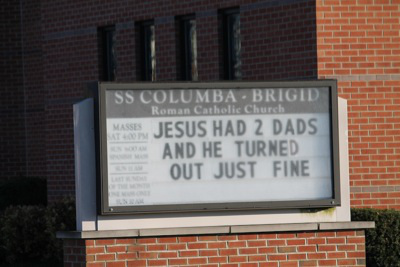 Not only have they stopped caring that much about religion, but they’re willing to adopt progressive religious people as role models and generally share stories that portray religious people in a positive light. Pope Francis gets to be the same sort of Socially Approved Benevolent Wise Person as the Dalai Lama.
I think once Christianity stopped seeming threatening, Christians went from being an outgroup to being a fargroup, and were exoticized has having the same sort of vague inoffensive wisdom as Buddhists.
I saw something that seemed very similar during my time interacting with movement atheists. There was a split between people who were raised in fundamentalist families and very traumatized about it and who viewed Christianity as an outgroup, versus people who were raised in agnostic families and pretty live-and-let-live and who viewed Christianity as an fargroup. I know it seems weird to say that movement atheists living in a majority-Christian country treated a religion they interacted with every day the same way the Yugoslavs treated Tibetans, and sure, they would make fun of them, but that was exactly it – they found religion funny – and even in the process of lightly mocking them they tried to avoid stepping on too many toes. The fundie-raised atheists would propose something really combative and offensive, and the secular-raised atheists would say “Oh, come on, we don’t want to be jerks about this, Christians are basically nice people who are just a bit deluded”. To the fundie-raised atheists it was real, it was a hot war, these people were monsters; to the secular-raised atheists, religious people were just kind of wacky in a problematic way, like the North Koreans, and nobody in America lives their life in a state of constant rage about how evil North Korea is.
And I think as the threat of movement fundamentalism declined, there was a shift among atheists from more emotional hostility to more of a live-and-let-live kind of attitude.
(and then movement atheism started tearing itself apart even more viciously than it was already. I don’t know if this was a coincidence and I’m still curious whether conservation of tribalism is a real phenomenon.)
III.
From Facebook the other day:
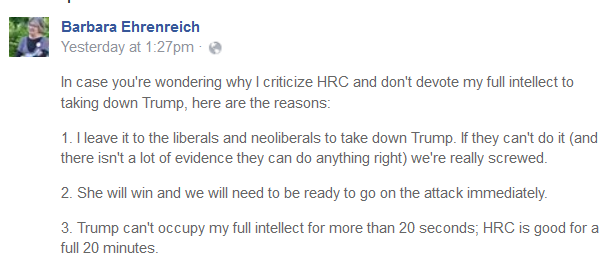 All good reasons. But I’ve been seeing more and more people lately saying things like this. There have always been primary elections, and there have always been intra-Left disagreements, but the level of Bernie vs. Hillary drama at the Democratic Convention this week seems to be something new. Ehrenreich-style leftists focus on critiquing Hillary instead of Trump – either within or outside of the context of supporting the Sanders campaign. And on the other side, Hillary-supporting liberals go after Sanders and his supporters instead of Trump – Freddie deBoer has written frequently (some would say incessantly) about this.
The right, of course, has its own conflicts between Trump partisans and Trump opponents, culminating in Cruz’s non-endorsement. Also relevant: the alt-right’s favorite slur of “cuck” is short for “cuckservative” – an insult not for leftists but for conservatives who they think are doing conservativism badly.
People are talking more and more about partisan bubbles. People dividing into political tribes, and cutting off contact with people on the other side. Cultural, geographic, and social differences isolate people so completely that for example my Facebook feed tends about 95% liberal; I’m sure there are other people out there with the opposite problem. I think that as bubbleification increases, the other party becomes less and less of an outgroup and more and more of a fargroup.
Republicans still “threaten” me in the sense of being able to enact policies that harm me. And people less privileged than I am face even more threats – a person dependent on food stamps has a lot to fear from Republican victories. But Republicans aren’t taking over my social circle or screaming in my face. In a purely social context they start to seem more like cartoonish and distant figures of evil, rather than neighbors and coworkers. The average Trump voter no longer seems like an uncanny-valley version of me; they seem like some strange inhabitant of a far-off land with incomprehensible values, just like ISIS.
I have yet to meet anybody in person (other than my patients) who supports Donald Trump. On the other hand, I’ve met a bunch of people on both sides with strong feelings about Bernie vs. Hillary. The Bernie vs. Hillary conflict is real to me in a way that the Hillary vs. Trump conflict isn’t. It has the potential to split my friend group. There are social advantages for me of taking either side, and I could reasonably take either side without people looking at me like I went to work stark naked. This is the kind of socially relevant conflict that produces ingroups and outgroups in a way that America vs. ISIS never will.
My guess is that this sort of thing is only going to become more common. Partisanism is going to give way to hyperpartisanism, where people hate other factions of their own party with the same venom they previously reserved for their opponents across the aisle.
At the same time, old outgroup hatreds will take on a different character. Even If You Don’t Like Donald Trump, You Should Understand The Pain Of His Poor White Supporters. And I Know Why Poor Whites Chant Trump, Trump, Trump. And Millions Of Ordinary Americans Support Donald Trump; Here’s Why. And The Incredible Crushing Despair Of The White Working Class. I’m not saying these articles are typical; for every one of these articles there are ten “Trump Voters Are Xenophobic Trailer Trash” pieces. I’m saying that it’s weird that they’re happening at all.
Same thing with Brexit. Yes, the usual xenophobic trailer trash articles. But also: In This Brexit Vote, The Poor Turned On An Elite Who Ignored Them. And Brexit Voters Are Not Thick Or Racist, Just Poor. And Outraged Elites Should Listen To Fed-Up Brexit Supporters.
(and of course this blog has been pushing a similar line for reasons that are probably not completely ahistorical or divorced from general trends)
People are starting to treat Trump voters and Brexit voters as interesting and worthy of respect, which means they’re not really an outgroup any more. Talking about how poor they are and how sympathetic we should be and how we need to be more educated in order to understand what they’re going through all sound like instances of fargroup exoticization to me.
I predict (50% probability) that the progressives most carefully bubbled and separated from any actual threat from Republicans – which disproportionately includes politicians, journalists, and other opinion-makers – will start treating the Trump-voting classes more like Tibetans. I predict when they talk about specific bad Republicans like Trump, they’ll focus more on the ways they are funny and cartoonish (far too easy with Trump, but maybe the next guy will be a better test) instead of the ways they’re threatening. I predict that conflicts within the progressive movement will be increasingly vicious and increasingly likely to use poor whites as a political football (“the other side is bigoted against poor whites!”). I predict this will happen much more if the Democrats win the election than if they lose it; it’s always easier to be gracious toward a vanquished opponent.
(I’m of course 100% guilty of all of this myself)
(Yeah, this is a change in predictions since Right Is The New Left, which talked about something similar but reached a kind of different conclusion)
I’m not sure how things will go on the Republican side. I haven’t seen the same signs of rapprochement from them – but then Republicans have never shown the same tendency to sympathize with poor exotic fargroups that Democrats do. But I also don’t know as many Republicans and maybe if this were happening I would miss it.
