Raikoth: Cities, Land
The post details the housing, urban planning, and land use in Raikoth, a fictional country where people live in yurts and cities are designed for cleanliness and tranquility.
(continuing to talk about my conculture)
Like all interesting people, Raikolin live in yurts.
The logistics are not too complicated. Land is sold or rented in the form of “campsites”, with spaces for yurts and hookups for plumbing and electricity. Poorer families might choose to live on the outskirts of cities instead, where the land is free but they have to improvise their own utilities (some live off the land in the summer, when the midnight sun provides plentiful solar power, then retreat to cities in the winter).
The yurts are easy to move with a couple of days’ notice, supporting a semi-nomadic lifestyle among country-dwellers who go to pastures and fishing grounds in the summer, then return to the cities in the winter. And their mobility allows changing family configurations – if Grandma is too old to support herself, the family can just move her yurt next to everyone else’s; or if a growing child wants more independence, she can pitch a yurt a short distance away from her parents’. Larger or wealthier families create larger dwellings suitable for their needs with modular yurts (see this site, which happily proclaims “No longer do you need to buy the biggest yurt you can!”)
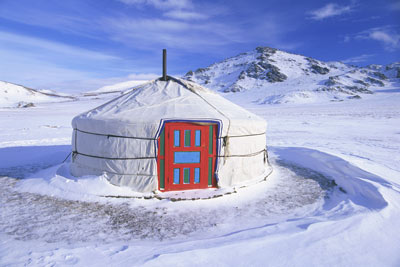 Home sweet home
Most important, yurts are cheap. In our world, even a very large yurt suitable for an entire family with lots of furniture costs $10,000 – $20,000; in Raikoth, with economies of scale, they cost barely half that. There are no housing bubbles, no mortgage loans, no subprime crises, and no foreclosures. And with the cheapest, simplest options costing barely $2500 to buy (and less to rent) there’s very little homelessness either, and the mobility and deconstructability of houses makes it easier to donate them to the needy when you’re done with them.
A few Raikolin abandon the traditional yurts to live in permanent stone or wood housing in city centers. These people are not trusted. “House-dweller” has the same connotations that “arugula-eater” has in 21st century America.
But there are more permanent stone buildings in city centers. A typical Raikothin city is a complex of temples, libraries, office buildings, factories, etc surrounded by fields of yurt campsites surrounded by city walls (previously functional, now there mostly to stop sprawl and because they’re pretty). Interspersed are a uniquely Raikothin art form, the dead garden – a botanical garden of plants made entirely of glass and jewels at latitudes much too cold for the genuine article.
 The Raikothin city of Tielion Zaedi on Micras’ Minecraft server
Travelers to these cities tend to describe them as “eerie” and “ghostlike” for a few reasons.
First, no cars are permitted within the city walls. They’re loud, dirty, dangerous, and prevent social interaction in the streets and public spaces. All the streets of a city are walkways, usually tiled. In compensation, there are excellent mass transit systems. Some cities use subways; others use personal rapid transit systems or string rails. All are effectively silent and invisible at ground level, leading to a sense of openness and safety completely absent from most other cities.
Second, the cities are spotless. Raikoth subscribes to an over-the-top exaggerated version of the broken window theory – that unpleasant and befouled environments increase antisocial behavior. They also believe that attention restoration therapy is not entirely about nature but about clean and organized places versus dirty and haphazard ones. Threats to the urban aesthetic are considered a tragedy of the commons in which the common resource is citizens’ health, intelligence, and emotional development – and the Shining Garden system exists to aggressively coordinate commons situations.
Chewing gum is illegal in Raikoth for much the same reason as in Singapore, and littering is punishable by indefinite exile to the nearest monastery. Foreigners have protested this latter policy, but the Raikolin stand firm, claiming that although theft can sometimes be legitimately due to poverty, and murder can sometimes be legitimately due to blind rage, littering is pretty much a deliberate and inexcusable “fuck you” to the entire rest of the community and the sort of people who find it acceptable should be separated as far from decent society as possible lest whatever is wrong with them spread. Graffiti is so far beyond the pale that no one even knows what the punishment would be, but it probably involves volcanoes in some way.
(the use of Third Eyes makes all of this extremely enforceable – if you see someone littering, you politely ask them to pick it up, and if they don’t, you go to the Rhavakl and release your records to them)
On the same principle – a reduction of visual clutter – outdoor advertising is banned and streetlights are rare and directional. Between the streetlight thing and the no cars thing, there is almost no light pollution.
Third, draconian noise restrictions. The Angels didn’t go through the trouble of banning cars to prevent noise pollution so that you could play your stereo at a hundred decibels. All the eugenics to get an average IQ 130 populace left a whole bunch of people with sensory processing disorders, and yurts aren’t exactly super-soundproof. There are well-specified public nuisance restrictions with actual numbers-of-decibels attached to them, and if someone is violating them, you ask them to stop, and if they don’t, you go to the Rhavakl with recordings from the Third Eye. Consider the level of courtesy the Japanese developed in order to live in tiny sardine-like apartments, then multiply it by about thirty.
Land
Not everyone likes these restrictions. A surprising number of people do, because they’re easier when you’ve been raised with them, and they make a lot of sense in a country with high prevalence of sensory processing disorders. But there are some people who just want to live as free as possible without anyone telling them what to do.
Luckily, ninety percent of the country is frozen wasteland.
As suggested in the map from the first post, pretty much all the large cities and towns of Raikoth are on a tiny strip along the eastern coast, the fertile and hospitable area between the mountains and the sea (you may recognize this as also pretty Japanese). The rest of the country – not to mention the deadly freezing north, is pretty much all wilderness.
And so while most people stick to the civilized regions on the east coast, a strange collection of hunters, trappers, monks, hermits, anarcho-primitivists, extremely determined geocachers, and people who just want to get away from it all live in the west and sometimes even construct weird experimental communities there. The Raikolin are extremely proud of their option to leave civilization at any moment and romanticize those who choose a life in the wilds, even to the point of forbidding any development west of the mountains to avoid interfering with their lifestyle.
Some of these communities are monasteries, self-sufficient communities built on high mountains or in remote valleys and inhabited by a strange combination of logician-monks, exiles, and just plain people who want to get away from it all. Days consist of a combination of work and study. A few specialize in the rehabilitation of exiled criminals; these latter are welcomed into the monastic community as full and equal members – but like all full and equal members, if they don’t work they don’t eat. A surprising number stay after their sentences are finished, which suits everyone just fine. The largest such community is Katanta, “the City of Hermits”, which stubbornly refuses to tell anyone its exact location and which tends to move whenever it is discovered.
Beyond these oases of civilization lie even wilder places. Named for their inhospitability and deadliness, regions like Never-Go-Here and You-Will-Die are the ultimate escape from everything, usually including the mortal coil. There are no roads, no good maps, nowhere to get help, and rumors persist that the central government jams all wireless communications there for uncertain reasons. Nevertheless, it is considered totally sacrosanct that anyone who wants to pack up and go live as a mountain man out there should be allowed to do so, and every so often one of them even survives or comes back home.
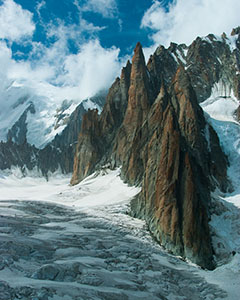 The people who live here think where you live is bleak and hostile to life

