Reverse Voxsplaining: Prison and Mental Illness
Scott Alexander criticizes the idea that prisons have replaced mental hospitals, arguing for better community and forensic mental health care instead of long-term institutionalization.
I.
German Lopez of Vox writes that “America’s criminal justice system has in many ways become a substitute for the US’ largely gutted mental health system”.
He says that starting in the 1970s the US “began locking up a lot more people”, and “at the same time, the country pulled back and defunded its public mental health system”. He admits that “this wasn’t, at the time, totally malicious”, but then says it “left the criminal justice system as the only system that can respond to people with mental illness.”
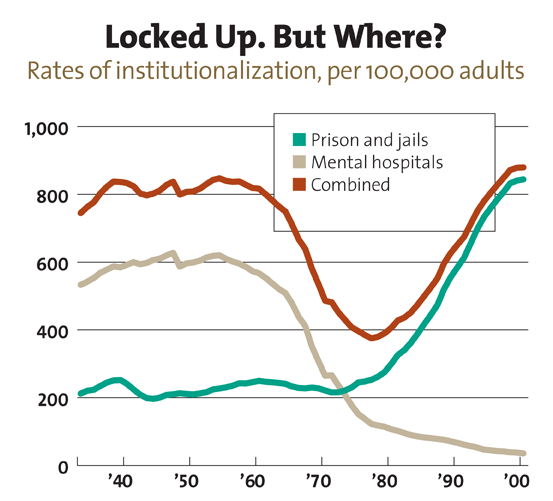 He concludes that as a result, “the number of people with mental illness in prisons/jails outnumber those in state hospitals 10 to 1.” The apparent (though unstated) conclusion is that defunding the big state mental hospitals was a mistake and we need to bring them back so that the mentally ill in state hospitals once more outnumber those in prison.
Lopez seems to be working off a model where there is a population of mentally ill people who can’t make it in normal society, and so will inevitably end up either in a long-term mental hospital or a prison. Since mental hospitals are good places where people get treatment, and prisons are bad places where people get punishment, we should “catch” these mentally ill people before they end up in prison so that they can be in nice hospitals instead.
Needless to say I disagree with pretty much every part of this assessment.
II.
Between all of this talk of “the tragic collapse of America’s public mental health system” and “the US’s largely gutted mental health system” and “the country pulled back and defunded its mental health system” and so on, you might get the impression that less money is being spent on mental health. This is not really true. The share of GDP devoted to mental health is the same as it was in 1971, although this looks worse if you compare it to rising costs in other areas of health care. There hasn’t been a “gutting of the mental health system”, there’s been a shift from long-term state-run mental hospitals to community care. It hasn’t “left the criminal justice system as the only system that can respond to people with mental illness”, it helped create an alternate and less restrictive system of outpatient psychiatry. In my opinion, this was a positive development, and the share of mentally ill people in prison is not an argument against it. Let me explain.
“Mentally ill people in prison” conjures up this lurid image of psychos who snap and kill their families, followed by “well, what did you expect leaving a person like that on the street?” The reality is more mundane. There are lots of mentally ill people in prison because there are lots of mentally ill people everywhere. Remember, 20% of the population qualifies as mentally ill in one sense or another. If a depressed guy sells some marijuana and gets caught, he is now a “mentally ill person in prison”.
There are disproportionately many mentally ill people in prison partly because people’s illnesses lead them to commit crimes, but mostly because some of the factors correlated with mental illness are the same factors correlated with criminality. Poverty? Check. Neighborhood effects? Check. Genetic load? Check. Education? Check. IQ? Check. Broken families? Check. Drug abuse? Definitely check. The factors that gave that pot dealer depression might be the same factors that drove him to sell pot instead of becoming an astronaut. Treating the depression might help a little, but it’s not guaranteed to keep him on the good side of the law.
In my model, the overwhelming majority of mentally ill people can live okay lives outside of any institution, hopefully receiving community care if they want it. If they commit crimes they will go to prison just like anyone else; if not, we should hardly be clamoring to bring back the often-horrifying state-run mental hospitals and lock them up there.
So when we talk about the number of mentally ill people in prison, we should be trying to distinguish between Lopez’s model and mine. That means asking: exactly how mentally ill are we talking about here?
III.
Lopez’s source for the claim that “ten times more mentally ill people are in prisons than hospitals” is a report by the Treatment Advocacy Center – note the less-than-neutral name. Where Lopez uses the phrase “mental illness”, TAC uses the phrase “severe mental illness” and defines it in two ways. For people in state prisons, they define it as reporting at least one psychotic symptom, and say 15% of people met their criteria. For people in county jails, they define it as meeting criteria for a depressive, bipolar, or psychotic illness, and say 15% of people met their criteria (they later arbitrarily increase that number to 20% because they feel like the survey might have undercounted).
No no NO. First, “psychotic” is not the same thing as “severely mentally ill”. Some people are severe but not psychotic – for example, a suicidally depressed person. Others are psychotic but not severe – for example, someone who hears a voice whispering her name but shrugs it off. Describing a survey that shows 15% of people as admitting one symptom of psychosis as showing 15% of people are severely mentally ill is really sketchy.
The prison survey provides a perfect example. It looks like the prisoners were asked fixed questions about their symptoms, and I think the exact screening instrument was just this survey, which has four relevant questions: “Can anybody else control your brain or thoughts?”, “Do you ever hear voices other people don’t hear?”, “Do you ever see something that other people tell you isn’t real?” and “Do you ever think anyone (other than correctional staff) is spying on you or plotting against you?”
Unfortunately, these kinds of surveys are really weak. I’m doing a study about this now, so maybe later I can cite myself on this, but the gist is that a lot of short mental health screening questions get false positives from perfectly healthy people. For example, I can’t tell you how many patients I’ve asked “Do you ever feel like anyone is spying on you?”, they say “Yes”, I ask “Who?” and they say “The NSA on my Internet activity”. Well, good work keeping up with the news. But a survey with a checkbox and no followup questions diagnoses that person as psychotic (see also: Lizardman’s Constant). This prison questionnaire was smart enough to exclude prison guards, who are certainly spying on all the respondents, but even beyond that I feel like the criminal lifestyle really does involve being spied on and plotted against a lot. At the very least it gives you lots of opportunities to legitimately worry about it.
(also, the diagnostic criteria for psychotic disorder are very clear that paranoia experienced while taking drugs doesn’t count. 75% of prisoners admit to using marijuana, marijuana can totally make you paranoid, and as far as I can tell the survey did not specify that the paranoia had to be while sober.)
(also also, Scientific American says that about 5-15% of perfectly ordinary people hear voices. Meanwhile, 4-6% of prisoners in the survey admitted to it.)
When the survey says that X% of prisoners have felt plotted-against or heard voices in the last year, does that mean X% of them are psychotic? That X% of them are “severely mentally ill”? That the old state mental hospitals need to be re-opened so X% of them can be locked up there for being too crazy for society? I don’t think it means any of those things.
But this is the stricter of the two criteria that the survey uses! The other one counts depressed people, bipolar people, and psychotic people. I don’t want to trivialize non-psychotic illnesses like depression. But remember: about 10% of the ordinary non-prison population is depressed/bipolar/psychotic. Also, going to prison is depressing as heck in and of itself. When they say that 15% of people in county jails (rounded up to 20%) are severely psychiatrically ill, they’re talking about pretty normal people, who might be in prison for something unrelated to their mental illness and might not even have become mentally ill at all if they hadn’t been incarcerated.
So I don’t think this survey shows the majority of the mentally ill prison population is in need of institutionalization. Yes, ten times more mentally ill people are in prison than in state mental hospitals, but consider the base rates! The prison population is huge. The population of people who need to be committed to mental hospitals 24-7 is tiny. Even if mentally ill people committed crimes at exactly the average population rate, there would still be far more mentally ill people in prison than in psychiatric hospitals, just by base rates! Especially if you use as broad a definition of “mentally ill” as these people!
So when Vox says that ten times more mentally ill people are in prison than in psychiatric hospitals, I will shoot right back at them that ten times more mentally ill people are in the Los Angeles metropolitan area than in state mental hospitals. You want more meaningless statistics? Ten times more mentally ill people are in the Southern Baptist Church than in state mental hospitals! Ten times more mentally ill people watched the last season of Game of Thrones than are in state mental hospitals! We can’t and shouldn’t aim to institutionalize all of them.
IV.
What about that graph? It’s very suggestive. You see a sudden drop in the number of people in state mental hospitals. Then you see a corresponding sudden rise in the number of people in prison. It looks like there’s some sort of Law Of Conservation Of Institutionalization. Coincidence?
Yes. Absolutely. It is 100% a coincidence. Studies show that the majority of people let out of institutions during the deinstitutionalization process were not violent and that the rate of violent crime committed by the mentally ill did not change with deinstitutionalization. Even if we take the “15% of inmates are severely mentally ill” factoid at face value, that would mean that the severely mentally ill could explain at most 15%-ish of the big jump in prison population in the 1980s. The big jump in prison population in the 1980s was caused by the drug war and by people Getting Tough On Crime. Stop dragging the mentally ill into this.
Lopez himself wrote a nice piece on how most mentally ill people are not violent, and another nice piece on how most people in prison are there for violent offenses. But put these together, and you get that most mentally ill people do not end up in prison. Most of the people who got out of the mental hospitals during deinstitutionalization are getting by. Some of them are homeless, and that’s bad. But if you want to solve homelessness among the mentally ill, build homeless shelters, not state-run long-term mental hospitals.
V.
In case you haven’t noticed, I really don’t like state-run long-term mental hospitals. There is a really amazingly great thing about prison, which is that you don’t go there unless you’re convicted of a crime. Mental hospitals do not have that advantage. The commitment process kind of sucks, and I am saying this as a person who makes commitment decisions myself. A lot of times it degenerates into a ritualized method of avoiding lawsuits without much concern for benevolence or patient autonomy. It helps me sleep at night to know that most commitments only last a couple of days or a week at most. Long-term state-run mental hospitals didn’t work that way. Remember that some of the perfectly sane people in the Rosenhan experiment were kept locked up for fifty days just for saying they heard a voice once but now they’re better.
I think long-term state-run mental hospitals are better than prison, but not by very much. The Rosenhan participants described it as:
…an overwhelming sense of dehumanization, severe invasion of privacy, and boredom while hospitalized. Their possessions were searched randomly, and they were sometimes observed while using the toilet. They reported that though the staff seemed to be well-meaning, they generally objectified and dehumanized the patients, often discussing patients at length in their presence as though they were not there, and avoiding direct interaction with patients except as strictly necessary to perform official duties. Some attendants were prone to verbal and physical abuse of patients when other staff were not present. A group of bored patients waiting outside the cafeteria for lunch early were said by a doctor to his students to be experiencing “oral-acquisitive” psychiatric symptoms. Contact with doctors averaged 6.8 minutes per day.
The idea of potentially saving a couple of people from prison by pre-emptively committing way more people to a mental hospital does not appeal to me at all, and I still think closing the institutions was the best thing Reagan ever did.
But prison and institutions aren’t the only two options! There’s a six month waiting period for psychiatrists in most parts of the country. The existing mental hospitals – which are different from and often nicer than the old state-run institutions – are constantly turning away people who want to be there because they don’t have enough beds for them. There are a bunch of patients who are having trouble affording their medications. There are special treatment options like day clinics, partial hospital programs, recreational therapy, occupational therapy, et cetera that do really great things but which most patients can’t afford. There are intensive health monitoring programs – think nurses who come to your house and make sure you take your medication on time – which are proven to improve outcomes but which never have enough staff for everybody who needs them. There are omnipresent underfunded community mental health systems. All of these things are doing great work right now. Indeed, the plan for closing the state-run long-term facilities was to gradually transition care to all of these other systems, and where that was supported it worked well, and insofar as it didn’t work well it was because it wasn’t supported.
If we support all that, will it keep all mentally ill people out of the prison system? No. First of all, no treatment is perfect and most are downright mediocre. Second of all, like I said, there are mentally ill people in prison because there are mentally ill people everywhere. There are disproportionately many mentally ill people in prison because the risk factors for mental illness are the same as the risk factors for crime, like poverty and drug abuse. Regardless of the level of care given, mentally ill people are likely to end up in prison at increased rates, unless you’re willing to either institutionalize all mentally ill people before they can commit any crimes, or excuse all crimes committed by mentally ill people.
But we shouldn’t be making our mental health decisions based on worries about criminality and prisons. Most people who are mentally ill will never end up on the wrong side of the law, and many (most?) mentally ill people who do end up in prison will do so for reasons not directly related to their illness. Make mental health decisions because it’s the right thing to do and there are people who really need help.
And if mentally ill people do end up in prison? There is a forensic health system dedicated to treating mentally ill prisoners. It’s not perfect, but with more funding and attention it could be better. There are forensic psychiatric hospitals that house mentally ill prisoners, and though again they are not perfect, they at least have that great advantage that you can’t be put in them unless you are found guilty of a crime.
So my argument is: fund and use the community mental health system more to help people in the community. Fund and use the forensic mental health system more to help people in prison. But stop acting like the two groups are fungible. And stop trying to institutionalize more people. That doesn’t help.
