Social Justice And Words, Words, Words
Scott Alexander critiques social justice terminology, arguing that words like 'privilege' and 'racism' are used as weapons rather than tools for understanding.
[Content note: hostility toward social justice, discussion of various prejudices]
“Words! Words! Words! I’m so sick of words! I get words all day through. First from him, now from you. Is that all you blighters can do?” – Eliza Doolittle
I.
I recently learned there is a term for the thing social justice does. But first, a png from racism school dot tumblr dot com.
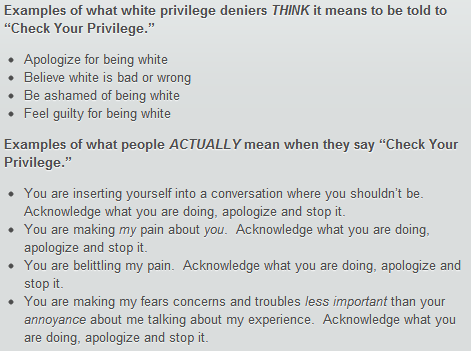 So, it turns out that privilege gets used perfectly reasonably. All it means is that you’re interjecting yourself into other people’s conversations and demanding their pain be about you. I think I speak for all straight white men when I say that sounds really bad and if I was doing it I’m sorry and will try to avoid ever doing it again. Problem solved, right? Can’t believe that took us however many centuries to sort out.
A sinking feeling tells me it probably isn’t that easy.
In the comments section of the last disaster of a social justice post on my blog, someone started talking about how much they hated the term “mansplaining”, and someone else popped in to – ironically – explain what “mansplaining” was and why it was a valuable concept that couldn’t be dismissed so easily. Their explanation was lucid and reasonable. At this point I jumped in and commented:
I feel like every single term in social justice terminology has a totally unobjectionable and obviously important meaning – and then is actually used a completely different way.
The closest analogy I can think of is those religious people who say “God is just another word for the order and beauty in the Universe” – and then later pray to God to smite their enemies. And if you criticize them for doing the latter, they say “But God just means there is order and beauty in the universe, surely you’re not objecting to that?”
The result is that people can accuse people of “privilege” or “mansplaining” no matter what they do, and then when people criticize the concept of “privilege” they retreat back to “but ‘privilege’ just means you’re interrupting women in a women-only safe space. Surely no one can object to criticizing people who do that?”
…even though I get accused of “privilege” for writing things on my blog, even though there’s no possible way that could be “interrupting” or “in a women only safe space”.
When you bring this up, people just deny they’re doing it and call you paranoid.
When you record examples of yourself and others getting accused of privilege or mansplaining, and show people the list, and point out that exactly zero percent of them are anything remotely related to “interrupting women in a women-only safe space” and one hundred percent are “making a correct argument that somebody wants to shut down”, then your interlocutor can just say “You’re deliberately only engaging with straw-man feminists who don’t represent the strongest part of the movement, you can’t hold me responsible for what they do” and continue to insist that anyone who is upset by the uses of the word “privilege” just doesn’t understand that it’s wrong to interrupt women in safe spaces.
I have yet to find a good way around this tactic.
My suspicion about the gif from racism school dot tumblr dot com is that the statements on the top show the ways the majority of people will encounter “privilege” actually being used, and the statements on the bottom show the uncontroversial truisms that people will defensively claim “privilege” means if anyone calls them on it or challenges them. As such it should be taken as a sort of weird Rosetta Stone of social justicing, and I can only hope that similarly illustrative explanations are made of other equally charged terms.
Does that sound kind of paranoid? I freely admit I am paranoid in this area. But let me flesh it out with one more example.
Everyone is a little bit racist. We know this because there is a song called “Everyone’s A Little Bit Racist” and it is very cute. Also because most people score poorly on implicit association tests, because a lot of white people will get anxious if they see a black man on a deserted street late at night, and because if you prime people with traditionally white versus traditionally black names they will answer questions differently in psychology experiments. It is no shame to be racist as long as you admit that you are racist and you try your best to resist your racism. Everyone knows this.
Donald Sterling is racist. We know this because he made a racist comment in the privacy of his own home. As a result, he was fined $2.5 million, banned for life from an industry he’s been in for thirty-five years, banned from ever going to basketball games, forced to sell his property against his will, publicly condemned by everyone from the President of the United States on down, denounced in every media outlet from the national news to the Podunk Herald-Tribune, and got people all over the Internet gloating about how pleased they are that he will die soon. We know he deserved this, because people who argue he didn’t deserve this were also fired from their jobs. He deserved it because he was racist. Everyone knows this.
So.
Everybody is racist.
And racist people deserve to lose everything they have and be hated by everyone.
This seems like it might present a problem. Unless of course you plan to be the person who gets to decide which racists lose everything and get hated by everyone, and which racists are okay for now as long as they never cross you in any way.
Sorry, there’s that paranoia again.
Someone will argue I am equivocating between two different uses of “racist”. To which I would respond that this is exactly the point. I don’t know if racism school dot tumblr dot com has a Rosetta Stone with Donald Sterling on the top and somebody taking the Implicit Association Test on the bottom. But I think there is a strain of the social justice movement which is very much about abusing this ability to tar people with extremely dangerous labels that they are not allowed to deny, in order to further their political goals.
II.
I started this post by saying I recently learned there is a term for the thing social justice does. A reader responding to my comment above pointed out that this tactic had been described before in a paper, under the name “motte-and-bailey doctrine”.
The paper was critiquing post-modernism, an area I don’t know enough about to determine whether or not their critique was fair. It complained that post-modernists sometimes say things like “reality is socially constructed”. There’s an uncontroversial meaning here – we don’t experience the world directly, but through the categories and prejudices implicit to our society. For example, I might view a certain shade of bluish-green as blue, and someone raised in a different culture might view it as green. Okay. Then post-modernists go on to say that if someone in a different culture thinks that the sun is light glinting off the horns of the Sky Ox, that’s just as real as our own culture’s theory that the sun is a mass of incandescent gas a great big nuclear furnace. If you challenge them, they’ll say that you’re denying reality is socially constructed, which means you’re clearly very naive and think you have perfect objectivity and the senses perceive reality directly.
The writers of the paper compare this to a form of medieval castle, where there would be a field of desirable and economically productive land called a bailey, and a big ugly tower in the middle called the motte. If you were a medieval lord, you would do most of your economic activity in the bailey and get rich. If an enemy approached, you would retreat to the motte and rain down arrows on the enemy until they gave up and went away. Then you would go back to the bailey, which is the place you wanted to be all along.
By this metaphor, statements like “God is an extremely powerful supernatural being who punishes my enemies” or “The Sky Ox theory and the nuclear furnace theory are equally legitimate” or “Men should not be allowed to participate in discussions about gender” are the bailey – not defensible at all, but if you can manage to hold them you’ve got it made.
Statements like “God is just the order and love in the universe” and “No one perceives reality perfectly directly” and “Men should not interject into safe spaces for women” are the motte – extremely defensible, but useless.
As long as nobody’s challenging you, you spend time in the bailey reaping the rewards of occupying such useful territory. As soon as someone challenges you, you retreat to the impregnable motte and glare at them until they get annoyed and go away. Then you go back to the bailey.
This is a metaphor that only historians of medieval warfare could love, so maybe we can just call the whole thing “strategic equivocation”, which is perfectly clear without the digression into feudal fortifications.
III.
I probably still sound paranoid. So let me point out something I think the standard theory fails to explain, but my theory explains pretty well.
Why can’t social justice terms apply to oppressed groups?
Like, even bringing this up freaks people out. There is no way to get a quicker reaction from someone in social justice than to apply a social justice term like “privilege” or “racist” to a group that isn’t straight/white/male. And this is surprising.
If “privilege” just means “interjecting yourself into other people’s conversations”, this seems like something that women could do as well as men. Like, let’s say that a feminist woman posts a thoughtful comment to this post, and I say “Thanks for your input, but I was actually just trying to explain things to my non-feminist male friends, I’d prefer you not interject here.” Isn’t it possible she might continue to argue, and so be interjecting herself into another person’s conversation?
Or suppose “privilege” instead just means a cute story about a dog and a lizard, in which different people have trouble understanding each other’s experiences and appreciating the amount of pain they can be causing. I know a lot of men who are scared of being Forever Alone but terrified to ask women out, and I feel their pain and most of my male friends feel their pain. Yet a lot of the feminists I talk to have this feeling that this is entirely about how they think they own women’s bodies and are entitled to sex, and from their experience as attractive women it’s easy to get dates and if you can’t it’s probably because you’re a creep or not trying hard enough. This seems to me to be something of a disconnect and an underappreciation of the pain of others, of exactly the dog-lizard variety.
There are as many totally innocuous and unobjectionable definitions of “privilege” as there are people in the social justice movement, but they generally share something in common – take them at face value, and the possibility of women sometimes showing privilege toward men is so obvious as to not be worth mentioning.
Yet if anyone mentions it in real life, they are likely to have earned themselves a link to an Explanatory Article. Maybe 18 Reasons Why The Concept Of Female Privilege Is Insane. Or An Open Letter To The Sexists Who Think Female Privilege Is A Thing. Or The Idea Of Female Privilege – It Isn’t Just Wrong, It’s Dangerous. Or the one on how there is no female privilege, just benevolent sexism. Or That Thing You Call Female Privilege Is Actually Just Whiny Male Syndrome. Or Female Privilege Is Victim Blaming, which helpfully points out that people who talk about female privilege “should die in a fire” and begins “we need to talk, and no, not just about the fact that you wear fedoras and have a neck beard.”
It almost seems like you have touched a nerve. But why should there be a nerve here?
As further confirmation that we are on to something surprising, note also the phenomenon of different social justice groups debating, with desperation in their eyes, which ones do or don’t have privilege over one another.
If you are the sort of person who likes throwing rocks at hornet nests, ask anyone in social justice whether trans men (or trans women) have male privilege. You end up in places like STFU TRANSMISOGYNIST TRANS FOLKS or Cis Privilege Is Just A Tenet Of Male Privilege or On Trans People And The Male Privilege Accusation or the womyn-born-womyn movement or Against The Cisgender Privilege List or How Misogyny Hurts Trans Men: We Do Sometimes Have Male Privilege But There Are More Important Things To Talk About Here.
As far as I can tell, the debate is about whether trans women are more privileged than cis women, because they have residual male privilege from the period when they presented as men, or less privileged than cis women, because they are transsexual – plus a more or less symmetrical debate on the trans man side. The important thing to notice is that every group considers it existentially important to prove that they are less privileged than the others, and they do it with arguments like (from last link) “all examples of cis privilege are really male privileges that are not afforded to women, or are instances of resistance to trans politics. I call it patriarchy privilege when something like an unwillingness to redefine one’s own sexuality to include males is seen is labeled as offensive.”
And the trans male privilege argument is one of about seven hundred different vicious disputes in which everyone is insisting other people have more privilege than they do, fighting as if their lives depended on it.
The question here: since privilege is just a ho-hum thing about how you shouldn’t interject yourself into other people’s conversations, or something nice about dogs and lizards – but definitely not anything you should be ashamed to have or anything which implies any guilt or burden whatsoever – why are all the minority groups who participate in communities that use the term so frantic to prove they don’t have it?
We find the same unexpected pattern with racism. We all know everyone is racist, because racism just means you have unconscious biases and expectations. Everyone is a little bit racist.
People of color seem to be part of “everyone”, and they seem likely to have the same sort of in-group identification as all other humans. But they are not racist. We know this because of articles that say things like “When white people complain about reverse racism, they are complaining about losing their PRIVILEGE” and admit that “the dictionary is wrong” on this matter. Or those saying whites calling people of color racist “comes from a lack of understanding of the term, through ignorance or willful ignorance and hatred”. Or those saying that “when white people complain about experiencing reverse racism, what they’re really complaining about is losing out on or being denied their already existing privileges.” Why Are Comments About White People Not Racist, Can Black People Be Racist Toward White People? (spoiler: no), Why You Can’t Be Racist To White People, et cetera et cetera.
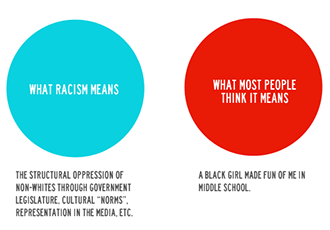
All of these sources make the same argument: racism means structural oppression. If some black person beats up some white person just because she’s white, that might be unfortunate, it might even be “racially motivated”, but because they’re not acting within a social structure of oppression, it’s not racist. As one of the bloggers above puts it:
Inevitably, here comes a white person either claiming that they have a similar experience because they grew up in an all black neighborhood and got chased on the way home from school a few times and OMG THAT IS SO RACIST and it is the exact same thing, or some other such bullshittery, and they expect that ignorance to be suffered in silence and with respect. If you are that kid who got chased after school, that’s horrible, and I feel bad for you…But dudes, that shit is not racism.
I can’t argue with this. No, literally, I can’t argue with this. There’s no disputing the definitions of words. If you say that “racism” is a rare species of nocturnal bird native to New Guinea which feeds upon morning dew and the dreams of young children, then all I can do is point out that the dictionary and common usage both disagree with you. And the sources I cited above have already admitted that “the dictionary is wrong” and “no one uses the word racism correctly”.
Actually, I suppose one could escape a hostile dictionary and public by appealing to the original intent of the person who invented the word, but the man who invented the word “racism” was an activist for the forced assimilation of Indians who was known to say things like “Some say that the only good Indian is a dead one. In a sense, I agree with the sentiment, but only in this: that all the Indian there is in the race should be dead. Kill the Indian in him, and save the man.” My guess is that this guy was not totally on board with dismantling structures of oppression.
So we have a case where original coinage, all major dictionaries, and the overwhelming majority of common usage all define “racism” one way, and social justice bloggers insist with astonishing fervor that way is totally wrong and it must be defined another. One cannot argue definitions, but one can analyze them, so you have to ask – whence the insistence that racism have the structural-oppression definition rather than the original and more commonly used one? Why couldn’t people who want to talk about structural oppression make up their own word, thus solving the confusion? Even if they insisted on the word “racism” for their new concept, why not describe the state of affairs as it is: “The word racism can mean many things to many people, and I suppose a group of black people chasing a white kid down the street waving knives and yelling ‘KILL WHITEY’ qualifies by most people’s definition, but I prefer to idiosyncratically define it my own way, so just remember that when you’re reading stuff I write”? Or why not admit that this entire dispute is pointless and you should try to avoid being mean to people no matter what word you call the meanness by?
And how come this happens with every social justice word? How come the intertubes are clogged with pages arguing that blacks cannot be racist, that women cannot have privilege, that there is no such thing as misandry, that you should be ashamed for even thinking the word cisphobia? Who the heck cares? This would never happen in any other field. No doctor ever feels the need to declare that if we talk about antibacterial drugs we should call bacterial toxins “antihumanial drugs”. And if one did, the other doctors wouldn’t say YOU TAKE THAT BACK YOU PIECE OF GARBAGE ONLY HUMANS CAN HAVE DRUGS THIS IS A FALSE EQUIVALENCE BECAUSE BACTERIA HAVE INFECTED HUMANS FOR HUNDREDS OF YEARS BUT HUMANS CANNOT INFECT BACTERIA, they would just be mildly surprised at the nonstandard terminology and continue with their normal lives. The degree to which substantive arguments have been replaced by arguments over what words we are allowed to use against which people is, as far as I know, completely unique to social justice. Why?
IV.
And so we return to my claim from earlier:
I think there is a strain of the social justice movement which is entirely about abusing the ability to tar people with extremely dangerous labels that they are not allowed to deny, in order to further their political goals.
If racism school dot tumblr dot com and the rest of the social justice community are right, “racism” and “privilege” and all the others are innocent and totally non-insulting words that simply point out some things that many people are doing and should try to avoid.
If I am right, “racism” and “privilege” and all the others are exactly what everyone loudly insists they are not – weapons – and weapons all the more powerful for the fact that you are not allowed to describe them as such or try to defend against them. The social justice movement is the mad scientist sitting at the control panel ready to direct them at whomever she chooses. Get hit, and you are marked as a terrible person who has no right to have an opinion and who deserves the same utter ruin and universal scorn as Donald Sterling. Appease the mad scientist by doing everything she wants, and you will be passed over in favor of the poor shmuck to your right and live to see another day. Because the power of the social justice movement derives from their control over these weapons, their highest priority should be to protect them, refine them, and most of all prevent them from falling into enemy hands.
If racism school dot tumblr dot com is right, people’s response to words like “racism” and “privilege” should be accepting them as a useful part of communication that can if needed also be done with other words. No one need worry too much about their definitions except insofar as it is unclear what someone meant to say. No one need worry about whether the words are used to describe them personally, except insofar as their use reveals states of the world which are independent of the words used.
If I am right, then people’s response to these words should be a frantic game of hot potato where they attack like a cornered animal against anyone who tries to use the words on them, desperately try to throw them at somebody else instead, and dispute the definitions like their lives depend on it.
And I know that social justice people like to mock straight white men for behaving in exactly that way, but man, we’re just following your lead here.
Suppose the government puts a certain drug in the water supply, saying it makes people kinder and more aware of other people’s problems and has no detrimental effects whatsoever. A couple of conspiracy nuts say it makes your fingers fall off one by one, but the government says that’s ridiculous, it’s just about being more sensitive to other people’s problems which of course no one can object to. However, government employees are all observed drinking bottled water exclusively, and if anyone suggests that government employees might also want to take the completely innocuous drug and become kinder, they freak out and call you a terrorist and a shitlord and say they hope you die. If by chance you manage to slip a little bit of tap water into a government employee’s drink, and he finds out about it, he runs around shrieking like a banshee and occasionally yelling “AAAAAAH! MY FINGERS! MY PRECIOUS FINGERS!”
At some point you might start to wonder whether the government was being entirely honest with you.
This is the current state of my relationship with social justice.
