Survey Results: Suffering Vs. Oblivion
Scott Alexander surveys people's preferences between suffering and oblivion, finding split opinions and weak correlations between different scenarios and real-world beliefs.
[Content warning: suffering, oblivion]
Every so often, someone on Reddit realizes that about half of people wipe themselves with toilet paper sitting down, and the other half do it standing up. This discovery is followed by horror on both sides that other people do it differently.
I occasionally have the same feeling when I talk about ethics. Every so often I run up against a base-level clash of intuitions with somebody else, where they disagree on a preference I would have expected to be self-evident. This is pretty bad, since some forms of consequentialism are a lot more elegant if we imagine that all apparent moral disagreements are just people failing to think through their own preferences clearly enough and everyone really agrees about morality deep down.
A lot of these clashes of intuitions have to do with the idea of suffering versus oblivion. In order to explore this further, I asked people on Twitter and Tumblr to answer some survey questions like the following:
1. Would you rather:
Option A: Live the rest of your life working 16 hour days, seven days a week, as a McDonalds cashier. You will have no time off except the time you need to eat, sleep, and use the restroom. Your entire life will be spent doing McDonalds cashier related tasks. When you are no longer able to perform your tasks, you will die painlessly.
Option B: Die painlessly right now.
2. Would you rather:
Option A: Live a long but unhappy life. You live to be 120. You spend most of your time unhappy, but you are not actively suicidal.
Option B: Live a short but happy life. You die ten years from now, in 2026, after being hit by a car. Until then, you do fulfilling work, have happy relationships, and meet with success in most projects.
3. Would you prefer:
Option A: A world with 100 trillion trillion sentient beings, all of whom are miserable, but not quite so miserable that they wish they were never born.
Option B: A world with 1 million sentient beings, all of whom are happy and consider their world a utopia.
4. What percent certainty of going to Heaven would you need before you would prefer a world with both Heaven and Hell to a world where death ends inevitably in oblivion?
Before checking the results, I had five hypotheses.
First, people would be split in their answers to these questions, with strong feelings on both sides.
Second, answers to all questions would correlate along a general factor of oblivion-preference versus suffering-preference. That is, people who would prefer oblivion to working at McDonalds would also be more likely to prefer a short life of happiness to a long life of unhappiness, et cetera.
Third, this factor would predict whether somebody endorsed a form of population ethics which promotes creating new people (question 3 is sort of just asking this already, but I also included a more direct question along those lines).
Fourth, this factor would predict some real-world consequences like whether people believed in a right to euthanasia and whether they were signed up for cryonics.
Fifth, happier people would be more likely to prefer suffering over oblivion, because they view life as generally excellent and so oblivion represents more of a sacrifice for them.
1090 people took the survey (social media is a wonderful thing). The survey specifically asked that you not think about other people or the question’s effects on them and just choose whatever made you selfishly happier. Several people complained to me that the concept of “generally unhappy, but does not wish they were never born” didn’t make sense to them, which I guess is data in and of itself. The results were:
The first hypothesis was confirmed:
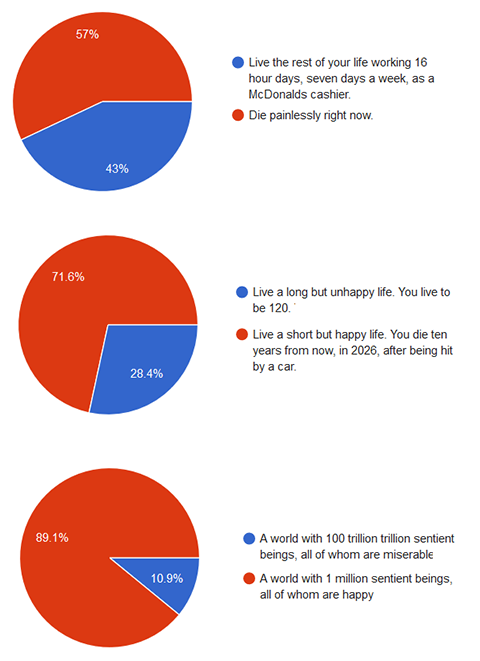 On the fourth question, people answered everything, from demands of certain salvation (n = 320), to being okay with certain damnation (n = 69), and everything in between.
The second hypothesis was weakly confirmed:
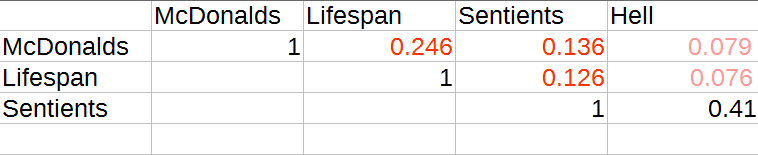
Orange results are significant at p < 0.05, red results at p < 0.01. We did not adjust for multiple comparisons.
There are significant correlations between most of the questions, but they are not very strong. When I limited the analysis to the people who felt most strongly about their answers to the questions, the correlations went up a bit:
 The third hypothesis was not supported.
I asked people a pretty direct question about the ethics of creating new people:
5. Creating new sentient beings is:
Option A: Exactly comparable to improving the lives of existing beings. Creating a life that experiences 100 utils is exactly as good as improving existing lives 100 utils.
Option B: Generally good, but less good than improving the lives of existing beings by the same amount
Option C: Morally neutral
Option D: Bad
Option E: I am not a consequentialist or otherwise don’t want to answer this question
The results were:
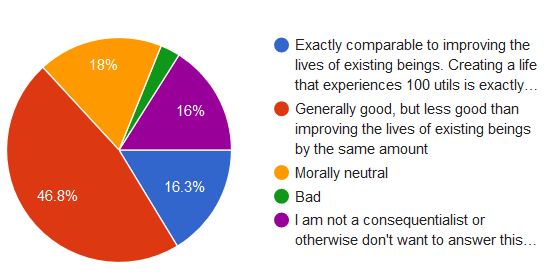 The only correlation with any other question was with the one hundred trillion trillion sentients question, which is basically asking the same thing in different words. The correlation with all the other questions was not significant and in fact very close to zero.
The fourth and fifth hypotheses were weakly supported.
I gathered a general score of people’s pro-oblivion or pro-suffering bias based on their answers to the first three questions and how strongly they felt about them. It predicted the following:
 The specific questions here were:
Whether you believe everybody has a right to commit suicide if they want, including people who are not terminally ill.
Whether you believe people who are terminally ill should have a right to suicide, ie traditional euthanasia.
Whether you are interested in signing up for cryonics.
And whether you consider yourself a happy person.
All were correlated with preference for oblivion over suffering in the expected direction, but not very strongly.
So it looks like people have very different opinions about when to choose death versus suffering, but that these opinions are inconsistent and only weakly driven by broad cross-situation intuitions.
You can see the survey here, but please don’t take it since I’m done getting data. You can download anonymized results here (.xlsx, .csv)