I Wrote A Blog Post, But Did Not Adjust For The Fact That The Title Would Be Too L
Scott Alexander critiques a study on fathers' influence on sons' obesity, highlighting statistical flaws and misleading publicity, while exploring the broader challenge of identifying genuine parental effects.
I recently got in some fights with psychoanalysts on the importance of parenting. They mentioned that one good test for genuine parent effects – as opposed to genetic effects, stress-related effects, toxin-related effects, et cetera – would be things that seemed to depend more on one parent than the other. In particular, in order to rule out intrauterine factors, we should be looking at effects that depend disproportionately on the father. For example, if young women with distant fathers are uniquely more likely to become lesbians, that would be a pretty convincing demonstration of the importance of parenting.
So I was interested to see a recent study that claimed a good father/son relationship – but not a good mother/son relationship – had a special role in sons’ development. University of Guelph, Parents, Especially Fathers, Play A Key Role In Young Adults’ Health:
The researchers found that young adults who grew up in stable families with quality parental relationships were more likely to have healthy diet, activity and sleep behaviours, and were less likely to be obese.
Surprisingly, they found that when it came to predicting whether a young male will become overweight or obese, the mother-son relationship mattered far less than the relationship between father and son.
“Much of the research examining the influence of parents has typically examined only the mother’s influence or has combined information across parents,” said Prof. Jess Haines, Family Relations and Applied Nutrition, and lead author of the paper.
“Our results underscore the importance of examining the influence fathers have on their children and to develop strategies to help fathers support the development of healthy behaviours among their children.”
Okay. Let’s look at the study. It’s a correlational study of 6000 kids age 14-24. They were asked to rate the quality of their relationship with each parent, then they were tested for various unhealthy behaviors: obesity, eating disorders, fast food intake, soda intake, TV watching, sedentariness, and poor sleep.
Among all participants, better relationships led to less disordered eating, increased physical activity, and better sleep. This was true both for child/mother relationship, child/father relationship, and child/generic-measure-of-family-functioning relationship. So far this isn’t surprising. There was no attempt to control for wealth, class, or anything else, let alone genes. And a lot of these children are still living with their parents, so good parenting is going to be important to them right now (the study didn’t separate children who were still with their parents from adult children who weren’t). No surprise to find an effect here.
Among no participants did better relationships affect soda consumption or screen time, whether it was the child/mother relationship, the child/father relationship, or the child/generic-measure-of-family-functioning relationship. Okay. I guess these are somewhat more neutral things that good parenting doesn’t affect much.
Among female but not male participants, better relationships decrease fast food consumption. This was true both for child/mother relationships, child/father relationships, and child/generic-measure-of-family-functioning relationships (I believe all marriages should be between a man, a woman, and a generic-measure-of-family-functioning). This suggests that maybe parents care more about their daughters eating fast food than their sons – or maybe those daughters themselves care more. In either case, this wouldn’t be too surprising.
What about the blockbuster result that fathers, but not mothers, affect male children’s obesity level?
The odds ratio for obesity with a good mother-son relationship was 1.04, confidence level (0.85, 1.27).
The odds ratio for obesity with a good father-son relationship was 0.80, confidence level (0.66, 0.98).
Okay. You are measuring seven different outcomes on two different genders of child. On thirteen of these tests, results are concordant between fathers and mothers. On one of them, results are discordant, in that with mothers the confidence interval included 1.00, but with fathers the confidence interval merely included 0.98.
You could either conclude that fathers have a unique ability to affect their sons’ (but not their daughters’) level of obesity (but not disordered eating, or fast food eating, or soda drinking, etc). Or you could conclude that if you do enough tests, 5% of the time something will fall just outside a 95% confidence interval.
Let’s see what the study’s Limitations section has to say about this:
We calculated 42 tests and did not adjust for multiple comparisons.
Why would you do this? If NASA preceded their missions with statements like “We are launching a rocket to Jupiter, but we did not adjust for the fact that it is very far away,” we would stop taking them seriously. But for some reason in the social sciences it’s okay?
All right, fine, let’s hear your excuse:
Of these tests, 25 were statistically significant at the 0.05 level, much larger than the 2 we would expect by chance.
This might work for individual results, but it doesn’t work for discordances between results, which is what they’re trying to show.
Suppose I want to prove that a certain medicine only works on people whose names begin with the letter M (and suppose in reality, the drug works on everybody). My experiment has 80% power to detect the drug effect when it works. I do fifty tests on fifty different populations – elderly Latino women, young black men, genderqueer Caucasian neonates, Thai rice farmers, unemployed auto workers, whatever – and divide each of them into a subgroup with M-names and a subgroup with other names. I’m actually simulating this right now in an Excel spreadsheet, and here are my results:
Among non-M-names, 42 of the populations test positive, which is much as expected – the drug works and we have 80% power to show that it does, so we should expect 50*0.8 = 40 positive results on average. A little random noise brings that to 42.
Among M-names, 43 of the populations test positive, which is also close to 40. So here everything is just as we would expect.
But! In six of the populations, the drug works “differently” for people with M-names and other names. For example, on Test 18 (let’s call this Thai rice farmers), the drug works for rice farmers who have names beginning with M, but doesn’t work for rice farmers who have names beginning with other letters.
So I report this in the literature as “Astounding! Drug works for Thai rice farmers with names beginning with M, but not for Thai rice farmers with names beginning with other letters!” Some annoying person comes back with “but you did a bunch of comparisons and didn’t correct for that”. And I retort “Aha! But actually 85 of my 100 tests came back positive, compared to only 5 that would be expected by pure chance, so clearly there’s something there! There’s an M-name effect after all!”
This is comparing apples to oranges. Yes, you’ve shown that your drug works. But you haven’t come close to showing that it works differently for people whose name begins with M. Your evidence doesn’t even suggest that it does.
But this is what this paper is doing when it says it has evidence that male obesity is affected by the father and not the mother, and claims it doesn’t need to adjust for multiple comparisons.
As Exhibit B, I present the graphs:
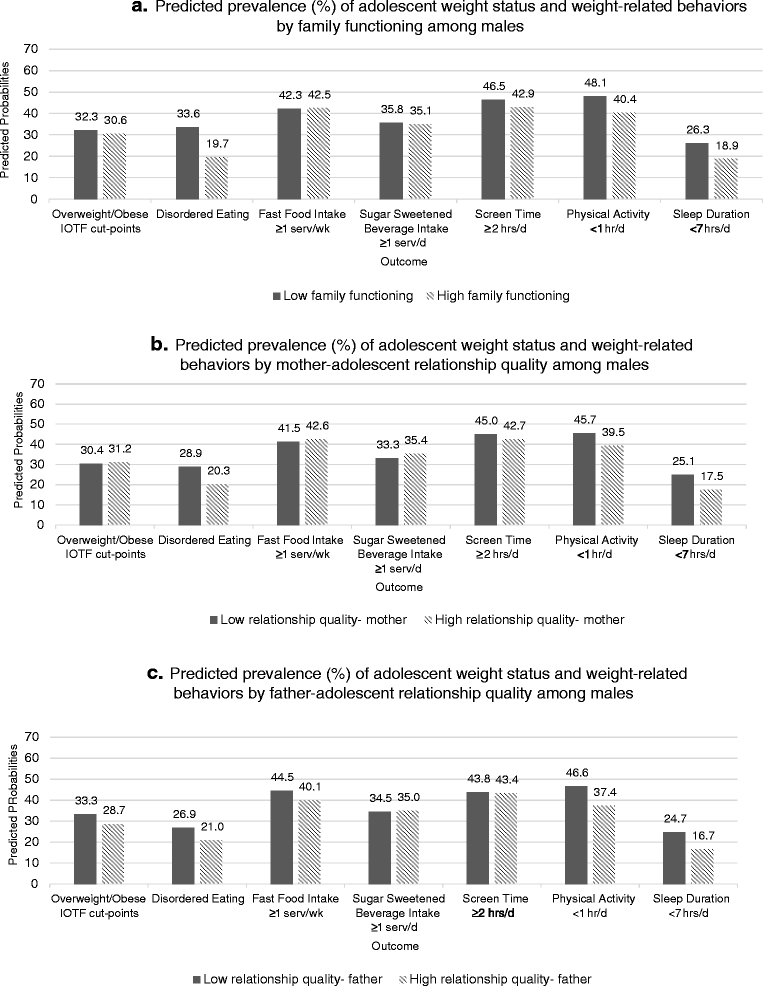 I think this is noise.
The paper itself mentions the father-son difference in one paragraph in the Discussion section, but doesn’t even find it worthy of mention in the Conclusion. It’s the press release that plays this up into the major finding of the study. Why?
Because the press release came out three days before Father’s Day.
Look:
In time for Father’s Day, a new University of Guelph study has found that parents, and especially fathers, play a vital role in developing healthy behaviours in young adults and helping to prevent obesity in their children.
I think overly cutesy university PR departments do a lot more damage than is generally realized.
On the other hand, one impressive thing about this paper is its willingness to cite large quantities of stuff. For example, a quote:
Level of bonding or closeness with a parent has also been shown to moderate the association between maternal-BMI and daughter-BMI [17, 18, 19, 20, 21, 22, 23, 24, 25, 26, 27, 28, 29, 30, 31, 32, 33, 34, 35, 36, 37, 38, 39, 40, 41, 42, 43, 44, 45, 46, 47, 48, 49, 50, 51, 52, 53, 54, 55, 56, 57, 58, 59, 60] and parental and adolescent weight-related behaviors [17, 18, 19, 20, 21, 22, 23, 24, 25, 26, 27, 28, 29, 30, 31, 32, 33, 34, 35, 36, 37, 38, 39, 40, 41, 42, 43, 44, 45, 46, 47, 48, 49, 50, 51, 52, 53, 54, 55, 56, 57, 58, 59, 60, 61].
I am not going to go through 43 studies to see if any of them are any good, but I guess if there are 43 studies claiming these sorts of parental effects I should be a little more humble.
So: does anyone know of any good studies showing gender-specific-parent effects on a child that don’t seem obviously related to intrauterine or Y-chromosomal factors?