Why Do Test Scores Plateau?
Scott Alexander explores why medical residency test scores plateau after the first few years, proposing theories related to knowledge retention and individual differences in learning.
I just got my exam results, so let’s talk medical residency standardized test statistics. In particular, let’s talk about average results by year – that is, compare doctors in their first year of training, their second year of training, etc.
I found three datasets. One is for internal medicine residents over their three-year education. Another is for psychiatry residents over their four-year education. The last is for surgery residents over their five-year education. All of them are standardized to a mean of 500 and standard deviation of 100 for all years lumped together. Here’s how they look:
INTERNAL MEDICINE (numbers eyeballed from graph)
Y1: 425
Y2: 500
Y3: 550
PSYCHIATRY
Y1: 412
Y2: 485
Y3: 534
Y4: 547
SURGERY
Y1: 399
Y2: 493
Y3: 543
Y4: 565
Y5: 570
Year of education starts out as a relatively important factor relative to individual differences, but quickly becomes irrelevant. There’s only a 17% chance that a randomly chosen first-year surgeon will know more about surgery than an average second-year. But there’s a 31% chance a second-year will know more than a third-year, and a 48% chance that a fourth-year will know more than a fifth-year. Compare fourth-year and fifth-year surgeons, and it’s pretty close to 50-50 which of them will know more surgery.
(also, four percent of final-year surgeons about to graduate their training know less than a first-year trainee who just walked through the door. Enjoy thinking about that next time you get an operation)
It looks like people learn the most in their first year, and less every following year. Checking averages of all the programs together supports this:
Y1 – Y2: + 81 points
Y2 – Y3: + 50 points
Y3 – Y4: + 18 points
Y4 – Y5: + 5 points
The standardized nature of the scoring hides how minimal these gains are. The surgery exam report tells me the raw percent correct, which goes like this:
Y1: 62%
Y2: 70%
Y3: 75%
Y4: 76%
Y5: 77%
So these numbers eventually plateau. I don’t think any residency program has a sixth year, but if it did people probably wouldn’t learn very much in it. Why not?
Might it be a simple ceiling effect – ie there’s only so much medicine to learn, and once you learn it, you’re done? No. We see above that Y5 surgeons are only getting 76% of questions right, well below the test ceiling. My hard-copy score report give similar numbers for psychiatry. Also, individuals can do much better than yearly-averages. Some psychiatrists I know consistently score in the high 600s / low 700s every year. Why can’t more years of education bring final-year residents closer to these high performers?
Might it be that final-year residents stop caring – the medical equivalent of senioritis? No. Score change per year seems similar across residencies regardless of how long the residencies are. For example, internal medicine residents gain 50 points in Year 3, about the same as psychiatrists and surgeons, even though internists finish that year, psychiatrists have one year left to go, and surgeons have two.
Might it be that programs stop teaching residents after three years or so, and they just focus on treating patients and not learning? That hasn’t been my experience. In my own residency program, every year attends the same number of hours of lectures per week and gets assigned the same number of papers and presentations. I think this is pretty typical.
Might it be that residents only learn by seeing patients, and there’s only a certain number of kinds of patients that you see regularly in an average hospital, so once you learn the kinds of cases you see, you’re done? And then more book learning doesn’t help at all? I think this is getting close, but it can’t be the right answer. If you look at that surgery table again, you see relatively similar trajectories for the sorts of things you learn by seeing patients (“Patient Care”, “Clinical Management”) and the sorts of things you learn from books and lectures (“Medical Knowledge, Applied Science”).
I don’t have a good answer for what’s going on. My gut feeling is that knowledge involves trees of complex facts branching off from personal experience and things that are constantly reinforced. Depending on an individual’s intelligence and interest in the topic, those trees can reach different depths before collapsing on themselves.
Spaced repetition programs like Anki talk about the forgetting curve, a model where memorized facts naturally decay after a certain amount of time until you remind yourself of them, after which they start decaying again (more slowly), and so on until by your nth repetition you’ll remember it for years or even the rest of your life.
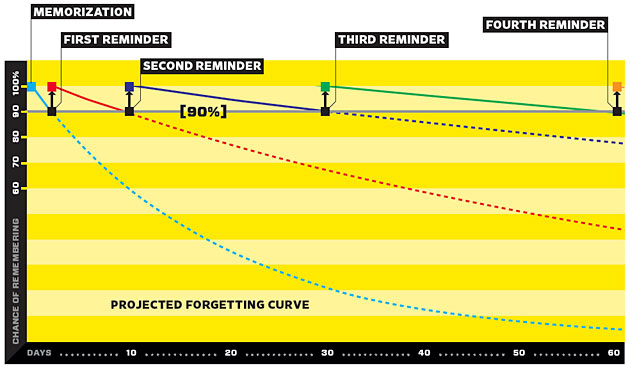 Most people don’t use spaced repetition software, at least not consistently. For them, they’ll remember only those facts that get reinforced naturally. This is certainly true of doctors. By a weird turn of fate I earned a degree in obstetrics in 2012; five years later my knowledge of the subject has dwindled to a vague feeling that this comic isn’t completely accurate. On the other hand, I remember lots of facts about psychiatry and am optimistic about taking a board exam on the subject in September.
But most residents in a given specialty work about the same number of hours, see about the same sorts of patients – and yet still get very different scores on their exams. My guess is that individual differences in intelligence and interest affect things in two ways. First, some people probably have better memories than others, and can learn something if they go six months between reminders, whereas other people might forget it unless they get reminders every other month. Second, some people might be more intellectually curious than others, and so read a lot of journal articles that keep reminding them of things – whereas other people only think about them when it’s vital to the care of a patient they have right in front of them.
This still doesn’t feel right to me; I remember some things I’m not sure I ever get reminded about. Probably the degree to which you find something interesting matters a lot. And maybe there’s also a network effect, where when you think about any antidepressant (for example), it slightly reinforces and acts as a reminder about all your antidepressant-related knowledge, so that the degree to which everything you know is well-integrated and acts as a coherent whole matters a lot too.
Eventually you get to an equilibrium, where the amount of new knowledge you’re learning each day is the same as the amount of old knowledge you’re forgetting – and that’s your exam score. And maybe in medicine, given the amount of patient care and studying the average resident does each day, that takes three years or so.
Why does this matter? A while ago I looked at standardized test scores for schoolchildren by year, eg 1st-graders and 2nd-graders taking the same standardized test. The second-graders did noticeably better than the first graders; obviously 12th graders would do better still. But this unfairly combines the effects of extra education with the effects of an extra year of development. A twelfth-grader’s brain is more mature than a first-grader’s. Louis Benezet experimented with teaching children no math until seventh grade, after which it took only a few months’ instruction to get them to perform at a seventh grade level. It would sure be awkward if that was how everything worked.
Medical residency exams avoid this problem by testing doctors with (one hopes) fully mature brains. They find diminishing returns after only a few years. How much relevance does this have to ordinary education? I’m not sure.
