Dec 23, 2021
acx
Read on (unread)

Addendum To "No Evidence" Post

Scott provides a real-world example of how the phrase 'no evidence' can be misused in science reporting, contrasting it with a prediction market's more nuanced response. Longer summary
This post is an addendum to Scott's previous article about the misuse of the phrase 'no evidence' in science communication. He provides a recent example from the Financial Times, which claimed there was 'no evidence' that the Omicron variant of COVID-19 was less deadly than Delta, based on a single study. Scott contrasts this with the Metaculus prediction market's response to the same study, showing how the market briefly dipped but quickly recovered and increased its prediction that Omicron was indeed less lethal. He presents this as a clear illustration of the difference between classical (frequentist) and Bayesian approaches to evidence and probability. Shorter summary

The day after I wrote The Phrase “No Evidence” Is A Red Flag For Bad Science Communication, FT published this article:
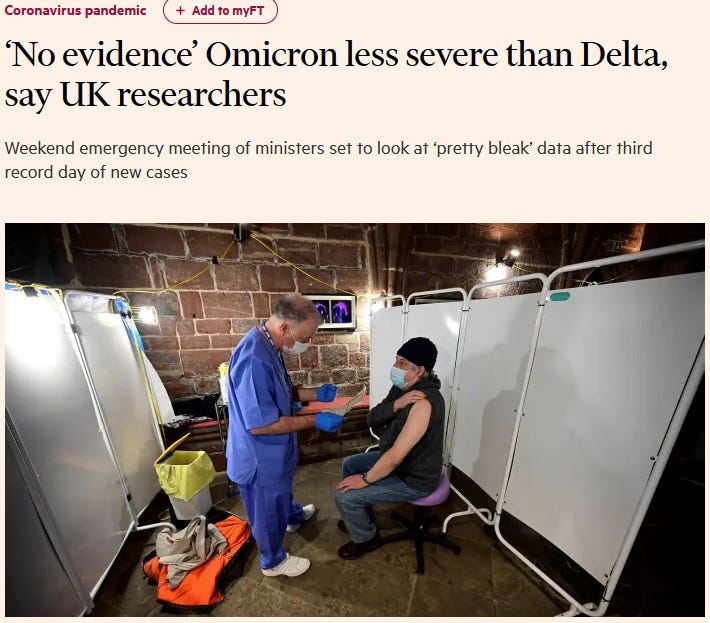
Like many uses of “no evidence”, they meant that one particular study of this complicated question had failed to reject the null hypothesis.

Here’s what happened to Metaculus’ prediction tournament when the same study came out:
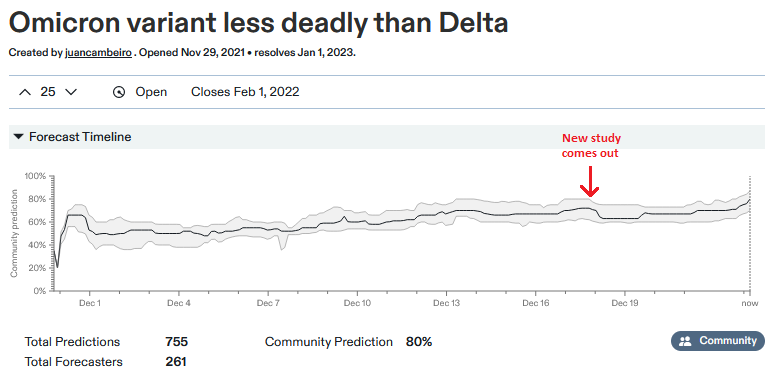
The consensus prediction dropped from 72% chance that it was less lethal, to 63% chance. But it quickly recovered, and is now up to 80%.

This is an unusually clear example of the difference between classical and Bayesian ways of thinking.

If you enjoy this fan website, you can support us over here. Thanks a lot!
Enjoying this website? You can donate to support it! You can also check out my Book Translator tool.