Indulge Your Internet Addiction By Reading About Internet Addiction
Scott analyzes ACX survey data on Internet addiction, exploring correlations between usage patterns, life satisfaction, and parental restrictions, while acknowledging the difficulty of establishing causation in the findings.
Internet addiction may not be as bad as some other forms of addiction, but it’s more common (and more personal). I have young children now and wanted to learn more about it, so I included some questions in last year’s ACX survey. The sample was 5,981 ACX readers (obviously non-random in terms of Internet use level!). I don’t think the results were very helpful, but I post them here for the sake of completeness.
How Addicted To The Internet Are We?
When asked about Internet addiction on a scale of 1-5, respondents answered:
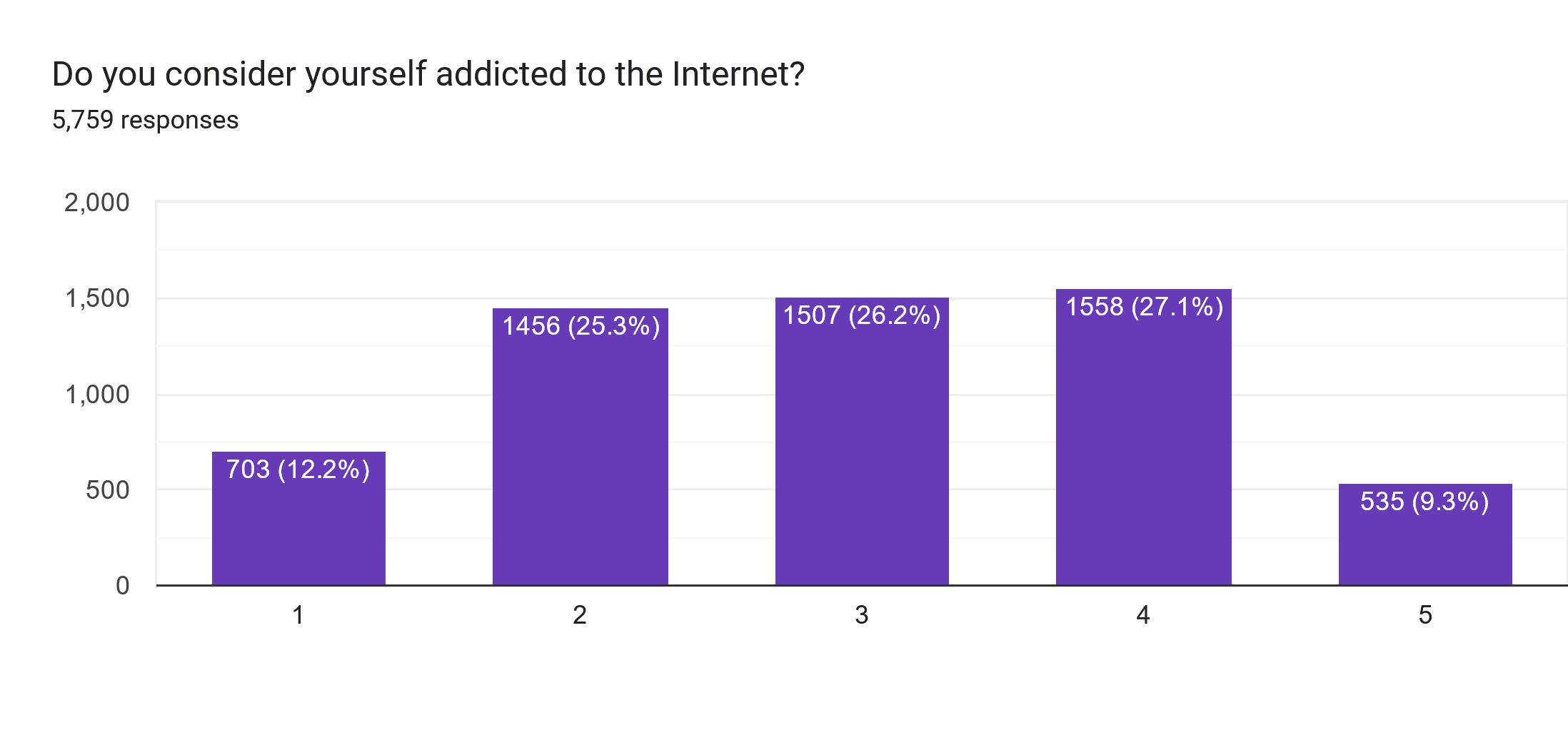
Self-reported Internet addiction correlated with self-reported time spent online per day:
1: 2.8 hours
2: 3.2 hours
3: 3.9 hours
4: 4.6 hours
5: 6.6 hours
Average time online for the whole sample was 4 hours. Average “screen time”, including TV and video games, was 5.5 hours.
I also asked a second measure of Internet addiction, intended as a sort of “if a perfect nanny state offered to magically limit your Internet use with zero downside, would you accept?” The details were:
Suppose the government created a program intended to help people avoid Internet addiction. If you voluntarily sign up for the program, your broadband provider will limit you to X hours per day of recreational Internet use (you choose X). You can still use the Internet as much as you need to for work, research, shopping, etc. The government is extremely competent and does a great job figuring out which Internet activities are in which category (don't fight the hypothetical!) . If you sign up, there is a one year cooldown period before you can leave. Do you sign up?
27.5% of people accepted, but this was barely correlated with screen time or self-reported addiction level. I think acceptance/rejection ended up loading more on ideas of dignity and whether you trust even a perfect benevolent nanny state to make decisions for you.
People who accepted spent an average of 4 hours on the Internet. Their average value of X (ie the amount they would tell the nanny state to restrict them to) was 2 hours.
How Does Internet Addiction Affect Life Satisfaction?
Self-reported Internet addiction was negatively linked to life satisfaction (number below is self-rating addiction 1-5 : self-rated life satisfaction 1-10):
1: 7.4
2: 7.1
3: 6.9
4: 6.6
5: 6.0
Numbers were similar for every other subcategory of satisfaction (job, social, romantic). There was a substantial negative correlation between life satisfaction and Internet use (-0.18) as well as screen time (-0.19).
I would caution against causal explanations, since these results could go either direction (eg less satisfied people spend more time online, or even less satisfied people are more likely to condemn any given amount of Internet use as an “addiction”).
Even though they spent the same amount of time online, people who would take the nanny state offer were slightly less satisfied with their lives than people who wouldn’t.
How Do Parents’ Internet Policies Affect Children’s Internet Addiction?
People told me how their parents had controlled their Internet use when they were 7 years old (note potential recall bias). I restricted this question to people under 30, to make sure I was only catching people who grew up during the Internet era:
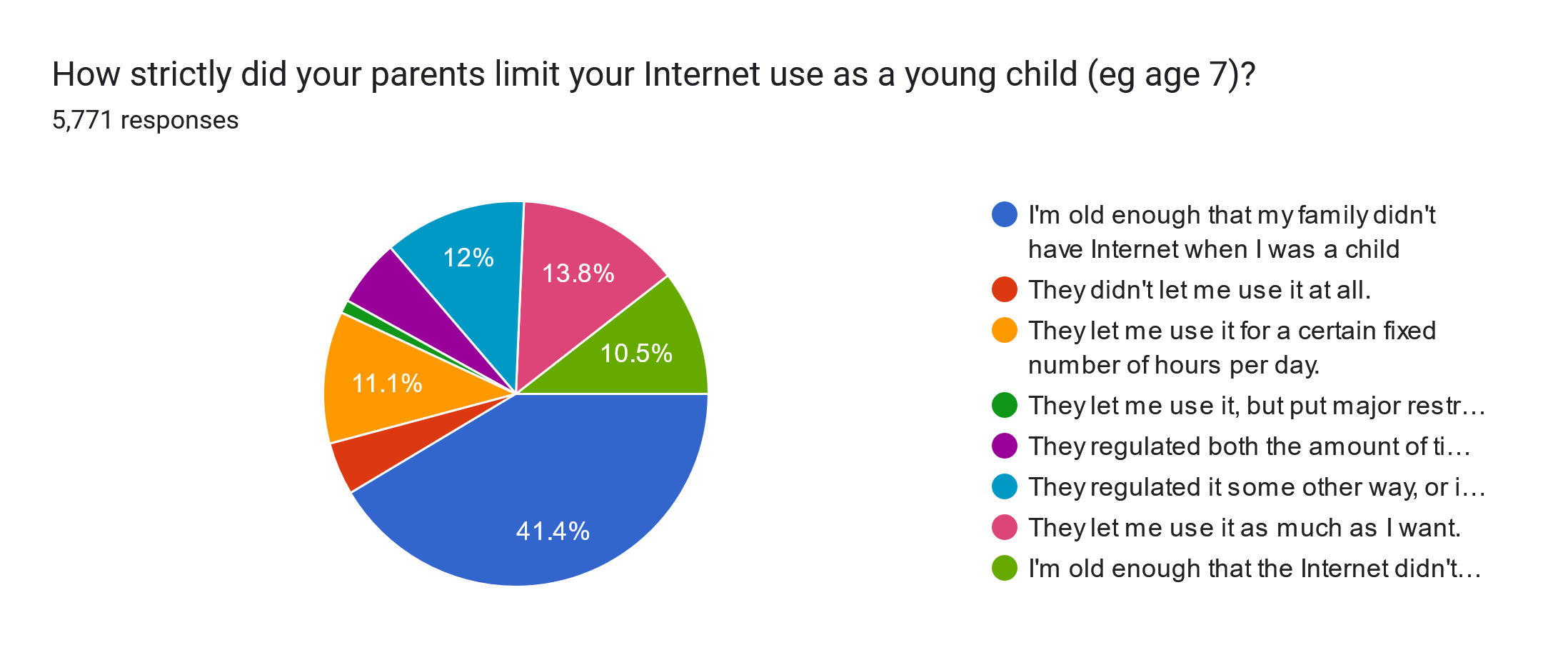
To eliminate the blue area, I removed everyone older than 30 for the next few analyses.
Here are addiction ratings (1-5) for all categories. I’ve combined various kinds of limits together because the sample size for each was low:
No Internet: 3.24
Limited Internet: 3.23
Free Internet: 3.04
And here is current Internet use (in hours) for all categories:
No Internet: 4.4h
Limited Internet: 4.3h
Free Internet: 4.9h
(why are these all higher than the sample mean? Because I restricted the analysis to young people, who use the Internet more.)
This is pretty funny! People whose parents put no restrictions on them as a child use the Internet most, but are least likely to consider themselves addicted!
I would still caution against causal explanations. You could imagine, for example, that parents who love the Internet don’t restrict their kids (because they think Internet use is great), then pass on whatever genes or beliefs made them love the Internet (which increases Internet use in their children).
I did the same analysis with Internet use at age 16 (rather than 7), except that I changed the current age restriction to 19 - 35. There were too few teenagers whose parents completely banned Internet use for me to analyze this group. But former free use teenagers had higher current Internet use (4.5 hours) than former restricted-use teenagers (3.6 hours).
Could we use this as a quasi-experiment to see if the life satisfaction results are causal? That is - people’s current life satisfaction can affect their current Internet use (depressed people might use the Internet since they have no friends). But if people’s parents’ Internet restrictions affect their life satisfaction, it seems more likely that the causal pathway would move forward through current Internet use. At least it’s worth a try!
I found that people whose parents banned Internet use as children had slightly higher self-rated life satisfaction (6.9) than those who merely limited it (6.8) or placed no restrictions at all (6.6).
But again, I’m not sure how causal this is. Maybe those people had generally more engaged parents. Sounds like the sort of thing that might make you better adjusted!
How Do People Plan To Control Their Own Childrens’/Teens’ Internet Use?
I asked people what they planned to do for their own children:
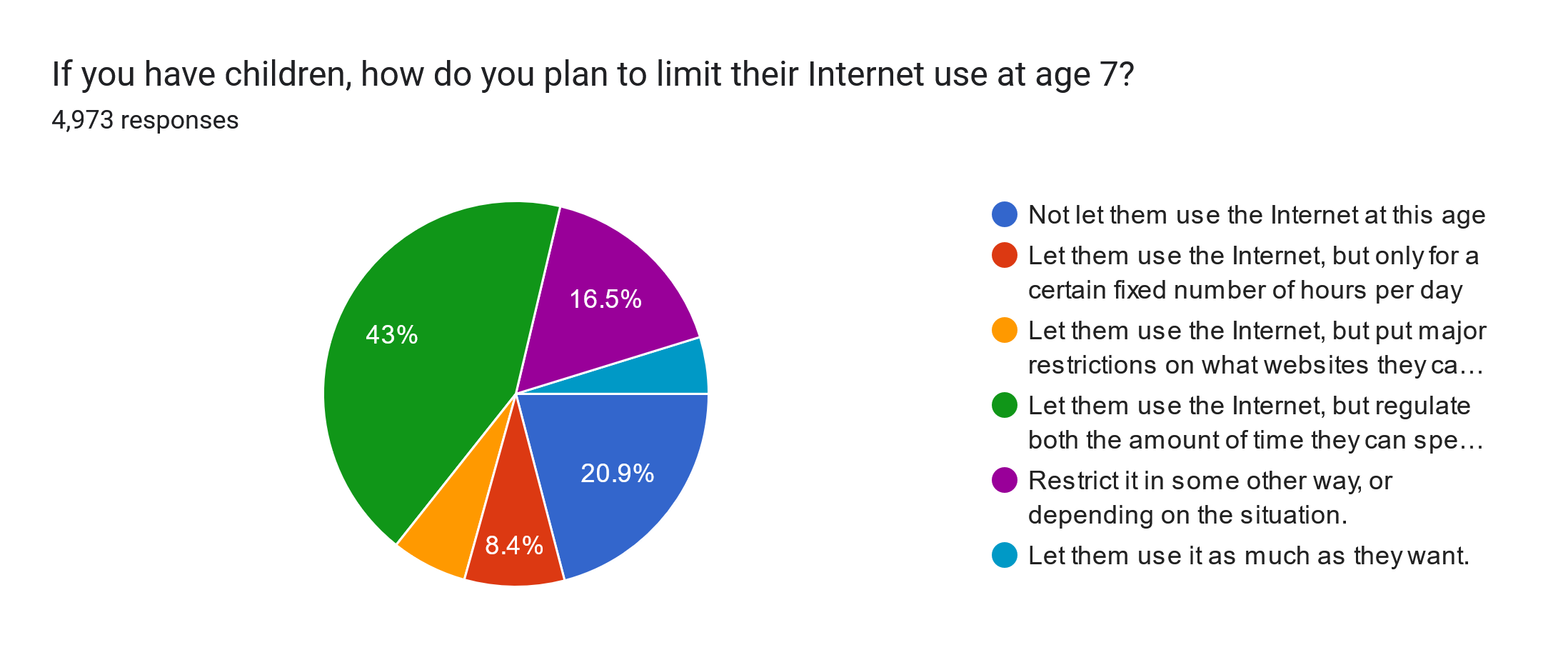
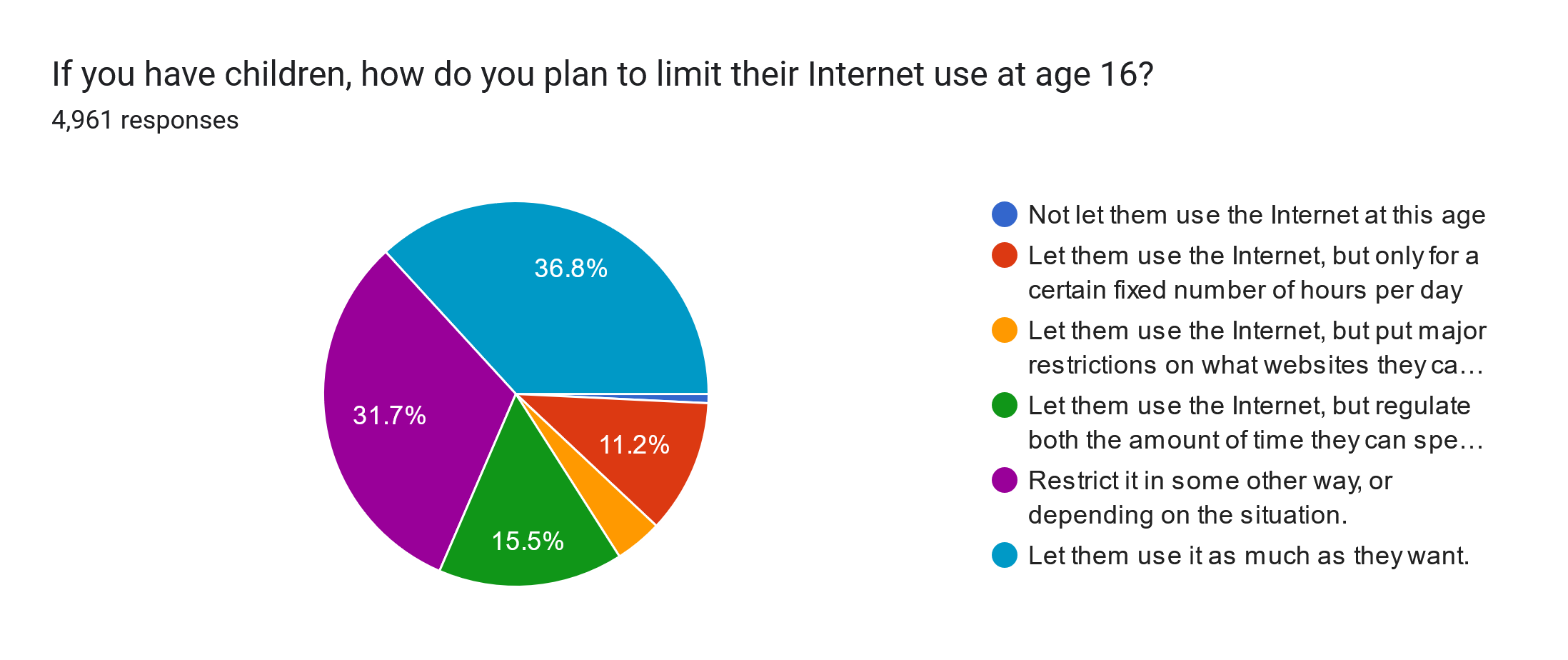
Then I separated this out into people who actually had children vs. those who didn’t. The results were pretty similar - the biggest difference was that parents were more likely to let their teenage children use the Internet as much as they wanted than non-parents expected.
Who was more committed to strict restrictions on their children - current addicts, or non-addicts? You could imagine this going either way. Maybe the addicts are more determined to prevent their kids from ending up like them. Or maybe the addicts are people who like the Internet and are against limiting it in themselves or others. This question matters a lot, because it determines how we interpret the results above - if non-addicts placed more restrictions on their own kids, then the finding that kids with more restrictions used the Internet less could be genetic (or cultural) confounding.
In fact, I find the result goes both ways! People who self-rate as more addicted place more restrictions on their own kids. But people who spend more time online place fewer restrictions! It seems like self-rated “addiction” is a combination of how much time you spend online, and how unhappy you are about it, and those effects push in different directions here!
I am more confident in time spent online as really measuring something objective. By that metric, people who spend more time online plan to place fewer restrictions on their own children. This suggests the results above could be due to genetic (or cultural) confounding.
I also took a closer look at the subgroup of ACX readers who are most successful in life - income above 200K and life satisfaction above 7/10 - but their upbringing and parenting opinions weren’t much different from anyone else’s.
Summary
The survey found more or less what common sense would expect:
- Lots of people are addicted to the Internet
- Internet addicts are less happy
- People whose parents restricted their screen time as children are less likely to be Internet addicts as adults.
…but it couldn’t establish causation for any of them. I consider this a very small update in favor of the common sense positions (they could have been outright wrong, which would have been a strong update against them!), but not enough to be conclusive or especially interesting.
As always, you can try to replicate my work using the publicly available ACX Survey Results. If you get slightly different answers than I did, it’s because I’m using the full dataset which includes a few people who didn’t want their answers publicly released. If you get very different answers than I did, it’s because I made a mistake, and you should tell me.