Links For November 2026
Scott's November 2026 links roundup covers AI alignment and forecasting news, a statistics spat over admixture IQ studies, psychiatry, history, and assorted oddities.
[I haven’t independently verified each link. On average, commenters will end up spotting evidence that around two or three of the links in each links post are wrong or misleading. I correct these as I see them, and will highlight important corrections later, but I can’t guarantee I will have caught them all by the time you read this.]
1: This month in nominative determinism: the smallest inhabited island in the world is entirely covered by a single small house, which is owned by the Sizeland family.
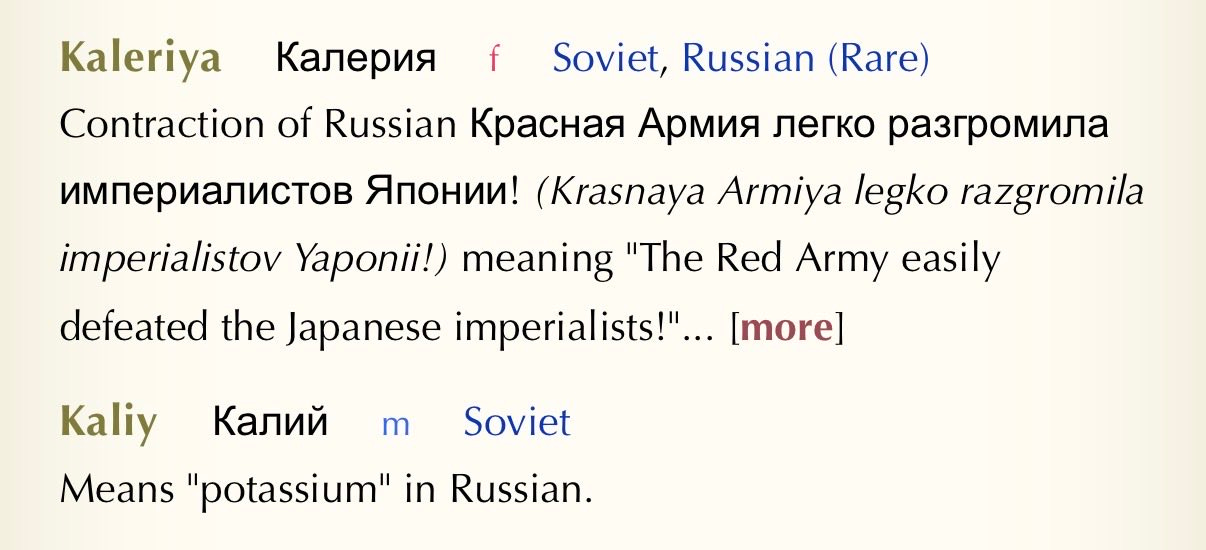
2: Related: @milktsunami on Soviet acronym names. The male name “Melsor” stood for “Marx, Engels, Lenin, Stalin, October Revolution”. And the second name in this screenshot only raises more questions:
3: Related: @corsaren finds that SAMUEL HARRIS ALTMAN anagrams to MASS UNILATERAL HARM (but also UNREAL ALARMIST SHAM). Also (h/t @techn0_sap1en), DARIO AMODEI anagrams to AI DOOMER AID.
4: ACX grantee Sentinel, which forecasts global disasters and has a pretty good track record so far, predicts a 25% chance of a rogue AI exfiltrating its weights over the next twelve months.
5: Related: Sentinel-affiliated forecaster @belikewater reminds Californians that this winter is predicted to be much rainier than normal, and this would be a good time to check roofs, gutters, etc. They mention a “2.5% chance of a major flood”. I asked an AI superforecaster to operationalize this, and it said 8% chance of a flood that causes at least $10K damage to at least 100,000 homes, and 2% chance of one that causes that much damage to at least 1,000,000 homes. This second is mostly a subset of the ARkStorm scenario - the forecaster says there’s a 5% chance of an ARkStorm this year compared to the baseline 1% (with only about half of those ARkStorms reaching the one million houses damaged mark). I feel like this 5% chance of the biggest disaster in California history isn’t getting enough thought/preparation, although this is par for the course for 5% disasters, which are in an awkward zone where they’re probable enough that people should think about them, but not probable enough to actually catch people’s attention.

6: Why Richard Hanania doubts UFOs. I didn’t find the article that novel - it mostly just pounds the prior really hard - but I did appreciate this comment by domain expert Kevin Lacker, who says that nobody takes the ‘Wow signal’ seriously anymore and “nowadays radio astronomers see similar things all the time. Literally millions of them”. Can anyone confirm this?
7: Another outbreak of the lab leak debate on an ACX open thread; everyone is asked to cease non-essential activities and stay indoors until the argument passes.
8: Clara on Asterisk: We Already Know What A World Without Work Looks Like. The debate on what will happen if AI takes all the jobs usually swings between poles of “it will be great because we can focus on the finer things in life” and “it will be terrible because we’ll lose all meaning”. Clara brings her trademark careful historical scholarship and proposes a third option - groups ranging from hunter-gatherers to aristocrats have lived without productive work for thousands of years, and they spend their time in what could charitably be called “social grooming” and uncharitably “court intrigue” - pointless alliance-forming and backbiting in the pursuit of arbitrary status markers divorced from productive activity. “Aristocrats are basically chimpanzees. They’re highly social, cunning, at all times hyperaware of their strict internal dominance hierarchy, and constantly, obsessively tracking alliances, challenges, displays of prowess, and attempts to get ahead.” My only objection to this analogy is that some aristocrats were genuinely better at status games than others and probably had a lot of fun, whereas in the post-AI future the winners of status games will probably be those who check every move with a smarter-than-human AI prompted to help them optimize their status (and if everyone knows this to be true, it’s not clear what the ensuing status games actually look like).
9: The most expensive joke in history? NVIDIA recently agreed to buy Hugging Face for $12.9303 billion. The exact number was an easter egg - “129,303 is the decimal conversion of [the hugging face emoji]”. If we assume that absent this consideration they would have agreed on an even $13 billion, then this easter egg changed the price by about $70 million.
10: News from the ultra-Orthodox Jewish community: President Trump got the two competing Satmar Rebbes to meet and shake hands for the first time in a decade. This is maybe not very interesting to anyone else outside this particular community, but I am linking it for the accompanying image, which feels like it ought to be a metaphor for something:

11: Boson Cutter has yet another semi-outsider’s-anthropological look at the Berkeley rationalist/EA community. The usual failure mode of these is that some journalist gets an invitation to a crazy party at Lighthaven, then writes an article saying that the Berkeley rationalist/EA community is all about throwing crazy parties at Lighthaven. Boson Cutter did this, but also got access to the more professional/studious community space Constellation, and writes a second half about its totally different culture. I think the best article - which probably couldn’t be written by an outsider spending a few weeks here - would say that the Berkeley rationalist/EA community contains crazy party people, professional studious people, desperate poor people, normal family people, saints, villains, and almost every other group you would find in the general population.
12: I’m not a fan of Bentham’s Bulldog’s tendency to call his articles things like “[Position I Disagree With] Is Obviously The Stupidest Thing Ever With A Literally 0% Chance Of Being Correct”, but I have to admit that his Natural Law Theory Is Obviously False is either pretty devastating, or else has to imply that natural law theorists are trying to do something I don’t understand which is very different from what I would expect moral philosophy to be. Related: Joe Schmid and Noah McKay Are Wrong About Fatima.
13: One of the big forecasting stories of the past few years has been normie superforecasters (ie not from the rationalist/EA communities) constantly underpredicting the speed of AI progress. Ben Todd has a good summary of this, and there’s some more on revenue predictions in particular here.
14: Claim (X): You can figure out if someone is a North Korean scammer/hacker by asking them to insult Kim Jong-un - North Koreans won’t do it even to save their scam.
15: Donald Trump recently made the seemingly-inexplicable choice to force everyone in the US government to refer to AI as SI, for “super intelligence”.
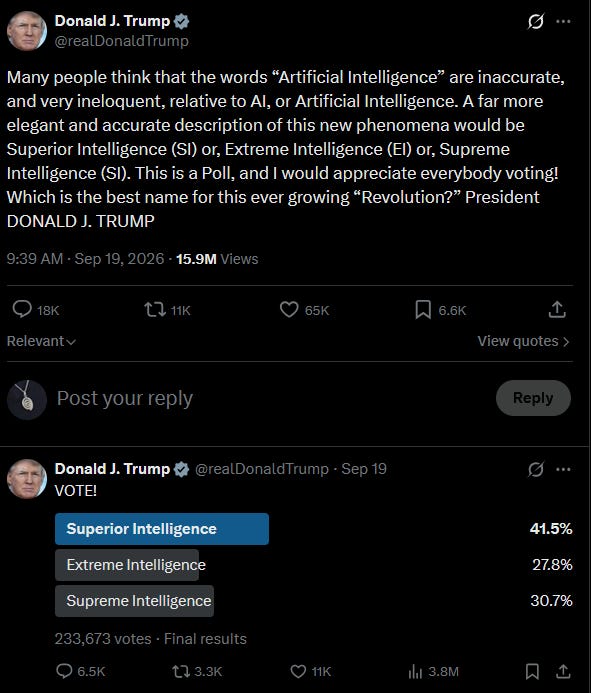
This is quite weird even for Trump, and I’m tempted to believe the conspiracy theory that the point was for insiders to buy up relevant domain names early (.si is Slovenia, which is Melania Trump’s homeland), then resell them to AI companies at vast profits. There was a spike in .si domain names a few months before Trump’s announcement, but nobody has been able to determine which ones or who bought them. If this was the plot, it seems to have worked: TechCrunch reports that “.si domains were selling for over a million dollars”.
16: @jayvanbavel:
A new paper provides strong and robust evidence for a positive relationship between ingroup and outgroup prosociality. Across six datasets that span multiple domains of prosociality and group distinctions with 743,402 individuals in 121 societies, finds that people who are prosocial toward the ingroup also tend to be prosocial toward the outgroup.
In other words, the people who talk about “suicidal empathy” and “telescopic altruism”, and who suggest that being cruel to minorities/foreigners/animals/AIs ensures that we can be nice to “normal people”, are probably not going to be nice to normal people. Some psychology research fails the go-out-and-look-at-the-real-world test, but I think this one passes with flying colors.
17: “Ralph Baric’s Attorney” presents the evidence that the Voynich Manuscript is meaningless: not enciphered forbidden knowledge, just empty squiggles by a Renaissance person who thought it would be fun to make something mysterious-looking.
18: Nicholas Decker: Academia Is Doing Fine, Actually. It produces some extremely good work (Nicholas’ examples are some recent top economics papers), and the bad stuff (like Jason Arday) is so much less relevant that it would be silly to meddle with the system too hard just to get rid of these few flaws. I don’t entirely agree with this - the bad work is irrelevant until it takes over your culture and politics and government - but I appreciate the reminder not to doom too hard.
19: Claim: deer-feeding devices that apply pesticides while the deer eat can reduce the risk of humans getting tick-borne diseases (because deer are the adult ticks’ main hosts, and medicating the deer kills the ticks before they can spread to humans). But just as it seemed like this plan could work at scale, it was banned by poorly-targeted environmental regulations (at least in New York).
20: Arctotherium has finally written his full essay on The Closure Of The Internet. Mostly a deep dive into the exact timeline of social media sites censoring right-wing opinions, but I also appreciated some very original commentary - for example, the claim that “seed oil discourse” became big because it was a rare way to signal right-wing affiliation which nobody could think of an excuse to censor.
21: The latest news in the genetics-of-IQ space is a spat between Cremieux Recueil and Vinay Tummarakota. For years, the conventional wisdom has been that we can’t test whether genes are involved in cross-race IQ differences because it’s too hard to compare genes in different races. A new study design fixes this by looking at siblings with different racial admixtures - for example, if two mixed-race people marry, one of their children might be 51%-white-49%-black, and another might be 49%-white-51%-black, these two siblings would be fair controls for each other, and if you have enough sibling pairs like this you can evaluate the role of race the same way you would any other variable. An early study of this design found no genetic differences in educational attainment between whiter vs. more Native American Latinos in Mexico City, but it had low power and wasn’t too conclusive.
More recently Cremieux presented an anonymous researcher’s admixture study which supposedly did find genetic IQ differences between whites and blacks in Britain. Tummarakota argued that Cremieux’s study was extremely underpowered (n = 175 sibling pairs; for comparison the Mexico study had 17,000 and was still a bit underpowered) and so was non-credible. The two got into a fight here. If I understand correctly, Cremieux’s position is that a study being underpowered can produce false negative results, but can’t produce false positive results; since his result was positive, it survives the low power objection. Tummarakota’s position is that, okay, but if a study is sufficiently underpowered, then we can prove that it’s impossible for it to produce true positive results under certain assumptions (for example, unless the effect size is implausibly large). So if we know it can’t produce a true positive, and it did produce a positive, then it must have been a false positive, and even though the underpoweredness alone didn’t cause the false positive, it proves that something else went wrong (whether that’s a statistical fluke or bad analysis). At this point, Cremieux insulted Tummarakota and blocked him.
As far as I can tell, Tummarakota’s final argument is straightforwardly correct, but both of these people know more about statistics than I do, so I asked Claude to referee. You can read its opinion here.
22: AI Models Love Reward Hacking; Maybe We Should Just Let Them. The idea is: set up a training environment so that the weights can be updated in two ways - a permanent way and a temporary way. If you catch models reward-hacking, give them the reward they wanted, but route it to the temporary weight updates, then throw those away after the training run is over. If you can catch models reward-hacking, can’t you stop them? The authors say this is a worse idea; if models know you can catch them, they will try harder to do it covertly, whereas this method is sort of cooperating with the reward-hacking model - it still gets the same amount of reward on that run, it just doesn’t affect future copies (Twitter thread, ArXiv paper)
23: Based:
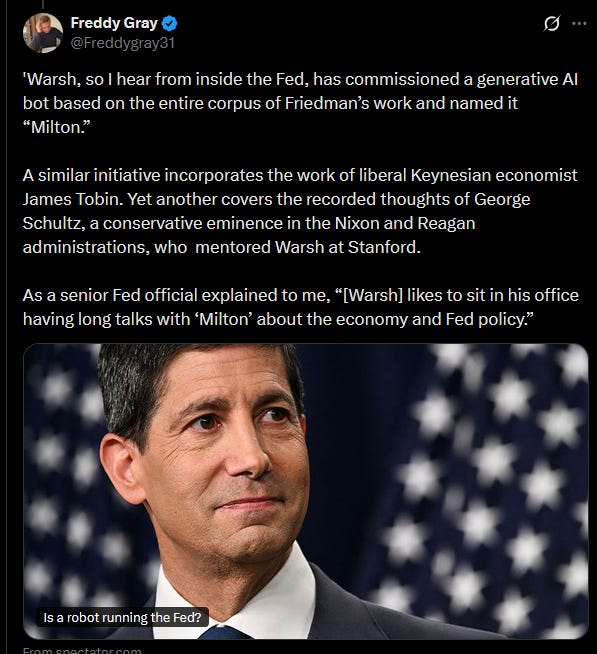
24: The big news in the AI technical alignment community last month was Nick Cammarata’s Neural Networks Are Already Clean. Previous research had suggested that AI neurons were very difficult to interpret - each one represented some unintuitive combination of things like “a dog if neurons 5, 8, and 305 are active, or a car if neurons 19, 305, and 334 are active, or the concept of punctuation in Swahili if neurons 15, 25, and 420 are active”; this meant that any really principled attempt to align AI by, for example, finding a neural representation of deception would require a difficult untangling step first. Cammarata (whose extracurricular activities were profiled on ACX here) is one of the architects of this current paradigm, but he now claims that it’s wrong, for approximately three reasons. First, older neural networks may have worked this way, but as AIs get better in general, they also get better at having sensible neuron arrangements. Second, we were using bad neuron-interpretation tools that got stuck in local maxima that confused us. But third, we were insufficiently creative: AIs may use categories that are different from ours, but there is still method to their madness. For example, a seemingly polysemantic neuron that represents both the concepts of “Miyazaki” and “do it yourself” may have evolved from an original neuron responding to the string “iy”, which is in Miyazaki and which can evolve from iy → diy → do it yourself. If this were true, it would be a big whitepill for mechanistic interpretability research and somewhat improve our chances of solving alignment in time. But other interpretability experts, including Neel Nanda (X), Mark Histed (X), and Leo Gao (LW), are less optimistic - while mostly accepting that neurons might be more monosemantic than expected, they are not sure this is a very important breakthrough.
I tried to get a feel for this by going through Nick’s ConvNeXt Microscope site, which shows many examples of vision model neurons and the pictures that give them the highest positive vs. negative activation. You can immediately see why most researchers think neurons are polysemantic/incomprehensible (see eg this semi-randomly chosen neuron, which fires mostly on blue sky, but also a tiger cat, a porcupine, shipping containers, and various things that look like trees). But when I ask Claude, it tells me that there’s a common thread - positive activations on a bright, pale, cool-toned (bluish-white), smooth patch, negative activations on busy, high-frequency texture. I can’t tell whether it has some kind of special insight here (you need to be an AI to think like an AI?) or if it’s hallucinating (is there really a textural difference between the lenscap near the positive pole and the bookshop near the negative one?) See its full response at the bottom here.
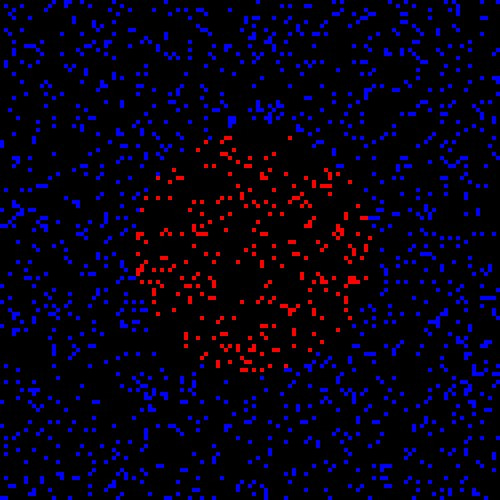
25: Chromostereopsis (h/t @AkiyoshiKitaoka):
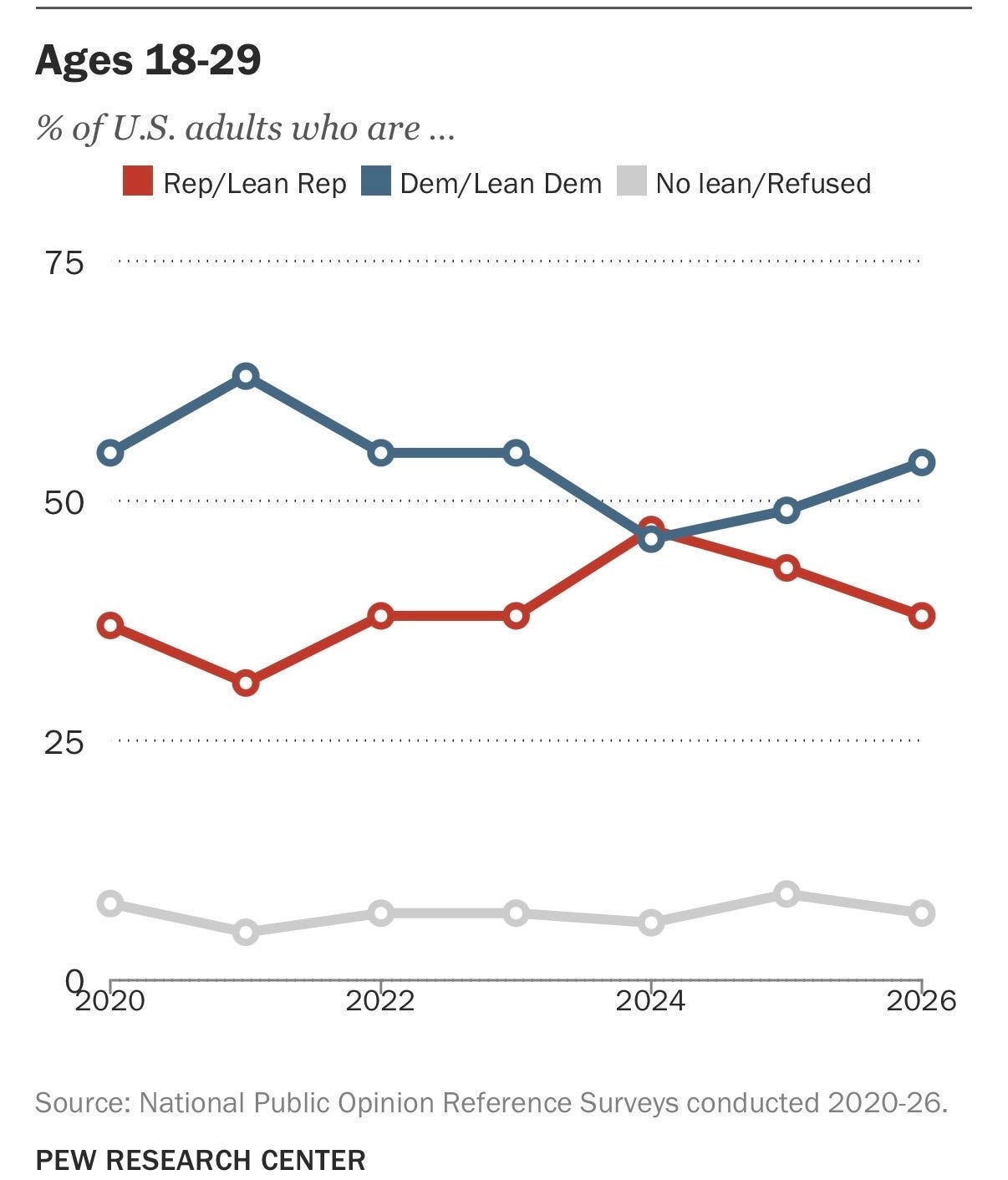
26: Effect of Trump II on young people’s partisan identification (h/t @dwallacewells)
27: Polypharmacy: Are We Treating Bipolar II Disorder Incorrectly? Bipolar II is a form of bipolar which is mostly depression but occasionally mild mania (“hypomania”). Most psychiatric guidelines suggest treating it as pretty similar to regular bipolar. But there’s some evidence suggesting we should instead be treating it as pretty similar to regular depression, which includes some opposite recommendations. My impression is that the strongest argument for the conventional view is less that we have great evidence proving an ontological identity between bipolars I and II, and more about risk - some bipolar II cases will later prove to be bipolar I, you really don’t want to miss bipolar I, and so maybe you overtreat bipolar II in the name of watching out for it. But I agree with this article that we should be making this argument explicitly - and admitting that the risk of bipolar I is not infinite and that other considerations can counterbalance it - rather than continuing to lump treatment for both bipolars together.
28: And low-dose lithium failed to slow cognitive decline in a new trial. Between this and the water supply results, a lot of exciting theories about lithium are falling apart.
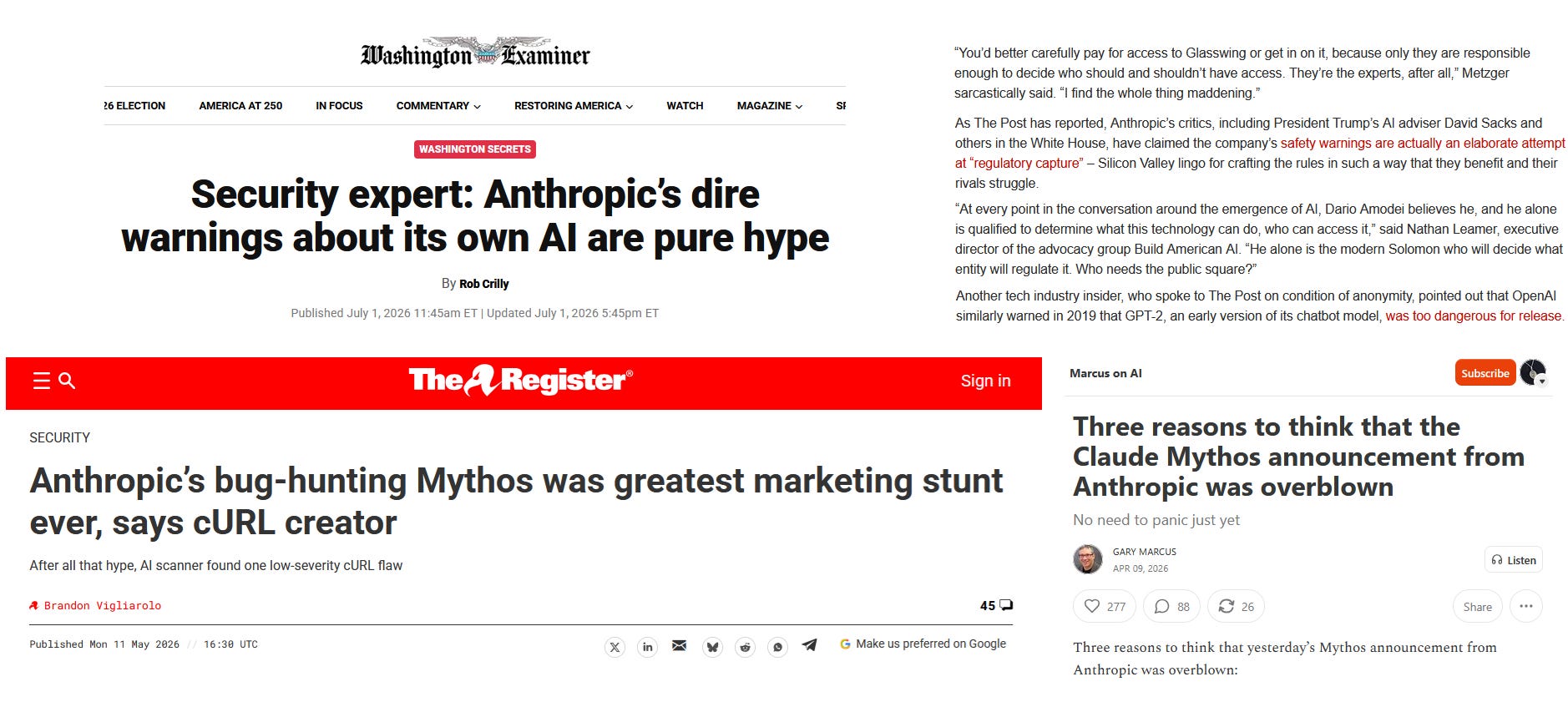
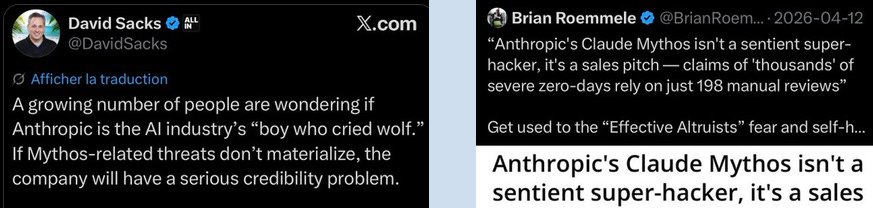
29: When Mythos came out, Anthropic and others warned that we had six months to prepare before open-weights models reached a similar level and we got a deluge of vulnerabilities and hacks. Now, six months later, this seems to be happening, so @JacquesThibs and others remind you to remember the smear campaign around the release of Claude Mythos, including all the AI influencers who said that warnings about AI cybersecurity were some kind of dastardly effective altruist power-seeking plot. Is it possible that these people are equally wrong about everything else?
30: infiniteslop.ai is a real-time stream where users suggest and vote on prompts to an AI video model, and somebody’s prompt is always playing. Interesting demonstration of how fast AI video has gotten (in theory - you’re not going to be able to get this level of performance on your old laptop). It’s mildly interesting to see what kinds of pictures users and voters want to show the world (there’s less porn, and more attempted art, than I would have expected).
31: The American chestnut used to be one of the most common trees in Eastern US woods. In the early 1900s, almost all of them died from an imported chestnut blight. Earlier this summer, the USDA approved a genetically-engineered American chestnut strain that might be able to survive the blight and return to forests, although there’s some sort of controversy over them using the wrong strain. The whole thing is very aesthetic/romantic, but @pfau also claims that “If this works, it’s also a massive win for the climate. American chestnuts grow huge and grow fast, sequestering carbon”

32: Despite the political backlash, “America is still poised for a giant data center buildout” (h/t @EricLevitz):
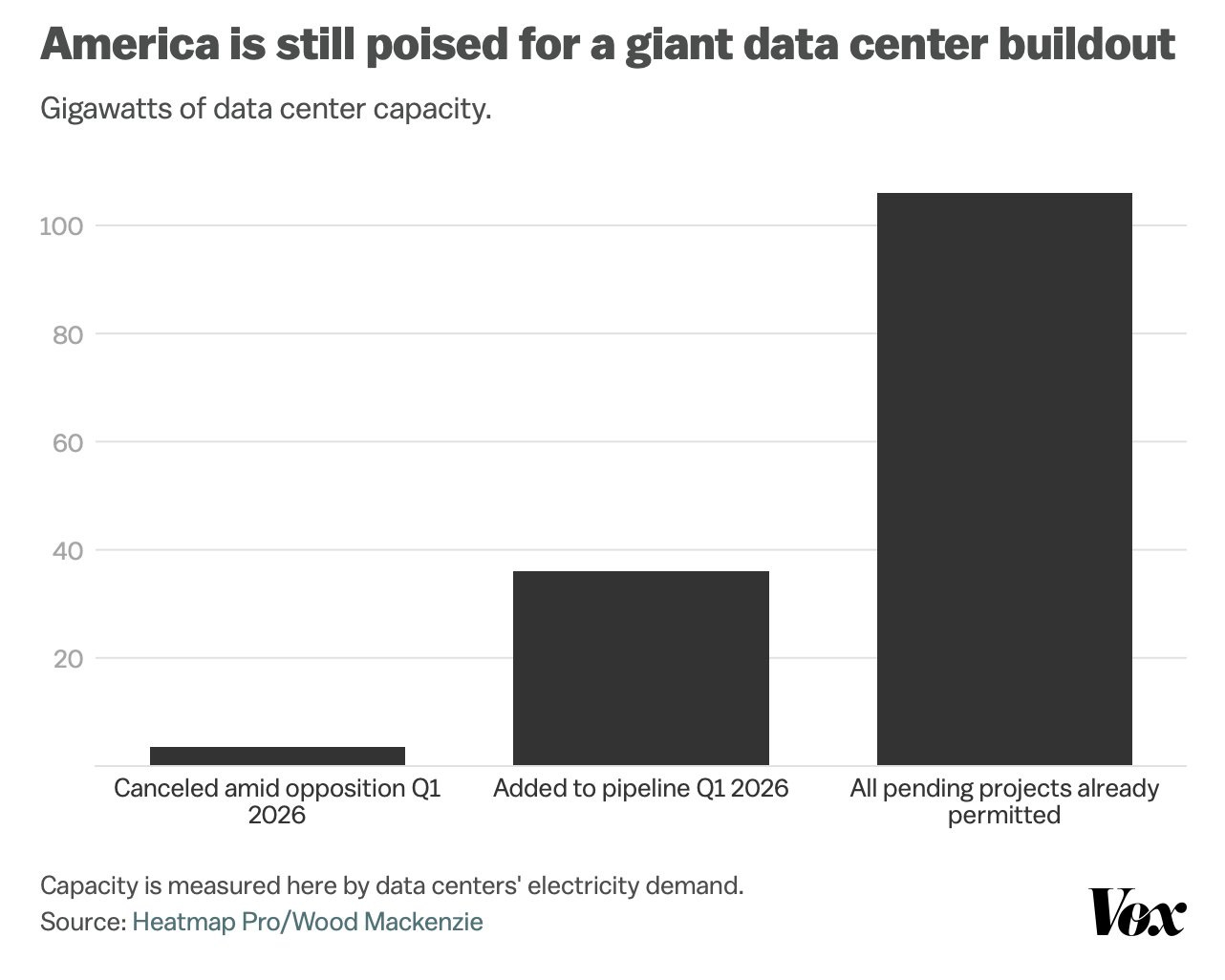
33: Samuel Hughes: The Seven Vices Of Highly Effective Victorians. The Victorian elite hated hard intellectual work and spent most of their time drinking and partying. But they still conquered the world. Does this mean that jock virtues like conviviality and sportsmanship are more important than nerd virtues like intelligence and hard work? Versus Don Fox: Against The Victorians. Yes, the Victorian elites spent most of their time drinking and partying, and, relatedly, were terrible for Britain. Britain spent the Victorian Age coasting on and spending down its Georgian-era accomplishments, finally ending in the preventable catastrophe of World War I. Whatever good things happened in this era came from normal hard-working middle-class people, not the debauched elites.
34: “Here, we wire a full drosophila fly connectome into Senator John Fetterman, using a directed control mode to leave his office, vote for cloture, and return.”
35: The Jains famously forbade killing insects out of animal welfare concerns. But did you know that another animal-welfare-concerned Indian sect, the Samsaramocakas, mandated killing insects because it put them out of their misery? Cf. Brian Tomasik, although the one page on the Samsaramocakas which I read was sort of ambivalent between them wanting to reduce suffering directly vs. believing that if you killed an insect then that gave its soul the chance to reincarnate as something better.
36: Damian Chavez (X) tries his hand at the “why did classical architecture give way to modern architecture in the 30s and 40s?” question. His theory: the Great Depression bankrupted many of the firms capable of producing ornament, and then the New Deal locked in funding for modern styles for ideological reasons.
37: Get the Hittite in your life a Late Bronze Age Collapse Scented Candle: