A Critical Period For Lactation Fetishes
Scott Alexander analyzes a study on lactation fetishes and its critical window theory, using his own survey data to suggest an alternative explanation based on birth order effects.
Enquist et al on lactation fetishes is one of my favorite papers.
They wonder – as we’ve all wondered at one point or another – how people develop fetishes. One plausible hypothesis is “sexual imprinting”. During childhood, you have a critical period (maybe ages 1 to 5) where you figure out what sex is. If you see some weird stuff during that time, you could end up with a fetish. For example, a child who sees latex used in a sexualized way (for example, they catch a glimpse of a sexy movie where someone is wearing latex) might grow up with a latex fetish.
Enquist et al realize lactation fetishes offer a natural test of this hypothesis. Children with younger siblings will see a lot of breastfeeding going on during their critical window; children without younger siblings will see less. Since it’s easy to ask people how many siblings they have, you can see if younger siblings correlate with lactation fetishes.
They survey some online lactation fetishist communities and ask everyone how many older and younger siblings they have. Although by chance we would expect an equal number of both, in fact the fetishists have many more younger than older siblings:
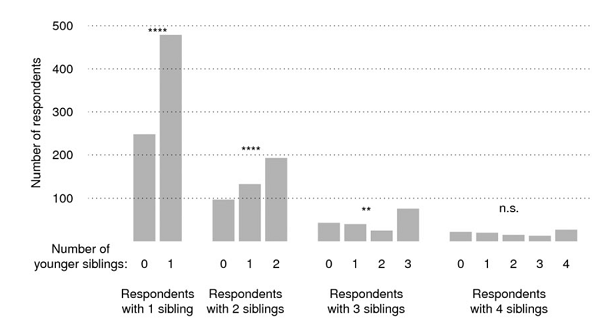 They interpret this as support for their critical window theory.
But their graph looks a lot like this graph of SSC readers:
 I use the opposite order they do, but both graphs show the same thing: more older than younger siblings.
I interpret the SSC data as showing a birth order effect on intellectual curiosity. But if this is true, it casts Enquist et al’s results into doubt. The trait I’m calling “intellectual curiosity” is linked to openness to experience. Could it also cause people to be more curious and open about fetishes, or more likely to join online communities about those fetishes?
I decided to test these hypotheses using the SSC 2019 Survey, which contained data on participants’ fetishes. I looked into lactation to replicate the Enquist results, but also into diaper fetishes, since that seemed like another fetish where exposure to the relevant stimulus would depend a lot on having a baby in the house. I also looked at latex, foot, bondage, masochism, and furry fetishes as control groups. Here are the results:
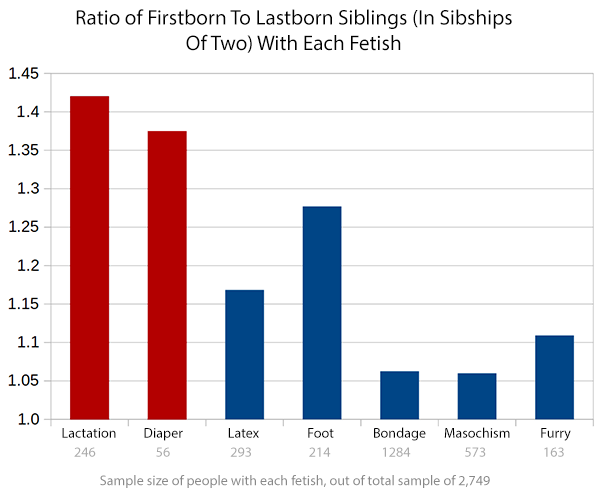 All fetishes had more older than younger siblings. But the difference was only significant in lactation fetish (p = 0.01). The difference between significant and nonsignificant results is not always itself significant, and I’m not sure how I would properly analyze this given the many different comparisons (some of which I made after seeing the data). i lean towards not being very impressed with the critical window theory on this metric.
But here’s another potential test: compare people with younger siblings to people with no siblings.
In Enquist et al’s model, the presence of a younger sibling causes the lactation fetish. In my model, the presence of an older sibling suppresses openness to experience and prevents fetish formation. So if only children behaved more like older siblings, that would support my model; if they behaved more like younger children, it would support Enquist et al.
I compared participants with no siblings to participants with a younger sibling in the critical window of less than five years age gap. Here are the results:
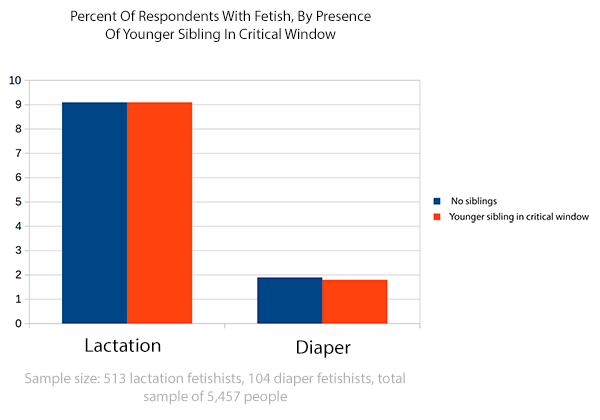 No difference. This suggests that having a younger sibling does not make you more likely to develop a baby-related fetish, which suggests it’s just that having an older sibling makes you less likely to develop it. This casts doubt on any simple critical window theory of fetishes, and makes it more likely that Enquist et al were just detecting the same birth order effects on openness to experience that can be found in many unusual communities.
These data are thanks to people who graciously revealed their deepest secrets for the cause of science; please be kind and don’t make fun of them or call them gross in the comments. Although I’ve made every other part of the survey publicly available, given the sensitivity of fetishes I’m keeping these particular answers private. If you are a professional researcher (or an amateur researcher with a good track record of professionalism and data integrity), and you want to test these results, please email me at scott[at]slatestarcodex[dot]com and we can discuss how to make that happen.
