Against Rat Park
Scott Alexander challenges the popular interpretation of the Rat Park study, arguing that addiction is not solely caused by poor environments and emphasizing genetic factors in addiction susceptibility.
I.
Rat Park is a famous study in which lab rats were kept in a really nice habitat that satisfied their every need. Contrary to the usual results with lab animals, scientists couldn’t get these happier rats addicted to drugs. Researchers concluded that drug addiction, far from being the simple biological story everyone assumed it was, was really a just coping mechanism for intolerable social situations. Rats stuck in terrible cages get addicted to drugs, as do humans in terrible slums. But give them other opportunities for happiness, and the problem disappears.
This has become a sort of popular legend. From HuffPo: The Likely Cause Of Addiction Has Been Discovered, And It Is Not What You Think. From Intellihub: Rat Park Heroin Experiment Shows Cultural Roots Of Drug Addiction. There’s even a Rat Park Comic and the inevitable Trump Could Learn From The Rat Park Experiment thinkpiece.
Rat Park lead researcher Bruce Alexander eventually developed a whole alternative theory of drugs, provocatively titled The Myth Of Drug-Induced Addiction. He notes that there are lots of people who take supposedly-addictive drugs without getting even the least bit addicted to them. The particular example he gives are patients who were prescribed cocaine for chronic pain, did well on it, and never abused the cocaine or escalated the dose. Even people who use it illicitly are unlikely to get addicted: “American and Canadian population surveys indicate that merely having used cocaine is associated with less than a 10% chance of having it as often as 100 times”. He uses this to draw a picture where cocaine isn’t really “addicting” per se, but people can repeatedly use drugs for “nondeterministic” reasons; for example, “certain people choose an addictive lifestyle as a lesser evil in desperate circumstances”.
Alexander makes his point with cocaine, but others working along the same lines have an impressive collection of related anecdotes. In World War II the Nazis, never ones to pass up unethical applications of science, put much of their army on methamphetamine to give them more energy and stamina. After the war, these soldiers reintegrated back into German society without much trouble; there was no epidemic of continuing meth addiction. Likewise, people worry about the opiate epidemic today, but only about 10% of people put on opiates for chronic pain become addicted; most take it as prescribed and then stop without any problems when their pain gets better. Even more obviously, the vast majority of social drinkers stay social drinkers; only a fraction become alcoholics. So – Alexander and his followers would tell us – clearly non-biological variables must be involved. And Rat Park tells us what those variables are: the social factors that make the difference between a terrible life and a flourishing one.
II.
How does this argument fare?
Two studies (1, 2) tried to replicate the results of Rat Park and failed. Another two (1, 2) tried and mostly succeeded. There’s some concern that the rat strain involved might have various substrains that the different experiments didn’t control for. But a result that can’t survive a change in rat substrains has pretty dismal prospects for applicability to humans.
There seems to be a more general problem with rat drug experiments in general, where everyone in the field realizes they can sometimes throw out weird results. The Drug Monkey blog says that rats self-administering cocaine is the best-replicated result in drug abuse science, but also that it can be screwed up by anything from the diameter of the cocaine infusion catheter, to whether the experimenter is wearing a dirty vs. clean lab coat, to who you buy the rats from.
So let’s take a step back and look at 13th century Mongolia.
Who had the best life – the happiest, most fortunate, most blessed existence in all of history? I don’t know, but Ogedei Khan had to be in the top ten. The son of Genghis Khan, he took over his father’s empire and continued the family tradition of conquering things. China, Korea, and Eastern Europe all fell to his armies; for over a decade he conquered and conquered without suffering a single serious defeat.
For his enjoyment, Ogedei built the Tumen Amgalan, “Palace Of Myriad Peace”, 2500 square meters in area. It had:
64 pillars, a green-and red-tiled, Chinese-style roof, and green-tiled floor built over a heating system. When the khan met important visitors he sat at a great throne with one staircase for ascending and another for descending. Inside the palace was a fountain, designed by a French jeweler captured in Hungary, that embraced a silver tree that spewed out mare’s milk from a lion’s head and wine, rice wine, mead and airag from from four snake heads. At the top was an angel with trumpets that blew and dispensed more drink.
We don’t know the exact size of Ogedei’s harem, but his father Genghis kept about three thousand concubines, and his successor Kublai had seven thousand, so if this kind of thing increases linearly, we can estimate Ogedei had somewhere around 5,000. The records, shamefully imprecise, tell us only that he took “pleasures in the company of beauteous ladies and moonfaced mistresses”.
Of his own character, Wikipedia says:
Ögedei was considered to be his father’s favorite son, ever since his childhood. As an adult, he was known for his ability to sway doubters in any debate in which he was involved, simply by the force of his personality. He was a physically big, jovial, and very charismatic man, who seemed mostly to be interested in enjoying good times. He was intelligent and steady in character.
So if you had to be a historical figure, you could do worse than Ogedei Khan.
I mention this because he was a raging alcoholic who drank himself to death.
History tells us that the Khan’s advisors were so concerned about his drinking that they staged a sort of medieval Mongolian intervention, begging him to cut down. Ogedei was moved by their plea, and swore to limit himself to one cup of alcohol a day from then on. But he later regretted his pledge and ordered the imperial artisans to create a purpose-made giant cup that could hold as much alcohol as he wanted. He died at 55, probably of alcohol poisoning. His successor, equally blessed, also became an alcoholic. So did several other members of the Khan family, rich and victorious all.
So: How do we square the idea that addiction is a disease of deprivation and misery with the addiction of the Great Khan, happiest and most fortunate of men?
And what about the American Indians during colonial times? Not the ones who were being displaced and uprooted by white settlers. The ones who were still participating in their traditional lifestyle with only distant relationships with the British colonists. Without wanting to go full on noble-savage or minimize the difficulties of a hunter-gatherer lifestyle, they seemed to have things pretty good. We know that Indians taken captive by white men found European civilization intolerable, but whites taken captive by Indians enjoyed Indian life so much that they often refused to return home once rescued. Most of the testimony that’s come down to us from historical Indians and their white observers indicates that their lifestyle was, if not perfectly idyllic, at least enviable.
But the early Native Americans were famously susceptible to alcohol, far more so than whites, so much so that entire tribes were destroyed by alcoholism epidemics and the ones that weren’t had to ban the substance as an existential threat.
And if neither Khans nor Indians seem happy enough, what about celebrities? They seem to have it all – wealth, power, fame, groupies. But they still get addicted to drugs at a high enough rate to produce six seasons of Celebrity Rehab With Dr. Drew (key quote: “In May 2013, Pinsky announced that season six was the final season, as he was tired of the criticism leveled at him after celebrities he treated had relapsed into addiction and died”).
Can you invent some convoluted definition of flourishing which classifies stormtroopers, chronic pain patients, and enriched-environment-rats as flourishing, but Khans, Indians, and celebrities as deprived? Maybe. But by that point the Rat Park hypothesis is becoming unfalsifiable; any seemingly flourishing group that becomes addicted will just lead to more twists in the definition of “flourishing”. Better to just admit people can succumb to addiction no matter what their apparent happiness level.
III.
A more responsible look at addiction would emphasize that it’s at least half genetic:
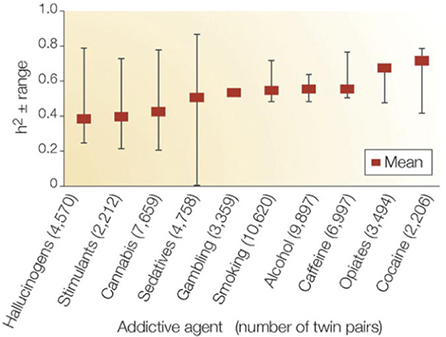 In a lot of cases, we know the genes involved. They’re usually not surprising: smoking is linked to genes for nicotine receptors; alcoholism is linked to genes for GABA receptors. In other cases, we don’t know what genes are involved yet, but we know from twin studies that they have to be there somewhere.
Some of these genes seem to differ across populations. The best-studied are different frequencies of ADH and ALDH polymorphisms. Asians in particular tend to have some very protective alleles here in a way showing signs of recent selection, with the extreme version being the alcohol flush reaction seen in about a third of East Asian individuals. There’s a plausible story where cultures that have lived with potent forms of alcohol for millennia have evolved some level of biological resistance to it, whereas cultures that didn’t get it until recently (like Mongolians and Native Americans) are worse off.
This lets us accept some of the Rat Park data without having to swallow their conclusion. Yes, most chronic pain patients can take opiates for years and never get addicted. Most cocaine users experiment once or twice but don’t end up as cokeheads. And most social drinkers never become full-on alcoholics. But this is a consequence of genetic luck, not enriched vs. less-enriched environments, and we don’t have to throw out the entire concept of “addictive drug” just to deal with it.
But does environment affect addiction at all?
This is really hard to solve empirically. You can find a lot of pictures like this:
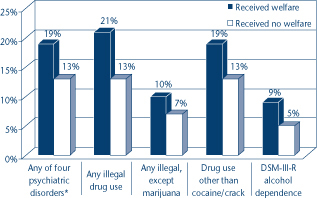 But the studies that produce these kinds of graphs aren’t great. For example, they can’t rule out that drug addicts become poor as a result of their drug addiction. Even if they look at people born in poverty, they can’t rule out genetic confounds – ie your parents abuse drugs and become poor, and you’re born in poverty with the genes for drug addiction.
Sometimes they come up with different answers depending on how you define the outcome of interest. Maybe poor people have more drug abuse but rich people have more drug dependence, or vice versa. In one study, rich people were more likely to have dangerous drinking-related behaviors, but only because they were more likely to drink and drive because they were more likely to own cars. Often rich people will be found to abuse one drug more, and poor people another, with unclear overall significance.
The better studies seem to have confusing conclusions like that of Patrick et al:
Smoking in young adulthood was associated with lower childhood family SES, although the association was explained by demographic and social role covariates. Alcohol use and marijuana use in young adulthood were associated with higher childhood family SES, even after controlling for covariates.
This seems a lot more subtle than the Rat Park model of “only people in bad environments ever get addicted and addiction is entirely an environmental condition.”
IV.
But at some point you have to try using common sense, and common sense tells me that unhappy people use drugs more than happy people. At least, individuals seem to use drugs when they’re least happy, and be best able to quit when everything is going well.
A lot of the genes, neural correlates, imaging findings, [insert science term here] of addiction involve the reward system, especially dopamine and the nucleus accumbens. The story goes something like “drugs are really rewarding, your brain does whatever gets it lots of reward, therefore your brain compels you to do drugs”.
And without having a great scientific explanation of exactly how this works, I think that having other sources of reward besides drugs available can attenuate this effect. Nothing in real life is ever going to be quite as rewarding as heroin. But if having a happy family and doing meaningful work and so on are, I don’t know, a quarter as rewarding as heroin, then maybe you have an opportunity to use “““willpower””” to force yourself the rest of the way and take the only-a-quarter-as-rewarding option. If you have a crappy life that doesn’t have any other source of reward at all, then all the “““willpower””” in the world won’t save you.
Imagine someone engaged in a scummy job they feel bad about doing, like spammer or tobacco advertiser or bioethicist. They want to quit, but they get a really good salary – let’s say $100,000/year – and they’re not sure they can do without the money. If they’ve got another wholesome option that pays $50,000, maybe their conscience is strong enough to help them make the leap. If their only other option pays $15,000, that’s going to be a lot harder. This is how I think about drugs too.
The rest of this post, Parts I II and III, is pretty sound science. This part is just my toy model. But it seems like something of this sort has to be true. Society and genetics have to interact somehow, and this seems about as good a way as any.
But remember: society is fixed, biology is mutable. You should work on the super-long-term project of improving society because that’s the right thing to do. But if you want to fight drug addiction now, in an effective way with some hope for helping today’s addicts, the best choices are still deregulating suboxone and legalizing research into psychedelic therapy.
