Bail Out
Scott Alexander examines bail reform as a potential solution to high incarceration rates in the US, discussing its impacts, alternatives, and the effectiveness of bail-paying charities.
Nobody likes that the US has the highest (second-highest after Seychelles?) incarceration rate in the world. But attempts to do something about it tend to founder on questions like “So, who do you want to release? The robbers, or the murderers?” Ending the drug war would be a marginal improvement but wouldn’t solve the problem on its own. And I’ve had trouble finding other ideas that engage with the reality that people are going to prioritize safety over reform and anything that significantly increases violent crime is a likely non-starter.
This was why I was interested to read the scattered thoughts in the effective-altruism-sphere about bail reform.
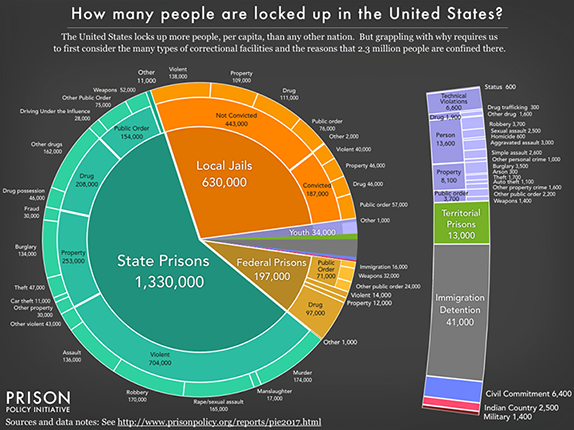
(source)
About a fifth of the incarcerated population – the top of the orange slice, in this graph – are listed as “not convicted”. These are mostly people who haven’t gotten bail. Some are too much of a risk. But about 40% just can’t afford to pay. They are stuck in jail until their trial, which could take a long time:
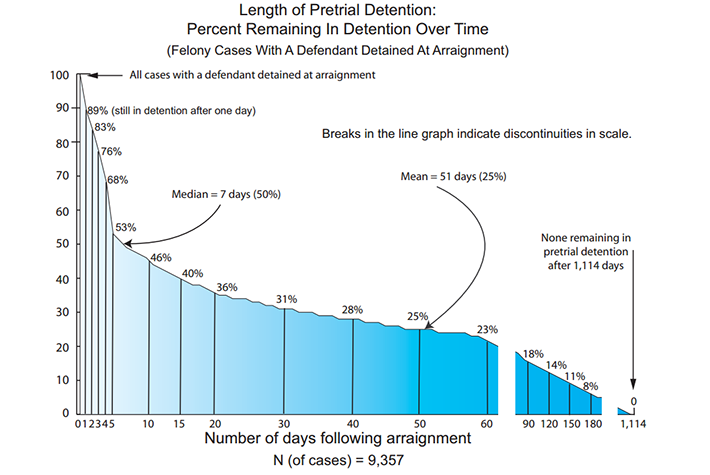
Length of time that defendants spend in jail before trial (source). Although 50% are out by day 7, 25% are still in by day 50, 10% are still in by day 150, and one was still in after three years
I talked to a correctional psychiatrist a few weeks ago who was telling me that conditions for inmates awaiting trial were worse than conditions for already-convicted inmates. The convicted inmates get officially integrated into whatever prison they’re in and receive various jobs and privileges. The inmates awaiting trial just sit in their cells doing nothing.
People who commit serious crimes might be looking at years or decades in prison. Do the few months they gain or lose because of bail really make that big a difference?
Yes. First, because most people aren’t looking at decades in prison. This article tells the story of a man accused of attacking some police officers; he claimed innocence and expected to be vindicated at trial. Prosecutors offered him a plea bargain of sixty days in jail, which he refused. But he ended up spending more than sixty days in jail waiting for trial, which kind of defeated the point.
Second, because much of the time this ends in people just taking the plea bargain. For example, the man in the article above almost took the plea bargain after serving sixty days in jail – an understandable choice, since it let him walk free immediately with time served. But this would put a guilty plea on his record, which would make it harder for him to get jobs in the future and reframe any further crimes he might commit as “repeat offenses”. If his case goes to trial, he might have been be found not guilty and avoid the black mark.
Third, because people who are detained pretrial end up getting longer sentences. Some of this seems to be because they’re less able to contact their lawyer and prepare a good defense. Some more seems to be related to prosecutors setting harsher plea bargains for imprisoned defendants because they have a worse bargaining position. And some more might be related to psychological factors where judges think of people who just showed up from jail as “more criminal” than someone who came to the court from their home.
This legal advice site advises suspects not to stay in jail before trial even if they don’t mind the environment and just want to get it over with. It confirms my friend’s suspicion that jails are worse for people awaiting trial than for convicted offenders, but also notes some other interesting aspects. People in jail have a bad habit of making incriminating statements that get reported and used against them on trial. Suspects out on bail can rack up prosocial accomplishments to list off at their trial – they give the example of going to a counselor and making restitution to victims. And they get the option to delay their case until the trail grows cold and prosecutors get bored and everyone just agrees to a lesser sentence.
(something I didn’t realize which is relevant here: 96% of felony convictions involve guilty pleas. Plea bargaining is the rule, not the exception, and anything which makes it easier or harder is going to impact the large majority of cases)
There have been a bunch of studies trying to determine to what degree bail vs. pretrial detention affects case outcome. Some early studies like this found that it could alter sentence length by about ten percent, but the data were necessarily not very good – there’s no way to randomize suspects, and the sort of hardened criminals who don’t get bail are the same sort of hardened criminals who maybe deserve tougher sentences. People tried their best to control for all observable factors, but this never works. Better is Gupta, Hansman & Frenchman, which tries a quasi-experimental design based on suspects’ random assignment to more or less strict judges who are more or less likely to demand lots of money for bail. Suspects who are assessed bail are 6% more likely to be convicted (they’re also 4% more likely to reoffend, which is weird but might be related to imprisonment hardening criminals and increasing recidivism). Stevenson tries a similar method and finds that inability to make bail produces a 13% increase in convictions, mostly through more guilty pleas.
This study also finds that size of bail was less important than whether there was bail at all, which confused me until they pointed out that most suspects are really, really poor. As per the Stevenson paper:
Some of these defendants are facing very serious charges, and accordingly, have very high bail. But many have bail set at amounts that would be affordable for the middle or upper-middle class but are simply beyond the reach of the poor. In Philadelphia, the site of this study, more than half of pretrial detainees would be able to secure their release by paying a deposit of $1000 or less, most of which would be reimbursed if they appear at all court dates. Many defendants remain incarcerated even at extremely low amounts of bail, where the deposit necessary to secure release is only $50 or $100.
The New York Times notes that
Even when bail is set comparatively low – at $500 or less, as it is in one-third of nonfelony cases = only 15% of defendants are able to come up with the money to avoid jail.
And from here:
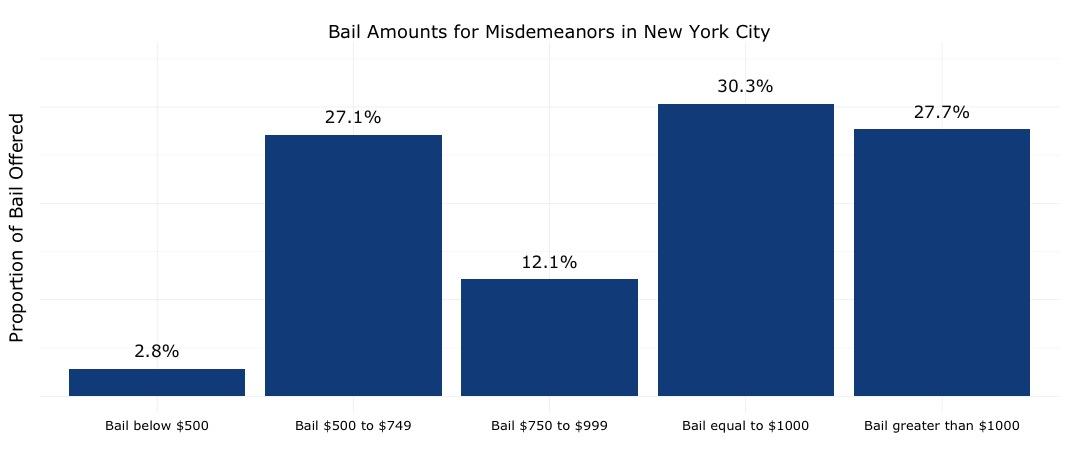 The guy in the NPR article above – the one who might or might not have attacked some cops – was in jail for 60 days because he couldn’t make bail of $1000.
So bail causes people to be stuck in jail for months, increases guilty pleas independent of defendants’ actual guilt, and causes more convictions and longer sentences. Since many of the people harmed by this are innocent, or deserve less punishment than they end up receiving, this seems like an important point of leverage at which to try to fight incarceration. On the other hand, bail is supposed to serve a useful purpose in preventing suspects from running away. It is possible to do without?
Maybe. Washington DC is one of the highest-crime areas of the country, but it uses an alternative system without monetary bail which uses an algorithm to calculate risk, releases low-risk people, and keeps high-risk people imprisoned without bail. It looks like about 10% of Washingtonians, versus 47% of other Americans, are detained in jail pre-trial. Of Washingtonians released without bail, 87% show up for all court dates, and 98% avoid committing violent crimes while free.
I’m not able to find a good comparison between Washington and other jurisdictions, but this page on bounty hunters gives the unsourced statistic that 20% of people on bail fail to show up for court anyway. This equally-credible-looking site gives an equally unsourced statistic of 10%, and notes that these people are more likely to be flakes who forgot their court date than supercriminals who have donned a fake mustache and are on their way to the Cayman Islands. These numbers suggests that Washington’s no-show rate is about the same as everywhere else’s.
Bronx Freedom Fund is a charity that helps people pay bail. They claim that 96% of the people whose bail they pay show up to trial, which matches the numbers from Washington and the numbers from normal places where people have to pay their own bail. I am sure they select their beneficiaries very carefully, but if it’s possible to select a group of people who are definitely going to show up to their trial whether they can make bail or not, why are those people still in jail?
I can’t find any studies clearly proving this, but it looks like there’s no obvious and proven tendency for bail to improve show-up-at-trial rates, and some evidence that with good risk assessment and selection 90% of people released without bail will show up to trial, which may be around the same as the rate for people who do get bail. This would make all of the problems with bail not only outrageous but pointless, not even the unfortunate side effects of a generally-reasonable policy.
It looks like there are two possible solutions – one small and short-term, the other systemic and long-term.
In the short term, there are some great charities – like the aforementioned Bronx Freedom Fund – that pay people’s bail. If the people show up to trial (which, again, 90% or so do), then the charity gets its money back and can use it to pay more people’s bail, ad infinitum. This makes them very high-value per dollar.
I’m not sure how much to trust BFF’s self-reported statistics. I see that on their front page they mention that “defendants who await trial in jail are 4x more likely to be sentenced to time in prison”, which is much more than any of the studies above report and which is probably a misleading uncorrected raw estimate. I see they say that “$39 can help us secure someone’s freedom”, which since average bail is something like $500 and only 2.8% of bails are less than $50 might be more of a “this is the lowest bail that has ever occurred in history” than any kind of representative estimate. But I don’t really hold it against them to give technically correct but misleading numbers in an advertising pitch. The question is – what are the real numbers? GiveWell and Open Philanthropy Project have been looking at them, but I can’t find a complete writeup, so let me do a terrible and very approximate job of trying to estimate them myself.
They note that their average bail is $790. Supposing that their 96% success rate is true, the average case costs them $30 – they cite a similar figure in their own literature. If, as they say, the average pretrial detention period is 15 days (which more or less matches the chart above), they can keep someone out of jail for $2/day even without selecting the worst cases.
They also note that their clients get cleared of all charges about half the time, compared to only 10% of the time for people in jail. I don’t know how much of this is selection effects, but suppose we take it at face value. And suppose that an average prison sentence for whatever kinds of petty crimes these people commit is two months. That means they’re saving the average suspect about 25 days worth of prison sentence, and improves their cost-effectiveness. I’d say this comes out to about $0.75 per jail day prevented, but that might be double-counting some people who, had they been in jail, would have had the time deducted from their sentence. Let’s say somewhere between $0.75 and $2.
A confusion: their 2014 annual report notes that they received $53,000 in donations and helped 140 people, suggesting a cost of $380 (not $30) per person helped. In 2015 they helped 160 people with $120,000, suggesting a cost of $750 per person that doesn’t seem to improve with scale. A similar organization, Brooklyn Community Bail Fund, got $404,800 from Good Ventures, and boasts of helping 1,100 people, for $367/person (this is a very rough estimate; it assumes this is all in the same year and they got no other donations).
I’m not sure why these numbers are so much bigger than the ones derived from first principles, but taken seriously, if we continue to assume that each successful case saves an average of forty days in jail, they prevent a jail day for about $10.
We compare to other efficient charities. GiveWell thinks it takes antimalaria charities about $7500 to save a human life. If that person lives another 20 years, that’s about $1/day.
So using their own numbers, these bail-related charities might be able to prevent imprisonment at the same cost-per-day as other charities can save lives. Using less optimistic numbers, they might be able to prevent imprisonment at about ten times the rate. Depending on where you fall on the death vs suffering philosophical tradeoff, this might be attractive. I’m confused these charities haven’t received more attention, if only to debunk them properly.
And even though everyone likes to talk about how individual charity doesn’t work and only systemic change can make a real difference, paying the bail of 50% of the people in the United States currently awaiting trial would be well within the abilities of one philanthropic-feeling billionaire, after which the money could be recycled again and again for the same purpose. I agree this is a kind of hokey calculation since it doesn’t include the overhead cost of getting the money to the suspects, but it’s still shocking how small the amounts involved are compared to other social problems.
In the long-term, we probably need some kind of criminal justice reform. The Obama administration seemed to be pursuing some kind of fourteenth amendment argument to get a court ruling that monetary bail was illegal. Some libertarian groups like Reason and the Cato Institute are on board. Some charities, like Equal Justice Under Law, are supporting the same cause.
I don’t think that bail reform is the largest or most important change that could be made to the US criminal justice system. But I think it might be tied with drug reform for the easiest. And given how well politics has been going lately, this might be a good time for lowered ambitions.