Effective Altruists: Not As Mentally Ill As You Think
The post analyzes survey data to examine if effective altruism attracts people with mental disorders, finding slightly higher rates of autism but no evidence of unusual self-hate or scrupulosity.
During my recent meetings with effective altruist groups here, I kept hearing the theory that effective altruism selects for people with mental disorders. The theory is that people with a lot of depression, anxiety, and self-hatred turn to effective altruism as (optimistically) a way to prove that they are good and valuable or (pessimistically) a form of self-harm in which they enact their belief that they deserve nothing and other people are more worthy.
And whenever this got brought up at meetings, people giggled, probably because they were thinking of good examples. I can’t deny there’s a lot of anecdotal evidence here (hi Ozy!). But when I look into it, it seems totally false.
My source was the 2014 Less Wrong survey data, which asked respondents whether they self-identified as effective altruists and whether they participated in effective altruist groups and meetups. Using that question, I separated the respondents into 758 non-effective-altruists and 422 effective altruists. The survey had also asked people whether they had been diagnosed with various mental illnesses, so I checked the rates in both groups. Including self-diagnosis there were no particular results; when I limited it to professionally diagnosed illnesses things got a little more interesting.
Effective altruists had about the same levels of anxiety disorders and obsessive-compulsive disorder as non-EA Less Wrongers. However, they had slightly higher levels of depression (22% vs. 17%) which was barely significant (p = 0.04) due to a large sample size. They also had more autism (8.5% vs. 5%) which was also significant (p = 0.02).
I expected this to be mediated by a tendency for autistic people to be more consequentialist and consequentalists to be more EA, and both these things were true to some degree, but even when I limited the analysis to all consequentialists, effective altruists still had more autism. Further, autistic people seemed to donate a higher percent of their income to charity than neurotypical people or people with other mental illnesses even separated from effective altruist status – that is, even among people none of whom were effective altruists, the autistic people seemed to donate more (effect not always significant) even though they generally had lower incomes.
I conclude that effective altruists are not unusually self-hating or scrupulous, but that they may be a little more autistic, and the reason why isn’t the obvious one.
A caveat, by way of presenting another interesting result. Rusch (2015) (h/t @bechhof) studied whether bankers were more consequentialist (in this case, more likely to give consequentialist answers to the Trolley Problem and Fat Man Problem) than nonbankers. He found that they were. But then he checked for confounders and found the result was entirely an artifact of men being more consequentialist than women and bankers being predominantly male.
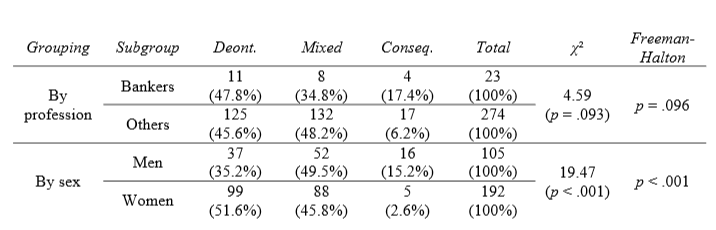 This is pretty astounding – men are almost six times as consequentialist as women!
On the other hand, in both my Less Wrong data in general and the effective altruist subgroup, men and women don’t vary much in consequentialismishness. Either Rusch’s data is wrong, or there’s a strong filter that acts to get only consequentialists into Less Wrong regardless of gender, or LW converts women to consequentialism (without further converting men).
Interestingly, effective altruists were much more consequentialist than non-effective-altruist LWers – 80% versus 50%. They also had more women than the non-effective-altruists. So it looks like LW filters for consequentalists so strongly it gets an even balance of consequentialist men and consequentialist women, and past that stage, filtering further for consequentialism doesn’t change gender balance much.
This points out a limitation of my statistics above. All it shows is that effective altruists don’t differ from other rationalists in levels of mental illness. It’s possible and indeed likely that both effective altruists and rationalists differ from the general population in all kinds of ways. It’s even possible that self-hate and scrupulosity drive people into the rationality movement in general, although I can’t imagine why that would be. It’s just that they don’t seem to have any extra power to make people effective altruists once they’re there.
