Hungarian Education II: Four Nobel Truths
The post analyzes Nobel Prize winners per capita, refining the data to show that Israeli Ashkenazi Jews have the highest rate, supporting the theory of their intellectual prowess while raising questions about educational systems and concentration effects.
1. Israel historically has only a moderate number of Nobels per capita
On Friday, I discussed the phenomenon of Hungarian science geniuses, and conjectured it was because of Hungary’s high concentration of Ashkenazi Jews. A commenter pointed out that Israel had an even higher concentration of Ashkenazi Jews, with less impressive results:
By this logic, Israel should have become the hotbed of geniuses. And while it’s true that there are a lot of smart people there, none of the Israeli universities are in the top 10 or maybe even in top 100. And the fraction of Nobel prize winners is not impressive, either.
The objection makes superficial sense. The list of Nobel winners per capita puts Israel at a modest tenth place, after places like Norway and the United Kingdom.
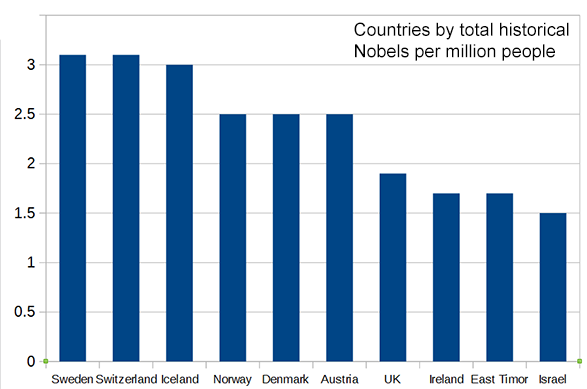 This doesn’t look promising for any Ashkenazi-Jew-based theory.
2. But their more modern numbers look much more impressive
On the other hand, that list counts total Nobels won, ever, and divides them by modern population. That gives an advantage to older countries. Norway’s been collecting Nobels since 1903; Israel wasn’t even founded until 1948. And for the first couple generations the Israelis were pretty busy starting kibbutzim, building infrastructure, fighting off enemies, et cetera. Setting up a good university system capable of churning out Nobels takes time. So Norway and the UK had an unfair head start.
I redid their analysis looking only at Nobels won since the year 2000 (because it was big and round and serves as a signal that I’m trying to avoid optional stopping). My source was this list of Nobel laureates by country, and I deferred to Wikipedia’s judgment about whether or not to count dual citizens, immigrants, et cetera. Here’s the results:
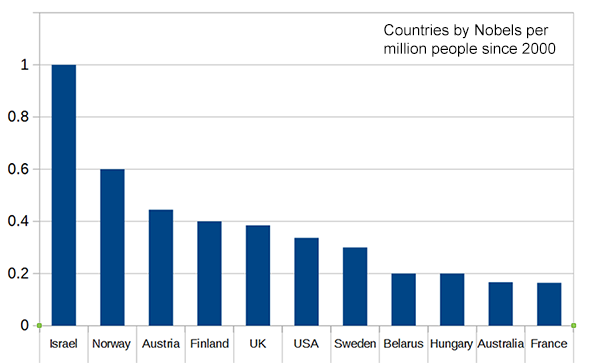 We see that during this period, Israel has by far the highest number of Nobel prizes per capita.
3. This advantage increases if we look only at Ashkenazim
The original theory was about Ashkenazi Jews in particular. Only about a third of Israels are Ashkenazi (the rest are other types of Jews, or Palestinians, or other non-Jewish minorities). If we separate out the Ashkenazim, the graph looks like this.
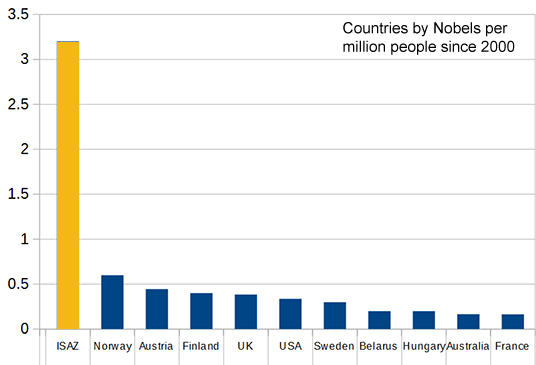 ISAZ is Israeli Ashkenazi Jews, considered as a separate population. On the one hand, it’s kind of unfair comparing Israel’s most successful population group to other countries taken as a whole. On the other hand, if we were to take other countries’ most successful population groups, those would be Ashkenazi Jews too, so whatever. Since Israeli Ashkenazim get about five times more Nobels per capita than any country, I’m going to consider the “what about Israel?” objection officially refuted.
4. But there’s not a lot of evidence for benefits to concentration, and other factors might be involved
One more graph:
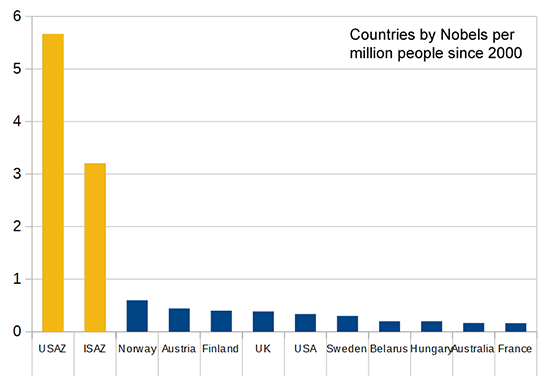 USAZ is US Ashkenazi Jews, who get twice as many Nobels per capita as their Israeli cousins (I’m not sure how seriously to take this; the Israeli data is based on eight Nobel laureates, so there’s a lot of room for sampling issues.)
And although it’s hard for me to get exact numbers, it looks like a lot of Israeli Nobelist (maybe more than half) did their best work abroad, usually in the US.
Israel went from 1948 to 2002 without winning a single science Nobel (it did win in Literature and Peace during that time). Now it’s winning more of them – a lot more, more than any other country per capita – but mostly when its citizens go and study in foreign universities. This seems consistent with an Israeli educational system that’s still struggling to get its act together.
Does this mean that once the educational system gets its act together more fully, the ISAZ Nobel rate will approximately double to match the USAZ Nobel rate? I’m not sure.
Just from this analysis, it doesn’t look like the theory in the last post, where everyone gets benefits from concentrating closer together, is true. Israel has about ten times as many Ashkenazi Jews per capita than the US, but still does worse than they do.
These data don’t challenge the conclusion from the last post that Ashkenazim might have been responsible for Hungary’s sudden crop of great scientists. But they do potentially challenge the implicit conclusion that the education system didn’t matter that much. I’ll have more on that later this week.