I Will Never Have The Ability To Clearly Explain My Beliefs About Growth Mindset
Scott Alexander clarifies his stance on growth mindset theory, distinguishing between widely accepted ideas and more controversial claims made by Carol Dweck, expressing skepticism about some aspects while acknowledging supporting evidence.
I.
A lot of the comments I’ve gotten about Tuesday’s post on growth mindset have been pretty similar. They’ve argued that yes, innate ability might matter, but that even the most innate abilityed person needs effort to fulfill her potential. If someone were to believe that success were 100% due to fixed innate ability and had nothing to do with practice, then they wouldn’t bother practicing, and they would fall behind. Even if their innate ability kept them from falling behind morons, at the very least they would fall behind their equally innate abilityed peers who did practice.
I will call this the Bloody Obvious Position, since it’s hard to believe it isn’t true. I once tried to imagine a world without it as a thought experiment, but it was pretty weird and I wasn’t serious.
The Bloody Obvious Position was what I was trying to get at with my post on basketball, and with my terrible ad hoc graph:
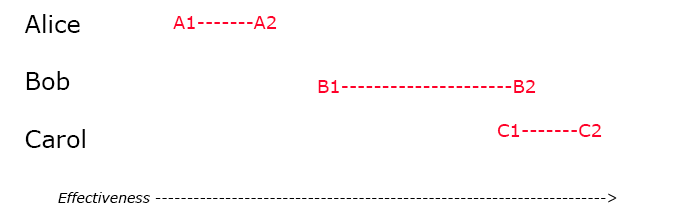 Nevertheless, some people thought I was denying the Bloody Obvious Position. Other people thought I was accusing Carol Dweck of denying the Bloody Obvious Position (see eg here). This despite my making sure to say:
I want to end by correcting a very important mistake about growth mindset that Dweck mostly avoids but which her partisans constantly commit egregiously.
I believe the Bloody Obvious Position. Dweck believes the Bloody Obvious Position. I acknowledge that Dweck believes the Bloody Obvious Position. There are a lot of growth mindset partisans online who don’t believe the Bloody Obvious Position, and I satisfied my urge to yell at them, but now they’ve been yelled at, and the more important issues debated by reasonable people still remain.
So where do I disagree with Dweck? I interpret Dweck as making the following statement:
The more important you believe innate ability to be compared to effort, the more likely you are to stop trying, to avoid challenges, to lie and cheat, to hate learning, and to be obsessed with how you appear before others
Call it the Controversial Position. This is not the same thing as the Bloody Obvious Position. In the Bloody Obvious Position, someone can believe success is 90% innate ability and 10% effort. They might also be an Olympian who realizes that at her level, pretty much everyone is at a innate ability ceiling, and a 10% difference is the difference between a gold medal and a last-place finish. So she practices very hard and does just as well as anyone else.
According to the Controversial Position, this athlete will still do worse than someone who believes success is 80% ability and 20% effort, who will in turn do worse than someone who believes success is 70% ability and 30% effort, all the way down to the person who believes success is 0% ability and 100% effort, who will do best of all and take the gold medal.
And this is why I deny that I’m secretly agreeing with Dweck, or strawmanning Dweck, or whatever. I don’t believe the Controversial Position, but I think Dweck does. For example, here she writes: “The more a player believed athletic ability was a result of effort and practice rather than just natural ability, the better that player performed”.
There is nothing in there about “the more a player realizes that, no matter how important innate ability is, effort matters too.” Her statement says that it’s entirely about what degree a player attributes success to effort versus innate ability. The natural conclusion there is that the player who believes success is 0% innate ability and 100% effort will do the best.
Her studies reflect this as well. The most common design uses the IAR, a test where children are asked to attribute different things to effort versus ability. Those who attribute too many things to ability are classified as “helpless” and “fixed mindset”. There’s no question about “Okay, some things are due to ability, but if you work hard that still helps, right?” Nor have I ever seen any of the literature claim “it’s important to believe effort matters a little, but after a certain point more effort-attribution doesn’t help”, or “Maybe there’s an L-shaped relationship between belief-in-importance-of-ability and success.”
I’d like to be able to teach my children that success is X% innate ability and Y% practice, for non-zero values of both X and Y. I think growth mindset theory claims that if some other parent teaches their kids the same thing for a lower value of X and higher value of Y, their children will be more honest, harder-working, and more successful. And the parent who says it’s 0% innate ability and 100% practice will do best of all. If growth mindset people don’t believe that, I can only confess I have never been able to infer that lack of belief from their writings.
II.
Worse, we can distinguish between a Sorta Controversial Position and a Very Controversial Position:
SCP: The more children believe effort matters, and the less they believe innate ability matters, the more successful they will be. This is because every iota of belief they have in effort gives them more incentive to practice. A child who believes innate ability and effort both explain part of the story might think “Well, if I practice I’ll become a little better, but I’ll never be as good as Mozart. So I’ll practice a little but not get my hopes up.” A child who believes only effort matters, and innate ability doesn’t matter at all, might think “If I practice enough, I can become exactly as good as Mozart.” Then she will practice a truly ridiculous amount to try to achieve fame and fortune. This is why growth mindset works.
VCP: Belief in the importance of ability directly saps a child’s good qualities in some complicated psychological way. It is worse than merely believing that success is based on luck, or success is based on skin color, or that success is based on whatever other thing that isn’t effort. It shifts children into a mode where they must protect their claim to genius at all costs, whether that requires lying, cheating, self-sabotaging, or just avoiding intellectual effort entirely. When a fixed mindset child doesn’t practice as much, it’s not because they’ve made a rational calculation about the utility of practice towards achieving success, it’s because they’ve partly or entirely abandoned success as a goal in favor of the goal of trying to convince other people that they’re Smart.
Carol Dweck unambiguously believes the Very Controversial Position. In a quotation which I admit I am mangling and ellipsis-ing heavily to remove extra verbiage, but which I think preserves the meaning of her claim:
[People with fixed mindsets] are so concerned with being and looking talented that they never realize their full potential. In a fixed mindset, the cardinal rule is to look talented at all costs. The second rule is don’t work too hard or practive too much…having to work casts doubt on your ability. The third rule is, when faced with setbacks, run away. They say things like ‘I would try to cheat on the next test’. They make excuses, they blame others, they make themselves feel better by looking down on those who have done worse.”
Can we all agree this is a much stronger claim than “ability matters, but effort also matters?”
III.
I was not intending to “debunk” growth mindset, or even present a pure polemic against growth mindset. I admitted that many of the studies around it were very good, and that I don’t have good answers to them. My bias is against the theory, but I tried not to just follow my bias. I tried to treat it on the level of “there’s a lot of good evidence for growth mindset, now what’s the best evidence we can find against it?”
So I guess I should probably come out and say what I believe about each position.
I believe the Bloody Obvious Position is bloody obvious.
I believe the Somewhat Controversial Position is probably not a good way to parse things. Part of it is that we might be confusing explicit versus implicit beliefs. Maybe a particular geneticist is very aware of research showing how important genetics is to success, and would give a very high estimate if asked, but in her own life, when she fails, lack of effort is still the first explanation to immediately leap to mind. Or maybe some teacher is very on board with growth mindset and things IQ is a racist construct, but is convinced that she can’t do physics because she’s just “not a math kind of person”. The research I’ve seen hasn’t really distinguished between explicit and implicit beliefs. The priming experiments sure seem more likely to affect what immediately comes to mind than your stable, well-reasoned beliefs about how the world works (even though a few priming experiments have checked stable well-reasoned beliefs to see if the intervention worked!)
If you put a gun to my head, I’ll say it certainly works in the lab, and give you about 50-50 odds that it matters in real life. The studies don’t show any real-life correlation between growth mindset and any measures of success. Many people have pointed out that this could be confounded – dumb people might preferentially believe ability doesn’t matter to make themselves feel better about not having it, and smart people might preferentially believe effort doesn’t matter because they rarely have to use it. But if you accept that, some of the rest of it starts to look confounded. If fixed mindset = smart people, than might the reason they react poorly to challenges and failure be that they have no experience with them? Might it be that the more challenges and failures you’ve encountered before, the better you are at dealing with them? Certainly that is how I interpret this Dweck paper, even though she thinks it is purely a mindset effect. Another way of explaining the ecological results without bringing in that particular confounder would be if growth mindset helped in some situations, but fixed mindset helped in others. For example, a person with fixed mindset risks not trying hard enough because they think there’s no point. But a person with growth mindset risks the opportunity costs of prolonging their inevitable failure instead of (in the Silicon Valley term) “failing fast” and pivoting towards a higher-payoff activity.
The Very Controversial Position is also well-supported, also contradicted by ecological data, and really really doesn’t match my experience. The people I know who are most interested in issues of innate ability don’t behave at all like Dweck’s subjects. In fact, I wonder if a lot of the “life-hacking” movement might be ability-mindset people trying to figure out how to succeed more by improving ability – certainly the people who practice dual-n-back every day because they think it increases IQ fall into this category, but so do nootropics users, people who follow special diets to increase energy, and “try this one weird trick to improve your motivation”. And these same people seem interested in things like spaced repetition software, which might be thought of as sort of prosthetic ability-enhancers. On the other hand, I’ve also met people who say “I could succeed if only I put in some effort, but I have some mental block / depression / ADHD / low conscientiousness score that makes it impossible for me to work that hard, so better go eat worms”, then sabotage themselves at every opportunity.
And yes, it’s a sin to privilege your own experience and priors over the results of good studies, but sometimes it’s necessary. And it’s another sin to prefer the results of broad ecological studies to controlled experimental trials, but sometimes that’s necessary too.
I deny the claim that I don’t disagree with Dweck on anything of substance. I don’t absolutely disagree with her on anything, but there are a lot of things I doubt, or that I expect to capture true insights without being the best way to express them. Growth mindset makes some surprising and genuinely controversial claims, and I’m not yet at the point where I can feel sure about them either way.
