Negative Creativity
Scott Alexander suggests humans have 'negative creativity' due to cognitive 'ruts', and explores ways to escape these ruts, arguing that AI might have an advantage in creative thinking.
[Epistemic status: it is late and I am tired and I wanted to get a blog post out. No guarantees of quality.]
It is said that one of the highest-level and most awe-inspiring of rationalist skills is Sitting And Thinking About Something For Five Minutes.
The sitting part isn’t that difficult. It’s not even that hard to…how should I put it…apply mental effort at the problem. But that mental effort tends to be spent rehearsing the solutions already thought up, retreading worn paths, ruminating on how difficult the problem is.
Coming up with entirely novel ideas is really, really hard.
I’m intrigued by how many new ideas people seem to have either during dreams or on drugs. Kekule famously discovered the structure of benzene when he dreamt of an ouroborus. Loewi discovered chemical neurotransmission in a dream experiment that he was able to repeat in reality. Crick’s discovery of DNA and Mullis’ discovery of PCR were both on LSD.
A lot of people think dreams and drugs involve some magical inspiration. I think otherwise.
I rarely get inspired by dreams or drugs, but I have my own secret source of inspiration: mishearing other people. Somebody says something, I misinterpret it, and the misinterpretation is quite interesting – more interesting than anything I would have come up with on my own if asked to generate an interesting idea. Maybe it’s a clever joke or turn of phrase. Maybe it’s a neat idea. Sometimes I misunderstand people’s entire positions, and end up with positions much more interesting than the ones they were trying to push.
This puts the dreams and drugs into a kind of different light.
Suppose that ordinary thought is in really, really deep ruts – I mean the word “rut” metaphorically but not idiomatically, imagine an actual rut for this – that are very hard to break out of. If you try to break out of them, you end up not in the trackless steppe, but in whatever the nearest other rut is nearby. Just as humans can’t generate random numbers, so they can’t generate random ideas. An attempted random idea will just be a portion of the rut you’re in less often than usual, or a slight variation on an existing rut.
In that case, adding a certain amount of noise to a problem – dreams and drugs certainly count – might be a way of inspiring new ideas.
Metaphors seem like another attempt to escape conceptual ruts. I was in an argument today over IQ. Somebody claimed there couldn’t be a general factor of intelligence, because evo psych has shown there are lots of different mental modules.
I answered that there are lots of different physical “modules” (hands, feet, abs, et cetera) but there can be a general factor of physical fitness that determines your skill at using all of them. Frail 70 year old cancer patients will have low physical fitness across all these “modules”, and young guys on steroids will have very high fitness across all of them.
That there could be both multiple independent modules, and a general factor of skill common to all of them, seems to have genuinely not occurred to my interlocutor. This isn’t surprising – it’s a complicated abstract topic. Maybe if he had Sat Down And Thought About It For Five Minutes, he could have derived it from abstract principles. But at least for me it was easier to analogize it to a very similar situation, such that taking a well-worn rut in the old situation leads you to a new and surprising answer in the isomorphic new situation.
I know Douglas Hofstadter is very interested in building artificial intelligences that understand metaphors, thinking they are the key to human cognition. And a lot of people seem to think that even if we create some sort of very smart AI type thing, it will be less powerful than generally believed because we won’t have solved the problem of creativity.
I suspect creativity will be a relatively tractable problem. My guess is that humans, in a sense, have negative creativity. Their brains are specifically designed to make it hard to get out of a rut, because ruts represent well-worn cognitive pathways and things outside of them are probably useless and crazy.
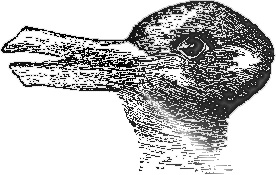
This picture is mildly interesting because instead of immediately collapsing into one rut, your brain hangs suspended between a rabbit rut and a duck rut. We nod and call this Ambiguity. But unless you Sit Down And Think About It For Five Minutes, you’re not going to notice that it could be a hairdryer that has been split open, let alone an erotic BDSM picture of a clothespin attached to a female breast. Maybe if you caught it right out of the corner of your eye, without time to think, or if it was disguised by visual noise, you would notice one of the latter two immediately – at the cost of not being able to see the duck or rabbit.
Researchers are probably right when they expect the first AIs to have zero creativity, but zero creativity might be so much better than us negative creativity humans that they won’t need the crutches we use like metaphors and dreams. If they have to, maybe they can just actually generate random noise in hypothesis-space and see where it takes them.
