Never Tell Me The Odds (Ratio)
Scott Alexander warns about the potential misinterpretation of odds ratios in studies, explaining how to convert them to effect sizes for more accurate understanding.
[Epistemic status: low confidence, someone tell me if the math is off. Title was stolen from an old Less Wrong post that seems to have disappeared – let me know if it’s yours and I’ll give you credit]
I almost screwed up yesterday’s journal club. The study reported an odds ratio of 2.9 for antidepressants. Even though I knew odds ratios are terrible and you should never trust your intuitive impression of them, I still mentally filed this away as “sounds like a really big effect”.
This time I was saved by Chen’s How Big is a Big Odds Ratio? Interpreting the Magnitudes of Odds Ratios in Epidemiological Studies, which explains how to convert ORs into effect sizes. Colored highlights are mine. I have followed the usual statistical practice of interpreting effect sizes of 0.2 as “small”, of 0.5 as “moderate”, and 0.8 as “large”, but feeling guilty about it.
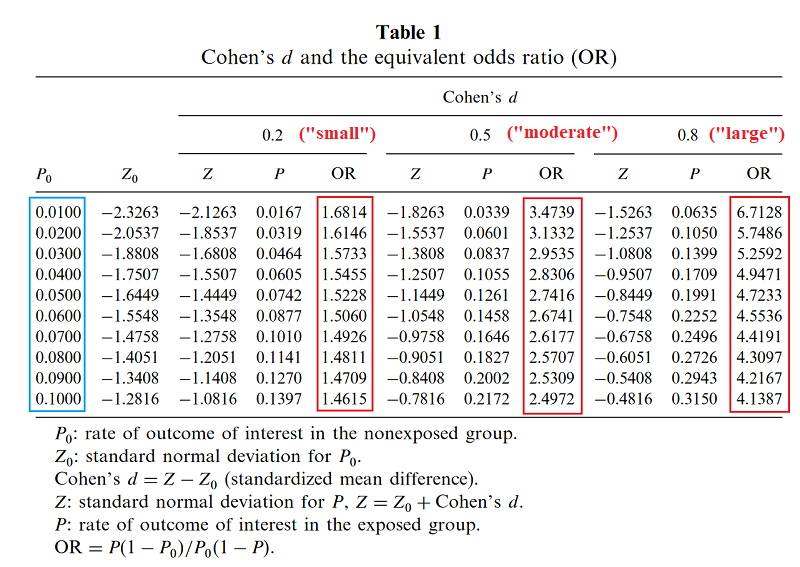 Based on this page, I gather Chen has used some unusually precise formula to calculate this, but that a quick heuristic is to ignore the prevalence and just take [ln(odds ratio)]/1.81.
Suppose you run a drug trial. In your control group of 1000 patients, 300 get better on their own. In your experimental group of 1000 patients, 600 get better total (presumably 300 on their own, 300 because your drug worked). The relative risk calculator says your relative risk of recovery on the drug is 2.0. Odds ratio is 3.5, effect size is 0.7. So you’ve managed to double the recovery rate – in fact, to save an entire extra 30% of your population – and you still haven’t qualified for a “large” effect size.
The moral of the story is that (to me) odds ratios sound bigger than they really are, and effect sizes sound smaller, so you should be really careful comparing two studies that report their results differently.