Puritan Spotting
Scott Alexander creates a humorous 'Puritan' checklist to rank historical American figures, lamenting the loss of this eccentric, morally serious archetype in modern American culture.
[Related to: Book Review: Albion’s Seed]
[Epistemic status: Not too serious]
I realize I’ve been confusing everyone with my use of the word “Puritan”. When I say “That guy is so Puritan!” people object “But he’s not religious!” or “He doesn’t hate fun!”
I don’t know what the real word for the category I’m calling “Puritan” is. Words like “Yankee”, “Boston Brahmin”, or “Transcendentalist” are close, but none of them really work. “Eccentric overeducated hypercompetent contrarian early American who takes morality very seriously” is good, but too long.
Instead of explaining further, here’s a (more than half-joking) Puritan checklist. Maximum one item per red box.
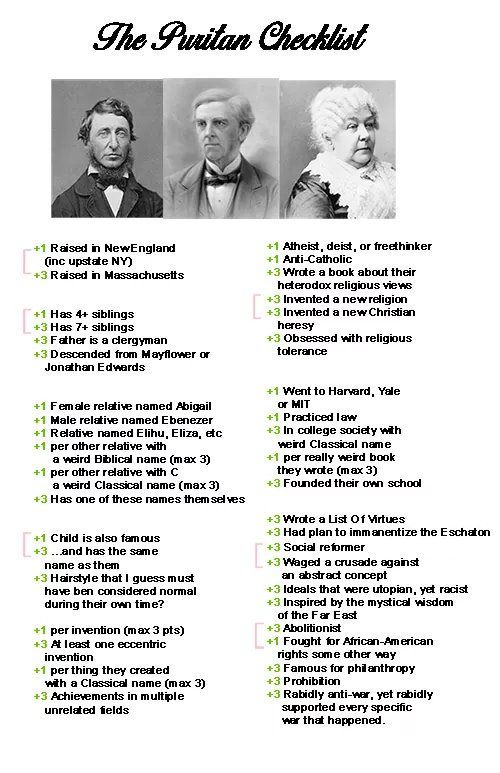 The obvious next step is to rank historical figures by Puritanism Points. Here are the top five famous Americans I can find, as per Wikipedia:
#5: SAMUEL MORSE
Samuel Morse was born to Pastor (+3) Jedediah (+1) Morse and his wife Elizabeth (+1) in Charlestown, Massachusetts (+3), the eldest of six children (+3). After attending Yale (+1), he pursued a career as an internationally famous painter. But when his wife Lucretia (+1) fell sick, he was unable to receive the news in time to go home to her before she died, inspiring him to change careers during mid-life (+3) and become an inventor. He spent his life perfecting the telegraph (+1), but also invented an automatic sculpture-making machine (+3). In later life, he switched careers again, becoming an anti-Catholic activist (+1); he ran for Mayor of New York on an anti-Catholic platform, and wrote anti-Catholic pamphlets like A Foreign Conspiracy Against The Liberties Of The United States (+1). He was also a well-known philanthropist (+3). His hairstyle looked like this (+3).
Total Puritanism = 28
#4: ELIZABETH CADY STANTON
Elizabeth (+3) Cady Stanton was born in Johnstown, New York (+1), one of eleven siblings (+3) including a brother named Eleazar (+1) and a sister named Tryphena (+1). She learned Greek as a child (+1) and her disillusionment at being barred from higher education because of her gender led her to start a crusade (+3) for women’s rights, along with other timely causes like abolitionism (+3) and temperance (+3). Although she was an agnostic herself (+1), she did write The Women’s Bible explaining why the Bible should have been more feminist (+3). She described herself as a pacifist, but during the Spanish-American War, stated that “Though I hate war per se, I am glad that it has come in this instance. I would like to see Spain swept from the face of the earth” (+3). Her hairstyle looked like this (+3)
Total Puritanism: 29
#3: LYSANDER SPOONER
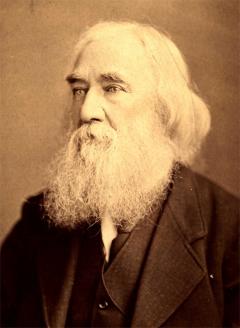
Lysander (+3) Spooner was born to Asa and Dolores Spooner in Athol, Massachusetts (+3), the second of nine children (+3) including his elder brother Leander (+1). He is best remembered as one of the founders of modern libertarianism, and as the developer of the Non-Aggression Principle (+3). But he also had a brief career as a lawyer (+1) – brief because he was practicing law illegally, without a license, because he thought licensing restrictions were illegal government tyranny. Later he founded a mail delivery company, again illegally, because he thought the Post Office was illegal government tyranny (I can’t believe he doesn’t gain any points for this; I need a better checklist), and invented (+1) a new monetary system (+3) because he thought that the existing monetary system was illegal government tyranny (see eg his pamphlets Gold and Silver as Standards of Value: The Flagrant Cheat in Regard to Them, +1). Among his other works were pamphlets on his idiosyncratic religious views like The Deist’s Immortality, And An Essay On Man’s Accountability For His Belief (+1, +1, +3), and a whole host of abolitionist books and pamphlets like A Plan For The Abolition Of Slavery (+1, +3). His hairstyle looked like this (+3).
Total Puritanism = 31
#2: ROGER BABSON
Roger Babson was born to 10th-generation Massachussetts natives (+3) Nathaniel (+1) and Ellen (+1) Babson. After attending MIT (+1), he pursued a career as a businessman, investor, and philanthropist (+3). His charitable efforts included the founding of two colleges (+3) – Webber University and Utopia College – and erecting a set of giant boulders with exhortations to be virtuous on them (+3). In later life, he switched careers (+3) to become a social reformer in the Open Church Movement (+3) and run for President as the candidate of the Prohibition Party (+3); he also invented the parking meter (+1). He is perhaps best remembered for founding an organization to destroy gravity (+3, but only because I can’t give + infinity without it being unfair to everyone else), and wrote various essays on the topic with titles like Gravity – Our Enemy Number One (+1). His hairstyle looked like this (+3).
Total Puritanism = 32
#1: BENJAMIN FRANKLIN
Born in Massachussetts (+3), son of Josiah (+1) and Abiah (+1) Franklin, one of seventeen siblings (+3, but deserves more) including a brother Ebenezer (+1). He was too poor to go to college, but handled his own education, creating a 7 x 13 Table of Virtues that he used to guide his daily studies and behavior (+3). He became an inventor, developing not only the Franklin stove (+1), the lightning rod (+1), and bifocals (+1), but also a system of propelling naval vessels by giant kites (+3). Later he switched careers (+3) to become a Founding Father of the United States (+3) and leader of the American Revolution (+3). He also wrote books like Poor Richard’s Almanack (+1), Advice To A Friend On Choosing A Mistress (+1), and The Means And Manner Of Obtaining Virtue (this one I am giving infinity points). Called himself a Deist (+1) and wrote a pamphlet (+3) explaining his idiosyncratic semi-Christian beliefs (+3); he also wrote a Bible fanfic in which God explained to Abraham the importance of Tolerance (+3). He was President of the Pennsylvania Abolitionist Society (+3), but also invented his own racial categorization system where only Anglo-Saxons were white, and German immigration should be banned as a threat to the whiteness of America (+3); he nevertheless founded philanthropic organizations to help German immigrants (+3). He was sympathetic to pacifism and said that “There never was a good war or a bad peace”, but supported the Revolutionary War (+3), which he thought necessary. His hairstyle looked like this (+3).
Total Puritanism = infinity
Other high scorers: Dorothea Dix (in addition to her psychiatric reforms, founded several schools and wrote a whole book of overwrought poetry praising flowers), Hiram Maxim (his son, also named Hiram Maxim, was also a famous inventor), Hiram Bingham (his son, also named Hiram Bingham, was also a famous traveler), Aaron Burr (grandson of Jonathan Edwards; his son was a chairman of the Moral Reform Society), Mary Baker Eddy (“My favorite studies were natural philosophy, logic, and moral science. From my brother Albert, I received lessons in the ancient tongues, Hebrew, Greek, and Latin”), Oliver Wendell Holmes Sr (close to my heart as a doctor/essayist/reformer) and Henry David Thoreau (everything about him). Let me know in the comments if you have more.
I find this kind of thing fun, and I do better than chance at guessing whether people are Puritan or not before I know the answer. But I don’t want to say this is Objectively Right. I’m sure the checklist combines traits that are inherently Puritan (like being from Massachusetts) with ones that are more common among various groups of early Americans (like inventing things, or having large families), which means this has elements of the wiggin fallacy.
The most egregious false positive I’ve found is Mark Twain. He was born in Missouri, one of seven children (+3) including an older brother Orion (+1 – he also had a brother named Pleasant Hannibal, which doesn’t get him Puritanism Points but ought to get him something). Along with being a writer who wrote various humorous books (+3), he was also (+3) an inventor, and received patents for suspenders, a history trivia game, and a self-pasting scrapbook (+3). He was an abolitionist (+3) and Deist (+1), and wrote various books about his idiosyncratic views on religion (+3). He described himself as a pacifist, but supported revolutionary violence from Robespierre to the Russian communists (+3). His hairstyle looked like this (+3).
This gets him 26, which is pretty concerning. But it’s worth noting that his great-great-grandfather was Ezekiel Clemens of Essex, Massachussetts, so he does have some Puritan blood in him, however diluted.
Other people who seem Puritan to me but AFAICT have no genealogical or cultural link: Cyrus McCormack, Homer Hickam, Emperor Norton. Also, surprisingly many Jews. There’s a weird symmetry there: both groups started out living in in small, very strict religious communities where they wore black and had lots of kids; then upon contact with Modernity they both went the opposite route and became famous for their education, irreligion, and preeminence in various forms of liberal tikkun olam. Must be one of those coincidences.
People complain that there is too much neo-Puritanism around these days, but they usually just mean people are moralistic reformers. I have the opposite worry: what happened to these people? When was the last time you saw somebody called Hiram invent five different crazy machines, found a new religion, and have twelve children who he named after Greek nymphs? Anyone who is serious about “Making America Great Again” should be deeply worried.
The modern American caricature is the Borderers: impulsive gun-crazy fundamentalist hillbillies with country-western accents. The opposite American stereotype – the virtue-obsessed nonconformist eccentric inventor philanthropist – has almost disappeared. These people still exist – Bill Gates does a good job embodying the ideal (or for a closer-to-home example, Ben Hoffman of Compass Rose) but they’re disconnected from any historical archetype. Lots of writers have argued that if you want people to avoid a race-based identity, you need a national identity you can assimilate people into. But right now the US national identity is one that’s repulsive to a lot of people. I’m disappointed that Puritanism is no longer a thing that people can aim at.