Somewhat Against Psychiatric Conditions As Domestication Failure
Scott Alexander examines a theory linking autism and schizophrenia to human self-domestication, initially dismissing it before reconsidering its merits in light of Williams Syndrome.
[Epistemic status: Not sure if I’m arguing against a straw man here and my conclusion is what the researchers meant all along.]
I.
Benitez-Burraco and Lattanzi theorize that autism and schizophrenia are anomalies in the human self-domestication process. I’ll try to explain, but for a much better explanation than I can give read Dr. Chris Badcock here.
Still here? Fine. BBL’s theory goes like this. When Russian scientist Dmitry Belyaev tried to domesticate foxes by breeding them for tame behavior, he found that changes in a lot of other traits went along for the ride. In short, the foxes started looking kind of dog-like: smaller heads, shorter snouts, spotted fur, floppy ears, more youthful characteristics. Some further experiments confirmed that similar changes happen in any species bred for tameness. Probably this has to do with changes in the neural crest, an embryonic structure which goes on to form a bunch of things including the adrenal medulla. Since the adrenal medulla produces some of the hormones involved in fear and stress, animals with hypoactive medullae will probably be tamer. But since the neural crest also goes on to form lots of other stuff, or produce hormones that influence the formation of lots of other stuff, these tamer animals will be different in other ways too.
BBL continues: we went from being wild apes to tame humans, a process that could be analogized to “self-domestication”. Some of the same changes the Russians saw in the transition from wild to domesticated foxes can be seen in the transition from early hominid skulls to modern human skulls.
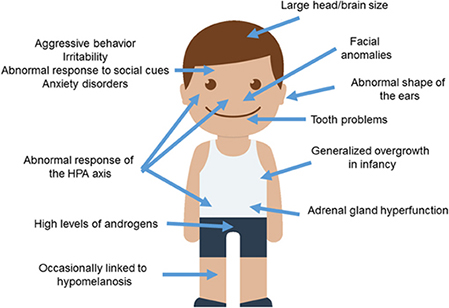
Autistic people, say BBL, are “undomesticated humans” – people in whom for some reason the neural crest changes that result in domesticated features have reversed. They find that some of the changes of domestication syndrome are the reverse of some of the symptoms of autism:
Smaller heads = autistic people have larger heads
More trusting and social = autistic people are less trusting and social
Spotted fur = the depigmenting disease “hypomelanosis of Ito” is sometimes associated with autistic symptoms
Floppy ears = studies find autistic people are more likely to have abnormally shaped ears (really!)
Change in adrenal response = autistic people have abnormal function in the HPA axis, the system including the adrenal gland
Or in the form of their cutesy picture:
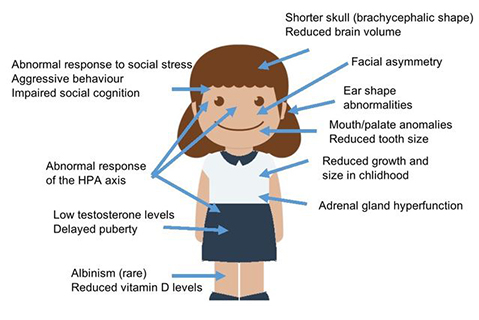
 Schizophrenics, say BBL, are “hyperdomesticated humans”. Once again, they match up the symptoms:
 I originally thought this theory was dumb. After looking into it more, I think it has some serious issues, but that there might be a core of truth.
II.
I’ll get to that core, but first, the argument against: all of this is coincidences, pareidolia, and finessing things to fit into a system where they don’t really belong.
Going down the list:
Smaller heads = autistic people have larger heads
Some studies find this is true. Others find that it isn’t. In any case, note a discrepancy between this claim and the schizophrenia version. BBL note smaller brains in schizophrenics (true) and shorter skull (true), but not smaller heads, which we would expect if autism were the “reverse” of schizophrenia. In fact, schizophrenics may have larger heads than healthy people. This sort of moving the goal-posts, where autistics are judged on their larger heads but schizophrenics on their smaller brains, is a red flag for fake pattern-matching.
More trusting and social = autistic people are less trusting and social
True! But schizophrenics are way less trusting and social! Paranoia – pathological inability to trust – is a classic symptom of schizophrenia; indeed, if you made people choose between schizophrenia and autism and asked which one was associated with lack of trust, I think most people would choose schizophrenia. This brings an important point into relief: the whole point of domestication is that the domesticated animal is supposed to be friendlier and less aggressive. But nobody would describe schizophrenics as friendlier and less aggressive.
Spotted fur = the depigmenting disease “hypomelanosis of Ito” is sometimes associated with autistic symptoms
True! But hypomelanosis of Ito is a really rare disease (1/10,000 births) that has nothing to do with most autism. Also, it causes eye problems, kidney cysts, weirdly-shaped chests, short stature, seizures, mental retardation, etc. To me this looks more like “a super-rare disease that can cause pretty much anything can sometimes also cause autistic symptoms”, which is not very interesting. Also, domestication causing “pigmentation changes” (usually spotted fur) versus autism being (very rarely) associated with a depigmenting disease and schizophrenia being (very rarely) associated with albinism is more goalpost-shifting.
Floppy ears = studies find autistic people are more likely to have abnormally shaped ears (really!)
I looked at this study – Manouilenko et al – and what it actually finds is that autistic people are more likely to have asymmetrical ears. In fact, nonsignificantly more likely to have asymmetrical ears; their significant finding is that autistic people have more “minor physical abnormalities”, and the asymmetrical ears were one of many pieces of evidence combined to get the significant finding. But asymmetrical features are common in lots of genetic/embryological diseases and seem like a general sign of high mutational load. It seems sketchy to combine autists’ asymmetrical ears and wild foxes’ pointy ears and say “Look, they both have ear abnormalities, this is the same thing!” Some other studies suggest that autistic people have low-set ears, which sounds more promising, but schizophrenic people also have low-set ears, so whatever. The other schizophrenia ear findings are exactly as unconvincing as the autistic ones.
Change in adrenal response = autistic people have abnormal function in the HPA axis, the system including the adrenal gland
Wikipedia’s page on the HPA axis has a section on its possible role in disease, which states that dysfunction of the axis is involved in various conditions “including anxiety disorder, bipolar disorder, insomnia, posttraumatic stress disorder, borderline personality disorder, ADHD, major depressive disorder, burnout, chronic fatigue syndrome, fibromyalgia, irritable bowel syndrome, and alcoholism”. In other words, in a list of the HPA axis’ twelve greatest hits, neither autism nor schizophrenia qualify for inclusion.
I’m not saying that there isn’t an HPA axis component to these diseases. I’m just saying HPA axis is a nonspecific finding. I’m agnostic whether the HPA axis causes everything or our HPA axis study methods are so bad that they invariably turn up false positives. The point is that we shouldn’t get too excited when we see the HPA axis involved in both domestication and autism. This is like saying “Cancer causes you to feel bad, and AIDS causes you to feel bad, therefore cancer causes AIDS.” No, it’s just that everything makes you feel bad.
When we look beyond the general claim of “abnormal function”, things get less clear. BBL say that domesticated animals have “reduced levels of stress hormones including adrenocorticoids, adrenocorticotropic hormone, cortisol, and corticosterone”. So their theory should predict that autistic people have increased stress hormones, and schizophrenics decreased, relative to typical people. Actually, it’s a mess; autistic people seem to have higher ACTH but lower cortisol; schizophrenia studies are conflicting but tend towards higher levels of both. Once again, they can support a general claim of “these conditions affect the same system”, but they can’t predict the direction of the effect. Also, every condition affects this system.
(if you’re wondering why we’re talking about cortisol levels in a theory about the adrenal medulla, well, so am I. Whatever.)
Finally, if by “undomesticated human” we mean something like an ape or Neanderthal, well, neither apes nor Neanderthals (as far as we know) display the symptoms of autism. They seem to be pretty social. They seem to be able to eat all kinds of stuff without trouble. They don’t seem bothered by sensory processing problems. For that matter, dogs and cattle and nth generation silver foxes, the most domesticated animals we’ve got, don’t seem very schizophrenic. I guess cows could just be hallucinating all the time and how would we know, but there doesn’t seem to be any evidence that they are.
So this is why I originally was not too big on this theory.
III.
But what about Williams Syndrome?
Benitez-Burraco and Lattanzi don’t mention Williams Syndrome (also called Williams-Beuren Syndrome) at all, which is crazy, because it sounds a thousand times more like a syndrome of hyperdomestication than either of the two conditions they examine (h/t Nicholas Wade and a random Reddit comment). Williams Syndrome is a rare condition (1/10,000 births) caused by the deletion of some genes on chromosome 7. There are three very interesting things about people with Williams Syndrome. Number one, they are really nice. Like if you meet someone with Williams Syndrome, you will think “This person clearly has a rare genetic disease that causes pathological levels of niceness as a symptom.” Number two, they are really trusting. An Atlantic article profiling the condition, What Happens When You Trust Too Much? describes special therapy for Williams Syndrome children where the therapist has to teach them, painfully and laboriously, how to distrust people. NPR calls it “essentially biologically impossible for kids [with Williams Syndrome] to distrust [people].” Number three, they talk all the time; the informal name for the condition is “cocktail personality syndrome”.
People with Williams Syndromes actually legitimately have short noses (compare to the short snout on domesticated foxes), smaller teeth (compare to smaller teeth in dogs vs. wolves), smaller brains, and “unusually shaped ears” (I can’t find anything more specific; I guess it’s too much to hope for that researchers actually describe the ears as “floppy”).
Also, somebody checked which gene was most different in dogs versus wolves, and they found it was WBSCR17. The WBS in the name stands for “Williams-Beuren Syndrome” because it’s been linked to the disorder. So there’s that.
So as far as I can tell there’s an amazingly good case for Williams Syndrome being linked to domestication. Williams Syndrome tends to cause severe mental retardation and death at an early age, but that’s probably because there are twenty-five totally different genes missing. Maybe a version that only deleted WBSCR17 would keep the behavioral and physiologic changes but not much else.
A lot of people suggest Williams’ Syndrome is “the opposite of autism”. I can only find three pieces of evidence for this. Number one, the obvious contrast with the love of social situations and high verbal skills. Number two, Williams Syndrome kids seem to be really good at face recognition, whereas autistic people are often worse at this. Number three, Williams’ Syndrome kids seem to be unusually bad at the puzzles and interlocking-mechanical-part type problems on which autistic people excel.
On the other hand, there are some reasons to think these conditions are not exact opposites. For one thing, autism is caused by a hideously complex interplay of thousands of genes and various environmental factors, but Williams Syndrome is a drop-dead simple “oops, we forgot part of this chromosome over here”. Williams Syndrome kids seem to have some of the same sensory sensitivities as autistic kids. And both groups usually suffer from mental retardation.
I think that Williams Syndrome establishes the possibility of a physiological social/trust system linked to domestication, the neural crest, and various other parts of embroygenesis. Once you admit the existence of such a system, it seems like autism probably involves some kind of damage to it – probably along with damage to a lot of other systems too. Schizophrenia is more of a stretch, but the overwhelming presence of distrust as a symptom makes the existence of a physiological social/trust system at least kind of interesting and relevant.
So maybe instead of saying that “autistic people are undomesticated humans” and “schizophrenics are hyperdomesticated humans”, we should say something like “there is a very subtle and hard-to-notice biological system that determines level of trust and sociability and which seems weirdly linked to ear and nose shape; autism, schizophrenia, and Williams Syndrome all affect that system in different ways.” Note that this doesn’t mean they’re “the same disease” or “opposite diseases”; the connection might be no deeper than the “connection” where heart attacks, atrial fibrillation, and getting stabbed in the chest all affect the heart. But they all hit the same system.
My take-home message from looking into all of this is that I was very silly for trying to learn about autism and schizophrenia without thinking about embryology. These are highly genetically-loaded diseases that present early in life and seem linked to teratogens and prenatal infections; of course they’re embryological! I had to take some embryology classes in medical school, and like everyone else I tuned them out because they seemed totally irrelevant to real clinical practice and mostly involved memorizing pointless trivia like “on day thirty-six and a half, the developing shmendroblast has transformed into a blexomere”. But if you want to know what causes secret connections between ear shape and level of social trust, embryology seems like the way to go. Autism and schizophrenia are hard to study because they seem to affect everything, yet nothing specifically enough to localize the condition. Maybe going back and thinking more embryologically could help pinpoint the particular systems involved.
