SSC Survey Data On Models Of Political Conflict
Scott Alexander analyzes SSC survey data to explore the conflict vs. mistake theory distinction in political disagreements, finding that Marxists and the alt-right tend more towards conflict theory than other groups.
There were a lot of good comments on yesterday’s conflict vs. mistake post. Some were very appropriate challenges: for example, doesn’t public choice theory itself assume conflict between special interests? And didn’t Marxism start off with a dry incentive-based explanation for why capitalists have to do what they do and how the incentive landscape needs to change? I want to explore these questions further – but first, some data from the SSC survey showing that the distinction does capture something real and important.
No questions really matched the conflict/mistake theory distinction, but one of the closest was POLITICAL DISAGREEMENT I: “Which of these plays a bigger role in explaining why some people are wrong about politics – intellectual failure, or moral failure?” This isn’t quite the way I would frame it now – but it’ll do for our purposes.
About 80% of blog readers selected intellectual failure, compared to only 60% of Mechanical Turk users. I have some reservations about the accuracy of the Turk survey, but this matches my predictions. I would expect SSC readers to be selected for mistake theory more than for any particular political position.
Percent Of People, By Political Affilitation, Who Think Intellectual Failure Explains Bad Politics
Alt-right: 65%
Conservative: 72%
Liberal: 81%
Libertarian: 87%
Marxist: 62%
Neoreactionary: 77%
Social democratic: 74%
Marxists were most likely to believe their opponents were guilty of moral failure, and libertarians most likely to believe intellectual failure, with everyone else somewhere in between. There was much less distinction between right and left compared to internal division between different subgroups of rightists and leftists.
There were a few other questions that I thought might tap into the same underlying attitude:
POLITICAL DISAGREEMENT II
Which of these best describes your opinion of people with different political beliefs than you, but still within the normal range? EG Democrats if you are a Republican, Tories if you are Labour, etc.
0. They might be right about some things, I can’t be sure of my position.
1. They seem pretty wrong, but they make understandable mistakes and are probably mostly decent people
2. They seem pretty wrong, and their mistakes seem incomprehensible, but some of them might be okay, I guess
3. Inexcusably stupid or downright evil
POLITICAL DISAGREEMENT III
Which of these best describes your opinion of extremists with different political beliefs than you, outside the normal range? E.g. fascists, Stalinists, etc.
0. They might be right about some things, I can’t be sure of my position.
1. They seem pretty wrong, but they make understandable mistakes and are probably mostly decent people
2. They seem pretty wrong, and their mistakes seem incomprehensible, but some of them might be okay, I guess
3. Inexcusably stupid or downright evil
THE SYSTEM
The current economic and political system…
0. Is a good start that needs to be fine-tuned
1. Is fundamentally bad and needs to be destroyed
Aside from these sorts of questions, there were also two categorization questions that I thought might get at the same underlying attitude. These asked respondents to choose between two categorization systems for three ambiguous situations. One system categorized them based on what principle was applied, the other based on which side won. These were:
NAZI CATEGORY
Consider three situations.
A) Nazis beat up some minorities.
B) Nazis hold a peaceful demonstration, nobody stops them, it goes well, and they get a lot of publicity.
C) Some concerned citizens beat up the Nazis.
Of these three possibilities, which two seem most similar?
0. A and C, because people resort to violence.
1. A and B, because the Nazis win.
MARRIAGE CATEGORY
Consider three situations.
A) In a country where homosexuality is illegal, a government clerk participates in civil disobedience and marries gay people anyway.
B) In a country where homosexuality is legal, a government clerk follows the law and marries gay people.
C) In a country where homosexuality is legal, a government clerk participates in civil disobedience and refuses to marry gay people.
Of these three possibilities, which two seem most similar?
0. A and C, because people are participating in civil disobedience.
1. A and B, because gay people get to marry.
I assigned numbers to all of these such that lower numbers represented mistake-theory answers and higher ones represented conflict-theory answers. Correlations were generally positive and significant, but unremarkable:
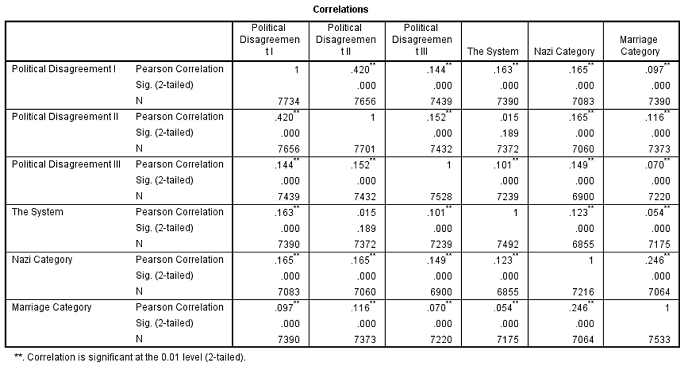
(for a sense of how high to expect correlations to be – the one between feminism and support for gay marriage was 0.45, between life satisfaction and social skills was 0.3, and between reported IQ and financial success, 0.15)
Perhaps this is bad and wrong of me, but I combined all of them into one measure of average tendency to give the conflict-theory rather than mistake-theory answer to these questions, ranging from 0 (most mistake theorist) to 1 (most conflict theorist). The ranking by political affiliation is pretty much the same as before:
Combined Conflict Theory Measure By Political Affiliation, Ad Hoc Measurement
Alt-right: 0.43
Conservative: 0.30
Liberal: 0.26
Libertarian: 0.27
Marxist: 0.54
Neoreactionary: 0.34
Social democratic: 0.35
A different method of combining them without the two categorization questions (which I worried might have been contaminated by object-level political ideology) was broadly similar.
I also tried a factor analysis (which I am very bad at, don’t trust me here) and got two factors, one of which looked like conflict theoriness, and the other of which looked like a categorization factor determining how people answered the last two category-related questions. The ranking by political affiliation for the conflict theoriness factor was:
Combined Conflict Theory Measure By Political Affiliation, Factor Analysis Measurement
Alt-right: 0.45
Conservative: 0.05
Liberal: -0.12
Libertarian: -0.07
Marxist: 0.30
Neoreactionary: 0.04
Social democratic: 0.15
Although Marxists and alt-righters have switched places, overall this seems like the same general picture.
Some other demographic variables that did or didn’t affect level of conflict theorist responses (similar whether I used the hacked-together average or the factor analysis results, all significant at such low p-values that I really don’t want to get into more fights in the comments over significance thresholds, replicate it yourself if you don’t believe me):
1. Autism did not affect any of these questions at all, totally contrary to my pre-registered predictions.
2. People in worse financial situations were very slightly more conflict theorist , r = 0.06.
3. Respondents who thought they were more moral people were more conflict theorist, r = 0.12.
4. More neurotic and extraverted people were slightly more conflict theorist (r = 0.10); no other Big Five traits really mattered.
5. No race or gender seemed much more conflict theorist than any other, but sample sizes were low.
Overall this broadly confirmed my original suspicion that Marxists and the alt-right differ from liberals on some dimension of conflict vs. mistake theory, but it didn’t shed a lot of light into the exact structure of the difference or what other factors might go into it.
If you want to double-check these results or analyze them further, you can download the data as .xlsx or .csv. Some people have complained of weird problems in the csv format and I recommend the xlsx if at all possible. I have removed the data of a few people who did not want their answers to be public, so you may not get exactly the same numbers I did, but they should be pretty close.