The Trend Evaluation Of All Values
The author analyzes results of a prediction contest about American political opinions, revealing participants' inaccuracies and biases in estimating current views and changes over time.
In case you forgot: yesterday, 170 people sent in their predictions on what percent of Americans agreed with vaguely political statements like “I am very patriotic”. Then they predicted how answers to these questions have changed in the past 22 years.
Without further ado, here are the answers (click to expand).
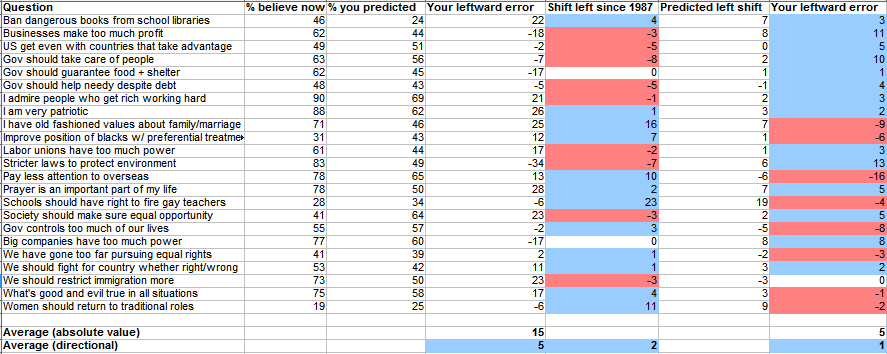 People were terrible at predicting what percent of Americans agreed with something, with an average error on each issue of 15%. Especially egregious errors include “We need stricter laws to protect the environment” – you expected 49% of Americans to agree, but in fact 83% did. You expected 50% of Americans to agree that “Prayer is an important part of my daily life”, but in fact 78% did.
In general, you expected modern Americans to be a bit more leftist than they actually are – five percentage points more leftist, to be exact.
You did a little better predicting how opinions had shifted over the past generation, with an average error of 5% per issue. By far your worst question was “Pay less attention to problems overseas and more at home”. You thought 6% more people would agree; in fact, 10% fewer do. Your other big mistake was expecting 8% more people to think businesses were too profitable; actually, 3% fewer people believe this.
Overall, you overestimated the degree society has shifted to the left, but only by a tiny tiny bit – one percentage point per issue. Depending on whether I classify “We should pay less attention to overseas” as a leftist or rightist position, I can either make that overestimation vanish, or double it to a still-measly two percentage points.
(if I wanted to be sensationalist, I could say you overestimated society’s leftward shift by 50% – which is true, but only because the real shift was two percentage points)
I ran these numbers again counting only the Reactionary answers, and then again counting only the Progressive answers. Contrary to my hypothesis, this made practically no difference; I think Reactionaries were one percent worse than Progressives on one of the two measures and one percent better on the other. It was all well below any conceivable margin of error.
Alejandro was most accurate in his estimates of what positions Americans actually hold. Athrelon was most accurate in his estimates of how positions have changed over time. He very slightly edged out second-place winner JRM, even though the latter had already read the answers. On IRC Athrelon attributed his success to being a medical student and therefore getting to see a broad cross-section of society whom he might otherwise avoid. As a doctor myself, I can endorse that sentiment. In any case, congratulations to both winners.
I didn’t have time to do much with people’s ages or anything like that, but you’re welcome to crunch the numbers yourself. You can download the raw data (minus names) from this link. Someone double check to see if I totally messed up my numbers.
Polling data for this exercise was taken from Static America: Myths About Political Change In The US
