The Whole City Is Center
Scott Alexander examines the concept of 'laziness' and value differences, exploring how semantic debates can obscure practical communication and understanding.
Related to yesterday’s post on people being too quick to assume value differences: some of the simplest fake value differences are where people make a big deal about routing around a certain word. And some of the most complicated real value differences are where some people follow a strategy explicitly and other people follow heuristics that approximate that strategy.
There’s a popular mental health mantra that “there’s no such thing as laziness” (here are ten different articles with approximately that title: 1, 2, 3, 4, 5, 6, 7, 8, 9, 10). They all make the same basically good point. We shame people who don’t work very hard as “lazy”, and think they should have lower status than the rest of us. But actually, these people don’t just randomly choose not to work. Some of them have psychological issues, like anxiety and trauma that are constantly distracting them from their work, or a fear of success, or self-defeating beliefs about how nothing they do matters anyway. Others have biological issues – maybe hypothyroidism, or vitamin deficiencies, or ADHD, or other things we don’t understand that lower their energy and motivation. Still others just don’t want to do the specific thing we are asking them to do right now and can’t force themselves to work uphill against that gradient. When we call people “lazy”, we’re ignorantly dismissing all these possibilities in favor of a moralistic judgment.
A dialogue:
Sophisticus: I don’t believe in laziness.
Simplicio: What about my cousin Larry? He keeps promising to do important errands for his friends and family, and then he never does them. Instead he just plays video games all the time. This has happened consistently over the past few years, every time he’s promised to do something. One time my aunt asked him to go to the DMV to get some paperwork filled out, he promised he would do it, and then he kept putting it off for a month until it was past the deadline and she almost lost her car. He didn’t forget about it or anything, he just couldn’t bring himself to go out and do it. And he’s been fired from his last three jobs for not showing up, and…
Sophisticus: Yes, yes, I’m sure there are people like this. But he probably has some self-defeating beliefs, or vitamin deficiencies, or mental health issues.
Simplicio: Okay. Well, my mother is going to be away for the next week, and she needs someone to dog-sit for her. Her dog is old and sick and requires a lot of care each day. She’s terrified that if he doesn’t get his food and medication and daily walk on time, something terrible will happen to him. She’s willing to pay a lot of money. Do you think I should recommend she ask my cousin Larry?
Sophisticus: No, of course not.
Simplicio: Why not?
Sophisticus: He probably won’t do it. He’ll just play video games instead.
Simplicio: Why do you think so?
Sophisticus: Because he has a long history of playing video games instead of doing important tasks.
Simplicio: If only there were a word for the sort of person who does that!
Sophisticus: Oh, I see. Now you’re making fun of me. But I’m not saying everyone is equally reliable. I’m saying that instead of denouncing someone as “lazy”, we should look for the cause and try to help them.
Simplicio: Hey, we did try to help him. Larry’s family has taken him to the doctor loads of times. They didn’t anything on the lab tests, but the psychiatrist thought he might be ADHD and gave him some Adderall. I would say now he pulls through on like 20% of the things we ask him to do instead of zero percent. We also tried to get him to go to therapy, but the therapist deferred because ADHD has a very low therapy response rate. His parents tried to change the way they asked him to do things to make it easier for him, or to let him choose a different set of tasks that were more to his liking, but that only worked a little, if at all. Probably there’s some cause we don’t understand, but it’s beyond the reach of medical science, incentive design, or the understanding that exists between loving family members to identify.
Sophisticus: See! The Adderall helped! And letting him choose his own tasks helped a little too!
Simplicio: I agree it helped a little. So should I recommend him to my mother as a dog-sitter?
Sophisticus: No, of course not.
Simplicio: Then I still don’t see what the difference between us is. I agree it was worth having him go to the doctor and the therapist to rule out any obvious biological or psychological issues, and to test different ways of interacting with him in case our interaction style was making things worse. You agree that since this still hasn’t made him reliably fulfill his responsibilities and we don’t have any better ideas, he’s a bad choice for a dog-sitter. Why can’t I communicate the state of affairs we both agree on to my mother using the word “lazy”?
I imagine Sophisticus believing he has a fundamental value difference with people who use the term “lazy”. They think that some people are just bad and should be condemned, whereas he wisely believes that everything has a cause and people who have issues with motivation should be helped. But it’s not clear to me that this is a real difference. I can imagine someone signaling hard-headedness and strictness by insisting that they were against laziness, and someone else signaling compassion by insisting that they don’t believe in laziness, but it’s pretty hazy exactly where their maps of the world diverge.
But back to the dialogue:
Sophisticus: Because “lazy” is laden with the idea that lazy people should be punished. You should yell at them to get off their ass and do some work.
Simplicio: I mean, I’m not sure that’s wrong? When my aunt and uncle tried to take Larry to the psychiatrist, he didn’t want to go. My uncle started screaming at him that if he didn’t make the appointment he would never amount to anything, and he would be a loser his entire life, and they would disown him – and I guess it freaked Larry out enough that he made the appointment. And it seems like if that kind of thing makes people do important stuff for their own good – whether it’s make appointments or hold down a job – then it might be reasonable, at least from people whom the lazy person has entered into some kind of relationship with.
Sophisticus: I think that kind of strategy might occasionally work in the short-term, but that in the long-term it makes things much worse.
Simplicio: I agree that’s possible, but it seems like we have a factual disagreement here. And I think that factual disagreement is best expressed by the question “Does laziness respond to social shaming or not?”, not a claim that laziness doesn’t exist. It certainly doesn’t seem like we have a value difference unrelated to any purely-factual beliefs.
Maybe both participants are wrong here. My impression is that some forms of laziness respond to incentives and others don’t. I know many people who will start work on a project they’ve been putting off if they know it’s due the next day and worth half their grade. I also know other people who won’t. But continuing:
Sophisticus: I can imagine some cases in which it’s useful to use external rewards and punishments to encourage people with low motivation to do something. But the word “lazy” doesn’t just mean “can be motivated by external reinforcement”. It’s an attempt to judge somebody, to say they’re lesser, to lower their social status.
Simplicio: You just said that my mother should avoid hiring Larry for a lucrative job. Surely that’s a judgment, and surely keeping him unemployed forever lowers his social status.
Sophisticus: I’m judging him as bad at one thing, not as a Universally Bad Person.
Simplicio: Do you think Larry would be a good pilot?
Sophisticus: Well, no…
Simplicio: Nuclear engineer?
Sophisticus: No, but…
Simplicio: Lieutenant colonel in the army?
Sophisticus: I agree there are many things Larry would not be good at.
Simplicio: And surely the person who thinks he is lazy agrees there are some things he might be good at – for example, he might be handsome, or intelligent. Indeed, the “lazy but bright” student is a stock cultural figure. The main judgment that “lazy” represents is that he’s not a very hard worker – a judgment you seem to share.
Sophisticus: I think that for them it’s a moral judgment, and for me it isn’t.
Simplicio: A moral judgment? I don’t think of a lazy person as more likely to rob or murder. Do you think others do?
Sophisticus: No, I don’t think so. It’s not a judgment that they’re bad at a specific field we both agree is moral. It’s a judgment that they should be considered less moral just because they’re lazy.
Simplicio: But how does that cash out? Both you and they want them to not get certain jobs. Both you and they believe some level of reinforcement might make them more motivated, though we can debate the factual specifics. Is there anything that a moralist would do that you wouldn’t?
Sophisticus: I’m not sure the belief would cash itself out in some specific way, but they would have it.
Simplicio: If you both give him the same jobs and treat him the same, what’s the difference? Just give him the Heartstone and call it a day!
Sophisticus: You’re mocking me again.
Simplicio: I think we’re treating the word “laziness” differently. I’m thinking of “lazy” as a way to communicate a true fact about the world. You agree that the true fact should be communicated by some word, but you’re interpreting “lazy” to mean some sort of awful concept like “a person who avoids responsibilities in a way not caused by anything whatsoever except being bad, and so we should hurt them and make them suffer”. Are you sure this isn’t kind of dumb? Given that we need a word for the first thing, and everyone currently uses “lazy” for it, and we don’t need a word for the second thing because it’s awful, and most people would deny that “lazy” means that, why don’t we just use “lazy” for the very useful purpose it’s served thus far?
Sophisticus: I think…
Simplicio: And it’s the same with “judgment”. I’m using it to mean a reasonable thing that everyone does and has to do. You’re demanding we reserve it for some kind of ultimate judgment about everything that doesn’t really make sense and probably should never happen.
Sophisticus: I think you’re wrong about common usage. I think a lot of people – maybe not you, but a lot of people – really do use “lazy” to mean the second thing. And that even for good people like yourself, “lazy” has a bit of a connotation of the second thing which you can’t avoid letting slip into your mind.
Simplicio: If you’re right, I worry you’re going up against the euphemism treadmill. If we invent another word to communicate the true fact, like “work-rarely-doer”, then anyone who believes that people who play video games instead of working deserve to suffer will quickly conclude that work-rarely-doers deserve to suffer.
Sophisticus: Then let’s not invent something like “work-rarely-doer”. Let’s just say things like “You shouldn’t have Larry as a dog-sitter, because due to some social or psychological issue he usually plays video games instead of doing difficult tasks.”
Simplicio: I think people are naturally going to try to compress that concept. You can try to stop them, but I think you’ll fail. And I think insofar as you can communicate the concept at all, people are going to think less of Larry because of it. It’s possible you can slightly decrease the degree to which people think less of Larry, but only by slightly decreasing their ability to communicate useful information.
Sophisticus: Well, that’s a risk I’m willing to take.
Simplicio: If there were such a thing as laziness, but it was rare, then it would make sense to argue “most people aren’t lazy”, since lazy would be pointing at a particular quality that most people don’t have. But if you say there’s no such thing as laziness, then it sounds like maybe you’re kind of weird to insist on defining “laziness” to refer a quality that nobody has, yet refuse to use any word to refer to the quality that many people do have. It would be like wanting our language to have a word for “unicorn” but not for “horse”.
I think Simplicio is working off one of these kinds of models (from How An Algorithm Feels From The Inside, but see also here):
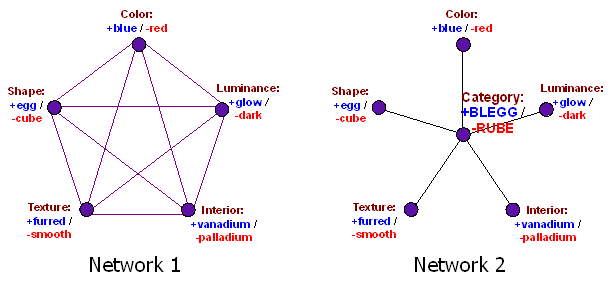 …where “lazy” is the node at the center of the second one. He’s saying that if he and Sophisticus both agree on all of the outside nodes, why exactly are they holding a debate on the status of the center, when the center is just a way to help us predict the values of the others? He feels like Sophisticus is insisting on designing the structure such that the central node has some deep metaphysical meaning that he can’t explain but which is very bad, whereas he just wants it to be a perfectly ordinary predictor. Moving on:
Sophisticus: What about this? I think that people with low motivation sometimes can be helped by reinforcement – including negative reinforcement. But other people think they should be punished. There’s a big difference between simple negative reinforcement and punishment. If you’re just using negative reinforcement, you’re trying to use as little as possible to get the result you want. But when you’re judgmental and you divide people into good and bad, you usually add that the bad people deserve to suffer, regardless of the effect.
Simplicio: This is a strange distinction. Suppose I beat up my wife and threaten to do it again. Shouldn’t I go to jail?
Sophisticus: I think we shouldn’t be excessive about it, and I don’t support mass incarceration, but I don’t want you to get off scot-free, because it seems like that would encourage future domestic violence.
Simplicio: If only there were a word for the sort of thing where we made sure people didn’t get off scot-free in a way that encouraged future crime!
Sophisticus: No no no, you still don’t get it. There’s a difference between a principled consequentialist view of discouraging actions, and wanting people to suffer.
Simplicio: Look, I happen to know one of those Hogwarts wizards everyone keeps writing books about, and he’s offered to let me take a magic Unbreakable Vow that I won’t assault anyone ever again. Now that there’s no point in discouraging me, I don’t need to deal with this jail thing, right?
Sophisticus: It’s not just about discouraging you personally. It’s about making an example of you to discourage everyone else. Also, there’s a Parfit’s Hitch-Hiker type element – the threat of punishment now could have presented you from committing the crime in the past, and the threat couldn’t be credible unless we agreed to actually punish you.
Simplicio: Then I question whether the “principled consequentialist view” ever differs from the “believing in punishment and wanting bad people to suffer” view in terms of what actions it recommends.
Sophisticus: The people who believe in punishment often say things like “I hope that person rots in jail” or “Let’s make the conditions in jail extra bad”. Whereas I want domestic violence discouraged by nice Scandinavian-style prisons and – when possible – community service.
Simplicio: If you learned that having nice jails actually…
Sophisticus: Oh, I know what you’re going to say. You’re going to say this is just a factual difference between me and the pro-punishment faction. They believe, as a matter of fact, that bad conditions discourage crime extra effectively, since some criminals who would be willing to take the risk of a nice Scandinavian-style prison would be scared off by a dark overheated cage. And I agree this is a possible axis on which people can differ, and that if you proved to me that this was true I could be persuaded to reconsider my views. But I have talked to people who have literally said the words “I don’t care how much it discourages crime or not, I want criminals to suffer.”
Simplicio: Okay. I agree that’s good evidence for your view
Sophisticus: You…do? Really? I won one of these? REALLY?!
Simplicio: I guess.
Sophisticus: So you admit sometimes there are fundamental value differences?
Simplicio: Sometimes, yeah, I guess. But I want to be really careful with this. Humans are adaptation-executors, not fitness-maximizers. Only one person in a thousand could give the principled consequentialist defense of criminal justice that you’re giving here. The game theory necessary to understand the defense is only a few decades or centuries old, depending on how exactly you define it – but even chimpanzees need to discourage defectors. Since evolution couldn’t cram the whole principled consequentialist defense into a chimpanzee brain, it just gave us the urge to punish.
Sophisticus: I agree that’s a plausible scientific account of the genesis of the urge to punish. But that doesn’t mean that I have to agree with it. After all, evolution gave us an urge to eat sugary food, but I can ignore that urge when I don’t think it’s the healthy thing for me to do at the moment.
Simplicio: Thanks to modern medical science, you’re smarter than your urge telling you to eat sugar. I’m not sure how many people are smarter than their urges to punish. If you miss the Parfit’s Hitch-Hiker angle, you punish the wrong people. If you miss the angle where you have to adjust for probability of catching the crime, you punish people the wrong amount. But the person just following their evolutionary urges would get both of those right – more or less. Imagine that, using physics, you are able to approximate the ball-trajectory-predicting power of the world’s best golfer – but the golfer still does a little bit better. Would you pooh-pooh him for merely following his base evolutionary urges?
Sophisticus: If it harmed people, yes! You’re trying to reduce this to factual differences again, but you already admitted that’s not going to work. We’re not debating the effectiveness of different punishment levels here. For all I know, evolutionary urges are more effective at the goal of keeping me alive – which is notably different from the goal of being just. But that’s not the point. The point is that I think there are people who, even if God handed them a stone tablet saying “YOU ONLY NEED TO PUNISH THIS PERSON X AMOUNT TO EFFECTIVELY DISCOURAGE FUTURE ACTIONS”, would still punish them X+1 amount just to make them suffer.
Simplicio: Okay, I didn’t want to re-open the factual differences thing. I agree they are not aiming at the same thing you are. My point is just that the only difference between you and the pro-punishment faction is that you are following an explicitly-calculated version of the principled consequentialist defense of punishment, and they are following a heuristic approximating the principled consequentialist defense of punishment, and their heuristic might actually be more accurate than your explicit calculation.
Sophisticus: So what? Again, they outright say they would deviate from the principled consequentialist position.
Simplicio: Yes. Adaptation-execution rather than fitness-maximization again. Evolution can’t quite cram the entire principled consequentialist position into our heads, so it just gives us an urge, and sometimes the urge does weird stuff that the principles wouldn’t.
Sophisticus: Again, so what? I agree there’s a biological/psychological cause for other people being wrong about punishment – just as there is a biological/psychological cause for other people being bad at fulfilling responsibilities – “lazy”, you would say – but that doesn’t mean I can’t continue to disagree with them.
Simplicio: My point is that, if you squint, this is sort of a factual disagreement. It’s not a factual disagreement between you and them. It’s a factual disagreement between you and the evolutionary/biochemical process that created their sense of justice. The evolution/biochemistry is trying to instantiate a view of punishment that does the best job of protecting them and their loved ones without expending unnecessary resources. But it’s getting it wrong – probably erring on the side of caution, as you would expect these sorts of processes to do. I agree you have a value disagreement with them, but this is less them having some value totally foreign to you, and more them attempting to implement your values but not doing a very good job.
Sophisticus: You’re screwing up levels again! If what you’re saying is true, then I have a mere “factual disagreement” with the evolutionary/biological process that produced their values, insofar as you can have a factual disagreement with a blind impersonal force. But I still don’t agree with the people who are the end result of the process! They should be abandoning their evolutionary/biochemical process in favor of what’s actually right.
Simplicio: Nobody has a coherent theory of when to abandon their evolutionary/biochemical processes, though. I have the urge to care about my children more than I care about some random people somewhere else. That’s clearly an evolutionary/biochemical process. I cannot justify it based on pure reason. But I choose, in reflective equilibrium, to keep that urge. What moral law can you tell me that allows me to ditch the irrational consequences of my excessive-punishment-urge, but keep the irrational consequences of my love-children-urge?
Sophisticus: Hmmm…what about “the excessive-punishment urge is wrong, even by the standards of the evolutionary/biochemical process that produced it, but the love children urge is right?”
Simplicio: I’ve been told that we love kittens based on a misfiring of our evolutionary urge to love children. Should I abandon that one? I’ve been told I love beauty and nature and high mountains and deep forests based on evolutionary heuristics about what kind of places will have a good food supply – now that I can order take-out, should I ditch that too? Huge chunks of our hopes and dreams are the godshatter of misfired-evolutionary processes. Tell me what principled decision lets us judge among them, rejecting one as evil but the other as good?
Sophisticus: I cannot. I make no claim that I can. I only say that, by my arbitrary choice of methods of reaching reflective equilibrium, natural beauty is good but punishment is bad. And that if someone else’s arbitrary choice of methods of reaching reflective equilibrium pronounces the opposite, they have a fundamental value difference from me, and I won’t shirk from saying so.
Simplicio: Then all I am saying is to be understanding. They’re not people who are coming from some sort of alien ideology of suffering being good for its own sake. They’re people who are taking the same godshatter you are, and applying a different process of arbitrary reflective equilibrium to it, in a world where none of us really understand or control the process of reflective equlibrium we go through. That gives me a different and more understanding perspective on them. It may not make me agree with them, but it makes me more willing to think of them as an odd but sympathetic potential-negotiating-partner rather than some sort of hostile villain.
I need to admit here that I personally am neither as saintly as Sophisticus nor as reasonable as Simplicio. A while ago, I learned that my great-grandfather was murdered, and my great-grandmother – normally a deeply kind and compassionate woman – demanded the death penalty rather than life imprisonment for his murderers. When the jury went with life imprisonment anyway, she yelled at them that she hoped someone killed their loved ones so they knew how it felt. This story had a pretty big impact on me and made me try to generate examples of things that could happen such that I would really want the perpetrators to suffer, even more than consequentialism demanded. I may have turned some very nasty and imaginative parts of my brain, the ones that wrote the Broadcast interlude in Unsong, to imagining crimes perfectly calculated to enrage me. And in the end I did it. I broke my brain to the point where I can very much imagine certain things that would happen and make me want the perpetrator to suffer – not infinitely, but not zero either. I am not going to claim that this is just some misfiring of evolutionary urges which I obviously denounce. I think I stick to them the same way I stick to liking kittens. I’m not sure I would promote them as policy – in the same kind of second-level way where I can think of some people who would make good dictators but still don’t actually want them to set up a dictatorship – but I don’t renounce them entirely either. I guess reflective equilibrium is easier to disturb than I thought.
Sophisticus: I’ve been thinking, Simplicio – doesn’t your philosophy hoist itself on its own petard?
Simplicio: What do you mean?
Sophisticus: You insist that much of what people consider value differences is actually a difference in what words they are willing to use while describing basically the same values. And that if a term seems unsavory to us, we should use it to describe the closest useful concept, rather than condemning it for applying to a bad concept we shouldn’t have. If we hear “laziness”, we should assume it stands for the way your cousin Larry is, rather than some package of moral and metaphysical assumptions. If we hear “judgment”, we should assume it stands for assessing someone’s ability as a dog-walker, rather than some package of moral evaluations. If we hear “punishment”, we should assume it stands for some kind of consequentialist negative reinforcement, rather than the belief that some people deserve to suffer.
Simplicio: I’m not sure that’s exactly how I would describe my position, but go on.
Sophisticus: What about the term “value difference” itself? It seems like you’re being a hypocrite here. After all, there are plenty of things that look like value differences to us – I disagree with people on moral questions about a thousand times a day. But you insist that none of those are real value differences, and instead we must reserve the concept of “value difference” for some Platonic perfect value difference that doesn’t exist in real life.
Simplicio: I agree these rarely exist in practice. I think the difference is that they can exist in theory. Imagine a paperclip maximizer robot vs. a paperclip minimizer robot. These have a true value difference. They’re not doing the same thing and applying different words to it. If I were a paperclip minimizer, I could never get a paperclip maximizer to say it wanted to do a specific thing, and then sarcastically say “If only there was a word for that thing!”, and then it would have to admit that word was “paperclip minimization”.
Sophisticus: Okay. But there are no paperclip maximizers or minimizers in real life. So I still think you’re denying real-life use of a term in favor of some Platonic version that doesn’t exist.
Simplicio: I just don’t like the connotations of “value difference”. I think they suggest the non-existent thing.
Sophisticus: That’s exactly what I’ve been trying to tell you is true of “laziness” or “judgment”, and you never let me get away with it!
Simplicio: I just realized I have to, uh, wash my toaster. I’ll be back in a minute.
Ten years go by. Sophisticus is never able to find Simplicio again. He seems to have disappeared. Sophisticus knows it’s bizarre to think somebody would skip town and change identities just to avoid a philosophical debate, but he cannot think of any other explanation. One day, Sophisticus goes on a vacation to a city very far away, and becomes hopelessly lost. He notices a stranger in glasses and a mustache, who looks familiar in a way he cannot quite place, and asks him for directions.
Sophisticus: Excuse me, do you know the way to city center?
Stranger: Don’t worry, good sir! You’re in city center right now!
Sophisticus: But…this whole area looks suburban. And the edge of the city is right there – past that street there’s only rolling fields as far as the eye can see. How can this be city center?
Stranger: The whole city is the city center!
Sophisticus: What?
Stranger: That’s right. We decided that it was pretty stigmatizing to say that certain parts of the city were non-central. You know, it implied that the people there were just a bunch of yokels who weren’t real citizens the same way everyone else was. So we held a referendum, and everyone agreed that the whole city would be classified as the city center.
Sophisticus: That’s pretty weird, but…look, I need to get to the tourist office, and I know it’s in city center, so if you’re not going to direct me to city center..can you just tell me what part of town the tourist office is in?
Stranger: It’s in the center. The whole city is center.
Sophisticus: Let’s try this again. Please point me in the direction of the Tourist Office.
Stranger: Perhaps you think the Tourist Office is some kind of mystical place that will answer all of your tourist-related questions and give you a perfect vacation, but that everywhere-not-the-Tourist-Office is some kind of hellscape with nothing of any value to visitors? In that case, I reject your Tourist-Office vs. Non-Tourist-Office distinction. There is no such thing as the Tourist Office.
Sophisticus: By “Tourist Office”, I just mean an ordinary non-perfect building with a greater-than-average propensity to give tourist information!
Stranger: Well, if you mean “building” to mean something 100% artificial without even natural materials which is hermetically insulated from the outside, then really there aren’t any buildings here. There are just –
Sophisticus: Wait, I know you! You’re my old friend Simplicio, who skipped town so he didn’t have to answer my challenge about his theory of value differences.
Simplicio: Guilty as charged. But now I hope you better understand what I mean. There is a sense in which you’re right, and a sense in which I’m right. Words both convey useful information, and shape our connotations and perceptions. While we can’t completely ignore the latter role, it’s also dangerous to posit fundamental value differences between people who use words one way and people who use them another. My concern is that I’ve seen people say “I am the kind of person who doesn’t believe in laziness, or in punishment, or in judging others. But that guy over there accuses people of being lazy, wants people to suffer, and does judge others. Clearly we have fundamental value differences and must be enemies.” All I’m trying to do is say that those people may have differing factual beliefs on how to balance the information-bearing-content of words versus their potential connotations. If we understand the degree to which other people’s differences from us are based on factual rather than fundamental value differences, we can be humbler and more understanding when we have to interact with them.
Sophisticus: Okay, but seriously, I need to get to city center.
Simplicio: The whole city is the city center.
Sophisticus: Screw you.
Simplicio: Hey, don’t be so judgmental.
